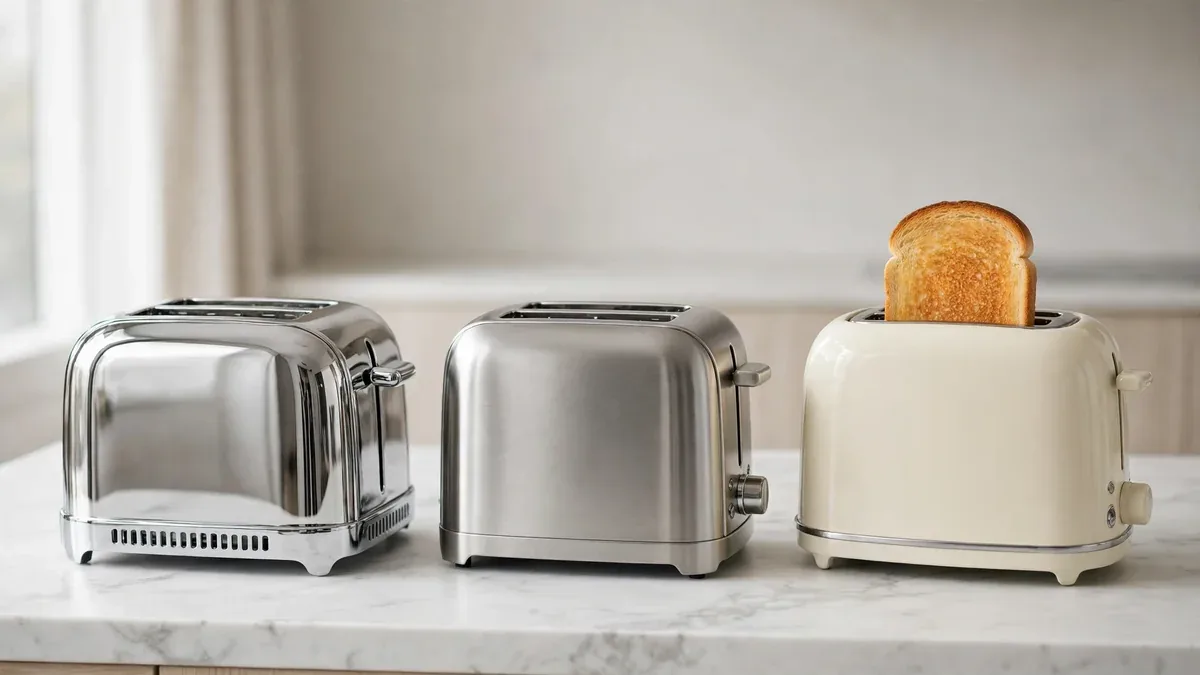

The best luxury toaster brands prove that even the simplest kitchen job deserves proper engineering. A toaster does one thing, twice a day, every day, and the difference between a cheap one and a great one shows up in every slice: even browning instead of pale edges and burnt centres, and a machine that still works beautifully in ten years rather than rattling its way to landfill in two.
Luxury in this category is not about gold trim or a famous name on the box. It is about thicker steel, better heating elements, wider slots that fit real sourdough, and controls that repeat the same result every morning.
Below are seven brands worth your money in 2027, from a hand-built British classic to a Japanese steam toaster that treats bread like a craft. Each one is judged on browning consistency, build quality, slot size, and ease of use.
Key takeaways
- A luxury toaster should brown both sides of a slice evenly, with no pale edges or scorched centres, across light and dark settings.
- Extra-wide slots matter more than extra features: real sourdough, bagels, and thick artisan loaves need room to fit and to rise.
- Thick steel bodies, quality heating elements, and replaceable parts are what separate a ten-year toaster from a two-year one.
- Expect around $180 to $330 for a two-slice luxury toaster, and around $280 to $450 for a four-slice model.
- Buy for your bread first and your kitchen second: match the slot width and browning control to what you actually toast every morning.

Why a luxury toaster costs what it does
A basic toaster costs very little because almost everything in it is thin: thin steel, thin elements, and a timer that guesses rather than measures. The result is one side darker than the other and bread that pops up still pale. Luxury brands spend their money in the opposite places, on the parts you cannot see as much as the parts you can.
The heating element is the clearest example. Cheaper toasters use thin wire elements that heat unevenly and lose their temper over time. Premium models use wider, heavier elements, often quartz or thick nichrome, arranged to cover the whole slice. That is why a Dualit or a Balmuda can brown a slice edge to edge while a budget machine leaves a pale border, and why the toast tastes better: even heat means the crumb dries evenly instead of steaming in the middle and crisping at the edges.
The body matters too. A heavy-gauge steel or die-cast body stays stable, resists heat discolouration, and protects the mechanism inside, and many of the brands below are built to be repaired rather than replaced. Over a decade of breakfasts, the price gap narrows, and the tested toaster picks on this site show the same pattern: build quality is what separates the keepers from the replacements.
| Brand | Best for | Typical two-slice price | Signature feature |
|---|---|---|---|
| Dualit | Longevity and repair | Around $260 | Hand-built chrome body, replaceable elements |
| Smeg | Retro design | Around $200 | 1950s styling, self-centring racks |
| Breville | Everyday precision | Around $200 | Lift and Look, A Bit More button |
| KitchenAid | Matching a full kitchen | Around $200 | Extra-wide slots, seven shade settings |
| Balmuda | Artisan bread | Around $329 | Steam technology, five bread modes |
| Magimix | Watching your toast | Around $280 | See-through glass sides |
| Alessi | Design statement | Around $200 | Pleated steel by Michele De Lucchi |
What to look for in the best luxury toaster brands
Before choosing a brand, it helps to know what separates a luxury toaster from a good-looking ordinary one. First, check the slot: measure the thickest bread you toast regularly, because a slot that is too narrow will crush a bagel and jam a sourdough slice. Look for slots of at least 36 millimetres, and wider if you bake your own bread. Self-centring racks are a useful bonus, since they hold thin slices upright so both sides brown evenly.
Next, look at the browning control. A single dial with vague numbers is the weakest option; the best luxury toasters give you repeatable settings, a countdown, and a way to check the toast without cancelling the cycle. A high-lift lever lets you retrieve small items like crumpets and English muffins without burning your fingers. Bagel, defrost, and reheat settings are worth having if you freeze bread, and a removable crumb tray saves you from shaking crumbs across the counter every week.
Finally, consider the finish and the footprint. Polished chrome shows fingerprints and needs a wipe after use, while brushed steel and enamel hide them better. A four-slice model is roughly a third wider than a two-slice, so measure your counter before you fall for the bigger machine. The profiles below apply these tests to each brand, so you can see where each one earns its price.
Dualit
Dualit is the oldest name on this list and, for many buyers, the only one that matters. The Classic toaster has been hand-built in Britain since the 1950s: a heavy polished chrome body, a mechanical timer dial, and a manual eject lever instead of an automatic pop-up. The two-slice model costs around $260, and the four-slice around $430. What you get for that money is a toaster designed to be repaired, not replaced, with replacement elements, timers, and levers available for years after purchase.
Performance is the point of the machine. Dualit uses its patented ProHeat elements, which toast one side at a time with a selector switch, and the result is remarkably even browning on thick bread, bagels, and buns. The slots are wide and deep, the crumb tray slides out for easy cleaning, and the whole machine feels solid in a way no pressed-steel toaster can match. It is not the most convenient toaster here: there is no automatic pop-up or digital display, and the chrome needs regular wiping. But if you want the last toaster you will buy for a decade or more, Dualit is the benchmark every other luxury brand is measured against.
Smeg
Smeg is the brand most people picture when they imagine a luxury kitchen, and its 50’s Style toaster is the purest expression of that look. The curved retro body comes in cream, black, red, pastel blue, and pastel green, and it matches the rest of the Smeg range so neatly that many buyers choose the whole set together. The two-slice model costs around $200, and the four-slice version around $300.
Under the styling, the engineering is sound. Self-centring racks hold slices in the middle of the slot for even browning, there are six browning levels, and the ball lever, reheat, defrost, and bagel functions cover the daily routine. The slots are wide enough for most artisan bread, and the automatic pop-up with a soft lift feels refined rather than abrupt. Smeg is not the best performer for very thick sourdough, and the enamel finish, while beautiful, can chip if it is knocked hard. But for a kitchen where looks matter as much as breakfast, Smeg is the easiest recommendation on this list.
Breville
Breville, sold as Sage in the United Kingdom and Europe, is the thinking cook’s luxury toaster. The A Bit More range, in two-slice and four-slice versions, costs around $200 and $280 respectively, and it is packed with small ideas that solve real annoyances. The Lift and Look lever raises the toast to check it without cancelling the cycle, the A Bit More button adds a short burst of extra browning, and an LED countdown shows exactly how long is left.
The slots are extra wide, the browning is consistent across the full slice, and the brushed stainless steel body is easy to keep clean. Breville also offers a die-cast model for buyers who want a heavier, more architectural machine, and a long-slot version for sourdough and ciabatta. The styling is modern rather than retro, which suits a contemporary kitchen better than a period one. For everyday use, with different breads and different mornings, Breville is the most forgiving and the most practical of the luxury brands.
KitchenAid
KitchenAid is best known for its stand mixer, and its toasters are designed to sit beside it as part of a matched set. The two-slice model costs around $200, and the four-slice version around $250, in a range of colours that coordinate with the mixers, from empire red to almond cream. That matching matters to a lot of buyers: a KitchenAid kitchen is a deliberate look, and the toaster is part of it rather than an afterthought.
The machine itself is a strong performer. Extra-wide slots take bagels and thick bread comfortably, there are seven shade settings with a clear dial, and the keep-warm function holds toast at serving temperature without drying it out. A high-lift lever retrieves small items, and the removable crumb tray and steel body are easy to clean. KitchenAid toasters are not the most distinctive on this list, and the browning can be slightly less even at the very darkest settings, but they are dependable, handsome, and easy to live with. If you already own KitchenAid appliances, this is the natural choice, and the guide to choosing the right toaster for your kitchen makes the same point: a toaster should fit the kitchen it lives in, not just the bread it toasts.
Balmuda
Balmuda The Toaster is the most unusual machine on this list, and the most expensive two-slice model at around $329. It comes from Japan, where Balmuda built its reputation on beautifully engineered small appliances, and it toasts with steam. You add a small measure of water before each cycle, and the sealed chamber fills with steam that keeps the inside of the bread moist while the surface crisps, so the bread tastes freshly baked rather than merely toasted.
There are five modes: sandwich bread, artisan bread, pizza, pastry, and oven, each with precise temperature control rather than a simple browning dial. The design is minimal and matte, in black or white, and it looks more like a piece of laboratory equipment than a kitchen appliance. The trade-offs are real: the capacity is small, the steam routine adds a step every morning, and it is not the machine for a large family toasting four slices at once. But for a household that buys good bread and wants it treated properly, no other toaster on this list comes close.
Magimix
Magimix is a French brand with a strong reputation for food processors, and its Vision toaster brings the same practical ingenuity to breakfast. The headline feature is the see-through glass side, which lets you watch the bread brown in real time and stop the cycle at exactly the shade you want. It sounds like a gimmick until you use it, and then it becomes hard to go back to guessing. The two-slice Vision costs around $280, and the four-slice version around $350.
Behind the glass, the engineering is serious. Extra-wide slots fit thick bread and bagels, the quartz elements heat quickly and evenly, and the controls cover browning, reheat, defrost, and bagel settings. The glass does need occasional cleaning, since it clouds with use, and the machine is wider than a standard two-slice toaster. But for anyone who has ever burnt toast because they could not see it, the Vision solves the problem in the most direct way possible.
Alessi
Alessi is a design house first and an appliance maker second, and its Plisse toaster, designed by Michele De Lucchi, is the most sculptural machine on this list. The pleated steel body catches the light like folded fabric, and the toaster reads as an object of design before it reads as a kitchen tool. The two-slice model costs around $200, which is reasonable for a piece by a named designer, and it comes in black, white, and grey.
The toasting itself is capable rather than class-leading. There are six browning levels, a bagel function, and slots wide enough for most everyday bread, though very thick sourdough can be a tight fit. The controls are simple and tactile, the crumb tray slides out for cleaning, and the machine is compact enough for a smaller counter. Alessi is not the choice for a household that toasts a lot of thick artisan bread every day, but it is the choice for a buyer who wants their toaster to be part of a design-led kitchen. Like the best pots and pans, it shows that small appliances can be both useful and beautiful at the same time.
How to choose between the brands
Start with your bread. If you buy thick sourdough, bake your own loaves, or toast bagels most mornings, slot width and browning evenness matter most, and Dualit, Breville, and KitchenAid should top your list. If you buy good artisan bread and want it treated with respect, Balmuda is in a class of its own. If you mostly toast standard sliced bread and want a machine that looks wonderful on the counter, Smeg and Alessi are the natural choices.
Next, think about how many people you toast for. A two-slice machine is enough for one or two people, and it leaves more counter space for everything else. A four-slice model is worth the extra width and cost if you have a family, or if you regularly make toast for guests. Remember that a four-slice toaster is also heavier and harder to store, so measure the space it will live in before you order. Also check the colour range: Smeg and KitchenAid offer the widest choice, which matters if you are matching other appliances.
Finally, weigh longevity against novelty. Dualit and Magimix are built to be kept and repaired, while Balmuda and Alessi are bought as much for the experience and the design as for the toast. Neither approach is wrong, but they suit different buyers. A toaster you keep for ten years is the better investment if you value durability, while a design-led machine is the better buy if your kitchen is a place you enjoy looking at as much as cooking in.
Checklist before you buy
- Measure your thickest bread and check the slot width, aiming for at least 36 millimetres for sourdough and bagels.
- Decide between two slices and four slices based on household size and available counter space.
- Check the browning control: repeatable settings, a lift-and-look lever, and a countdown are worth paying for.
- Confirm the functions you need, such as bagel, defrost, and reheat, especially if you freeze bread.
- Look at the finish in person if you can: polished chrome shows fingerprints, while brushed steel and enamel hide them.
- Ask about spare parts and warranty: a luxury toaster should be repairable and covered for at least two years.
Frequently asked questions
Are luxury toasters worth the money?
Yes, if you toast bread every day and care about the result. A luxury toaster browns more evenly, lasts far longer, and is often repairable, so the cost per breakfast over ten years can be lower than replacing a cheap machine every two years. If you rarely eat toast, a mid-priced toaster is the better buy.
What is the best luxury toaster brand overall?
Dualit is the best overall choice for longevity and even browning, thanks to its hand-built construction and replaceable parts. Breville is the best all-rounder for everyday use, while Balmuda is the best for bread quality. The right answer depends on whether you value durability, convenience, or taste most.
How much should I spend on a luxury toaster?
Expect around $180 to $330 for a two-slice luxury toaster and around $280 to $450 for a four-slice model. Below $180 you are usually paying for looks rather than engineering, and above $450 you are paying for design or rarity rather than better toast.
Do luxury toasters toast more evenly?
Generally, yes. Premium brands use heavier, better-placed heating elements and self-centring racks, which reduce the pale edges and hot spots common in cheap toasters. The difference is most obvious on thick bread, where a budget machine often burns the outside before the middle is warm.
Can a luxury toaster handle sourdough and bagels?
Most of the brands in this guide can, provided you choose a model with extra-wide slots. Dualit, Breville, KitchenAid, and Magimix all take thick sourdough and bagels comfortably. Check the slot width before buying, and use the bagel setting so only the cut side is toasted.
How long should a luxury toaster last?
A well-built luxury toaster should last at least ten years with daily use, and Dualit machines often last far longer because their elements and timers can be replaced. Keep the crumb tray empty, wipe the body regularly, and avoid shaking the toaster upside down to clean it.
The bottom line
The best luxury toaster brands earn their prices with better elements, wider slots, heavier bodies, and controls that give you the same result every morning. Dualit is the buy-once choice for longevity, Breville is the smartest everyday machine, Balmuda is the best for great bread, and Smeg will make your kitchen look its best.
Choose for your bread first, your household second, and your kitchen third, and buy the machine that fits all three. A good luxury toaster is a small daily luxury that pays for itself in better breakfasts, and in a machine you will still be glad to see on the counter in ten years.