


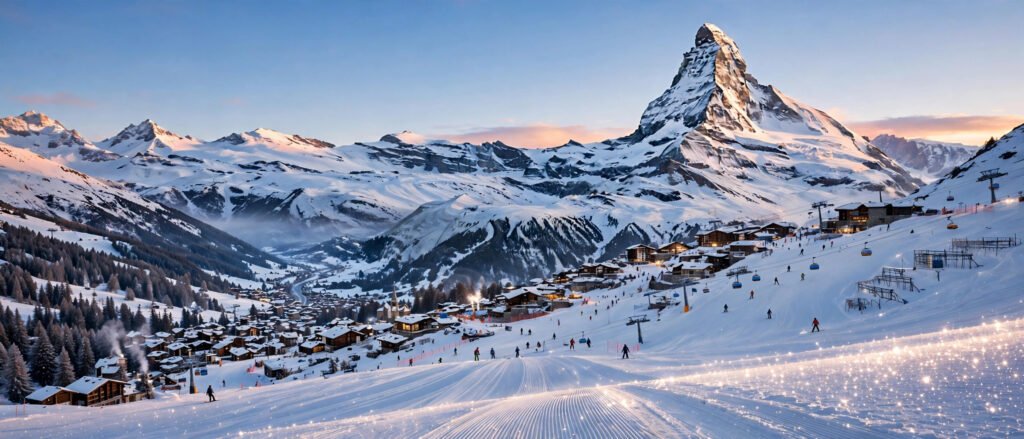
Short answer: The best places to go skiing are Zermatt in Switzerland, Whistler Blackcomb in Canada, Chamonix in France, Courchevel in France, Aspen Snowmass in the USA, Niseko in Japan, St. Anton in Austria, St. Moritz in Switzerland, Jackson Hole in the USA, and Banff in Canada. Zermatt is the best all-rounder, Niseko has the deepest powder, and Whistler Blackcomb is the largest resort in North America. Below are the details on each one, plus when to go and how to choose.

1. Zermatt, Switzerland — Best Overall
Zermatt is the pick if you only choose one resort. The car-free village sits at 1,620 metres under the Matterhorn, and the Matterhorn Ski Paradise links Switzerland with Cervinia in Italy for 360 kilometres of pistes on one international pass. The highest point is 3,899 metres, and glacier skiing at the Matterhorn Glacier Paradise (3,883 m) runs 365 days a year. The 2026/27 season runs from 1 November 2026 to 2 May 2027. Best for: everyone — three sectors (Sunnegga–Rothorn, Gornergrat and the glacier) cover every ability, and the village has the best mountain restaurants in the Alps.
2. Whistler Blackcomb, Canada — Best for Scale
Whistler Blackcomb is the largest ski resort in North America: 8,171 acres of skiable terrain across two mountains, with more than 200 runs, 16 alpine bowls and three glaciers, joined by the Peak 2 Peak Gondola. Annual snowfall averages about 11.7 metres. It is roughly two hours by road from Vancouver, and the pedestrian village means you can ski to your hotel door. Best for: families and mixed-ability groups — around half the terrain on each mountain is intermediate, and the scale means lift queues spread out.
3. Chamonix, France — Best for Expert Skiers
Chamonix hosted the first Winter Olympics in 1924 and remains the spiritual home of extreme skiing. The Aiguille du Midi cable car climbs to 3,842 metres and drops you onto the Vallée Blanche, a glacier descent of about 20 kilometres that you must ski with a mountain guide. The town itself is a real alpine town rather than a purpose-built resort, with a deep mountaineering culture. Best for: advanced and expert skiers, and anyone who wants steep terrain and big-mountain history.
4. Courchevel, France — Best for Pure Skiing
Courchevel sits inside Les Trois Vallées, the world’s largest linked ski area with 600 kilometres of pistes. Courchevel itself has 150 kilometres of marked slopes, ski-in/ski-out villages, and an altiport at 2,006 metres. The 2026/27 season runs from 4 December 2026 to 18 April 2027. Best for: intermediates who want a week of skiing without repeating a run, and for luxury — Courchevel has the highest concentration of palace hotels and Michelin-starred mountain restaurants in the Alps.
5. Aspen Snowmass, USA — Best for Glamour
Aspen spreads across four mountains: Snowmass for families, Buttermilk for beginners, Aspen Mountain (Ajax) and Highlands for experts, with more than 5,700 acres in all. Aspen Mountain and Snowmass open on 26 November 2026, Thanksgiving Day, and the airport is just 3 miles from town. Best for: a classic American ski holiday — serious skiing by day, and the best restaurants, galleries and nightlife of any US ski town after dark. For where to stay, see our best luxury hotels in Aspen.
6. Niseko, Japan — Best for Powder
Niseko, on Hokkaido, is the snowiest lift-served resort on earth: an average of 14 to 15 metres of snowfall per season, with overnight dumps of 30 to 50 centimetres common in January and February. Four linked resorts — Grand Hirafu, Hanazono, Niseko Village and Annupuri — wrap around Mount Annupuri (1,308 m) and share one lift pass. The snow is famously light and dry, thanks to cold Siberian air picking up moisture over the Sea of Japan. The season runs from late November to early May. Best for: powder skiers and snowboarders, night skiing, and the onsen-and-ramen culture after the lifts close.
7. St. Anton, Austria — Best Après-Ski
St. Anton is the heart of the Arlberg, one of the largest linked ski areas in Austria, and the birthplace of modern alpine skiing technique. The terrain is big, varied and reliably snowy, but St. Anton is most famous for its après-ski: the MooserWirt and Krazy Kanguruh are legendary, and the village parties as hard as it skis. Best for: confident intermediates and experts who want the full Austrian ski experience, on and off the slopes.
8. St. Moritz, Switzerland — Best for Luxury and Non-Skiers
St. Moritz is where winter tourism began, in 1864, and it hosted the Winter Olympics in 1928 and 1948. The Engadine valley gives you wide, sunny pistes above a frozen lake, where polo and White Turf horse racing run through the winter. The Corviglia ski area runs from 28 November 2026 to 4 April 2027, and Zurich is about three hours away. Best for: luxury travellers and mixed groups — non-skiers get world-class hotels, spas, shopping and events, while skiers get immaculate grooming and sunshine.
9. Jackson Hole, USA — Best for Steep Terrain
Jackson Hole in Wyoming is the steepest major resort in North America, home of the infamous Corbet’s Couloir — a narrow, near-vertical drop-in that is a rite of passage for expert skiers. The resort opens on 27 November 2026. The terrain is serious, the snowfall is deep, and the cowboy-town atmosphere in Jackson is unlike anywhere else in skiing. Best for: advanced and expert skiers chasing steeps, and for anyone who wants a wilder, less polished American ski trip.
10. Banff and Lake Louise, Canada — Best for Scenery
Banff combines three linked ski areas — Lake Louise, Sunshine Village and Mount Norquay — inside a UNESCO World Heritage national park, with a season running from November to May. Lake Louise has the most terrain and the most dramatic views; Sunshine sits high on the Continental Divide with a long, snowy season. Best for: scenery lovers and families — the Rockies views from the top of Lake Louise are the most photographed in North American skiing, and the town of Banff is a proper base with hot springs to soak in afterwards.
How to Choose the Best Place to Go Skiing

- First time skiing? Cervinia (linked to Zermatt), Buttermilk in Aspen, or the gentle slopes of Les Gets are the easiest places to learn.
- Chasing powder? Go to Niseko in January or February, when overnight falls of 30–50 cm are normal.
- Want the biggest area? Les Trois Vallées (600 km) in France or Whistler Blackcomb (8,171 acres) in Canada.
- Best time to go? The northern-hemisphere season runs from early December to mid-April, with the most reliable snow from mid-January to mid-March.
- Book lift passes early. Window prices are steep — a day in Zermatt runs about CHF 70–90, a day in Niseko around 12,000 yen, and a window ticket at Whistler can be over CAD 250. Multi-day passes and Epic/Ikon passes cut the cost significantly.
FAQs
Where is the best skiing in the world?
For all-round skiing, Zermatt in Switzerland is the most complete resort: glacier-guaranteed snow, 360 km of pistes shared with Cervinia in Italy, a car-free village and terrain for every level. For powder, Niseko in Japan is unmatched. For size, Whistler Blackcomb in Canada is the largest resort in North America.
When is the best time to go skiing?
Mid-January to mid-March has the most reliable snow across the Alps and North America. December is quieter and cheaper but less snow-sure; April brings sunshine and slushy spring snow. In Japan, January and February are peak powder months.
Which ski resort is best for beginners?
Cervinia in Italy (linked to Zermatt) is one of the best beginner resorts in the world, with wide, gentle pistes at high altitude. Buttermilk in Aspen and Les Gets in France are also excellent first-timer choices.
How much does a ski trip cost?
It varies enormously by destination. A day lift pass runs roughly CHF 70–90 in Zermatt, around 12,000 yen in Niseko, and over CAD 250 at the Whistler ticket window — buying multi-day passes or an Epic/Ikon pass in advance is almost always cheaper. Accommodation and flights are usually the bigger cost; Japan and the Austrian Alps are generally better value than Switzerland or Aspen.
Do I need a guide for the Vallée Blanche in Chamonix?
Yes. The Vallée Blanche is a 20-kilometre glacier descent with crevasses, and it should only be skied with a qualified mountain guide. Most Chamonix guide companies run daily group descents.
Sources
- InTheSnow, “The Best Ski Resorts in the World: The Definitive 2026/27 Guide” — inthesnow.com
- Forest Travel, “Best Luxury Ski Resorts in the World (2026–27)” — foresttravel.com
- TravelDojo, “Best Ski Resorts in the World” — traveldojo.com
- Zermatt Bergbahnen, Matterhorn Ski Paradise factsheet — matterhornparadise.ch
- Vail Resorts, Whistler Blackcomb press kit (8,171 acres, 200+ runs) — news.vailresorts.com
- Days.ski, Niseko resort guide (15 m average snowfall) — days.ski









