
Finding sandals that fit wide feet is a familiar frustration for a lot of men. The length is right, but the straps dig in across the top of the foot, and the sides spill over the edge of the footbed. Most sandals are built on a standard, medium-width last, which means wide feet are an afterthought rather than the starting point.
The fix is not simply to buy a bigger size. Going up a size makes the sandal longer, not wider. What actually helps is a sandal designed with width in mind: a broader footbed, straps that adjust across the forefoot and the heel, and a last that gives the toes room to spread.
Below are nine sandals for wide feet men in 2027, from rugged hiking sandals to simple everyday slides. Each one is described by what it is good at, what to watch for, and who it suits best, so you can choose by fit first and style second.
Key takeaways
- Wide feet need a wider footbed and adjustable straps, not just a longer size, because sizing up adds length without adding width.
- Look for sandals built on a wide last or offered in a wide fit, with straps that adjust across the forefoot, the midfoot, and the heel.
- Contoured cork or moulded footbeds support wide feet better than flat foam, especially for all-day walking.
- Try sandals on in the afternoon, when feet are at their widest, and check that no part of the foot spills over the edge of the footbed.
- No sandal can fix a foot problem, and persistent pain, numbness, or blistering is a sign to check the fit or speak to a podiatrist.
What wide feet actually need from a sandal
Width is the first thing to get right, and it is the thing most sandals get wrong. A standard-width sandal is built around a foot that is roughly a D width, while many men who struggle with fit are closer to an E or EE width. The difference is only a few millimetres across the forefoot, but it is enough to change everything about how a sandal feels.
Adjustability matters almost as much as width. A sandal with a single fixed strap can only fit one foot shape, and it is rarely yours. Three-point adjustment, with straps over the toes, across the midfoot, and around the heel, lets you loosen the parts that pinch and tighten the parts that need hold. You should be able to slide a finger under each strap without it feeling loose.
The footbed is the third piece. A flat piece of foam feels fine for an hour and tired by the afternoon, because it does nothing to support the arch or spread pressure evenly. A contoured footbed, whether cork, moulded EVA, or shaped rubber, cradles the foot and keeps weight distributed across the whole sole.
How we chose these sandals and what to look for
We started with fit. Every sandal below is either offered in a wide fit, built on a naturally broad last, or designed with enough strap adjustment to accommodate a wide foot without forcing it.
Next we looked at the footbed and the sole. A sandal for wide feet needs a footbed that is genuinely wide, not just a standard footbed with wider straps, and a sole with enough grip for the surfaces you will actually walk on. Our guide to gladiator sandals is a useful comparison here, because it shows how strap layout and sole shape change the fit, even when two sandals look similar.
Finally, we considered use. A hiking sandal and a beach slide are different tools, and the right choice depends on where you will wear them most. The nine below cover that range, from rugged trail sandals with toe protection to simple slides for the garden and the beach.
The 9 best sandals for wide feet men of 2027
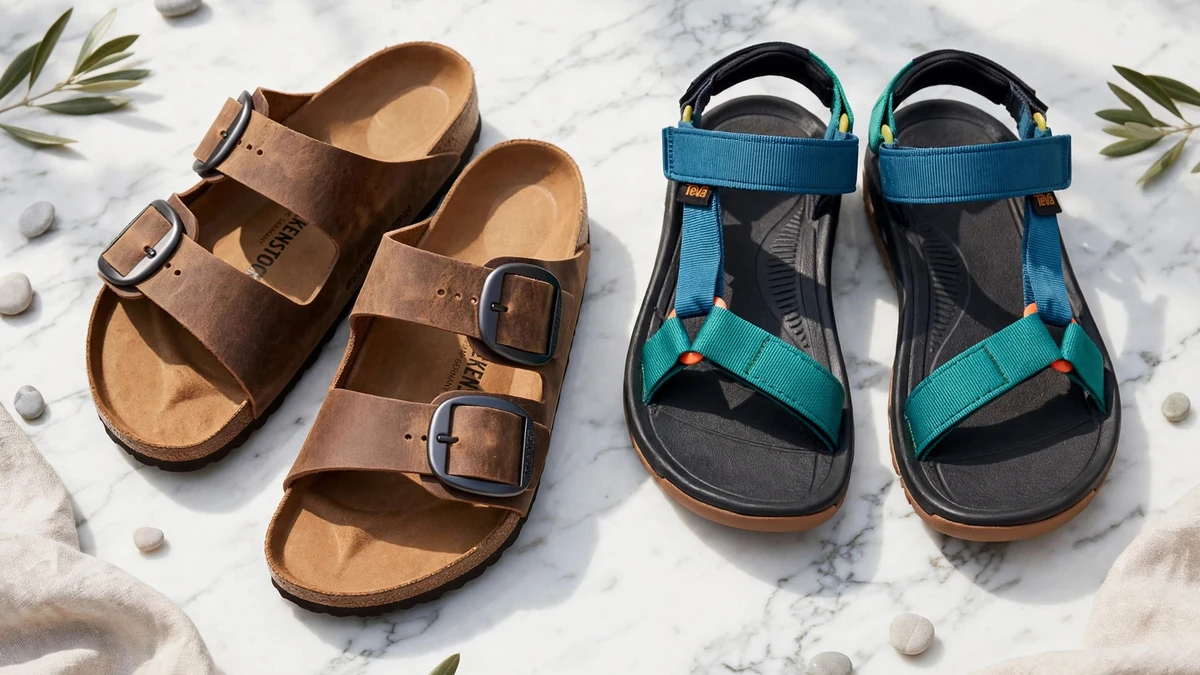
Birkenstock Arizona Big Buckle
What we like: The classic Arizona in a wide fit, with a broad contoured cork footbed and two wide adjustable straps.
What to consider: The cork footbed needs a short break-in, and the sandal is not made for wet conditions. Best for: Everyday wear, all-day walking on dry ground. Fabric: Leather upper, cork-latex footbed, EVA sole. Price range: Around $150. Standout feature: The wide fit is genuinely wide.
Most wide-footed men come back to this pair. The cork moulds to the foot over the first few weeks, so the fit gets better with wear.
Teva Hurricane XLT2
What we like: A lightweight sport sandal with three adjustable hook-and-loop straps, a wide and stable footbed, and a grippy rubber sole that handles wet ground well.
What to consider: The sporty look suits casual wear better than smart occasions, and the straps can feel stiff until they soften. Best for: Walking, water, and travel. Fabric: Recycled polyester straps, EVA footbed, rubber outsole. Price range: Around $70. Standout feature: Three-point adjustment for the forefoot and heel.
The Hurricane is the practical choice. It dries quickly, grips well on wet surfaces, and the three straps share the work of holding a wide foot securely.
Chaco Z/Cloud
What we like: A rugged hiking sandal with a wide footbed, a single-pull adjustable strap system, and a supportive dual-density midsole for long days on foot.
What to consider: The strap system takes a little practice to adjust evenly, and the sandal is heavier than a simple slide. Best for: Hiking, trails, and long walks. Fabric: Polyester webbing straps, dual-density PU midsole, rubber outsole. Price range: Around $110. Standout feature: The LUVSEAT footbed, which supports the arch on a wide base.
Chaco built its reputation on river and trail sandals, and the Z/Cloud shows it. The footbed is broad and supportive, and the sole grips well on uneven ground.
KEEN Newport H2
What we like: A closed-toe water sandal with a roomy, wide fit, a protective toe bumper, and a washable design that handles rivers, beaches, and muddy paths.
What to consider: The closed toe makes it warmer than an open sandal, and the look is firmly outdoors rather than smart. Best for: Water, trails, and rough ground. Fabric: Washable polyester webbing, EVA midsole, rubber outsole. Price range: Around $130. Standout feature: Toe protection with a genuinely wide fit.
If you want a sandal that can go in the water and on the trail without worrying about stubbed toes, the Newport H2 is hard to beat.
ECCO Yucatan
What we like: A comfortable leather sport sandal with three adjustable straps, a soft anatomically shaped footbed, and a durable rubber sole, in a fit that runs roomy across the forefoot.
What to consider: Premium price, and the leather straps need a little care if they get wet regularly. Best for: Everyday wear, walking holidays, and smart-casual days. Fabric: Yak leather upper, EVA footbed, rubber outsole. Price range: Around $140. Standout feature: A leather sandal that adjusts like a sport sandal.
The Yucatan is the smarter-looking option on this list. It works with shorts and a shirt as easily as with walking gear.
OluKai Ohana
What we like: A simple, comfortable flip-flop with a wide, anatomically shaped footbed, a soft lined strap, and a sole that supports the arch rather than lying flat.
What to consider: It is a flip-flop, so it offers no heel security for long walks, and the strap can rub between the toes on the first few wears. Best for: Beach days, the garden, and short trips. Fabric: Synthetic leather strap, EVA footbed, rubber outsole. Price range: Around $75. Standout feature: An arch-supporting footbed in a flip-flop.
Not every wide-footed man wants a strappy hiking sandal. The Ohana is the easy, everyday answer.
Reef Fanning
What we like: A classic beach sandal with a wide footbed, a soft padded strap, a built-in bottle opener in the sole, and a comfortable arch support that suits all-day wear.
What to consider: The thong design suits some feet better than others, and it is not a walking sandal for rough ground. Best for: Beach, holidays, and casual days. Fabric: Synthetic leather strap, EVA footbed, rubber outsole. Price range: Around $60. Standout feature: A wide, supportive footbed in a simple thong sandal.
The Fanning is a beach staple for a reason. The footbed is broader than most thong sandals, and the arch support means it stays comfortable far longer than a flat flip-flop.
Merrell Sandspur Rift
What we like: A lightweight hiking sandal with adjustable straps, a cushioned footbed, and a grippy sole, in a fit that accommodates a wider foot without feeling loose.
What to consider: The cushioning is softer than a Chaco or KEEN, so it suits moderate walks better than rough trails. Best for: Light hiking, walking, and travel. Fabric: Synthetic straps, EVA footbed, rubber outsole. Price range: Around $85. Standout feature: A light, packable hiking sandal that adjusts across a wide forefoot.
The Sandspur Rift is a good middle ground: lighter and more packable than a heavy hiking sandal, but with proper straps and a grippy sole.
Crocs Swiftwater Expedition Sandal
What we like: A roomy, lightweight water sandal with adjustable straps, a soft Croslite footbed, and a relaxed fit that suits wide feet straight out of the box.
What to consider: The casual look is not for everyone, and the soft footbed offers less arch support than a contoured cork or PU footbed. Best for: Water, camping, and relaxed days. Fabric: Croslite resin upper and footbed, rubber outsole. Price range: Around $55. Standout feature: A genuinely roomy fit at the lowest price on this list.
If comfort and ease matter more than looks, the Swiftwater is a straightforward choice. It is light, it dries fast, and the roomy fit means wide feet are comfortable from the first wear.
Which sandal is right for your feet
Start with how you will use them. For all-day walking and holidays, a contoured footbed and three-point adjustment matter most, which points to the Birkenstock Arizona, the Chaco Z/Cloud, or the ECCO Yucatan. For water and trails, grip and washability matter more, which points to the Teva Hurricane XLT2, the KEEN Newport H2, or the Merrell Sandspur Rift. For the beach and the garden, simplicity wins, and the OluKai Ohana, the Reef Fanning, or the Crocs Swiftwater will do the job well. Our summer fashion trends guide also shows how sandals fit into a warm-weather wardrobe.
Then think about your foot shape, not just its width. If your forefoot is wide but your heel is narrow, a sandal with independent forefoot and heel adjustment, like the Teva or the Chaco, will fit better than one with a single strap. If your feet swell in the heat, a hook-and-loop strap you can loosen during the day is more useful than a buckle you have to re-do. A guide to the best sneakers is a useful comparison here, because the same logic applies: fit is about the shape of the last, not just the number on the box.
Finally, try them on properly. Wear the socks, if any, you will wear with them, walk around the shop for several minutes rather than standing still, and check the fit in the afternoon, when your feet are at their widest. Your whole foot should sit on the footbed with a small margin all round, and no strap should leave a red mark after a few minutes.
The caveats that matter
Width labels are not standardised. One brand’s wide fit is another brand’s standard fit, and a sandal described as roomy may simply have a wider strap rather than a wider footbed. That is why the label alone is not enough, and why the real test is always how your foot sits on the footbed.
| Detail | What is known |
|---|---|
| What wide means | Usually an E or EE width, a few millimetres broader across the forefoot than a standard D width |
| The key fit test | Your whole foot sits on the footbed with a small margin, no spillover, no strap digging in |
| Best strap setup | Three-point adjustment across the toes, midfoot, and heel, ideally hook-and-loop or buckle |
| Best footbed | Contoured cork, moulded EVA, or shaped PU, which supports the arch and spreads pressure |
| When to try them on | In the afternoon, when feet are at their widest, after walking rather than first thing |
| Break-in | Cork footbeds need a week or two to mould; most synthetic sandals fit from the first wear |
| What to avoid | Fixed straps, narrow footbeds, sizing up for width, and smooth soles on wet ground |
| When to get advice | Persistent pain, numbness, blistering, or a foot condition, speak to a podiatrist before buying again |
If you have a foot condition, such as bunions, plantar fasciitis, or diabetes-related foot sensitivity, fit matters even more, and a sandal that rubs or presses in the wrong place can cause real problems. Choose soft, seamless straps, avoid anything that presses on a bunion, and speak to a podiatrist or clinician if you are unsure which features your feet need.
Checklist: choosing sandals for wide feet honestly
- Check the footbed: stand on it and confirm no part of your foot spills over the edge.
- Check the straps: each one should adjust independently, sit flat, and let you slide a finger underneath.
- Check the width label: look for a wide fit or a wide last, and do not trust the word roomy on its own.
- Try them on in the afternoon, when your feet are widest, and walk for several minutes, not just a few steps.
- Check the sole: it should grip on wet ground if you will wear them near water or on trails.
- Give cork footbeds a break-in week, and return a pair that still pinches after a few wears rather than hoping it will stretch.
Frequently asked questions
Should I size up if I have wide feet?
Usually no. Sizing up makes the sandal longer, not wider, and a too-long sandal can cause tripping and heel slip. Look for a wide fit in your normal length first.
What is the difference between wide fit and regular fit sandals?
A wide fit is built on a broader last, so the footbed itself is wider across the forefoot and the straps are spaced further apart. A regular fit with looser straps is not the same thing, because the foot still spills over the edge of a narrow footbed.
Are Birkenstocks good for wide feet?
Yes, in the wide fit. The Arizona is sold in narrow and wide versions, and the wide version has a genuinely broader footbed. Make sure you are buying the wide fit, and allow a week or two for the cork footbed to mould to your foot.
Can I wear sandals with bunions?
Often yes, if the straps are soft and adjustable and do not press on the bunion itself. Open designs with straps you can loosen across the forefoot are usually more comfortable than fixed or narrow straps. If a sandal causes pain over the bunion, stop wearing it and speak to a podiatrist.
How do I stop sandals from rubbing?
Check that the straps are not too tight, that they sit flat rather than twisted, and that the footbed is wide enough that your foot is not pushing against the strap edge. A little foot balm or anti-blister stick on the usual rub points helps on long walks, and new sandals should be broken in over short walks before a full day.
Do wide-fit sandals look different?
Not really. A wide fit is built into the last, so the sandal looks the same from the outside. The difference is in how it feels: the foot sits fully on the footbed, the straps do not pull, and the sandal looks like it belongs on your foot.
The bottom line
The best sandals for wide feet men in 2027 are the ones built around width from the start, not the ones you have to force your feet into. A wide footbed, straps that adjust across the forefoot and the heel, and a contoured sole that supports the arch will do more for comfort than any brand name or price tag. The Birkenstock Arizona is the strongest everyday choice, the Teva and Chaco are best for water and trails, and the OluKai and Reef are easiest for beach days.
Buy your normal length in a wide fit, try them on in the afternoon, and check that your whole foot sits on the footbed with room to spare. If a pair pinches after a few wears, it is the wrong fit, not a problem with your feet, and a different model will almost always fit better.