A vitamin C moisturiser sounds simple: a face cream with vitamin C in it. In practice, it sits between two familiar products and is often misunderstood.
That hybrid design is the reason it has become so popular, and the reason it causes so much confusion. People buy one expecting the fast, visible results of a strong serum, and are disappointed when the change is slower.
This guide explains what a vitamin C moisturiser actually is, how it differs from a serum, what the different forms of vitamin C do inside a cream, and how to tell a good one from a label claim.
Key takeaways
- A vitamin C moisturiser is a hydrating cream that contains vitamin C as an active ingredient, designed for daily brightening and barrier support in one step.
- It is gentler and slower than a vitamin C serum, because the dose is lower and the cream base cushions the active ingredient.
- The most common forms in creams are THD ascorbate, ascorbyl glucoside, and sodium ascorbyl phosphate, all more stable and gentler than pure L-ascorbic acid.
- Use it in the morning under sunscreen, and expect visible brightness after four to eight weeks of consistent use.
- A vitamin C moisturiser does not replace sunscreen, does not remove deep pigmentation on its own, and should be replaced if it turns dark orange or smells strongly metallic.
What a vitamin C moisturiser actually is
A vitamin C moisturiser is a face cream formulated with a form of vitamin C as one of its active ingredients. The cream base does the job of any moisturiser: it adds water to the skin, adds lipids that slow water loss, and leaves the skin feeling comfortable.
The key difference from a serum is dose and delivery. A serum is mostly active ingredient in a light base, designed to deliver a high concentration quickly. A moisturiser is mostly base with a moderate dose of active ingredient, designed to be comfortable enough for daily use.
The other difference is what else is in the jar. A good vitamin C moisturiser is built around supporting ingredients: squalane, ceramides, hyaluronic acid, or shea butter for hydration, and often vitamin E or ferulic acid to stabilise the vitamin C. These are not filler.
How a vitamin C moisturiser works and what to look for
Vitamin C works in the skin as an antioxidant and a collagen supporter. In plain terms, it helps mop up the damage caused by sunlight and pollution before that damage shows up as dullness, uneven tone, and fine lines.
When you are choosing one, look first at the form of vitamin C. THD ascorbate is oil-soluble, stable, and gentle, which makes it the most common choice in creams. Ascorbyl glucoside is water-soluble and stable, and it converts to active vitamin C slowly in the skin. Sodium ascorbyl phosphate is another gentle, stable derivative, often used in creams for sensitive skin. Pure L-ascorbic acid is the most studied form, but it is acidic and unstable, so it appears less often in creams and usually at a modest dose. Our guide to why vitamin C serums actually work explains the science behind these forms in more detail, and the same principles apply inside a cream.
Look next at the packaging and the texture. Vitamin C breaks down in air, light, and heat, so a pump bottle or an opaque tube protects it far better than a wide-open jar. A cream you enjoy using every morning is worth more than a stronger one you avoid, so texture matters too.
The 9 things to know about vitamin C moisturisers
It is a hybrid, not a serum in a jar
What it shows: A vitamin C moisturiser combines a hydrating cream base with a moderate dose of vitamin C, so it brightens and moisturises together, but more gently than a serum. What to consider: Do not expect serum-speed results. The dose is lower by design, and the brightening builds over weeks, not days. Best For: People who want one simple morning step. Material: Cream base with a vitamin C derivative. Price Range: Affordable to premium, roughly £15 to £80. Standout Feature: Brightening plus hydration in a single product.
Think of it as a daily habit rather than a treatment. Its strength is consistency, and its weakness is impatience. Used every morning, it delivers steady brightness. Used for a week and abandoned, it delivers nothing.
The form of vitamin C matters more than the percentage
What it shows: THD ascorbate, ascorbyl glucoside, and sodium ascorbyl phosphate are stable and gentle, while pure L-ascorbic acid is stronger but harder to keep stable in a cream. What to consider: A high percentage on the label means little if the form is unstable or the cream is stored badly. Best For: Sensitive or beginner skin, which does best with a derivative. Material: Derivative-based cream or low-dose L-ascorbic acid cream. Price Range: Mid-range to premium. Standout Feature: Stability, which keeps the vitamin C working until the jar is finished.
When a label shouts about a percentage but says nothing about the form, be sceptical. A 5 percent THD ascorbate cream that stays fresh will do more than a 15 percent L-ascorbic acid cream that oxidised a month after opening.
It differs from a vitamin C serum in dose and purpose
What it shows: A serum delivers a high concentration of vitamin C in a light base for targeted treatment, while a moisturiser delivers a moderate dose in a hydrating base for daily maintenance. What to consider: The two can be layered, serum first and cream on top, but they should not be judged by the same standard. Best For: Anyone choosing between one product or two. Material: Serum is water-light, cream is emollient. Price Range: Serums and creams overlap, roughly £15 to £80 each. Standout Feature: The moisturiser adds barrier support the serum does not.
If your skin is dry, the moisturiser alone is often enough. If your skin is resilient and you want faster brightening, a serum under the cream is a sensible combination, as long as you introduce one product at a time.
Texture tells you who it is made for
What it shows: Rich creams suit very dry and mature skin, gel-creams suit dry skin that wears makeup, and whipped creams suit skin that wants lightness with comfort. What to consider: A texture you dislike is a texture you will stop using, whatever the ingredient list says. Best For: Matching the cream to your skin type and your routine. Material: Rich cream, gel-cream, or whipped cream. Price Range: All price bands. Standout Feature: Texture is the best predictor of whether you will actually finish the jar.
Test the texture on the back of your hand before you buy, if you can. It should absorb within a minute, leave no sticky film, and feel comfortable under sunscreen. If it pills or feels tight, it is the wrong texture for you.
Supporting ingredients do half the work
What it shows: Squalane, ceramides, hyaluronic acid, and shea butter hydrate and repair the barrier, while vitamin E and ferulic acid stabilise the vitamin C. What to consider: A cream with vitamin C but no supporting hydrators is a treatment wearing a moisturiser’s label. Best For: Dry, sensitive, or barrier-damaged skin. Material: Cream with squalane, ceramides, or hyaluronic acid. Price Range: Mid-range to premium. Standout Feature: The supporting cast is what makes vitamin C tolerable for dry skin.
Read the ingredient list past the vitamin C. If the first few ingredients after water are emollients and humectants, the formula is built properly. If they are fragrance and alcohol, the brightening claim is doing all the work.
Packaging protects the vitamin C
What it shows: A pump bottle or opaque tube keeps air and light away from the vitamin C, while a wide-open jar exposes it every morning. What to consider: A beautiful jar can be the worst home for vitamin C, and a plain pump can be the best. Best For: Anyone who wants the cream to work as well in week eight as in week one. Material: Pump bottle, opaque tube, or airless packaging. Price Range: All price bands. Standout Feature: Airless packaging is the most practical sign of a well-designed vitamin C cream.
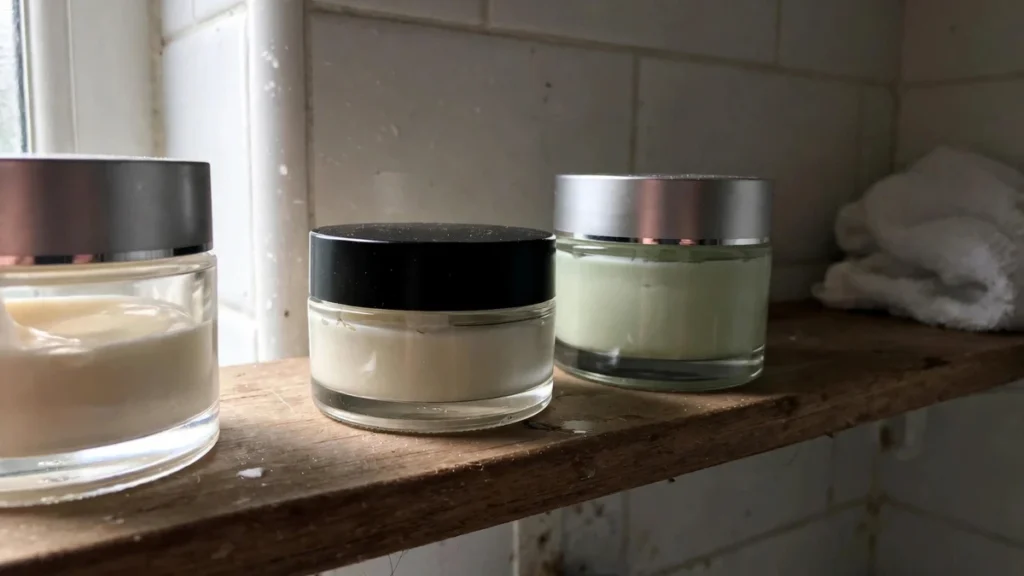
Store the cream in a cool place, away from the bathroom window and the radiator. A small size you finish in two to three months is better than a large jar that sits half-used for a year.
Morning is the right time to use it
What it shows: Vitamin C is an antioxidant, so it works best in the morning, when the skin faces sun and pollution, layered under moisturiser and sunscreen. What to consider: It can be used in the evening too, but the morning slot is where it earns its keep. Best For: Daily morning routines. Material: Any vitamin C cream, used in the morning. Price Range: Not price dependent. Standout Feature: Morning use pairs the antioxidant with the day’s sun exposure.
Apply it to clean, dry skin, give it a minute to absorb, then follow with sunscreen. If you use a separate serum, the order is serum, then moisturiser, then sunscreen. Our vitamin C guide on how to use it walks through the full routine, including what to layer and what to keep apart.
Results take weeks, and that is normal
What it shows: Brighter, more even-looking skin usually appears after four to eight weeks of daily use, while dark spots fade more slowly. What to consider: Giving up in week two is the most common reason a good cream seems not to work. Best For: Patient, consistent users. Material: Any well-formulated vitamin C cream. Price Range: Not price dependent. Standout Feature: Consistency, not strength, is what produces the result.
Take a photo in the same light on day one and again at week eight. The change is gradual enough to miss in the mirror, and a comparison photo is the honest way to judge whether the cream is working for you.
It does not replace sunscreen or a serum for stubborn pigmentation
What it shows: Vitamin C helps defend against sun damage and fades mild pigmentation, but it does not block UV and it will not remove deep melasma on its own. What to consider: A vitamin C cream without daily sunscreen is a good habit undone every afternoon. Best For: Anyone building a realistic routine. Material: Vitamin C cream plus a separate sunscreen. Price Range: The cream plus sunscreen, roughly £30 to £100 combined. Standout Feature: Honest limits, which are what make the product trustworthy.
If stubborn pigmentation is your main concern, a vitamin C moisturiser is a supporting player, not the lead. A stronger serum, sun protection, and patience matter more, and a dermatologist can advise on prescription options if the pigmentation is deep or persistent.
Who benefits most, and who should be careful
Dry and dull skin benefits most from a vitamin C moisturiser, because it gets brightness and hydration together, and the cream base makes the active ingredient comfortable.
Very sensitive or reactive skin should still start carefully. Choose a fragrance-free formula with a derivative, use it every other morning for two weeks, and only move to daily use if the skin stays calm. Avoid starting a vitamin C moisturiser at the same time as a new retinol or a strong exfoliant. Introduce one active at a time, so you know what is helping and what is irritating. A roundup of the best vitamin C moisturisers of 2027 is a useful next step once you know your skin tolerates the ingredient, because it compares real products rather than promises.
Oily skin can use a vitamin C moisturiser too, but it usually prefers a gel-cream texture, or a serum instead, because a rich cream can feel heavy. Combination skin often does best with a gel-cream in the morning and a richer cream only on the dry areas, or only in winter.
The caveats that matter
Vitamin C is well studied, but it is not a cure-all. It will not remove deep melasma, it will not replace sunscreen, and it will not work if the cream has oxidised. It can also interact with other actives.
| Detail | What is known |
|---|---|
| What it is | A hydrating face cream with vitamin C as an active ingredient, for daily brightening and barrier support |
| Best forms in creams | THD ascorbate, ascorbyl glucoside, or sodium ascorbyl phosphate; low-dose L-ascorbic acid also appears |
| When to use it | Morning, on clean dry skin, under sunscreen; richer creams also suit evening use |
| How long to see results | Brighter skin in 4 to 8 weeks; dark spots fade more slowly |
| Who should start gently | Sensitive, reactive, or barrier-damaged skin; start every other day |
| What to avoid pairing at first | Starting retinol and a strong exfoliant at the same time |
| Storage | Pump or opaque tube, cool place, away from light and heat; use within 2 to 3 months of opening |
| What it does not do | It does not remove deep pigmentation alone, reverse ageing, or replace sunscreen |
If you are pregnant, breastfeeding, or using prescription skincare, check with your clinician or dermatologist before adding a new active, especially at high strength. That is not a formality. Prescription treatments change what your skin can tolerate, and a simple check avoids weeks of irritation.
Checklist: choosing a vitamin C moisturiser honestly
Use these checks before you buy, and again after two weeks of use.
- Check the form: a stable derivative, or L-ascorbic acid at a modest dose, named on the label.
- Check the supporting ingredients: squalane, ceramides, hyaluronic acid, or shea butter should be present.
- Check the packaging: a pump or opaque tube protects vitamin C far better than a wide-open jar.
- Check the colour and smell: it should be pale and neutral, not dark orange or strongly metallic.
- Patch-test first: apply to your jawline or inner arm for two to three days before full-face use.
- Protect the result: use sunscreen every morning, because sun undoes brightening faster than any cream can build it.
Frequently asked questions
What is the difference between a vitamin C moisturiser and a vitamin C serum?
A serum is a concentrated treatment with a high dose of vitamin C in a light base. A moisturiser is a hydrating cream with a moderate dose, designed for comfortable daily use. The serum works faster and stronger, the moisturiser is gentler and adds barrier support.
Can I use a vitamin C moisturiser every day?
Yes, most people can. Start every other morning for two weeks if your skin is sensitive, then move to daily use if there is no redness or flaking. A gentle derivative formula is usually fine for daily use from the start.
Can I layer a vitamin C serum under a vitamin C moisturiser?
Yes. Apply the serum first, let it absorb for a minute, then apply the moisturiser. Do not double up on the same day you start both. Introduce one product at a time so you know what your skin is reacting to.
Why has my vitamin C cream turned orange?
It has oxidised, usually from air, light, or heat. A pale yellow is often still usable, but a dark orange or brown cream is less effective and more likely to irritate, so replace it.
Is a vitamin C moisturiser safe for sensitive skin?
Often yes, at a lower strength or as a derivative. Choose a fragrance-free formula, patch-test, and start every other day. If redness persists, stop and try a gentler routine.
Do I still need sunscreen if I use a vitamin C moisturiser?
Yes, every day. Vitamin C helps defend against sun damage, but it does not block UV. Sunscreen is what protects the brightness and even tone you are working to build.
The bottom line
A vitamin C moisturiser is a hydrating cream with vitamin C inside it, built for daily brightening and barrier support in one step. It is gentler and slower than a serum, which is exactly why it suits dry, sensitive, and beginner skin.
Choose one cream with a stable form of vitamin C, real hydrating ingredients, and packaging that protects it. Use it every morning under sunscreen for eight weeks, and judge it on how your skin looks and feels, not on how strong it feels on day one.