The best toys for 3 year olds are the ones a child returns to without being asked, day after day. Which ten deserve a place in your home in 2027? A wooden block set for building, a play kitchen for pretend cooking, a balance bike for outdoor confidence, and seven more picks that suit how three-year-olds really play.
Three is a turning point. Children at this age talk in full sentences, invent small stories, and test what their bodies can do. They still need toys that are sturdy and simple, but they also want toys that let them copy the grown-up world.
If learning is your main aim, educational toys for 3 year olds deserve a closer look on their own. Our guide to the best educational toys for three-year-olds covers that ground in detail, while this article takes the wider view, from building and pretend play to music, art and outdoor fun.
Key takeaways
- Choose toys that match a three-year-old’s hands, balance and imagination, not toys meant for older children.
- Open-ended toys last longest, because a block set or a play kitchen becomes something new every day.
- Check the maker’s age guidance, look for sturdy parts, and avoid small pieces that can come loose.
- Mix quiet play with active play, so building, drawing and puzzles sit beside bikes, balls and outdoor games.
- Rotate a small set of toys rather than filling a room, and watch which ones your child returns to.
How to Choose a Toy for a Three-Year-Old
Start with your child’s stage, not their birthday alone. Some three-year-olds are confident climbers, while others prefer sitting with a puzzle. A toy that fits their interests will be played with far more than a toy chosen only because it suits their age on the box.
Look for toys that do one thing well. A block set builds towers, a play kitchen invites cooking games, and a simple instrument makes music. Toys that try to do everything at once often end up doing nothing well, and they can frustrate a child who wants to understand how something works.
Think about where the toy will live and how it will be used. A balance bike needs outdoor space, a water table needs a garden or a wipe-clean floor, and an art set needs a table that can take a splash. The best toy for your home is the one that fits your space as well as your child.
What Matters Most at Three
At three, children learn through doing. They pour, stack, sort, pretend and repeat, and each repetition builds a small skill. A good toy gives them room to repeat without getting bored, because the play changes slightly each time.
Safety First, Always
Check the maker’s age guidance before you buy, and look for solid construction with no sharp edges. Avoid toys with small parts that can break off, loose cords, or button batteries a child could reach. If a toy feels flimsy in the shop, it will not survive a three-year-old for long.
What a Good Toy for a Three-Year-Old Feels Like

A good toy for a three-year-old feels solid in small hands. It has weight enough to stay put, edges that are smooth, and parts that are easy to grip. When a child picks it up, it should feel made for them, not like a smaller version of something meant for an adult.
It also feels open. A block can be a wall, a bridge or a phone, and a cardboard box can be a shop, a boat or a house. The best toys leave space for a child’s ideas, rather than telling them exactly what to do next.
The 10 Best Toys for 3 Year Olds
Each pick below earns its place for a clear reason. Some build strength and balance, some build language and imagination, and some simply give a child a happy hour of focused play. Together they cover the full range of what a three-year-old needs.
1. Wooden Building Block Set
Best for: building, balance and early maths.
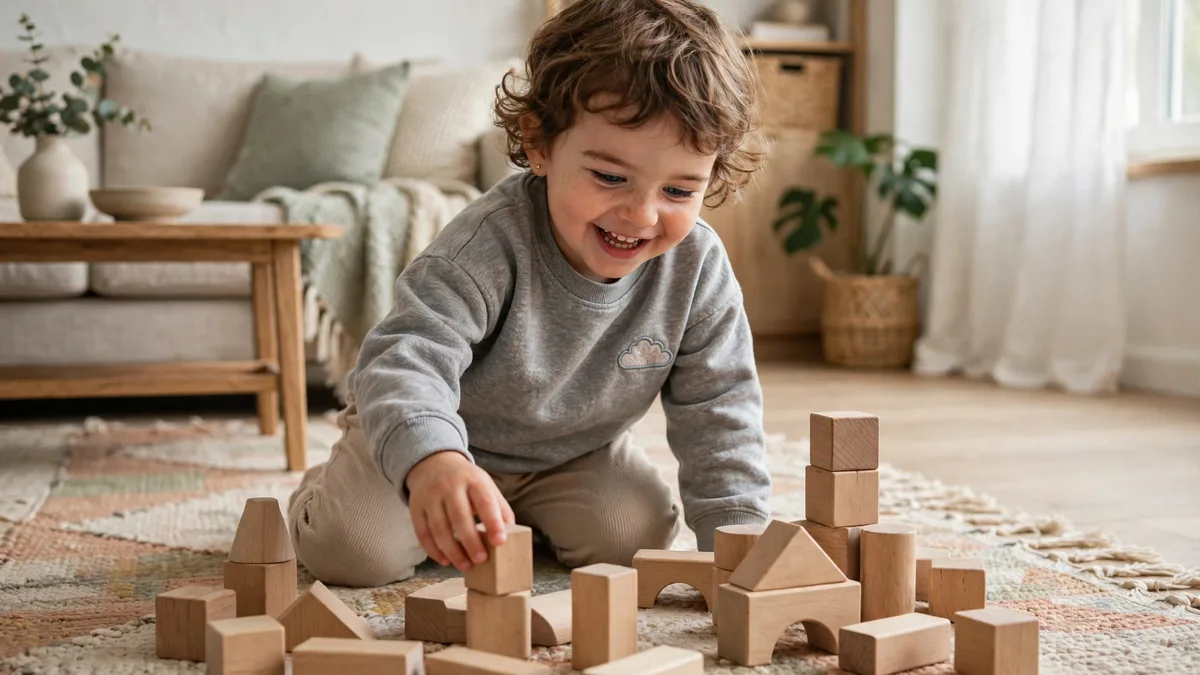
Wooden blocks are the classic three-year-old toy for a reason. A child stacks them, knocks them down, sorts them by shape and builds towers that reach higher each week. The weight of real wood helps a tower stand, and the feel of it teaches a child about balance without a single instruction.
2. Magnetic Tile Set
Best for: colour, shape and first building skills.
Magnetic tiles click together with a satisfying snap, which makes them easier for small hands than blocks that must balance. A three-year-old can build a house, a garage or a tall tower, then take it apart and start again. The bright colours also help a child learn to name what they see.
3. Play Kitchen with Accessories
Best for: pretend play and everyday language.
A play kitchen turns a corner of a room into a small world. A child stirs a pot, serves a meal to a teddy and copies the cooking they see at home. That copying is valuable play, because it lets a child practise the routines and words of daily life in a safe, low-stakes way.
4. Balance Bike
Best for: confidence, balance and outdoor play.
A balance bike has no pedals, so a child scoots along with their feet and learns to balance by feel. Most three-year-olds take to one quickly, and the skill transfers naturally to a pedal bike later on. For more outdoor ideas, see our guide to the best outdoor toys for kids.
5. Simple Jigsaw Puzzles
Best for: patience, focus and problem solving.
A puzzle with twelve to twenty-four large pieces suits a three-year-old well. The pieces are big enough to hold, the picture is clear enough to guide them, and finishing it gives a real sense of achievement. Puzzles also build patience, because a child learns to try a piece, turn it, and try again.
6. Art Easel and Drawing Set
Best for: creativity, colour and fine motor skills.
An easel gives a child a proper place to draw, paint and stick. Standing to draw uses the whole arm, which builds the strength needed for writing later on. Chunky crayons, washable paints and large sheets of paper are the right tools for this age, because they forgive a heavy hand.
7. Doll and Pushchair Set
Best for: caring play and storytelling.
A soft-bodied doll invites a child to practise care. They feed it, dress it, put it to bed and take it for a walk in a small pushchair. That kind of play helps a child understand feelings, both their own and other people’s, and it gives them words for comfort and kindness.
8. Musical Instrument Set
Best for: rhythm, listening and joyful noise.
A small drum, a shaker, a xylophone and a pair of bells are enough for a first band. A three-year-old learns rhythm by copying a beat, and learns listening by hearing how each instrument sounds different. Music play is also a natural way for a family to play together.
9. Ride-On Scooter
Best for: coordination and outdoor energy.
A three-wheeled scooter is steadier than a two-wheeled one, which makes it a good first scooter for a three-year-old. A child pushes with one foot, steers with the handlebar and learns to judge speed and space. It is a fine way to burn off energy on a dry afternoon.
10. Water and Sand Play Table
Best for: sensory play and outdoor afternoons.
A water and sand table gives a child two kinds of play in one place. They pour, scoop, splash and mould, and they learn how water flows and how damp sand holds a shape. It is messy play with a clear purpose, and most three-year-olds will stay at it far longer than you expect.
At a Glance: The 10 Picks Compared
Use this table to compare the ten picks at a glance. Each one suits a different kind of play, so the right choice depends on your child, your space and the time of year.
| Toy | Best for | Why it works | What to check |
|---|---|---|---|
| Wooden building blocks | Building and balance | Sturdy, open-ended, grows with a child | Mix of shapes, smooth edges |
| Magnetic tiles | Colour and shape | Click together easily, bright and clear | Strong magnets, sealed edges |
| Play kitchen | Pretend play | Copies daily life, builds language | Steady base, wipe-clean surfaces |
| Balance bike | Balance and confidence | Teaches balance by feel, no pedals | Light frame, low seat, helmet |
| Simple jigsaw puzzles | Focus and patience | Clear goal, sense of achievement | Large pieces, clear picture |
| Art easel and drawing set | Creativity and fine motor skills | Standing to draw builds arm strength | Washable paints, chunky crayons |
| Doll and pushchair set | Caring play | Practises kindness and storytelling | Soft body, simple clothes |
| Musical instrument set | Rhythm and listening | Copying beats, hearing differences | Sturdy build, no loose parts |
| Ride-on scooter | Coordination and energy | Steady three wheels, easy steering | Low deck, wide base, helmet |
| Water and sand play table | Sensory play | Pouring, scooping and moulding | Lid, outdoor space, towel nearby |
Before You Buy: A Quick Checklist
Run through this list before you buy any toy for a three-year-old. It takes a minute, and it saves you from a toy that sits unused.
- Check the maker’s age guidance, and make sure it is meant for age three.
- Look for sturdy parts, smooth edges and no small pieces that can come loose.
- Ask whether the toy invites open play, or whether it only does one fixed thing.
- Think about where it will live, and whether you have room to store it.
- Check that it can be cleaned, because everything a three-year-old owns gets dirty.
- Watch your child play with something similar first, if you can, and see what holds their attention.
Frequently Asked Questions
Are educational toys for 3 year olds worth buying?
Yes, when they are chosen for play rather than for lessons. Educational toys for 3 year olds work best when a child enjoys them, so look for toys that teach through building, sorting or pretend play. Our guide to the best educational toys for three-year-olds lists ten that do this well.
How many toys does a three-year-old need?
Fewer than most parents expect. A small set of open-ended toys, rotated regularly, gives a child more play than a room full of single-purpose toys. Watch which toys your child returns to, and keep those within easy reach.
Screen-based play has its place too; see our guide to the best kids tablets before you decide.
What toys help a three-year-old learn to talk?
Toys that invite stories help most, such as a play kitchen, a doll, toy vehicles or a simple puppet. Talk with your child while they play, name what they are doing, and ask gentle questions. The conversation matters more than the toy itself.
Are balance bikes safe for three-year-olds?
Yes, with the right size and a helmet. Choose a light bike with a low seat so your child’s feet rest flat on the ground, and start on a flat, traffic-free path. Stay close by until your child is confident steering and stopping.
When should I replace a toy my child has outgrown?
Replace a toy when it no longer holds your child’s interest, or when it is worn or broken. Pass good toys on to a younger child, and let your three-year-old help choose what comes next. Their interests at this age change fast, so check in every few months.
A Note on Safety
Always check the maker’s age guidance and inspect toys regularly for wear, loose parts and damage. Keep small parts, button batteries and loose cords out of reach, and supervise play with new toys.