

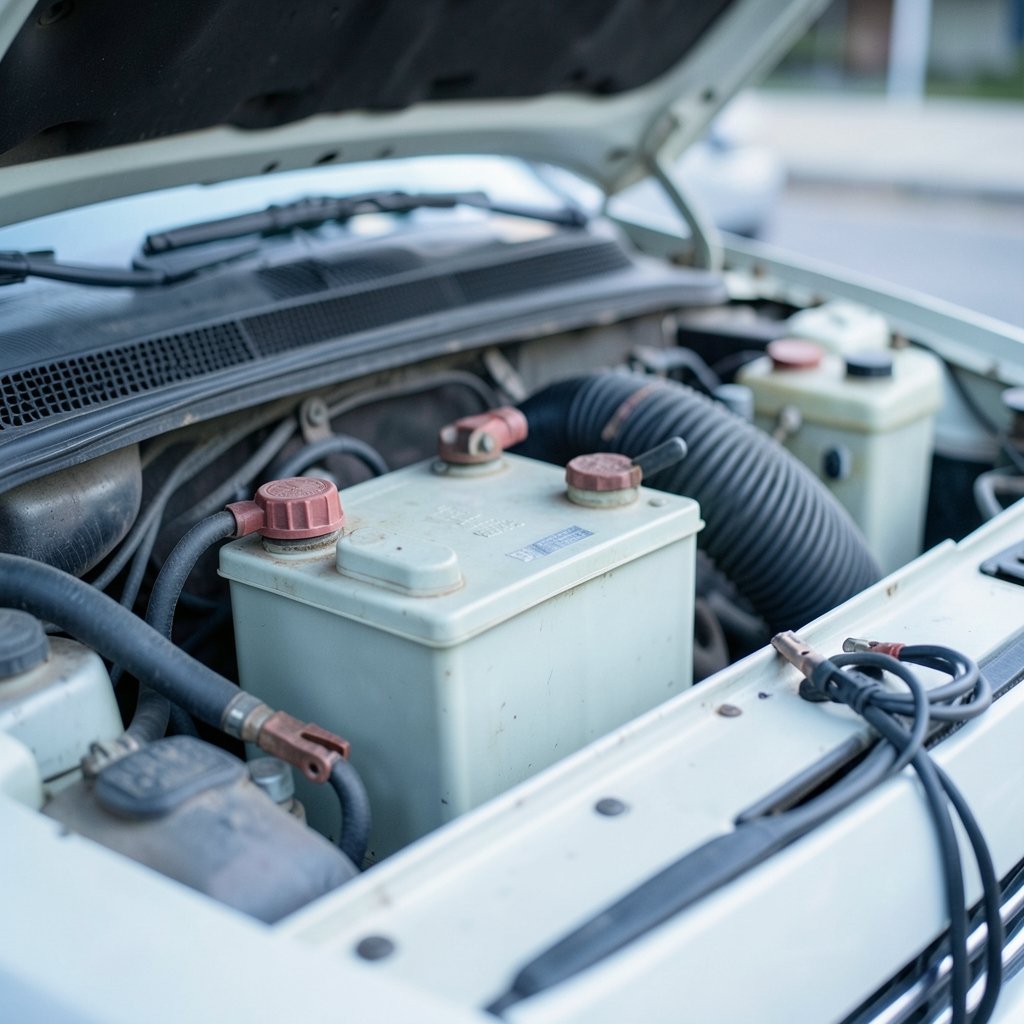
Quick Answer: What does the battery warning light mean?
The battery warning light means your car’s charging system is not keeping the battery topped up while the engine runs. In most cars it is a red rectangle shaped like a battery, sometimes with plus and minus marks, and it signals a fault with the battery itself, the alternator, the alternator belt, or the wiring between them.
It is not the same as the light that appears briefly when you start the car. A quick flash during the bulb check is normal; a light that stays on while driving is not. Some vehicles also show a separate high-voltage battery symbol in blue, amber, or red, which tracks charge level rather than a fault.
Before you act, weigh how the light behaves, whether other warnings appear, how the car is running, your remaining electrical load, and how far you are from a safe stopping place.
A Light That Looks Simple but Rarely Means What Drivers Assume

What runs through your head when a small red battery appears on the dashboard mid-journey? Most people jump straight to “the battery is dead” and start planning a replacement. That instinct is understandable, and it is also the single most common misreading of this particular warning.
The battery light is best understood as a charging system alert, not a battery health report. It switches on when the charging system fails to push the battery above roughly 13.5 volts while the engine is running, according to Firestone Complete Auto Care. In other words, the car is telling you the battery is not being replenished, not necessarily that the battery has reached the end of its life.
That distinction matters because it changes what you do next. A weak battery usually announces itself with a slow, laboured crank on a cold morning. A charging fault can strike a perfectly healthy battery in the middle of a motorway run, with no warning beyond that little red rectangle.
What the Symbol Actually Looks Like
Automotive references describe the icon consistently: a rectangle resembling a battery, often with a small plus and minus terminal marking. It usually glows red or amber depending on the manufacturer and the severity of the fault.
Because it is one of the quieter-looking warnings on the cluster, it is easy to dismiss next to flashing brake or oil pressure symbols. That is a mistake. A red charging warning belongs in the “deal with it soon” category, and treating it as cosmetic is how drivers end up stranded in a car park with a car that will not restart.
Normal Flash Versus a Real Fault
Here is the detail that saves a lot of unnecessary panic. When you switch on the ignition, the battery light illuminates as part of a bulb check, then goes out once the engine catches. According to AutoZone, that behaviour is entirely normal and deserves no attention.
The line between normal and concerning is simple:
| Behaviour | What it suggests | What to do |
|---|---|---|
| Glows briefly at startup, then goes out | Normal bulb check | Nothing |
| Flickers dimly at idle, brightens with revs | Early charging fault or loose belt | Get it tested soon |
| Stays on solidly while driving | Charging system failure | Reduce load, head to help |
| Comes on with brake, ABS, or stability warnings | Possible shared electrical fault | Treat as urgent |
A light that flickers is often the earliest clue, and it is the one drivers most often ignore because it seems to come and go. In practice, a flickering charge light frequently points to a slipping or worn alternator belt, a loose connection, or an alternator on its way out.
Why the Light Comes On: The Usual Suspects
The alternator
The alternator is the generator that powers your electronics and recharges the battery while you drive. When it fails, the battery becomes the sole source of electricity, and it drains fast. This is the most common cause of a solid battery light, and it is also the most expensive to ignore.
The alternator belt
If the belt that spins the alternator slips or snaps, the alternator stops generating. A snapped belt may bring a steering or temperature warning along with the battery light, since one belt often drives several components.
The battery itself
A battery with damaged plates or one that can no longer hold charge will trigger the light, particularly if it is old or has been deeply discharged. Corroded or loose battery cable terminals cause the same symptom by interrupting the connection.
The voltage regulator and wiring
The regulator controls charging voltage. When it misbehaves, charging becomes erratic, and the light may flicker rather than stay on. Damaged wiring or a poor ground can produce identical behaviour.
The Mistake Almost Everyone Makes
The classic error is replacing the battery first. Drivers see the symbol, assume the battery is at fault, and buy a new one, only to find the light returns within a day because the alternator was never charging it in the first place. A charging system test takes minutes and tells you which component is actually failing, so it is worth doing before spending money on parts.
The second common mistake is continuing to drive with the light on while every accessory is running. Heated seats, air conditioning, the radio, phone chargers, and headlights all draw from a battery that is no longer being replenished. Every one of them shortens the distance you can travel before the car dies.
How Far Can You Drive With the Light On?
This is the question every driver asks, and the honest answer is that it depends on the battery’s state of charge and your electrical load. A fully charged battery in good condition may carry the car for a reasonable distance with accessories switched off. An older, partially discharged battery may give you only a few minutes.
The car will keep running as long as there is life left in the battery, but once you switch off the engine there is a real chance it will not restart. That is the calculation to make: not “can I keep going?” but “can I get somewhere safe before I have to stop?”
What to Do in the Moment
- Stay calm and keep control. Do not brake sharply or pull over in a dangerous position.
- Switch off everything you do not need. Air conditioning, radio, heated seats, and charging cables all come off.
- Watch for a safe exit. A lay-by, service station, or quiet side road beats a hard shoulder.
- Head for help. A garage, parts store, or your home driveway, whichever is closest and safest.
- Avoid stopping the engine until you are somewhere you can afford to be stuck. Restarting may not work.
- Call for assistance if the car begins to lose power, the lights dim, or steering assistance fades.
If you must drive with the light on, switch off all accessories to reduce strain on the battery. That advice comes straight from manufacturer guidance, and it is the difference between limping to a garage and stopping dead on a slip road.
Reading the Dashboard as a Whole
A battery light rarely travels alone. When it appears alongside other symbols, the combination tells you a lot about what is happening.
A charging fault that also triggers a maintenance required reminder often means the car has logged a fault code and wants attention across several systems. If the ABS warning joins in, the electrical supply may be dropping low enough to upset sensitive modules, and it is worth reading about what the anti lock abs light means before assuming two separate failures. A stability control warning appearing at the same time is another sign of a shared electrical problem, and the guidance on service stabilitrak explains why those systems are so sensitive to voltage.
Patterns matter too. A light that appears only on damp mornings points toward connections and grounds. One that shows up after a long idle period suggests the battery is not holding charge. One that appears under heavy electrical load, such as at night with lights and wipers running, points at the alternator’s capacity.
Petrol, Diesel, and Electric Cars
The same symbol covers different hardware depending on what is under the bonnet. In petrol and diesel cars it refers to the 12-volt battery and the alternator charging it. In electric and hybrid vehicles, the 12-volt system still exists and still powers the electronics, so the warning can appear even though the traction battery is separate.
Some electric vehicles add a dedicated high-voltage battery indicator. It glows blue under normal conditions, turns amber when the pack is low on charge, and red when it is depleted. That is a charge level display, not a fault, and confusing it with the 12-volt warning leads drivers to the wrong conclusion.
Prevention Beats Roadside Rescue
Charging failures rarely appear from nowhere. A few habits keep the warning light away:
- Have the battery and charging system tested at every major service, or at least before winter.
- Keep battery terminals clean and tight. Corrosion is a quiet killer of charging performance.
- Watch for the early signs: dimmer headlights at idle, slower cranking, flickering interior lights.
- Avoid short trips that never let the battery recover from the drain of starting.
- Replace an ageing battery on schedule rather than waiting for a failure.
Extreme heat is a genuine factor. Tropical and desert conditions degrade 12-volt batteries and charging components over time, which is why a battery that served you well in a mild climate can fail early in a hot one.
When to Stop Driving Immediately
Some manufacturers take a stricter line than others. Lexus, for example, treats an illuminated battery warning as a malfunction of the driving system and advises stopping immediately in a safe place and contacting service. Other brands frame it as “have the vehicle checked as soon as possible.”
The practical rule sits between the two. If the car is still running normally, reduce electrical load and drive to the nearest help. If power steering falters, lights dim sharply, or the engine begins to misfire, stop as soon as it is safe and call for recovery. The same instinct applies to other warning symbols: a red light that signals an active fault deserves a prompt response, much like a red phone signal indicator that tells you something needs attention now rather than later.
Conclusion
The battery warning light is one of the most misunderstood symbols on the dashboard. It does not usually mean your battery is finished. It means the charging system has stopped doing its job, and the battery is now running on borrowed time. The bulb check at startup is normal, a flicker is an early warning, and a solid light is a countdown.
Treat it as a prompt to act rather than a reason to panic. Switch off what you can, head somewhere safe, and get the charging system tested before you buy a single part. That order of operations saves money, avoids a second breakdown, and turns a stressful dashboard moment into a straightforward repair.
FAQ
Does the battery light mean I need a new battery?
Not necessarily. The light indicates a charging fault, and the battery is only one possible cause. The alternator, the alternator belt, the voltage regulator, and corroded terminals can all trigger it. A charging system test identifies the real culprit before you spend money on a replacement.
Can I keep driving with the battery light on?
For a short distance, often yes, provided you switch off non-essential electrical loads and head for help. The car runs only on whatever charge remains in the battery, so the range is unpredictable. If the engine starts to misfire or the lights dim, stop somewhere safe.
Why does the battery light flicker instead of staying on?
A flicker usually points to an intermittent fault: a slipping belt, a loose connection, or a regulator that is not holding voltage steadily. It is often an early warning that becomes a solid light later, so it is worth investigating rather than waiting.
Will the car restart after I turn it off with the light on?
Possibly not. Once the engine stops, the battery has to crank it with whatever charge is left. If the alternator has not been charging it, that reserve may be too small. Try to park somewhere you can safely wait for assistance.
Is the battery light the same on electric cars?
Partly. Electric and hybrid cars still have a 12-volt battery and charging system, so the same warning can appear. Many also display a separate high-voltage battery indicator that shows charge level in blue, amber, or red, which is a different signal entirely.
How much does it cost to fix a charging fault?
It depends entirely on the failed component. A new battery is a modest expense, an alternator replacement costs considerably more, and a belt or terminal clean sits at the low end. Diagnosis first is the cheapest route, because it stops you paying for parts the car did not need.











