An angora blend cardigan is not a jumper with buttons. It is a layer with a halo, a knit that sheds, warms and softens in ways wool alone does not, and it rewards a different way of wearing it. The halo catches the light, which means it also catches lint, loose fibres and the eye. Worn well, it makes a plain shirt and dark trousers look considered.
The trick is to treat the cardigan as a deliberate layer rather than a default one. Button it with intent, choose what goes underneath it with care, and give it a home that is folded, not hung.
Below are nine steps for styling an angora blend cardigan for men, from the first fitting to the last fold of the season.
Key takeaways
- Fit the shoulders first, because a cardigan that slips there never sits right.
- Wear a smooth layer underneath, and keep the shirt collar outside the cardigan.
- Button it fully before a coat goes on, so the fronts cannot bunch.
- Expect shedding for the first month, and keep dark trousers for that period.
- No styling trick will save a cardigan that is washed hot, hung on a hanger, or rubbed by rough straps.
What makes an angora blend cardigan different to style
The difference is the halo. Angora fibres are fine and hollow, so they stand out from the knit and catch the light. That halo is what makes the cardigan look soft and expensive, and it is also what makes it shed, pill and show wear.
The blend matters too. At 10 to 40 percent angora with wool, cashmere or nylon, the knit has enough structure to hold a shape and enough halo to look special. Below that, it behaves like wool and the styling rules are the same as any cardigan. Above that, it becomes fragile, and the steps below matter more, not less. Our guide to how to style an angora blend sweater covers the fibre itself in more detail, if you want the background before you start.
Styling an angora blend cardigan is therefore less about fashion and more about care. The outfit around it should be simple, flat and smooth, so the halo is the only texture anyone notices.
What to know before you button it up
Start with the fit. Put the cardigan on over the shirt you plan to wear with it, and look at the shoulders in a mirror. The shoulder seam should sit on your own shoulder, not droop past it. If it slips, the fronts will pull open at the chest and the cardigan will look borrowed, however good the fibre is.

Next, look at what is underneath. A smooth cotton or merino layer stops the angora touching bare skin, which is what makes some men itch, and it gives the fronts something flat to sit against. A rough or textured layer underneath will catch the halo and start pilling from the inside. Our guide to how to style an alpaca blend cardigan makes the same point, because brushed fibres all behave the same way against rough cloth.
Finally, decide whether the cardigan is the outer layer or a mid-layer. If it is the outer layer, leave it open or buttoned at the middle and let it breathe. If it is going under a coat, button it fully first, so the fronts cannot bunch under the coat and crease the halo.
Nine ways to style an angora blend cardigan
Start at the shoulders, because a slipping seam ruins the whole fit
What to do: Try the cardigan on over the shirt you will wear with it, and look at the shoulder seam in a mirror. It should sit on the bone of your shoulder, with the sleeve starting where your arm starts. If it sits right, the fronts will hang level and the buttons will close without pulling.
What to avoid: Do not buy a size up for comfort, because the extra width drops the shoulder seam and makes the cardigan look borrowed. Do not judge the fit by the body alone, because a loose body can be fixed by the drape, while slipped shoulders cannot. Best For: The first fitting, before you wear it out. Time Needed: 5 minutes. Standout Tip: Compare the shoulder measurement with a cardigan you already own, rather than trusting the label size.
Let the collar sit on show, not hidden under the knit
What to do: Put the shirt on first, then the cardigan, and pull the shirt collar out so it sits on top of the cardigan neckline. The collar frames the halo and gives the outfit a finished edge, especially with a V-neck cardigan.
What to avoid: Do not trap the collar under the cardigan, because it will bunch, crease the halo at the neck, and look untidy by midday. Do not wear a collar that is wider than the cardigan opening, because it will fold over and hide the knit. Best For: V-neck and shawl-collar cardigans over a collared shirt. Time Needed: 1 minute. Standout Tip: A small, neat collar works better than a wide spread collar under an angora knit.
Button it fully before the coat goes on, so the fronts cannot bunch
What to do: When the cardigan is a mid-layer, do up every button before you put the coat on. The closed fronts stay flat under the coat, the halo is protected from the lining, and the cardigan will not crease at the waist.
What to avoid: Do not wear it open under a coat, because the loose fronts will bunch at the waist and rub against the lining, which pills the halo from the inside. Do not force the coat over a cardigan that is already bulky at the chest. Best For: Cold days when the cardigan goes under a wool overcoat. Time Needed: 1 minute. Standout Tip: Unbutton it again indoors, so the knit can breathe and the halo can recover.
Keep dark trousers for the first month, while the new knit sheds most
What to do: For the first few weeks, wear the cardigan with dark trousers and a dark coat, so the loose fibres that shed are invisible. Shake the cardigan out on the doorstep before you leave the house, and keep a lint roller by the door for a quick pass.
What to avoid: Do not wear it with pale trousers in the first month, because the shed fibres will show on every step. Do not shake it indoors, because the fibres will settle on furniture and soft furnishings. Best For: The first month with a new angora blend cardigan. Time Needed: 2 minutes a day. Standout Tip: Shedding settles after a few wears, so the dark-trouser rule is temporary, not permanent.
Let the dry cleaner handle the first clean, and hand wash only after that
What to do: Take the cardigan to a dry cleaner for its first clean, and ask for a gentle cycle. After that, hand wash it in a basin of cold water with a mild detergent, press the water out gently, and dry it flat on a towel.
What to avoid: Do not machine wash it, even on a wool cycle, because the agitation felts the angora and flattens the halo. Do not wring it, because wringing stretches the knit and breaks the fibres. Best For: The first clean, and every clean after it. Time Needed: 20 minutes, plus drying time. Standout Tip: Wash it less often than you think; airing it on a hanger for an hour is usually enough.
Comb the pills out gently, and keep the brush away from the halo
What to do: When pills appear, usually at the cuffs and under the arms, run a cashmere comb gently over the pilled area in one direction. The comb lifts the pills off without pulling the halo fibres out of the knit.
What to avoid: Do not use a brush on the pills, because a brush pulls at the halo and thins the knit. Do not pick pills off with your fingers, because that stretches the yarn and makes the next pill worse. Best For: Pilling at the cuffs, underarms and pocket edges. Time Needed: 10 minutes. Standout Tip: Comb only the pilled patches, not the whole cardigan, so the halo stays even.
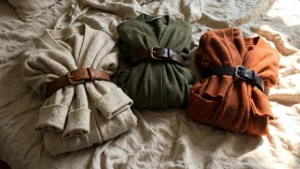
Roll it instead of folding it, so the fronts cannot crease
What to do: For travel or for a drawer, roll the cardigan loosely from the hem upward, with the fronts together. A roll has no fold lines, so the fronts cannot crease, and the halo is protected inside the roll rather than pressed flat.
What to avoid: Do not fold it sharply at the waist, because the fold line will press the halo flat and take days to recover. Do not hang it, because hanging stretches the fronts and pulls the shoulders out of shape. Best For: Packing for a trip, or storing it in a shallow drawer. Time Needed: 2 minutes. Standout Tip: Unroll it as soon as you arrive, and let it rest flat for an hour before wearing it.
Replace a loose button before it pulls the knit
What to do: Check the buttons every few wears, and if one feels loose, sew it back on at once with a matching thread. A button that is re-sewn early takes five minutes and leaves no mark; a button that tears out takes the yarn with it.
What to avoid: Do not keep wearing a cardigan with a loose button, because the weight of the fronts will pull the thread through the knit and leave a hole. Do not use a thick thread, because it will show through the halo. Best For: Any cardigan with a button front, checked monthly. Time Needed: 5 minutes. Standout Tip: Keep a spare button from the inside seam in a small envelope, so a replacement is always to hand.
Save it for still, cold days, because wind pulls the loose fibres out
What to do: Wear the cardigan on still, cold days, when the halo can do its work without being disturbed. On those days it is warmer than wool alone and needs no heavy coat indoors.
What to avoid: Do not wear it on a windy day without a coat, because the wind pulls the loose fibres out of the knit and thins the halo over time. Do not wear it in rain, because wet angora loses its loft and takes a long time to dry. Best For: Calm winter days, indoors and out. Time Needed: None, once you know the weather. Standout Tip: If the wind picks up, put a coat on over it rather than taking the cardigan off.
Matching the cardigan to the rest of your outfit
Keep the rest of the outfit flat and plain, so the halo is the only texture anyone notices. A smooth cotton shirt, dark flat-front trousers, and plain leather shoes are the natural partners. Our guide to how to style a camel hair blend cardigan makes the same point, because every halo fibre needs the same calm frame.
Colour is simpler than pattern. A navy, grey or charcoal cardigan works with almost everything, while a red or tan one needs a plain outfit around it. If the cardigan has a pattern, such as an argyle, let it be the only pattern in the outfit.
For the office, a dark angora blend cardigan over a white or pale blue shirt, with dark trousers and no tie, is a safe and warm choice. It reads as considered rather than casual, because the fibre itself signals care. For a weekend, the same cardigan open over a plain tee, with jeans and clean trainers, is enough.
The caveats that matter
The most common mistake is treating an angora blend cardigan like a wool one. Wool forgives a warm wash, a rough strap and a hanger. Angora does not, or at least not for long. The second mistake is buying a blend with too little angora and expecting the halo.
| Detail | What is known |
|---|---|
| Best first wear | Over a smooth shirt, buttoned up, with dark trousers while the knit sheds |
| Warmth without bulk | A mid-weight blend layers under a wool coat without bunching at the waist |
| Shedding | Loose fibres settle after a few wears; a lint roller at the door handles the rest |
| Who should wear a layer | Sensitive skin, or anyone wearing it against bare arms; a tee stops itching |
| What to avoid | Backpack straps, rough jacket linings and Velcro, which pill the halo |
| Cleaning | Cold hand wash or dry clean; dry flat, never wring, never tumble dry |
| Storage | Rolled or folded flat, cedar nearby, no hangers, no sharp folds |
| What it will not do | It will not look tidy under a crushed shell jacket, and it will not survive a hot wash |
If the cardigan starts to shed more than it did when new, it is usually a sign that it needs a gentle brush and a rest, not a wash. Lay it flat for a day, brush the halo lightly in one direction, and let the fibres settle.
Checklist: wearing an angora blend cardigan well
Use these checks before you put it on, and again when you take it off.
- Check the shoulders: the seam should sit on your shoulder, not droop past it.
- Check the layer underneath: smooth cotton or merino, never a rough or textured knit.
- Check the collar: pull the shirt collar out, so it sits on top of the cardigan neckline.
- Check the buttons: do them up fully under a coat, and leave the middle one done when it is the outer layer.
- Check for pills: run a cashmere comb over the cuffs and underarms, not a brush.
- Check the storage: roll it or fold it flat, with cedar nearby, and never hang it.
Frequently asked questions
Why are most angora blend cardigans for men secondhand?
Because few brands cut angora for men today. The fibre has long been marketed as a women’s luxury, so most men’s angora knits were made in the 1970s to 1990s, when makers blended it into everyday cardigans.
When does the pilling on a new angora blend cardigan stop?
Yes, a little, especially in the first season. The fine angora fibres work loose and form pills where fabric rubs, at the cuffs, under the arms and where a strap crosses the shoulder.
Will my boss think an angora blend cardigan is too casual?
Yes, if it is dark, plain and well fitted. A navy or charcoal cardigan over a white or pale blue shirt, with dark trousers, reads as considered rather than casual.
My angora blend cardigan itches — what helps?
A smooth cotton or merino layer, such as a plain tee or a collared shirt. The smooth surface stops the angora touching bare skin, which is what makes some men itch, and it gives the fronts something flat to sit against.
How should I pack this cardigan away once summer arrives?
Roll it loosely or fold it flat, with tissue between the fronts if you have it, and put cedar nearby to keep moths away. Never hang it, because hanging stretches the fronts and pulls the shoulders out of shape.
Why does my cardigan shed more on one side than the other?
Usually because one side rubs more: a bag strap on one shoulder, a seatbelt on one side, or the arm you rest on a desk. Switch the strap to the other shoulder, keep the cardigan away from seatbelts, and brush the shedding side gently in one direction to even the halo out.
The bottom line
An angora blend cardigan is a rewarding knit to style, because the fibre does most of the work. Keep the outfit around it flat and plain, fit the shoulders first, button it with intent, and give it a smooth layer underneath.
Look after it with cold water, a cashmere comb and folded storage, and it will keep its halo for seasons. Treat it like wool, wash it hot, hang it up or rub it with rough straps, and it will shed, pill and stretch until it is no longer worth wearing.