
A nose stud that fits properly is easy to forget you are wearing. It sits flat, it does not catch on your clothes, it does not press into the skin, and it does not work its way loose. A nose stud with the wrong sizing does the opposite: it pokes, snags, and slides around, and it can irritate a piercing that was perfectly happy the day before. The difference is usually a millimetre or two.
Sizing a nose stud is not complicated, but it is not guesswork either. Three measurements matter: the gauge, the thickness of the post; the length, the part that sits inside the piercing; and the size of the top, the ball, gem, or disc you see on the outside. Each one affects how the stud feels, looks, and stays put.
This guide explains the nine sizing facts you need in 2027, from what gauge numbers mean to how to measure the stud you already own, how sizing changes for a fresh versus a healed piercing, and when to let a piercer measure you. Get the size right once, and every later stud is an easy decision.
Key takeaways
- Gauge is the thickness of the post: 20 gauge is thinner than 18 gauge, and most nostrils are pierced at one of the two.
- Post length matters as much as gauge: too short presses into the skin, too long catches and moves around.
- Measure the stud you already wear before you order a new one, because it is the most reliable guide to your size.
- Fresh piercings need longer posts for swelling; healed piercings usually suit a shorter, neater post.
- Sizing charts are general guidance, not medical advice, and a piercer can measure your piercing in minutes if you are unsure.
What nose stud sizing actually covers
Nose stud sizing covers three measurements, and all three need to be right. The gauge is the thickness of the post, on a scale where a higher number means a thinner post. A 20 gauge post is about 0.8 millimetres thick, and an 18 gauge post is about 1.0 millimetre. Most nostril piercings are done at 20 or 18 gauge, set by the needle your piercer used.
The length is the wearable part of the post, the section that sits inside the piercing between the decorative top and the backing. For a nostril, that is usually 6 to 8 millimetres, depending on the thickness of your nostril tissue. A post that is too short pulls the top tight and presses the backing into the inside of your nose. A post that is too long leaves the stud wobbling and catching, irritating the piercing.
The third measurement is the size of the top, the part you see. Ball tops are usually 2 to 3 millimetres across, gem tops 1.5 to 3 millimetres, and flat discs 2 to 4 millimetres. A smaller top looks subtle and sits neatly. A larger top makes more of a statement, but it catches more easily and feels heavier.
How we chose these sizing facts and what to look for
These nine facts are organised in the order you need them when buying a stud: gauge first, then length, then top size, then backing style, then how to measure what you already own. That order matters, because the gauge is the one measurement you cannot change without a piercer, while the top size is the one you can change freely.
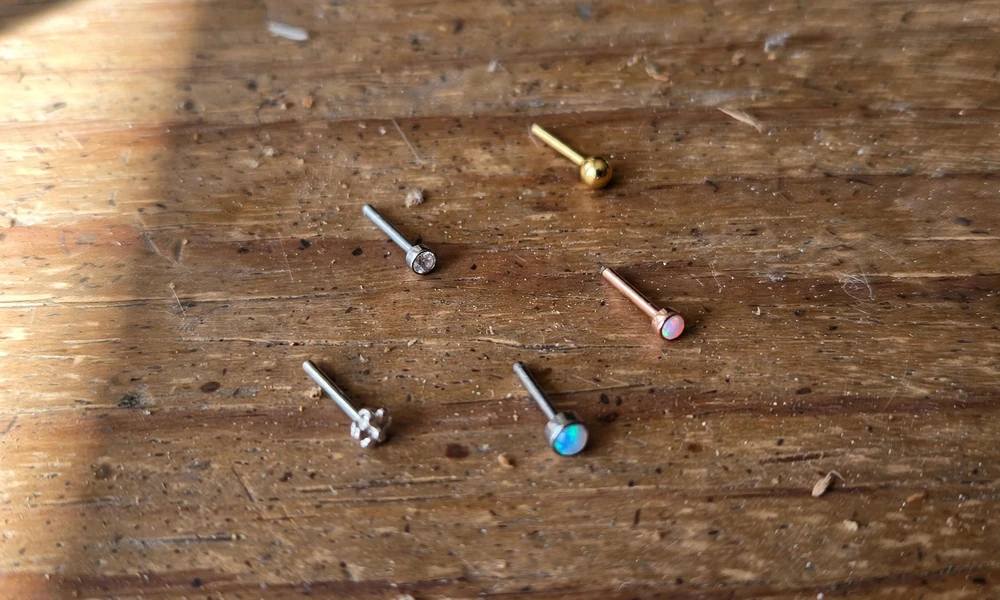
Look first at the stud you are wearing now. If it fits well, it is the best sizing guide you have. Measure its post length with a ruler, note whether it feels snug or loose, and check the gauge on the packaging or order. Our guide to buying a nose stud explains how gauge and length are listed by sellers, and the flat-back versus screw comparison shows how backing style changes the fit.
Finally, look at the material and the finish. A well-made stud has a smooth post with no rough edges, a securely set top, and a backing that sits flat. A rough post can irritate the piercing every time it moves. Size and material work together: the right size in a poor material still causes problems, and the best material in the wrong size still feels uncomfortable.
The 9 nose stud sizing facts that matter
Fact 1: Gauge is the thickness, and higher means thinner
Gauge confuses people most, because the numbers run backwards: a 20 gauge post is thinner than an 18 gauge post. For a nostril, 20 and 18 gauge are standard. A 20 gauge stud is lighter and subtler; an 18 gauge stud is sturdier.
What to do: Find out which gauge you were pierced at, and buy the same gauge. What to avoid: Putting an 18 gauge stud into a 20 gauge piercing, or the reverse. Best for: Anyone buying their first replacement stud. Time needed: A minute to check your records or ask your piercer. Standout tip: A piercer can measure your gauge in seconds.
Fact 2: Post length is measured inside the piercing
Post length is the part of the stud inside the piercing, from the underside of the top to the backing. For most nostrils, that is 6 to 8 millimetres. The right length depends on your nostril tissue.
What to do: Measure the post of a stud that fits you well, from the top to the backing. What to avoid: Choosing a length because it is the most common size. Best for: Anyone whose studs always feel too tight or too loose. Time needed: Two minutes with a ruler. Standout tip: Measure in millimetres, not inches.
Fact 3: Top size changes the look and the feel
The top is the part you see, and its size changes both the look and the comfort. A 1.5 millimetre gem is barely there, suiting a subtle everyday look. A 2 millimetre ball or gem is the most common size, visible without being obvious. A 3 millimetre top makes a statement but catches more easily.
What to do: Start with a 2 millimetre top if you are unsure, and go smaller or larger from there. What to avoid: Choosing a large, heavy top for a piercing that is still settling. Best for: Anyone choosing between a subtle and a statement look. Time needed: A minute to compare sizes. Standout tip: A flat disc top catches less than a ball.
Fact 4: Backing style changes how a size feels
The backing sits inside your nose, and its style changes how a stud feels. A flat-back labret has a small disc that sits flat inside the nostril, comfortable and easy to change. A nose screw has a curved tail that needs a twisting motion. An L-bend has a short bend that hooks in place.
What to do: Choose the backing style that matches how you want to change and wear the stud. What to avoid: Assuming a length that works in a flat-back will feel the same in a screw stud. Best for: Anyone switching backing styles. Time needed: A minute to think about which style you find easiest. Standout tip: Flat-back studs are the easiest to size.
Fact 5: Measure the stud you already wear
The most reliable way to size a new stud is to measure the one you already wear, because it is proven to fit. Take it out, lay it on a ruler, and measure the post from the underside of the top to the end of the post or the start of the bend. Note the gauge and whether the stud feels snug or loose.
What to do: Measure a stud that fits well, and write the numbers down before you order. What to avoid: Measuring a stud that never fitted properly, or guessing from memory. Best for: Anyone ordering a replacement online. Time needed: Three minutes with a ruler and a pen. Standout tip: Photograph the stud next to the ruler.
Fact 6: Fresh piercings need longer posts
A fresh nostril piercing swells, so a post that fits a healed piercing will be too short for a fresh one. Piercers fit a longer post at first, often 8 millimetres, then shorten it to 6 or 7 millimetres once swelling has gone down. A short post can press into swollen tissue and cause a bump.
What to do: Wait until healing is complete, then choose a length that suits the healed piercing. What to avoid: Buying a short post for a piercing that is still healing. Best for: Anyone in the first six months after piercing. Time needed: Four to six months of healing before a first size change. Standout tip: Ask your piercer to downsize the post at your check-up.
Fact 7: Nose shape and placement change the size
Where your piercing sits and the shape of your nose both affect the best size. A piercing high on the nostril, where tissue is thinner, usually suits a shorter post. A lower piercing, where tissue is thicker, usually needs a longer one. A small nose suits a smaller top; a broader nose can carry a larger one.
What to do: Judge the size by how it looks and feels on your own nose. What to avoid: Copying a friend’s size without checking whether your piercing sits in the same place. Best for: Anyone whose stud looks right in photos but feels wrong in person. Time needed: A minute in front of a mirror. Standout tip: Check the stud from the front and the side before deciding.
Fact 8: Comfort sizing covers sleep, glasses, and masks
A nose stud has to fit your life, not just your nose. Sleeping on your side, a long post or large top can press into the pillow and irritate the piercing. Glasses can catch on a high top, and a mask can snag on a proud stud. A shorter post and a flatter top solve most of these problems.
What to do: Think about how you sleep, what you wear on your face, and how often you change clothes. What to avoid: Choosing a large, proud top as your only everyday stud if you sleep on that side. Best for: Side sleepers, glasses wearers, and anyone who wears a mask. Time needed: A minute of honest thought. Standout tip: A flat disc top is the easiest to sleep in.
Fact 9: When in doubt, ask a piercer to measure you
If you have measured and guessed and still are not sure, a piercer can measure your piercing in minutes. They can tell you the gauge, the post length that suits your nostril, and whether a top size will sit well. Many do this for free.
What to do: Book a short appointment, bring the stud you are considering, and ask the piercer to check the fit. What to avoid: Ordering three sizes in the hope that one fits. Best for: Anyone who has had sizing problems, or whose piercing has been out a while. Time needed: Five to ten minutes at a piercing studio. Standout tip: Write down the gauge and length the piercer gives you.
Which size is right for you
For most people, the right size is the one they are already wearing, if it fits well. If your current stud is comfortable, does not catch, and sits neatly, measure it and buy the same gauge and length. If it is too tight, loose, long, or short, change one measurement at a time, starting with the length.
If you are choosing between 20 gauge and 18 gauge, the deciding factor is usually what you were pierced at. A 20 gauge stud is lighter and more delicate, and it suits a smaller nostril. An 18 gauge stud is sturdier and slightly more visible. The gold versus silver nose stud comparison is worth a look if you are choosing a metal too.
If you wear a flat-back stud, the length is a straight measurement and easy to get right. If you wear a screw or L-bend stud, allow a little extra length for the curve. If you are buying a stud as a gift, ask the wearer for their gauge and length, or buy a gift voucher.
The caveats that matter
Sizing charts are a guide, not a guarantee. Two people with the same gauge and post length can have different experiences, because nostril thickness, piercing placement, and comfort all vary. A size that is perfect for one person can press, catch, or slide on another. That is why measuring your own stud matters more than following a chart.
| Detail | What is known |
|---|---|
| Standard gauges | 20 gauge (about 0.8 mm) and 18 gauge (about 1.0 mm) |
| Standard post lengths | 6 to 8 mm, depending on nostril thickness |
| Common top sizes | 1.5 to 3 mm for balls and gems; flat discs 2 to 4 mm |
| Best way to size | Measure a stud that already fits you well |
| Fresh vs healed | Fresh piercings need longer posts; healed piercings usually suit 6 to 7 mm |
| Backing styles | Flat-back, screw, and L-bend fit differently at the same length |
| Comfort factors | Sleep, glasses, and masks favour a shorter post and a flatter top |
| When to ask a piercer | If you do not know your gauge, or if sizes keep failing |
If you have a skin condition, a metal allergy, or a piercing that is still healing, talk to your piercer before buying a new size. A different gauge or metal can change how a piercing behaves.
Checklist: sizing a nose stud honestly
Use these checks before you order, and again when the stud arrives.
- Check the gauge: buy the same gauge you were pierced at, usually 20 or 18 gauge.
- Check the length: measure a stud that fits you well, and match its post length in millimetres.
- Check the top size: start at 2 millimetres if unsure, and go smaller for a subtle look or larger for a statement.
- Check the backing: flat-back is the simplest to size, while screw and L-bend styles need a little extra length for the curve.
- Check the fit in real life: try the stud on, check it from the front and the side, and see how it feels when you sleep, wear glasses, or wear a mask.
- Check with a piercer: if the size keeps failing, or you do not know your gauge, get measured rather than guessing again.
Frequently asked questions
What gauge is a standard nose stud?
Most nostril piercings are done at 20 gauge or 18 gauge. A 20 gauge post is about 0.8 millimetres thick, and an 18 gauge post is about 1.0 millimetre. Ask your piercer if you are unsure.
What length nose stud do I need?
Most healed nostrils suit a post length of 6 to 7 millimetres, while fresh piercings usually need 8 millimetres for swelling. Measure a stud that already fits you well, and match that length.
How do I measure my nose stud size?
Take the stud out, lay it on a ruler, and measure the post in millimetres, from the underside of the top to the end of the post. Note the gauge and whether the stud feels snug or loose.
Is 20 gauge or 18 gauge better for a nose stud?
Neither is better in general. The right gauge is the one you were pierced at. A 20 gauge stud is lighter and more delicate, and an 18 gauge stud is sturdier and more visible. Match your piercing, not your preference.
What size gem should I choose for a nose stud?
A 2 millimetre gem is the most common choice, visible without being obvious. A 1.5 millimetre gem is very subtle, and a 3 millimetre gem makes a statement but catches more easily. A smaller, flatter top is more comfortable for side sleepers.
Can a nose stud be too short?
Yes. A post that is too short pulls the top tight against the skin and presses the backing into the inside of the nose, causing soreness and swelling. If your stud feels pinched, you need a longer post.
The bottom line
Nose stud sizing comes down to three numbers: the gauge, the post length, and the top size. The gauge is set by your piercing, the length by your nostril, and the top size by taste and comfort. Measure the stud you already wear, match those numbers, and you will get a stud that fits.
Get the size right once, write the numbers down, and every later stud is a simple decision. A well-fitting stud is one you forget you are wearing, and that is exactly what a good fit should feel like.