


What if the best camera for photography isn’t the one with the biggest sensor or the longest spec sheet, but the one you’ll actually carry? That question sounds simple, yet it’s the one most buyers skip. They compare megapixels, watch review videos, and then buy a body that sits in a closet because it’s too heavy, too complicated, or paired with the wrong lens.
Here’s the honest truth: there is no single best camera. There is a best camera for wildlife, a best camera for street work, a best camera for portraits, and a best camera for someone with $600 and a $3,000 budget. The goal of this guide is to help you match a camera to how you actually shoot, so your money goes toward the features that change your photos rather than the ones that just look good in a comparison table.
Why the “Best Camera” Question Has No Single Answer
Photography covers several distinct jobs under one name. A scenery shooter wants resolution and wide tonal range. A sports shooter wants fast autofocus and deep buffers. A street photographer wants something small and quiet. A portrait photographer cares about lens selection and skin-tone rendering more than frame rates.
That’s why two experienced photographers can recommend opposite cameras and both be right. Before you look at a single model, write down three things: what you shoot most, what you shoot in the worst light, and what you’re willing to carry. Those three answers eliminate most of the market for you.
It also helps to remember that cameras are systems, not objects. The body is the entry ticket; lenses, batteries, cards, and bags are the ongoing cost. A mid-range body with a great lens beats a premium body with a kit zoom almost every time. This is the same logic that applies when people learn how to start a photography business that actually turns profit — the gear is only one line in the ledger, and often not the most important one.
Sensor Size: The Trade-Off Nobody Explains Properly
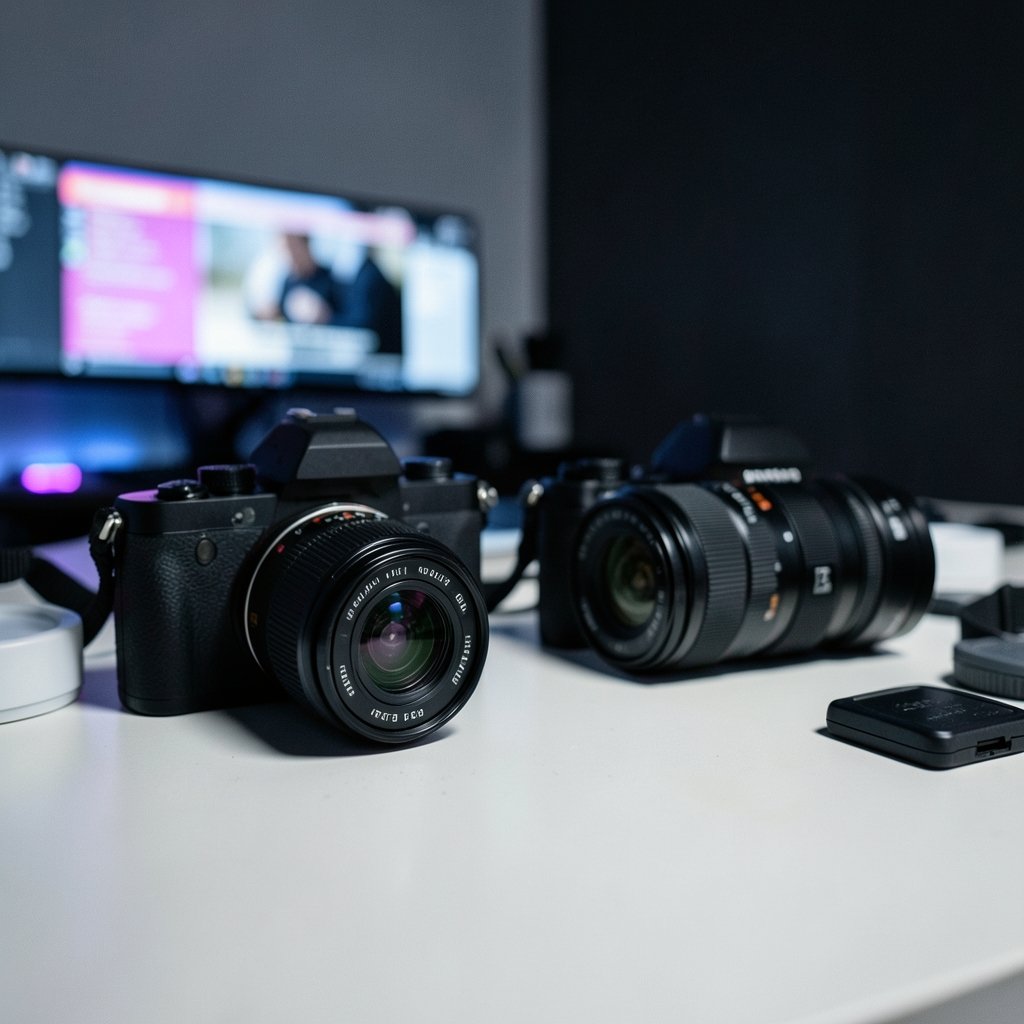
Sensor size gets more attention than any other spec, and more misunderstanding. Bigger sensors generally gather more light and offer shallower depth of field. Smaller sensors allow smaller bodies and smaller, cheaper lenses. Neither is automatically better.
| Sensor size | Strengths | Weaknesses | Best for |
|---|---|---|---|
| Full frame | Low-light performance, shallow depth of field, wide lens choice | Heavier bodies and lenses, higher cost | Portraits, events, low light |
| APS-C | Good balance of size, cost, and image quality | Narrower field of view with the same lens | Travel, wildlife on a budget, all-rounders |
| Micro Four Thirds | Very compact bodies and lenses, strong stabilization | More noise in low light, less shallow depth of field | Street, hiking, video-heavy work |
| Medium format | Very high resolution and detail | Expensive, slow, heavy | Studio, outdoor scenery, commercial print |
The practical tip: if you rarely print large or shoot in dim light, an APS-C or Micro Four Thirds kit will serve you well and leave budget for glass. If you shoot indoor events or love creamy background blur, full frame earns its weight.
One common mistake is buying a full-frame body and then only affording a slow, cheap zoom. A fast prime on a smaller sensor often produces better real-world results than a slow zoom on a bigger one.
The Lens System Matters More Than the Body
Bodies age fast. Lenses don’t. A good lens bought today can outlast two or three camera bodies, which is why the lens mount you commit to is the most consequential decision in the whole purchase.
Look for three things in a system:
- A fast standard prime, roughly 35mm to 50mm equivalent, that you can afford.
- A reliable portrait-length lens if you shoot people.
- A telephoto option that doesn’t cost as much as a used car.
Third-party lens makers have made this easier than ever. Many mounts now have excellent affordable primes and zooms from multiple brands, which means you’re no longer locked into first-party pricing. Before buying any body, browse the lens catalog for that mount and check prices on the focal lengths you actually want. If the lenses you need cost twice the body, you’ve picked the wrong system.
This is also where the used market shines. A previous-generation body paired with a high-quality used lens frequently outperforms a brand-new mid-tier kit at the same total price.
Autofocus: The Feature That Quietly Defines Modern Cameras
Autofocus is the area where camera generations differ most dramatically. Older contrast-detect systems hunted in low light and struggled with moving subjects. Modern systems with subject detection can lock onto eyes, animals, and vehicles with remarkable consistency.
For most photographers, autofocus quality matters more than a stop of tonal range. If your subjects move, prioritize a body with reliable subject-detection autofocus and a decent buffer. If you shoot scenery on a tripod, autofocus is nearly irrelevant and you can redirect that budget toward resolution and lenses.
Practical advice from working shooters: test autofocus in the worst light you’ll realistically face, not in a bright showroom. Dim indoor light separates capable systems from marketing claims. And learn the focus modes properly — many “autofocus problems” are actually user settings left on the wrong mode.
The same principle of capturing a decisive instant applies across photography. A single well-timed frame can carry enormous weight, as when an Anok Yai Mugler viral photo led to a Paris runway moment — the gear mattered far less than being ready at the right second.
Ergonomics, Weight, and the Camera You’ll Actually Carry
The best camera is the one that’s with you. This sounds like a cliché until you’ve lugged a heavy kit on a ten-mile hike and left it in the bag the whole time.
When you handle a camera, check these things:
- Grip comfort: Does your hand fit without cramping? Small bodies with big lenses can be awkward.
- Button and dial placement: Can you change exposure without looking down?
- Viewfinder quality: A good electronic viewfinder makes manual exposure far easier.
- Weight with your most-used lens attached: This is the number that matters, not the body alone.
- Battery life: Mirrorless bodies drain faster; budget for a spare.
A useful exercise is to rent or borrow a body for a weekend before buying. Two days of real use reveals more than two weeks of reviews. Many photographers discover that the camera they lusted after feels wrong in hand, and the one they dismissed feels perfect.
What About Smartphones and Compact Cameras?
It’s fair to ask whether a dedicated camera is even necessary. Modern phones produce excellent images in good light and handle sharing effortlessly. For casual documentation, a phone is genuinely the right tool.
Dedicated cameras still win in specific conditions: low light, fast action, shallow depth of field, long telephoto reach, and any situation requiring physical controls and a real viewfinder. If your photography is mostly daylight snapshots for social media, a phone plus better composition skills will improve your results more than any purchase.
Compact cameras with large sensors have also made a comeback, largely because they fit in a jacket pocket and produce files that hold up to editing. For street and travel work, a good compact can be the most-used camera you’ll ever own.
Setting a Realistic Budget
Budget is where most buying decisions go wrong, usually because people forget the accessories. A realistic total includes the body, at least one lens, a spare battery, memory cards, a bag, and possibly editing software.
| Budget band | What to expect | Smart strategy |
|---|---|---|
| Entry level | Capable APS-C or Micro Four Thirds body with kit lens | Buy used or previous generation, add a fast prime |
| Mid range | Strong autofocus, better build, good lens options | Spend more on lenses than the body |
| Enthusiast | Full frame or high-end APS-C, advanced features | Buy one excellent lens instead of three average ones |
| Professional | Dual card slots, weather sealing, fast bursts | Prioritize reliability and backup over specs |
The most common mistake is spending the entire budget on the body. A second common mistake is buying three cheap lenses instead of one good one. Both leave you with a kit that underperforms what the same money could achieve.
Another trap is chasing the newest model. Camera improvements between adjacent generations are often incremental, and the previous model frequently sells at a significant discount with nearly identical image quality. If you want a sense of how much a single image can matter over time, consider how portraits photography likeness became a lasting record for generations of families — nobody remembers which sensor was in the camera.
How to Test a Camera Before You Commit
You don’t need a lab. You need a repeatable test that reflects your actual work.
- Shoot in the dimmest light you’ll realistically encounter and check noise and autofocus.
- Photograph a moving subject, even a pet or a person walking, and review hit rate.
- Edit a raw file and push the shadows to see how much recovery you get.
- Carry the kit for a full day and note whether you resented the weight.
- Try the menu system and confirm you can find key settings quickly.
If the camera passes all five, it’s a good fit regardless of what reviews say. If it fails on weight or menus, no spec sheet will save the relationship.
There’s also a privacy and ethics dimension worth considering if you shoot in public or workplace settings. Cameras and connected systems capture a lot of data, and debates about surveillance are real — the story of how Kogniz contact tracing AI cameras tracked a workplace is a reminder that imaging technology carries responsibilities beyond image quality.
Conclusion
The best camera for photography is the one that matches your subjects, your light, and your willingness to carry it. Start with what you shoot, choose a lens system you can afford to grow into, prioritize autofocus only if your subjects move, and handle the body before you buy. Spend less on the newest model and more on good glass, a spare battery, and a bag you’ll actually use.
Then stop researching and start shooting. The camera that produces your best work is rarely the most impressive one on paper — it’s the one you know so well that it disappears in your hands.
Frequently Asked Questions
Is full frame always better than APS-C?
No. Full frame offers advantages in low light and shallow depth of field, but APS-C bodies are smaller, cheaper, and often pair with lighter lenses. For travel, wildlife on a budget, and daylight work, APS-C is frequently the smarter choice. The difference in final image quality is smaller than most buyers expect.
How much should I spend on my first serious camera?
A common approach is to split your budget roughly in half between the body and lenses, then set aside a little for a spare battery, cards, and a bag. Buying a previous-generation body used can free up significant money for better glass, which improves results more than a newer sensor.
Do megapixels really matter?
Only up to a point. For social media, web use, and prints up to roughly 16×24 inches, most modern sensors have plenty of resolution. Higher megapixels help with heavy cropping and large prints, but they also demand better lenses and more storage. Don’t let megapixel count drive the decision.
Should I buy new or used?
Used gear offers much better value, especially for lenses, which age slowly. Buy from reputable dealers with return policies or inspect carefully in person. Check shutter count on used bodies, test autofocus, and look for sensor scratches or dust that won’t blow off.
Is a kit lens good enough to start with?
A kit lens is a fine way to learn focal lengths and figure out what you actually shoot. It’s usually the weakest part of a starter kit, though. Once you know your favorite focal length, adding one fast prime will improve your images more than any body upgrade.
When should I upgrade my camera?
Upgrade when a specific limitation blocks your work: autofocus that misses moving subjects, a buffer that fills too fast, poor low-light performance, or a body that’s failing. If you can’t name the limitation clearly, the gear isn’t the problem — practice and better lenses usually are.














