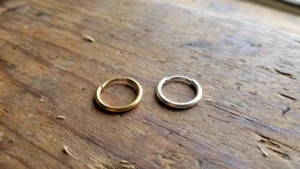
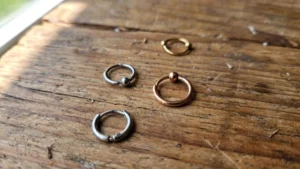
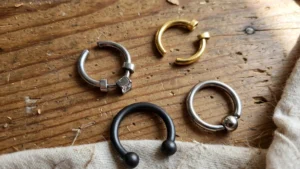
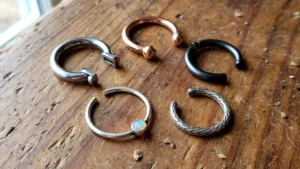
A septum ring is the most visible piece of jewellery you can wear, and the smallest. It sits in the centre of the face, so every detail shows: the metal, the finish, the size, and the way it closes. The two styles look similar from a short distance, but they open differently, feel different, and suit different kinds of wearers.
A seamless septum ring is a plain, unbroken circle with a tiny gap. You twist the ends apart to open it and twist them back to close it. A hinged septum ring, often called a clicker, has a small hinged section that snaps open and clicks shut. One is simple and smooth, the other is practical and quick. The right choice depends on how often you change your jewellery, how sensitive your skin is, and how much you want to spend.
Below are nine comparisons that matter in 2027, from how each style looks and feels to how it is cleaned, what it costs, and what happens when you want to keep it for years. Each one is written plainly, so you can weigh the trade-offs.
Key takeaways
- Seamless septum rings are smooth, simple circles with a small gap; hinged rings have a hinged section that clicks open and shut.
- Hinged rings are easier to put in and take out, especially for beginners, while seamless rings sit more smoothly once they are in place.
- Both styles suit everyday wear, but hinged rings are more secure for active days and seamless rings are lighter on the nose.
- Gold, titanium, and surgical steel are the safest metals for most skin; nickel-heavy alloys are the most common cause of irritation.
- No septum ring is completely maintenance-free, and a ring that is hard to open, tarnishes quickly, or irritates your skin is not worth keeping, however good it looks.
What seamless and hinged septum rings actually are
A seamless septum ring is a single circle of metal with no clasp, hinge, or join you can see. The two ends meet in a tiny gap, and the ring opens by twisting the ends sideways, never by pulling them apart. Because there is nothing sticking out, it feels smooth against the skin, and from the front it looks like a clean, unbroken circle.
A hinged septum ring is built differently. A short section of the circle is hinged, so it swings open and then clicks shut with a small snap you can feel. The difference is in the handling. You do not need to twist the metal, and you do not need a tool or a steady grip. You press the hinge, the ring opens, and it clicks closed again when it is in place.
Both styles are worn through the same septum piercing, and both come in the same gauges, diameters, and metals. Both come in the same gauges, diameters, and metals, but that one difference affects comfort, security, cleaning, and cost.
How we chose these comparisons and what to look for
We judged each style on the things that matter in daily wear, not on a photograph. Comfort over a full day, how easy it is to put in and take out, how securely it stays closed, how it is cleaned, what it costs for one ring and for a small set, how it behaves on sensitive skin, and how it looks with the rest of your jewellery.

Look at the metal first, because it decides most of the comfort. Solid 14-karat or 18-karat gold, implant-grade titanium, and surgical steel are the safest choices for most skin. Gold-filled and plated rings can be fine for short wear, but the coating wears thin and the metal underneath can irritate. If your skin reacts to cheap jewellery, choose titanium or solid gold, and avoid anything that does not name its metal plainly.
Look next at the size. A septum ring that is too small pinches, and one that is too large swings and catches. The diameter should clear the bottom of your nose by a few millimetres, no more. If you are choosing gold, our guide to gold jewellery for everyday wear explains how to tell solid gold from plated gold, which matters here, because this ring sits against delicate skin all day.
The 9 comparisons that matter in 2027
First impressions and how they look on the nose
From the front, a seamless ring looks like a perfect circle, smooth and unbroken, with nothing to catch the eye except the metal itself. A hinged ring looks almost the same, but a careful look can find the hinge and the tiny seam where it closes.
What we like: Seamless rings give the cleanest line, and hinged rings hide their hinge well on most designs. What to consider: A cheap hinge can look bulky and catch the light awkwardly. Best for: Seamless for a minimal look, hinged for decorated styles. Material: Gold, titanium, or surgical steel. Price range: About £15 to £120. Standout feature: The seamless ring’s unbroken circle.
Comfort and how they feel all day
A seamless ring is light and smooth, with no hinge, clasp, or edge pressing against the skin. Once it is in place, most people forget it is there. A hinged ring is slightly heavier, and the hinge sits against the inside of the nose, where the skin is thin.
What we like: Seamless rings feel like nothing at all; hinged rings feel secure. What to consider: A poor hinge can irritate the inside of the nose. Best for: Seamless for sensitive skin, hinged for peace of mind. Material: Implant-grade titanium or solid gold. Price range: About £15 to £120. Standout feature: The seamless ring’s smooth, edge-free feel.
Ease of putting them in and taking them out
This is where the hinged ring wins clearly. You press the hinge, the ring opens, and it clicks shut when it is in place, all in a few seconds, with no tools and no twisting. A seamless ring needs a gentle twist to open and another to close, and the ends must line up exactly, which takes practice and a steady hand.
What we like: Hinged rings are quick and tool-free; seamless rings are simple once you learn the twist. What to consider: Twisting a seamless ring the wrong way can bend it out of shape. Best for: Hinged for beginners, seamless for confident wearers. Material: Titanium or gold, which bend back more forgivingly. Price range: About £15 to £120. Standout feature: The hinged ring’s click-shut closure.
Security and what stays put
A hinged ring that clicks shut stays shut. The hinge locks, and the ring will not open on its own, even during sport, sleep, or a long day. A seamless ring stays closed by tension, and if the ends are not twisted back into perfect alignment, the gap can widen and the ring can work itself loose.
What we like: Hinged rings lock closed; seamless rings have nothing to fail. What to consider: A seamless ring with a wide gap can slip out unnoticed. Best for: Hinged for active days, seamless for quiet days. Material: Gold or titanium, which hold their shape. Price range: About £15 to £120. Standout feature: The hinged ring’s locking click.
Cleaning and everyday care
Both styles need the same basic care: warm water, a mild soap, and a soft cloth, with no harsh chemicals. The difference is the hinge. A hinged ring has a small moving joint that can trap skin oils and cleaning residue, so it needs a little more attention, a rinse under warm water and a gentle wipe around the hinge.
What we like: Seamless rings clean in seconds; hinged rings are easy to remove for a proper clean. What to consider: Residue can build up inside a hinge if it is never rinsed. Best for: Seamless for low-maintenance wearers. Material: Titanium or solid gold, which clean easily. Price range: About £15 to £120. Standout feature: The seamless ring’s joint-free surface.
Cost for one ring and for a small set
A plain seamless ring is usually the cheaper of the two, because it is a simple circle of metal with no moving parts. A hinged ring costs more to make, because the hinge must be fitted precisely and tested, and that cost shows in the price.
What we like: Seamless rings give the best value for a first ring. What to consider: A very cheap hinged ring may have a hinge that loosens quickly. Best for: Seamless for a first purchase, hinged for a ring you will wear daily. Material: Gold or titanium for lasting value. Price range: Seamless about £15 to £80, hinged about £25 to £120. Standout feature: The seamless ring’s lower price for the same metal.
Skin sensitivity and allergies
Most septum irritation comes from the metal, not the style, but the style still plays a part. A seamless ring has no hinge pressing on the skin, so there is less contact and less to react to. A hinged ring puts its hinge against the inside of the nose, and if that hinge is made from a cheaper alloy, or if its plating wears thin, the skin underneath is the first to notice.
What we like: Titanium and solid gold are kind to most skin in both styles. What to consider: Nickel-heavy alloys and worn plating are the most common causes of irritation. Best for: Seamless titanium for very sensitive skin. Material: Implant-grade titanium or 14-karat gold. Price range: About £20 to £120. Standout feature: Titanium’s lightness and hypoallergenic record.
Matching outfits and other jewellery
Both styles match the same outfits, because from the front they look nearly identical. The choice comes down to the rest of your jewellery. A seamless ring in plain gold sits quietly with gold earrings and a fine chain. A hinged ring with a small stone or a decorative hinge works better as a statement piece, and it pairs well with bolder earrings.
What we like: Plain seamless rings go with everything; decorated hinged rings make a focal point. What to consider: Mixing gold and silver in one outfit needs a deliberate, balanced hand. Best for: Seamless for everyday outfits, hinged for evenings. Material: Gold, silver, or titanium to match your other pieces. Price range: About £15 to £120. Standout feature: The plain gold seamless ring’s versatility.
Keeping them afterwards: resale and keepsake value
A septum ring in solid gold holds its value well, in either style, because the metal itself is worth something and a well-made ring can be worn for years. A seamless ring is simpler to resell, because there is nothing to wear out. Plated and costume rings in either style have almost no resale value, though they can still be kept as souvenirs.
What we like: Solid gold rings in either style keep their value. What to consider: A loose hinge lowers a hinged ring’s value sharply. Best for: Solid gold, seamless or hinged, as a keepsake. Material: 14-karat or 18-karat solid gold. Price range: About £60 to £120 and above. Standout feature: Solid gold’s lasting worth.
Which septum ring is right for you
If this is your first septum ring, choose a hinged ring in implant-grade titanium. It goes in and out easily, it locks shut, and it will not irritate most skin. You can change it without help, and you can take it out for cleaning without worrying about bending it. Once you are confident, a seamless ring in gold is a lovely second ring, lighter and smoother, and it looks cleaner in photographs.
If you change your jewellery often, the hinged ring is the practical choice, because the click-shut closure saves time and avoids the fiddling that wears a seamless ring out of shape. If you wear one ring for weeks at a time and rarely take it out, the seamless ring is the comfortable choice, because there is nothing pressing on the skin and nothing to clean around. Our guide to the best nose rings for women covers the wider family of nose jewellery.
If your skin is sensitive, the metal matters more than the style. Choose titanium or solid gold, and avoid anything plated, whatever the closure. The right ring is the one you can wear all day without thinking about it.
The caveats that matter
Neither style suits a piercing that is still healing. Wait until the piercing is fully healed before switching rings, and do not force a ring through a piercing that resists. A healed septum should accept a ring smoothly; pain, bleeding, or swelling means you should stop, leave the original jewellery in, and speak to your piercer.
| Detail | What is known |
|---|---|
| Best choice for beginners | Hinged rings, because they click open and shut without twisting |
| Best choice for a smooth look | Seamless rings, because they have no visible hinge or seam |
| When to avoid changing rings | While the piercing is still healing, or if it is sore or swollen |
| Who should avoid nickel | Anyone with sensitive skin or a history of jewellery reactions |
| What to avoid pairing | Cheap plated rings with a fresh or irritated piercing |
| Cleaning | Warm water and mild soap; rinse around the hinge on hinged rings |
| When to replace it | If the hinge loosens, the plating wears, or the ring irritates the skin |
| What neither style does | Neither style suits a healing piercing, and neither is maintenance-free |
If you are pregnant, breastfeeding, or using prescription skincare, check with your clinician before changing a piercing or adding new jewellery, especially if your skin is reacting.
Checklist: choosing between seamless and hinged
Use these checks before you buy, and again after a week of wear.
- Check the metal: solid gold, implant-grade titanium, or surgical steel, named plainly on the listing.
- Check the diameter: it should clear the bottom of your nose by a few millimetres, no more.
- Check the closure: a hinged ring should click firmly; a seamless ring should close with its ends perfectly aligned.
- Check the finish: smooth edges, no rough spots, and no plating that is already worn at the edges.
- Wear it for a day: it should feel like nothing by evening, with no rubbing, pinching, or redness.
- Keep the receipt: a ring that irritates your skin or loosens in the first week should go back.
Frequently asked questions
Which is better for a first septum ring, seamless or hinged?
A hinged ring is usually better for a first ring, because it opens and closes with a click and needs no twisting.
Can I wear a hinged ring every day?
Yes. A well-made hinged ring in gold, titanium, or surgical steel is designed for daily wear, and its locking hinge keeps it secure during sport and sleep.
Do seamless rings fall out easily?
Not if they are fitted well. A seamless ring stays closed by tension, so check that the ends are twisted back into perfect alignment after putting it in.
How do I clean a hinged septum ring?
Remove it, rinse it under warm water with a mild soap, and wipe gently around the hinge with a soft cloth. Rinse well and dry it before putting it back in.
Can I match a septum ring with a necklace?
Yes, and it is worth doing. Match the metal of the ring to the metal of the necklace, so gold goes with gold and silver with silver. A pearl necklace, such as one from our guide to the best pearl necklaces for women, sits well with a plain gold septum ring.
Is a septum ring safe for sensitive skin?
Often yes, if the metal is right. Choose implant-grade titanium or solid gold, avoid nickel-heavy alloys and plated rings, and stop wearing a ring that causes redness, itching, or swelling.
The bottom line
The best septum ring in 2027 is not the most expensive or the most decorated. It is the one that fits your nose, suits your skin, and stays comfortable all day. The closure matters, but the metal and the fit matter more.
Choose one ring, wear it for a week before deciding, and judge it on how it feels at the end of the day, not on how it looks in the box. A ring that is comfortable, secure, and kind to your skin is one you will keep wearing, and that is the honest test of whether it was worth buying.