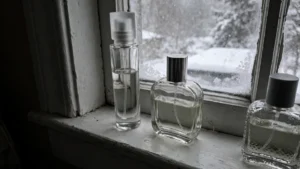
Driftwood is one of the strangest notes in perfumery, because it names a thing that cannot be put in a bottle. You cannot distil a piece of driftwood. You cannot press it, steam it, or extract an oil from it. What perfumers call driftwood is an idea: a piece of wood the sea has weathered, bleached, and smoothed, and the smell that idea carries is dry, pale, and a little salty.
That makes driftwood different from almost every other woody note. It is what happens to wood after years of salt water, sun, and wind.
This guide explains what driftwood means on a perfume label, how the accord is built, and how to tell a real driftwood character from a bottle that is only borrowing the word. It is written for anyone who has smelled a driftwood perfume and wondered what, exactly, they were smelling, and for anyone choosing their first bottle of the note.
Key takeaways
- Driftwood is a built accord, not an ingredient, made from cedar, vetiver, ambroxan, and mineral notes.
- The note smells dry, pale, and faintly salty, like sun-bleached wood on a beach, not like a forest.
- Grey driftwood leans cool and mineral, while golden driftwood leans warm and resinous.
- Driftwood is a quiet, unisex note that anchors a perfume without making it heavy or sweet.
- No driftwood perfume contains real driftwood, and the word on a label is a promise, not a guarantee.
What driftwood means in a perfume bottle
When a perfume lists driftwood, it is describing a character, not a material. The perfumer has combined woody molecules with mineral and salty ones until the result smells like wood that has spent years in the sea.
That is why two driftwood perfumes can smell so different from each other. One perfumer may lean on cedar and ambroxan for a pale, airy driftwood, while another leans on vetiver and amber for a warmer, golden one. Both are driftwood, and neither is wrong.
The nearest comparison is sea salt, which works the same way. Salt has no smell of its own, so a salt perfume is also an illusion, built from molecules that suggest the sea. Our roundup of sea salt perfumes explains that trick in detail, and driftwood uses the same sleight of hand, only with wood instead of water.
How a driftwood accord is built
A driftwood accord usually starts with a pale wood, most often cedar, because cedar is dry and clean without being sweet. Vetiver is added for depth and a faint earthiness, and ambroxan is added for the mineral, almost salty brightness that makes the wood read as weathered.

What is left out matters as much as what goes in. A good driftwood accord has no vanilla, no heavy amber, and no smoke, because sweetness and smoke would drag the wood back toward the forest. Light, airy notes such as green tea perfumes face the same problem, and for the same reason: when a note is built from suggestion rather than substance, the balance has to be exact.
9 things to know about driftwood perfume
Driftwood is not one wood, it is whatever the sea has kept
What it shows: A piece of driftwood on a beach might be oak, pine, cedar, or teak, and no one can tell by looking. The sea strips away the identity of the wood and leaves only the weathering, so the perfume note does the same thing, borrowing the weathered character rather than any one timber.
What to consider: Because the note has no single source, there is no standard driftwood smell, and two perfumers can build very different versions. Best For: People who like a note with room to surprise them. Material: Cedar, vetiver, ambroxan, mineral notes. Price Range: Around £100 to £300 depending on the house (approximate). Standout Feature: The only woody note defined by a process, not a tree.
No bottle of driftwood oil exists, the note is built, not harvested
What it shows: There is no essential oil of driftwood, no absolute, and no distillate. Every driftwood perfume is a construction, assembled from woody and mineral molecules until the result suggests weathered timber, and the perfumer’s skill is the only ingredient that matters.
What to consider: Because the note is built, quality varies more than with natural ingredients, and a low price usually means a simpler, thinner accord. Best For: Anyone who wants to understand what they are actually buying. Material: Cedar, vetiver, ambroxan, musk. Price Range: Around £100 to £300 depending on the house (approximate). Standout Feature: A note that exists only in the perfumer’s imagination.
Grey driftwood and golden driftwood are two different smells
What it shows: Wood that has bleached grey in the sun smells cool, mineral, and a little salty, while wood that has kept a golden tone smells warmer, softer, and faintly resinous. Perfumers use the same split, building a grey driftwood from cedar and ambroxan and a golden one from vetiver, amber, and warm woods.
What to consider: A grey driftwood can feel sharp in a warm room, and a golden one can feel heavy in high heat, so the version matters as much as the note. Best For: People who want to choose between the cool and warm sides of the note. Material: Cedar and ambroxan for grey, vetiver and amber for golden. Price Range: Around £100 to £300 depending on the house (approximate). Standout Feature: One word, two opposite characters.
The salt, not the timber, is what makes driftwood smell like driftwood
What it shows: Take the salt and the mineral edge out of a driftwood accord and what is left is ordinary cedarwood. The salt is not a garnish, it is the defining feature, and it is what separates driftwood from every other woody note on the shelf.
What to consider: Perfumes that call themselves driftwood but smell only of wood are usually cedarwood with a marine label, and they are the most common disappointment in the category. Best For: Anyone learning to tell real driftwood from a borrowed name. Material: Sea salt, ambroxan, cedar. Price Range: Around £100 to £300 depending on the house (approximate). Standout Feature: The mineral edge is the whole note.
Driftwood anchors a perfume without making it heavy
What it shows: Most base notes add weight. Amber adds warmth, oud adds darkness, and vanilla adds sweetness. Driftwood adds structure without adding any of those things, so a perfume can last for hours and still feel light, which is rare among woody notes.
What to consider: That lightness can read as thinness, especially in the first minutes, and people who expect a woody perfume to feel rich may find driftwood underwhelming at first. Best For: People who want longevity without a heavy dry-down. Material: Cedar, vetiver, ambroxan. Price Range: Around £100 to £300 depending on the house (approximate). Standout Feature: The lightest anchor in woody perfumery.
On skin it turns warmer and softer than it smells on paper
What it shows: A driftwood perfume on a blotter can smell sharp, thin, and almost cold. On skin, the same perfume warms up within an hour, the mineral edge softens, and the wood turns gentle, because body heat rounds off the sharpest molecules first.
What to consider: Judging driftwood on paper is the most common mistake people make with the note, and it leads to a lot of good perfumes being dismissed in the shop. Best For: Anyone who has tried driftwood once and thought it was too sharp. Material: Cedar, vetiver, ambroxan, musk. Price Range: Around £100 to £300 depending on the house (approximate). Standout Feature: The note that improves the most between paper and skin.
Driftwood and sand are not the same accord
What it shows: Sand accords are built from warm, powdery molecules and smell like a beach in the afternoon, soft and golden. Driftwood accords are built from pale wood and mineral notes and smell like the same beach in the early morning, cool and dry, and the two should not be confused.
What to consider: Perfumes that blend the two can be lovely, but a perfume that calls itself driftwood and smells of warm sand has missed the note. Best For: People who want to tell beach scents apart. Material: Cedar and ambroxan for driftwood, powdery musks for sand. Price Range: Around £100 to £300 depending on the house (approximate). Standout Feature: The cool half of the beach, not the warm half.
It is one of the few woody notes that stays comfortable in summer
What it shows: Most woody notes turn heavy in heat. Sandalwood gets creamy, cedar gets sharp, and oud gets dense. Driftwood stays pale and dry, because the mineral edge keeps it feeling fresh, and the lack of sweetness means it never turns cloying.
What to consider: Even driftwood has a limit, and on the hottest days the lightest, saltiest driftwood perfumes are the ones that hold up, while the warmer, amber-leaning ones can still feel heavy. Best For: People who love woody perfumes but give them up in summer. Material: Cedar, ambroxan, sea salt. Price Range: Around £100 to £300 depending on the house (approximate). Standout Feature: A woody note that does not melt in the heat.
Driftwood gets mistaken for cedarwood, and the mineral edge is the giveaway
What it shows: Cedarwood and driftwood share the same pale, dry woodiness, and on a first sniff they can be hard to tell apart. The difference is the mineral edge. Driftwood has a faint salty brightness that cedarwood does not, and once you have smelled it, the two are easy to separate.
What to consider: A lot of perfumes labelled driftwood are really cedarwood, and the only way to tell is to smell for that mineral note in the first hour. Best For: Anyone who wants to stop being fooled by a label. Material: Cedar for both, ambroxan and salt for driftwood only. Price Range: Around £100 to £300 depending on the house (approximate). Standout Feature: One mineral edge, and the whole note changes.
Who driftwood suits, and who it does not
Driftwood suits people who like clean, quiet scents. It is a good note for anyone who finds most woody perfumes too warm or too sweet, and for anyone who likes marine scents but wants something with more structure than a salt spray. It is also a good note for warm rooms, because the dry wood never turns sweet or heavy as the day goes on. It is also one of the most genuinely unisex notes in perfumery, because it is dry and mineral rather than floral or leathery, and it sits easily on any skin.
It does not suit people who want a perfume to announce itself. Driftwood is a close, personal scent, and it will not fill a room or leave a trail down a corridor. Like a white tea perfume, it is a quiet note, and if you like your perfume loud, you will find driftwood polite to the point of being shy. It also does not suit people who dislike mineral or salty scents, because the salt is not optional, it is the note.
The best way to find out is to wear one for a full day.
The caveats that matter
Driftwood is a subtle note, and subtle notes are easy to misjudge. On paper it can smell thin, in heat it can smell sharp, and in a crowded shop it can disappear entirely next to louder perfumes.
| Detail | What is known |
|---|---|
| What it is | A built accord of cedar, vetiver, ambroxan, and mineral notes, not an oil |
| What it smells like | Dry, pale, faintly salty wood, like sun-bleached timber on a beach |
| Where it sits | Usually in the base, where it anchors the perfume without adding weight |
| Grey versus golden | Grey leans cool and mineral, golden leans warm and resinous |
| Closest cousins | Cedarwood, sandalwood, and vetiver, all without the mineral edge |
| Longevity | Usually 4 to 6 hours, longer in eau de parfum strength |
| Who should test first | People who dislike mineral or salty scents should test on skin first |
| What it does not do | It does not smell smoky, sweet, or like a forest floor |
If you are sensitive to woody or mineral scents, or you have reacted to a woody perfume before, test a driftwood perfume on one wrist first and wait a day before wearing it properly. A simple skin test avoids a full day of a scent that does not suit you.
Checklist: buying a driftwood perfume honestly
Use these checks before you buy, and again after a week of wear.
- Check the note list: driftwood should be listed, or the wood should smell weathered, not freshly cut.
- Smell for the salt: a real driftwood accord has a mineral or salty edge in the first hour.
- Test on skin, not paper, and judge the dry-down after an hour, not the opening.
- Choose grey or golden: cedar and marine notes mean grey, vetiver and amber mean golden.
- Start with two sprays: driftwood is quiet, and more will not make it louder, only longer.
- Wear it in cool air first: the note is at its best in cool weather and by the sea.
Frequently asked questions
Why do so few perfumes list driftwood?
Because it is a hard accord to build well, and an easy word to misuse. A convincing driftwood accord needs the mineral edge in exact balance with the wood, and many houses would rather list cedarwood than risk a driftwood that smells like nothing. The note is rare because it is difficult, not because it is unpopular.
Can I layer driftwood over a citrus perfume?
Yes, and it works well. Spray the citrus first, let it settle for a minute, then add the driftwood over it. The citrus gives the opening a lift, and the driftwood gives the dry-down a pale, dry structure that a citrus alone cannot hold.
Why does driftwood perfume smell stronger in the evening?
Because the sharpest molecules fade first, and what is left is the warm, soft wood. In the morning the mineral edge is at its brightest, and by the evening the wood has taken over, so the perfume smells rounder and more present even though it is actually fading.
Does driftwood perfume work as a signature scent?
It can, if you like quiet scents. Driftwood is clean, dry, and hard to tire of, which are the qualities a signature scent needs, but it is also subtle, so it will not announce you in a room. If your idea of a signature is a scent people notice, driftwood is the wrong choice. If it is a scent you never tire of, it is a good one.
Does driftwood perfume age well in the bottle?
Reasonably well, because the accord is built from stable woody and mineral molecules rather than fragile citrus or floral ones. Keep it cool and dark, away from heat and light, and it should stay true for two to three years.
Which driftwood perfume is the easiest first buy?
Maison Margiela Replica Sailing Day, because it is the softest and most forgiving driftwood on the market, and it works in almost any setting. If you want the real note rather than the gentle version, Penhaligon’s Blasted Heath is the next step, and it is the most literal driftwood you can buy.
The bottom line
Driftwood is a note built from an idea rather than an ingredient, and that is what makes it worth understanding. It smells like wood the sea has kept, dry and pale and faintly salty, and it gives a perfume structure without weight, sweetness, or smoke. The best driftwood perfumes are the ones where you can smell the weathering, and the worst are the ones where the word is doing all the work.
Test it on skin, give it an hour, and judge it on the dry-down. If the pale, dry wood is still there when the salt has softened, you have found a real driftwood perfume, and you will know the note the next time you smell it, in any bottle, at any price.