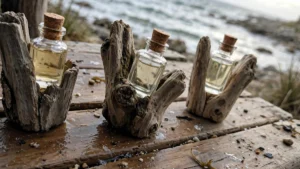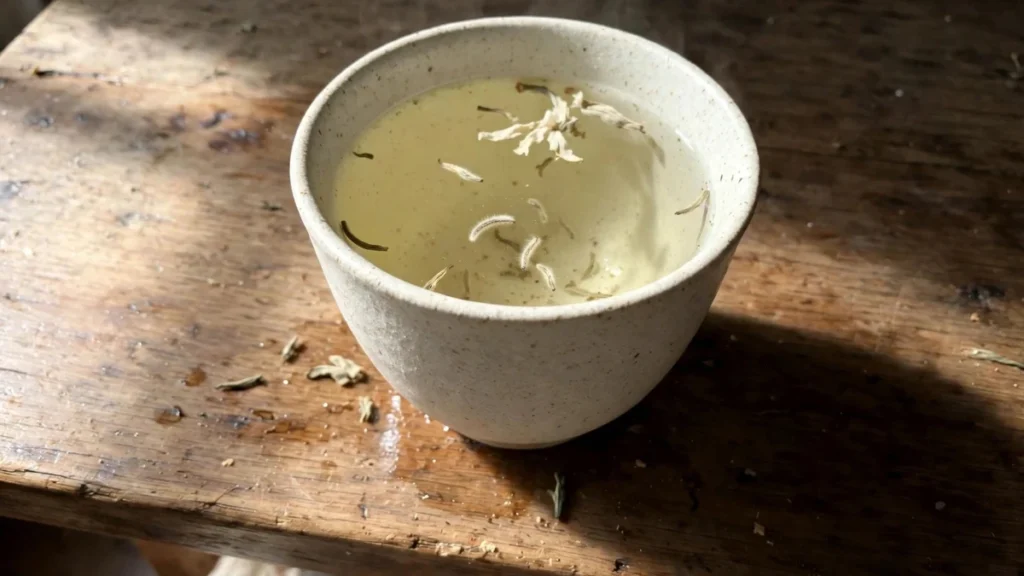
White tea perfume is the hardest tea note to describe, because there is so little of it to hold onto. A black tea perfume announces itself with malt and warmth. A green tea perfume arrives with a fresh, leafy snap. A white tea perfume does neither. It drifts in quietly, smells like clean air and pale flowers, and is gone before you have quite decided what you thought of it.
White tea is the least processed of all teas. It is made from the youngest buds of the tea plant, picked while they are still covered in fine silver hairs, and dried with almost no oxidation at all. That minimal handling is what gives white tea its pale colour, its gentle flavour, and its very short list of aromas. There is no roasting, no rolling, and no fermentation to create the bold flavours that green and black tea have.
This guide explains what a white tea perfume really is, how the note is built, why it fades so fast, and how to tell a genuine white tea accord from a bottle that only borrows the name.
Key takeaways
- White tea is made from young buds picked before the leaf opens, with almost no oxidation, which is why the note is so pale and delicate.
- A white tea perfume is built from clean musk, aldehydes and pale florals, not from brewed tea, and it smells like clean linen and melon rind, not like a cup of tea.
- The note is the quietest of the three teas, and it fades first, usually within three to five hours.
- White tea pairs best with citrus and white florals, and it suits warm weather, offices and anyone who wants a scent that sits close to the skin.
- No white tea perfume will project across a room or smell like a strong cup of tea.
What white tea is, before it becomes a perfume
White tea begins as a bud, not a leaf. In the spring, pickers take the youngest, unopened buds of the tea plant, still covered in fine, silvery hairs, and dry them gently in the sun or in a low oven. There is no rolling to bruise the leaf, no withering to start oxidation, and no fermentation. The bud is simply picked and dried, and that is the whole process.
That minimal processing matters for perfume, because everything a tea note can be in a bottle comes from what the tea itself contains. Black tea has the malt and the warmth because its leaves were fully oxidised. Green tea has the fresh, leafy snap because its leaves were heated to stop oxidation partway. White tea has neither, because almost nothing was done to it. What it does have is a soft, hay-like sweetness, a faint melon quality, and a clean, almost linen-like freshness.
It is also worth knowing that real white tea is rare and expensive. The picking window is short, the yield is small, and the best grades, such as silver needle, are made only from buds, with no leaf at all.
How a white tea perfume is actually made
A white tea perfume does not contain brewed tea. It contains an accord, which is a small group of aroma materials chosen to suggest the tea, built the way a cook builds a flavour from separate ingredients. For white tea, that accord is usually made from clean white musks, which give the skin-like base, aldehydes, which add the airy lift, and pale florals such as white iris or orange blossom, which give the scent its soft shape.

The reason for building the note this way is simple. Real white tea extract is far too faint to carry a perfume on its own, and it does not survive well in alcohol. The accord is what lets the perfumer make the idea of white tea last for hours, even if the real tea would fade in minutes. It is how almost all tea perfumes are made, and the quality of the bottle depends on how well the accord is built.
What separates a good white tea accord from a poor one is restraint. A good one stays pale and airy, with the hay-like sweetness just noticeable and the florals kept soft. A poor one leans too hard on the musk, and the result smells like soap or fresh laundry, with no tea character at all.
9 facts about white tea perfume
White tea is picked before the leaf opens
What it shows: The bud is harvested while it is still closed and covered in fine silver hairs, which is why the best white tea is called silver needle. What to consider: That short picking window and small yield are why real white tea is scarce. Best For: Understanding why white tea perfumes are rare and why a good one is worth its price. Material: Young tea buds, dried with almost no oxidation. Price Range: Silver needle tea is among the most expensive teas. Standout Feature: The silver-haired bud is the whole story of white tea, and the reason the note is so pale.
The fuzz on the bud is the point
What it shows: The fine silver hairs on the bud, called trichomes, protect the young leaf and carry some of the tea’s most delicate aromas. What to consider: Those hairs are also why white tea looks silvery in the packet. Best For: Anyone who wants to know what makes white tea different from every other tea. Material: Silver needle buds, covered in fine pale hairs. Price Range: The bud-only grade costs far more than leaf grades. Standout Feature: The silver fuzz is the visible sign of a tea that was picked at its youngest and most delicate.
White tea smells like hay and melon, not like a cup of tea
What it shows: The aroma of white tea is dry and pale, with a hay-like sweetness, a faint melon rind quality, and a clean linen freshness, rather than a strong tea flavour. What to consider: If you buy expecting a brewed cup, you will be disappointed, because the note is far subtler than the drink. Best For: Setting expectations before you buy, so the lightness feels like a feature, not a flaw. Material: The tea accord, built from musk, aldehydes and pale florals. Price Range: The same across all price points, since the note is light by nature, not by budget. Standout Feature: The hay and melon quality separates a real white tea accord from a generic white musk.
White tea is the quietest of the three teas
What it shows: Compared with green tea, which is fresh and sharp, and black tea, which is warm and malty, white tea is the palest and most fleeting of the three. What to consider: That quietness is why white tea suits offices and warm weather. Best For: Anyone choosing between the three tea notes and wondering which fits their routine. Material: The least oxidised of the three teas, with the lightest aroma. Price Range: White tea perfumes are usually priced between green and black tea perfumes. Standout Feature: Its quietness is its identity, not its weakness.
The note is built from aldehydes and white musk, not from tea leaves
What it shows: A white tea accord is made from clean white musks for the base, aldehydes for the airy lift, and pale florals for shape, because real tea extract is too faint to carry a perfume. What to consider: A bottle that leans too hard on the musk will smell like soap. Best For: Judging a white tea perfume by its drydown, which is where the quality of the accord shows. Material: White musk, aldehydes, white iris, orange blossom, and a touch of citrus. Price Range: The same materials appear at every price. Standout Feature: The aldehydes are what give white tea its spacious, open-window feeling.
White tea fades first because the molecules are light
What it shows: The aroma molecules that make white tea smell pale and airy are small and light, so they evaporate quickly, which is why the note usually fades within three to five hours. What to consider: That short life is normal for the note. Best For: Planning your day around a white tea perfume, with a travel spray for the afternoon. Material: Light, volatile aroma molecules, with a musk base to hold them. Price Range: Even the most expensive white tea perfumes fade fast. Standout Feature: The short life is a property of the note itself, not a flaw in the bottle.
It pairs with neroli and orange blossom, not bergamot
What it shows: White tea sits most happily with soft white florals such as neroli and orange blossom, which support the pale note without overpowering it. What to consider: Bergamot can be too sharp for white tea, and dark or heavy notes will bury it entirely. Best For: Choosing a white tea perfume by its supporting notes, and for layering it with a floral scent. Material: Neroli, orange blossom, white iris, and soft citrus such as mandarin. Price Range: The pairing is the same at every price point. Standout Feature: The neroli and orange blossom pairing is the signature combination for white tea.
On a label, white tea can mean almost anything
What it shows: There is no rule about how much white tea character a perfume must have to use the name, so some bottles are genuine tea accords and others are white musk with a tea label. What to consider: The only reliable test is your nose: if the drydown smells faintly of hay and clean linen, the tea is real. Best For: Shopping with scepticism, and testing before you buy a full bottle. Material: Anything from a genuine white tea accord to plain white musk. Price Range: The name appears at every price, from body mists to niche eaux de parfum. Standout Feature: The label is a promise, not a guarantee, and the drydown is the only proof.
White tea is the most discreet tea note you can wear
What it shows: White tea sits close to the skin, never projects across a room, and smells clean and inoffensive, which makes it one of the safest scents for offices, weddings and close company. What to consider: That closeness suits people who wear perfume for themselves, not for attention. Best For: Work, daytime events, warm weather, and anyone who dislikes strong perfume. Material: A light tea accord over a clean musk base, with no heavy or dark notes. Price Range: Office-safe white teas exist at every price, from high-street mists to niche eaux de parfum. Standout Feature: Its discretion is its strength.
How white tea compares with green and black tea
The three teas are best understood as a scale of oxidation. White tea is barely oxidised at all, green tea is heated to stop oxidation partway, and black tea is fully oxidised. That single difference decides everything about how the perfumes smell. White tea is pale, dry and fleeting. Green tea is fresh, leafy and sharp. Black tea is warm, malty and long lasting.
In practice, the choice is often about the season and the setting. White tea is at its best in spring and summer, when its lightness feels refreshing rather than faint. Green tea works year-round, and is the best all-rounder of the three. Black tea is at its best in autumn and winter, when its warmth feels comforting rather than heavy. Our guide to what a green tea perfume is is a useful companion, since green tea is the closest sibling.
It also helps to try the three side by side. Spray white tea on one wrist, green tea on the other, and black tea on the back of your hand, then wait an hour. The white tea will be the faintest, the green tea the freshest, and the black tea the warmest.
The caveats that matter
White tea perfumes are honest about their limits, and it helps to know them before you buy. The note is light, so longevity is short. Most white tea perfumes last three to five hours, and the lighter ones fade in two. That is normal for the note, not a flaw in the bottle. Reapplying in the afternoon is part of wearing white tea, and a small travel spray makes it easy.
| Detail | What is known |
|---|---|
| What the note is | An accord suggesting young white tea buds, built from musk, aldehydes and pale florals |
| What it smells like | Clean linen, hay sweetness, melon rind, soft white flowers, very little tea flavour |
| How long it lasts | Usually three to five hours; lighter mists fade in two to three hours |
| Best season | Spring and summer, and warm climates year-round |
| Best setting | Offices, daytime events, close company, warm weather |
| What to avoid pairing | Heavy oud, dark amber, or strong leather, which bury the tea note |
| Who should try a sample first | Anyone who dislikes soapy or powdery scents |
| What it does not do | It does not smell like brewed tea |
The other caveat is the soapy trap. Some white tea perfumes lean heavily on white musk, and on some skin that reads as fresh laundry rather than tea. If a white tea perfume smells like soap on you, try it on the other wrist, wait an hour, and if it still reads as soap, the formula is not a good match for your skin. A neroli perfume is often a better fit for people who want the same pale freshness without the soap.
Checklist: buying a white tea perfume honestly
Use these checks before you buy, and again after a week of wear.
- Test on skin, not paper: white tea is so light that a paper strip tells you almost nothing about how it will smell on you.
- Wait an hour: the opening is often sharper than the drydown, and the tea accord only shows itself once the citrus settles.
- Check the drydown: if it smells like soap or nothing at all after two hours, the bottle is not right for you.
- Start small: buy the smallest bottle, or a travel size, since you will reapply and use it faster than a heavier perfume.
- Layer if you want more: the matching body lotion underneath will extend the wear.
- Save it for warm weather: white tea can feel too faint in cold air.
Frequently asked questions
What does a white tea perfume smell like?
It smells pale and airy, like clean linen, a faint sweetness of melon rind, and a soft white floral edge, with a dry, hay-like note underneath.
Is a white tea perfume long-lasting?
No, and that is normal for the note. Most last three to five hours, and lighter mists last two to three hours.
What is the difference between white tea and green tea perfume?
White tea is made from young buds with almost no oxidation, so it smells pale, dry and fleeting. Green tea is heated to stop oxidation partway, so it smells fresher and sharper, with a leafy, vegetal edge.
Can I wear white tea perfume in summer?
Yes, summer is where white tea is at its best. The lightness that makes it fade quickly in winter becomes a strength in heat, when heavier perfumes can feel overwhelming.
Does white tea perfume smell like actual tea?
Not really. It smells like a suggestion of tea, built from clean musk, aldehydes and pale florals, with a hay-like sweetness and a melon rind quality.
Is white tea perfume good for sensitive skin?
Often yes, because white tea perfumes are usually light and free of heavy or dark notes. Choose a fragrance-free or low-fragrance option if your skin is reactive, patch-test on your inner arm first, and avoid spraying directly on irritated skin. Most white tea perfumes are built on a pale floral base, so our guide to what a floral perfume is is a useful next read.
The bottom line
A white tea perfume is not a strong scent, and it is not trying to be one. It is a pale, airy suggestion of young tea buds, built from clean musk and pale florals, and it works best when you accept it on those terms. The right bottle is the one whose drydown still smells faintly of hay and clean linen after an hour, even if nobody across the room ever notices it.
Start with a small bottle, test it on skin, wait an hour, and judge it on the drydown, not the first spray. If it smells like soap, try another. If it smells like fresh air, you have found your white tea.