A thread earring is one of the simplest pieces of jewellery you can own, and one of the easiest to misunderstand. It has no stud, no hook, and no butterfly back. It is a fine chain, usually gold or silver, that threads straight through the piercing and hangs down on both sides, longer at the front, shorter at the back, held in place by nothing more than gravity and friction.
That simplicity is the whole point. A thread earring moves gently as you turn your head, it catches the light without shouting, and it suits a single piercing just as well as a stack of several.
Below are nine things worth knowing about thread earrings in 2027, from how they are made and how they stay in, to who they suit, how to care for them, and what to avoid.
Key takeaways
- A thread earring is a fine chain that passes through the piercing and hangs in two lengths, with no back or clasp.
- Most threaders are made from fine gold or silver chain, and the weight and length change how they sit and move.
- Threaders suit healed piercings only, and they need a gentle hand, because a fine chain tangles easily and can slip out unnoticed.
- They come plain, with charms, or with gemstone drops, and they stack well with studs and small hoops.
- No thread earring is right for a fresh piercing, and a cheap, stiff chain is more likely to irritate the ear than a fine, flexible one.
What a thread earring actually is
A thread earring, often called a threader, is a length of fine chain with a straight, stiffened end that you feed through the piercing, then pull through until the chain hangs in two lengths. The front length is usually longer and carries the decoration, a charm, a gemstone, or simply the chain itself. The back length is shorter and acts as a counterweight, keeping the earring in place.
The design comes from a simple idea: a chain is flexible, so it moves with you, and it is thin, so it passes through a standard piercing easily. The earliest threaders were plain gold chains, worn on their own. Modern versions add small charms, pearls, crystals and coloured stones to the front end, and some are made in two metals, but the mechanism has not changed. It is still a chain, pulled through a hole, held by its own weight.
The name causes most of the confusion. A threader is not a thread, and it is not sewn through the ear. The chain is metal, usually gold vermeil, solid gold or sterling silver, and it is stiffened at one end so it can be fed through the piercing without a needle. If you are choosing your first pair, our guide to the best threader earrings is a good place to start, because it shows the styles that work best for a first threader and the ones to save for later.
How thread earrings work and what to look for
Look first at the chain itself. A good threader chain is fine, flexible and smooth, with links that move freely and a stiffened tip that slides through the piercing without catching. Hold the chain in your hand and let it fall. It should drape in a soft line, not hold a kink or a bend. A stiff, cheap chain will feel wiry, it will not hang straight, and it is more likely to irritate the piercing.
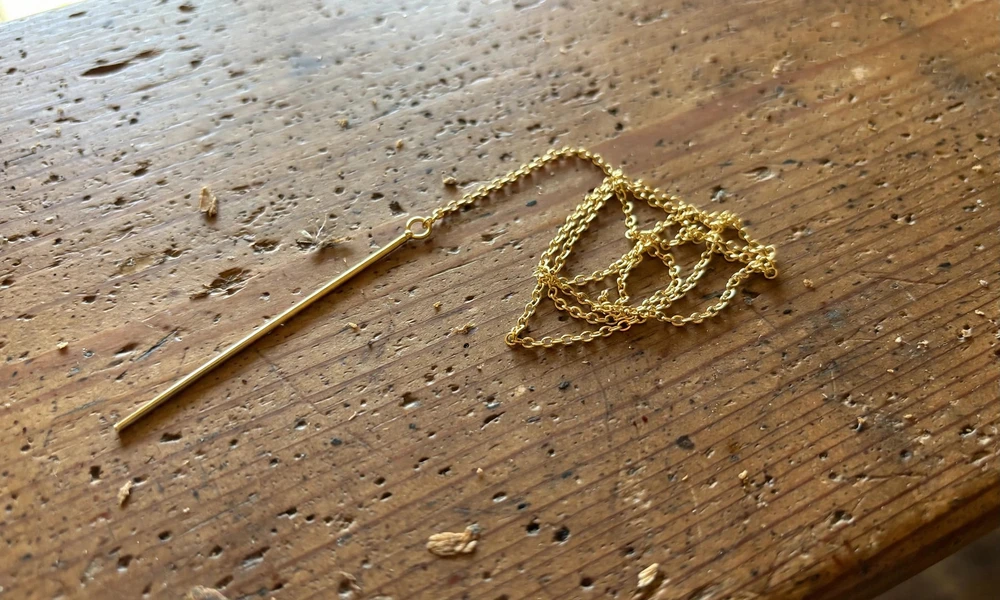
Look next at the length and the weight. Most threaders hang between five and ten centimetres at the front, with a shorter length at the back. A longer front is more dramatic and moves more, which suits an evening look. A shorter front is quieter and more practical, which suits everyday wear. Weight matters too. A threader should feel almost weightless, and if it pulls on the ear, it is too heavy for the chain, or the chain is too thick for the piercing.
Finally, look at the decoration. A plain chain is the most versatile threader, because it goes with everything and never dates. A charm or a gemstone drop adds personality, but it also adds weight and a point where the chain can catch on hair or clothing.
9 things to know about thread earrings
A thread earring is a chain that passes through the piercing
What it shows: The whole design is a single length of fine chain, fed through the piercing and left to hang, with no post, hook or back. What to consider: Because there is no fastening, a threader can slip out if the back length is too short, so check the balance before you leave the house. Best for: Anyone who wants a light, minimal earring with gentle movement. Material: Gold vermeil, solid gold, or sterling silver chain. Price range: Affordable to mid-range. Standout feature: A design with nothing to fasten and nothing to lose, except the earring itself.
The chain hangs in two lengths, front and back
What it shows: The front length is longer and carries the decoration, while the back length is shorter and acts as a counterweight that keeps the earring in place. What to consider: If the back length is too short, the earring will slide forward and out, so pull enough chain through to balance the two sides. Best for: Even, balanced wear that stays put through the day. Material: Fine chain in any metal. Price range: Affordable to mid-range. Standout feature: A balanced hang that moves gently without slipping.
Most threaders are made from fine gold or silver chain
What it shows: Gold vermeil, solid gold and sterling silver are the usual materials, chosen because they are smooth, flexible and kind to the ear. What to consider: Very cheap base-metal chains can feel stiff, tarnish quickly, and irritate sensitive ears, so the material matters more here than with a stud. Best for: Sensitive ears, everyday wear, and anyone who wants a threader to last. Material: Gold vermeil, solid gold, sterling silver. Price range: Affordable to premium, depending on the metal. Standout feature: A smooth, flexible chain that slides through the piercing without catching.
The pull-through design needs no back or clasp
What it shows: There is no butterfly back to lose, no screw to tighten, and no hook to bend, which makes a threader one of the simplest earrings to put on and take off. What to consider: That simplicity is also the risk, because there is nothing stopping the earring from sliding out if it is pulled, so be careful with scarves, hats and high collars. Best for: Anyone who loses earring backs, and anyone who wants a fuss-free earring. Material: Fine chain in any metal. Price range: Affordable to mid-range. Standout feature: Nothing to fasten, nothing to lose, nothing to break.
Threaders suit healed piercings, not fresh ones
What it shows: A threader should only be worn in a fully healed piercing, because the chain moves through the hole and can irritate tissue that is still healing. What to consider: If your piercing is less than a few months old, or if it is sore, swollen or weeping, wait, and wear a simple stud until it has fully settled. Best for: Healed lobe piercings, and second or third piercings that have fully settled. Material: Hypoallergenic metals for sensitive or recently healed ears. Price range: Affordable to mid-range. Standout feature: A gentle earring for a fully healed piercing, and nothing else.
They come in plain chains, charms and gemstone drops
What it shows: The simplest threader is a plain chain, while decorated versions add a charm, a pearl, a crystal or a small gemstone to the front end. What to consider: Decoration adds weight and a point where the chain can catch, so a decorated threader needs more care and a more secure balance than a plain one. Best for: Plain chains for everyday wear, decorated drops for evenings and occasions. Material: Gold or silver chain, with pearl, crystal or gemstone details. Price range: Affordable to premium. Standout feature: A plain chain that goes with everything, or a single charm that makes it personal.
Length and weight change how they sit and move
What it shows: A longer front length swings more and draws more attention, while a shorter front is quieter and more practical, and a heavier chain pulls more on the ear. What to consider: Long threaders catch on hair, scarves and collars, so save them for occasions when your hair is up or your neck is bare. Best for: Short threaders for work and everyday, long threaders for evenings. Material: Fine, lightweight chain in any metal. Price range: Affordable to mid-range. Standout feature: Movement that you can control simply by choosing the length.
Threaders need more care than studs
What it shows: A fine chain tangles easily, kinks if it is pulled, and needs to be stored hanging or laid flat, never tossed into a box with other jewellery. What to consider: Clean the chain gently with a soft cloth, keep it away from perfume and hairspray, and untangle it slowly, because pulling a kinked chain will only make the kink worse. Best for: Anyone willing to store jewellery carefully and clean it gently. Material: Fine chain in any metal. Price range: Affordable to mid-range. Standout feature: A delicate earring that rewards careful storage.
They work with one piercing or stacked with others
What it shows: A threader works on its own in a single lobe piercing, and it also stacks well, worn in a second or third piercing alongside a stud or a small hoop. What to consider: When stacking, keep the other earrings small and simple, because a threader needs room to move, and a crowded ear will tangle. Best for: Single piercings, and stacked ears where the threader is the longest piece. Material: Matching metals across the stack. Price range: Affordable to mid-range. Standout feature: A versatile earring that fits a minimal ear and a stacked ear alike.
Which thread earring is right for you
If this is your first threader, choose a plain, short gold or silver chain in the metal you wear most. It will go with everything, it will not tangle as easily as a decorated one, and it will teach you how a threader feels before you spend more on a fancier version. Wear it for a few days, check how it balances, and see whether you like the movement before you buy a second pair.
If you already own threaders, a decorated one is the next step. A pearl, a crystal or a small gemstone drop adds personality without changing how the earring works, and it suits evenings and occasions where a plain chain feels too quiet. Our guide to the best drop earrings covers similar ground, because a drop and a threader share the same job, they just do it in different ways.
If your ears are sensitive, choose a threader in solid gold, gold vermeil over sterling silver, or implant-grade titanium, and avoid cheap base-metal chains. The chain sits inside the piercing all day, so the material is in constant contact with the skin, and a poor metal will irritate faster here than it would in a stud that only touches the ear at the post.
The caveats that matter
The first caveat is the fresh piercing rule. A threader should never go into a piercing that is still healing. The chain moves through the hole every time you turn your head, and that movement can irritate healing tissue, slow the healing, and in the worst case cause the piercing to close unevenly. Wait until the piercing is fully healed, comfortable, and free of soreness, and then introduce a threader slowly, for a few hours at first.
| Detail | What is known |
|---|---|
| What it is | A fine chain fed through the piercing, hanging in two lengths, with no back or clasp |
| Best material | Gold vermeil, solid gold, or sterling silver chain, smooth and flexible |
| Who should wait | Anyone with a fresh, sore, or recently healed piercing |
| Best first choice | A plain, short chain in the metal you wear most |
| How it stays in | Gravity and friction, with the shorter back length acting as a counterweight |
| What to avoid | Cheap, stiff base-metal chains, and wearing a threader with a scarf or high collar |
| How to store it | Hanging, laid flat, or in its own pouch, never tossed in with other jewellery |
| What it does not do | It does not suit a fresh piercing, and it will not stay in if the balance is wrong |
The second caveat is tangling. A fine chain tangles, and a tangled threader is frustrating. Store it properly, keep it away from other chains, and clean it gently with a soft cloth rather than a harsh dip. If it does tangle, work slowly from the ends, and never pull hard, because a kinked chain is hard to straighten. For cleaning, the same gentle approach used for gold vermeil applies, as our guide to how to clean gold vermeil earrings explains.
Checklist: buying a thread earring honestly
Use these checks before you buy, and again after your first few wears.
- Check the piercing is fully healed, comfortable, and free of soreness before you try a threader.
- Check the chain in your hand: it should drape softly, feel smooth, and have a stiffened tip that slides easily.
- Check the length: a short front is best for a first threader, and a long front is best saved for evenings.
- Check the metal: gold vermeil, solid gold, sterling silver, or implant-grade titanium, not cheap base metal.
- Check the balance: pull enough chain through so the back length holds the front, and check it in a mirror before you leave.
- Check the storage: hang it, lay it flat, or keep it in its own pouch, and clean it gently with a soft cloth.
Frequently asked questions
Do thread earrings fall out easily?
They can, if the back length is too short or if the chain is pulled. Pull enough chain through to balance the two sides, and be careful with scarves, hats and high collars. A well-balanced threader will stay in through a normal day, but it will not survive a hard tug.
Can I wear thread earrings in a new piercing?
No. A threader should only go into a fully healed piercing, because the chain moves through the hole and can irritate tissue that is still healing. Wait until the piercing is comfortable and free of soreness, then try a threader for a few hours at first.
How long should a thread earring be?
Most threaders hang between five and ten centimetres at the front. A shorter front is quieter and more practical for everyday wear. A longer front is more dramatic and suits evenings, especially with hair up.
Are thread earrings comfortable?
Yes, if the chain is fine and light. A good threader feels almost weightless, and many people find it more comfortable than a heavy drop. If it pulls or feels wiry, the chain is too thick or too cheap, and a better-quality threader will feel different.
Can I wear thread earrings with other earrings?
Yes. A threader stacks well in a second or third piercing, worn alongside a small stud or huggie. Keep the other earrings small and simple, and let the threader be the longest piece, so the ear looks deliberate rather than crowded.
How do I stop a thread earring from tangling?
Store it hanging, laid flat, or in its own pouch, and never toss it into a box with other jewellery. Clean it gently with a soft cloth, keep it away from perfume and hairspray, and untangle it slowly from the ends if it does knot.
The bottom line
A thread earring is a fine chain that passes through the piercing and hangs in two lengths, held by nothing more than gravity and friction. It is light, it moves gently, and it suits a healed piercing in a way that few other earrings do. The best first threader is a plain, short chain in good metal, gold vermeil, solid gold or sterling silver, worn in a fully healed piercing and stored carefully.
Choose the length for the occasion, check the balance before you leave the house, and keep the chain clean and untangled. If you do that, a threader is one of the easiest earrings you will ever wear, and one of the most quietly elegant.