



Ask ten people what wisteria smells like and you will get ten different answers, and most of them will be partly right. Sweet, powdery, grape-like, spicy, musky, a little like lilac and a little like honey: the flower carries all of those facets at once, and which one you notice depends on the variety, the time of day, and your own nose.
The first thing to understand is that wisteria perfume never contains wisteria. The flower is a woody climbing vine in the legume family, and its scent molecules are too unstable and too low in yield to extract commercially. What perfumers call wisteria is an accord, a careful reconstruction built from other materials, and the quality of that reconstruction decides whether a perfume smells like a spring garden or like a vague, soapy floral.
This guide explains what a wisteria perfume actually is, how the note is made, how it behaves on skin, and how to tell a good one from a poor one.
Key takeaways
- A wisteria perfume contains no natural wisteria extract; the note is always a synthetic accord, rebuilt from materials such as solanone, heliotrope and lilac accords.
- Wisteria is a heart note, sweet, powdery and slightly spicy, with lilac, honey, grape and clove-like facets, and it usually appears between fresh top notes and a musky or woody base.
- The note is closest to lilac, but softer and greener, with less of lilac’s cold powder and more of a warm, honeyed sweetness.
- Wisteria perfumes last four to six hours on average, and they change more with skin chemistry than most florals, so testing on skin for a full afternoon is essential.
- No wisteria perfume smells exactly like the living flower, and a perfume that lists wisteria may still be built around violet, lilac or jasmine instead.
What wisteria is and where the scent comes from
Wisteria is a genus of woody climbing vines, native to East Asia and North America, in the legume family. The most fragrant species are Chinese wisteria, Wisteria sinensis, and Japanese wisteria, Wisteria floribunda, along with the less common Wisteria brachybotrys and the American Wisteria frutescens. The name comes from the Greek word for sweet, which describes the smell as much as the flower.
The scent itself is a small chemical puzzle. The most important odorant is usually identified as phenylacetonitrile, a close relative of the bitter-almond molecule benzaldehyde, with a more pronounced spicy edge and a distinct floral character. Around it sit eugenol, the clove-like molecule, methyl anthranilate, which gives the grape-like facet, and solanone, a green, fruity, slightly balsamic molecule also found in tobacco leaves and currant buds.
That chemistry is also the reason the note cannot be extracted. The molecules are volatile and unstable, the flowers give up almost no oil, and the scent changes as the flower ages, starting grape-like, turning sweet after a few hours, and ending musky after a few days.
How the wisteria note is made
A wisteria accord is built the way a painter mixes a colour: no single material gives you wisteria, but several together suggest it. Solanone provides the green, fruity, slightly balsamic backbone. Heliotrope and violet materials provide the powder. A lilac accord provides the soft floral sweetness. A touch of eugenol adds the spicy, clove-like edge, and methyl anthranilate adds the grape facet. Jasmine or honeysuckle can add warmth, and a soft musk in the base gives the whole thing staying power. Our guide to what a lilac perfume is covers a close relative, because lilac is built the same way, from the same kind of reconstruction, and the two notes share materials and a powdery character.
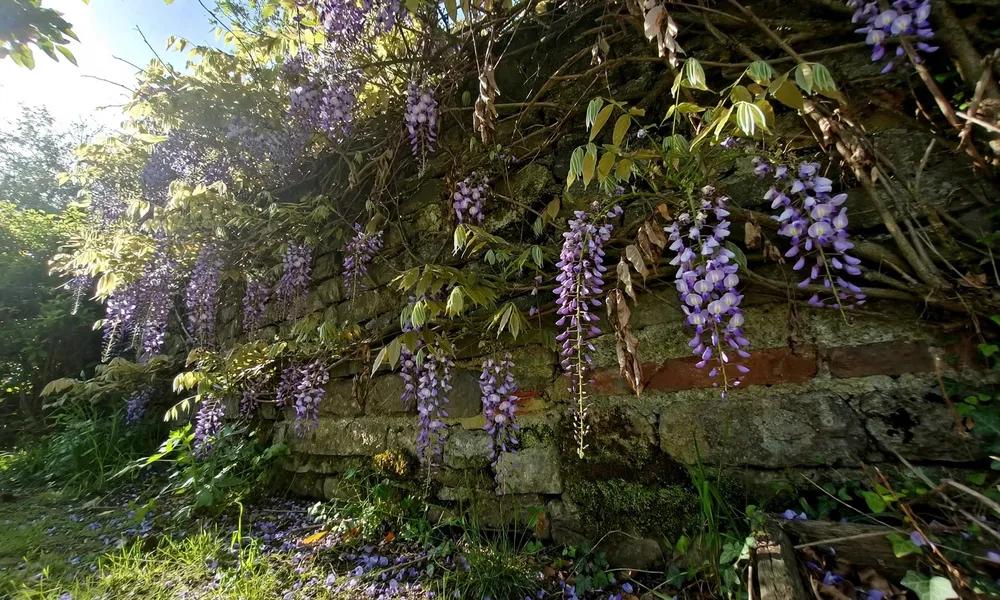
The typical concentration of a wisteria accord in a finished fragrance is low, around half a percent to two percent of the formula. That sounds small, but floral accords are potent, and too much of the powdery material turns a perfume soapy, while too much of the green material turns it sharp. The perfumer’s job is to keep the accord in balance with everything around it, so the wisteria reads clearly without overwhelming the composition.
There is also a historical wrinkle. Some of the materials once used to build wisteria accords, including certain aldehydes and musks, are now restricted or used in much smaller amounts than they were twenty years ago. That is one reason an older wisteria perfume can smell different from a modern one, and why a discontinued classic such as Crabtree & Evelyn Wisteria is remembered as powderier and more soapy than anything made today.
9 facts about wisteria perfume
Wisteria has no natural extract
What it shows: Every wisteria perfume is an accord, because the flower yields almost no oil and its scent molecules are unstable. The note is always a reconstruction, and the quality of that reconstruction is the whole difference between a good wisteria perfume and a poor one.
What to consider: Do not pay a premium for a claim of natural wisteria, because it does not exist in commercial perfumery. Best for: Anyone curious about how perfumery works, and anyone comparing wisteria perfumes fairly. Material: Synthetic accord built from solanone, heliotrope, lilac and musk materials. Price range: Approximately $27 to $210, depending on the house. Standout feature: The note is proof that a synthetic accord can smell more like a flower than an extract ever could.
It smells sweet, then spicy, then musky
What it shows: The living flower changes over time, starting grape-like, turning sweet after a few hours, and ending musky after a few days. A good wisteria accord follows the same arc on skin: a green, fruity opening, a sweet floral heart, and a soft, musky dry-down.
What to consider: Judge a wisteria perfume after three hours, not three minutes, because the musky phase is part of the scent. Best for: Patient wearers who like a perfume that evolves through the day. Material: Eau de parfum or eau de toilette, with a wisteria accord over musk. Price range: Approximately $40 to $200. Standout feature: The three-stage evolution, grape to sweet to musky, is unique among spring florals.
It is a heart note, not a top or a base
What it shows: Wisteria sits in the middle of a composition, bridging fresh top notes such as bergamot, water lily or green leaves and deeper base notes such as musk, cedar or patchouli. It is the note that connects the opening to the dry-down, and it is rarely the first thing you smell or the last.
What to consider: A perfume that lists wisteria as a top note is using it loosely, and the scent will behave like a heart note anyway. Best for: Anyone learning to read a note pyramid, because wisteria is a textbook heart note. Material: Heart-note accord, typically 0.5 to 2 percent of the formula. Price range: Approximately $40 to $210. Standout feature: Its bridging role is why wisteria works so well with both fresh and powdery partners.
Solanone does most of the work
What it shows: Solanone is the key molecule in the wisteria accord, giving it a green, fruity, slightly balsamic character. It is also found in tobacco leaves and currant buds, which is why wisteria has a faintly fruity, almost currant-like edge that lilac does not have.
What to consider: Too much solanone makes a perfume sharp and green, too little makes it vague and powdery. Best for: Fragrance enthusiasts who like knowing what they are smelling. Material: Solanone, CAS 19321-51-0, used in small amounts. Price range: Approximately $80 to $200 per kilogram of the raw material. Standout feature: One molecule, used in tiny amounts, carries the most recognisable part of the scent.
It is lilac’s softer, greener cousin
What it shows: Wisteria and lilac share a powdery, sweet floral character, and they share materials, including heliotrope-like powder and lilac accords. Wisteria is softer, greener and warmer than lilac, with a grape-like facet and a musky dry-down that lilac lacks. The violet perfume family is a useful comparison too, because violet adds the powder without the green, and wisteria sits between the two.
What to consider: If you love lilac but find it too cold or powdery, wisteria is the natural next step. Best for: Lilac lovers looking for a warmer, greener alternative. Material: Wisteria accord with lilac and heliotrope materials. Price range: Approximately $40 to $210. Standout feature: The lilac resemblance is real, but the green and grape facets make it distinct.
It fades faster than rose or jasmine
What it shows: Wisteria accords are built from light, volatile materials, so they do not last as long as heavier florals. Four to six hours is typical for an eau de parfum, and two to three for a light cologne, and the note is usually gone by the evening unless the base is built from strong musks.
What to consider: Plan to reapply in the afternoon, and do not judge a wisteria perfume by its longevity alone. Best for: Daytime and spring wear, when a short-lived, fresh floral is appropriate. Material: Eau de parfum or cologne, with a light wisteria accord. Price range: Approximately $27 to $210. Standout feature: Its short life is part of its charm, like the flower’s brief blooming season.
The same name can smell very different across brands
What it shows: Because wisteria is an accord, every house balances it differently. One brand leans into powder and makes a soapy vintage floral. Another leans into green and grape and makes a fresh spring scent. A third leans into honey and makes something warm and sweet. All three can honestly call themselves wisteria.
What to consider: Never buy a wisteria perfume on the note list alone. Sample first, on skin, for a full afternoon. Best for: Shoppers who are willing to test before they commit. Material: Varies by house, from soliflore accords to supporting heart notes. Price range: Approximately $27 to $210. Standout feature: The variation across brands is wider for wisteria than for almost any other floral note.
It is often confused with lilac, violet and jasmine
What it shows: Wisteria shares facets with all three: lilac’s powder and sweetness, violet’s powdery coolness, and jasmine’s warm, honeyed floral character. In a blend, it can be hard to tell where one ends and another begins, and many perfumes that smell like wisteria are actually built on lilac or jasmine accords.
What to consider: If a perfume smells like wisteria but lists no wisteria, it may still be the closest match for your nose. Best for: Anyone exploring powdery florals as a family, rather than a single note. Material: Wisteria accord alongside lilac, violet or jasmine materials. Price range: Approximately $40 to $210. Standout feature: The confusion is a compliment: wisteria borrows the best parts of its neighbours.
It is a spring note, but it works year-round in the right form
What it shows: Wisteria blooms for only a few weeks each spring, and its fresh, floral character feels most natural then. But the warmer, muskier versions, especially those with woody or amber bases, work well in autumn and winter too, when a light floral would feel out of place.
What to consider: Choose the fresh, green versions for spring and summer, and the warm, powdery versions for cooler months. Best for: Year-round floral wearers who adjust by base, not by note. Material: Wisteria accord over musk, wood or amber bases. Price range: Approximately $40 to $210. Standout feature: The note’s seasonality is a habit, not a rule, and the base decides the season.
Wisteria vs lilac, violet and jasmine
Lilac is the closest comparison, and the one most people reach for first. Both are powdery, sweet and spring-like, but lilac is colder and sharper, with a more pronounced powder and a cleaner, almost soapy edge. Wisteria is warmer, greener and softer, with a grape-like facet and a musky dry-down that lilac does not have.
Violet is powdery in a different way: cooler, more delicate, and more obviously floral, with a green, leafy edge that comes from violet leaf. Wisteria’s powder is warmer and heavier, and its sweetness is more honeyed. Wisteria sits in the middle of this family: warmer than lilac, greener than violet, lighter than jasmine.
That middle position is why wisteria works so well in blends. It can soften a sharp lilac, warm a cool violet, or lighten a heavy jasmine, and it rarely dominates. The perfumes that do make it a star, such as Aerin Wisteria, are interesting precisely because they ask a supporting note to carry a whole composition, and they succeed by keeping everything else quiet. Our guide to what a floral perfume is explains how these families overlap, and why a note list is a guide rather than a map.
The caveats that matter
Wisteria perfume is a gentle category, and its limits are gentle too. The note does not project far, it does not last all day, and it can be overwhelmed by stronger notes in the same bottle. It is the nature of a reconstructed floral accord, and it is why sampling on skin matters more for wisteria than for most notes.
| Detail | What is known |
|---|---|
| What it is | A synthetic accord that reconstructs the scent of the wisteria flower |
| Natural extract | None commercially available; the flower yields almost no oil |
| Key molecule | Solanone, with phenylacetonitrile, eugenol and methyl anthranilate |
| Where it sits | Heart note, between fresh top notes and musky or woody bases |
| Typical longevity | Four to six hours in eau de parfum, two to three in a light cologne |
| Closest relatives | Lilac, violet and jasmine, all powdery or warm florals |
| How to test it | Spray on skin, wait at least an hour, and judge the dry-down |
| What it does not do | It does not smell identical to the living flower, and it does not project strongly |
If you have sensitive skin or a fragrance allergy, patch-test any new perfume on your inner arm before wearing it on your neck or chest, and stop using it if redness or itching appears.
Checklist: understanding wisteria perfume honestly
Use these checks before you buy, and again after a week of wear.
- Check the role: is wisteria the star, or a supporting note, and does that match what you want?
- Check the supporting notes: violet means powdery, honeysuckle means sweet, green notes mean fresh.
- Test on skin, not paper, and wait at least an hour before deciding.
- Check the dry-down: the powder and musk that arrive late decide whether you will like it.
- Compare it with lilac and violet, because the differences tell you what you actually like.
- Store it away from light and heat, and use it within a year or two, because light florals fade faster than heavy ones.
Frequently asked questions
What is a wisteria perfume?
A perfume built around a wisteria accord, a synthetic reconstruction of the flower’s scent.
What does wisteria smell like?
Sweet, powdery and slightly spicy, with lilac, honey and grape-like facets. It is usually a heart note, appearing after the fresh top notes fade and before the musky base settles in.
Why is there no natural wisteria oil?
The flower gives up almost no oil, and its scent molecules are unstable and change as the flower ages.
How is wisteria different from lilac?
Wisteria is softer, greener and warmer than lilac, with a grape-like facet and a musky dry-down. Lilac is colder, sharper and more powdery.
How long does a wisteria perfume last?
Four to six hours is typical for an eau de parfum, and two to three hours for a light cologne.
Is wisteria perfume good for sensitive skin?
Often yes, but patch-test first. The synthetic materials used to rebuild wisteria, including aldehydes and musks, can irritate sensitive skin.
The bottom line
A wisteria perfume is a perfumer’s portrait of a flower that cannot be bottled, and that is what makes it interesting. The note is sweet, powdery and slightly spicy, with lilac, honey and grape-like facets, and it works best as a heart note, bridging fresh tops and musky bases. The best wisteria perfumes, from Aerin Wisteria to Lanvin Éclat d’Arpège, succeed by keeping the accord in balance and letting the flower speak without shouting.
When you shop for one, remember that the name on the note list is a plan, not a promise. Sample on skin, wait for the dry-down, and choose the version whose powder, sweetness and musk feel right to you. The living flower blooms for only a few weeks a year. A good wisteria perfume lets you carry a little of that spring with you, long after the vines have finished flowering.


