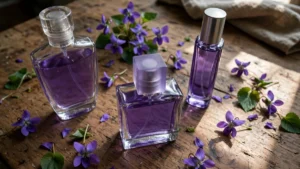
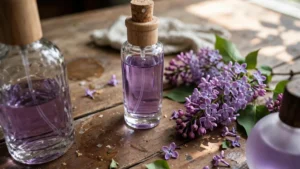
A violet perfume is a fragrance built around the scent of violets, but that simple description hides a small puzzle. There is no natural violet extract in perfumery. The flowers are too small, too delicate, and too low in oil to distil, so every violet scent you have ever smelled was built in a laboratory from aroma chemicals.
The puzzle deepens when you learn that violet means two different things. Violet flower is sweet, powdery, and soft, with a sugary warmth that feels like a spring garden. Violet leaf is green, watery, and crisp, with a cucumber-like freshness that has almost nothing in common with the flower. Knowing the difference is the key to understanding the note.
This guide explains what a violet perfume is, how the note is made, why it smells powdery, and how to choose one that suits you.
Key takeaways
- A violet perfume is built from aroma chemicals, mainly ionones, because real violets cannot be distilled into a usable extract.
- Violet flower is sweet and powdery, while violet leaf is green and sharp, and a perfume can be built on either one or both.
- Violet is usually a heart note, softening stronger florals and adding a powdery finish that makes a scent feel calm and clean.
- The note blooms slowly on skin, growing sweeter over the first hour, so give it twenty minutes before you judge it.
- No violet perfume smells the same on everyone, and the same note can read green on one person and powdery on another.
What a violet perfume actually is
A violet perfume is a fragrance in which violet is a leading or important note, and the violet in question is almost always a reconstruction. The violet flower contains very little aromatic oil, and the oil it does contain is fragile, so perfumers do not extract it the way they extract rose or lavender. Instead they use ionones, a family of aroma chemicals that smell like violets, and they build the flower around them with supporting notes such as iris, heliotrope, and raspberry.
The result is a note that smells like violet because it was designed to, not because it came from a violet.
What makes a violet perfume a violet perfume, then, is not the source of the note but its role. In most violet perfumes, the note sits in the heart of the scent, softening the stronger florals around it and adding a powdery finish.
How violet is made and what to look for
The violet note is built from ionones, mainly alpha-ionone and beta-ionone, which smell sweet, powdery, and floral, with a soft, woody undertone. Perfumers add other materials to shape the result. Iris and orris root deepen the powder. Heliotrope adds a sweet, almond-like warmth. Raspberry and blackcurrant add a fruity brightness. Violet leaf absolute, which is extracted from the leaves rather than the flowers, adds the green, watery freshness that balances the sweetness.

When you are choosing a violet perfume, look at the note list and ask which violet you are getting. A list that mentions violet leaf will smell greener and fresher. A list that mentions violet, violet flower, or ionone will smell sweeter and more powdery. A list that mentions both is usually the most balanced. A guide to floral perfumes is a useful companion here, because violet sits inside the floral family, and understanding where it fits helps you compare it with rose, iris, and lily.
Also look at the concentration. An eau de toilette will usually read greener and lighter, because the violet leaf comes forward at lower strength. An eau de parfum will usually read sweeter and more powdery, because the ionones have more room to bloom.
9 facts about violet perfume
Violet has no natural extract
What it shows: Real violets cannot be distilled into a usable oil, so every violet perfume is built from ionones and supporting notes. What to consider: This is normal in perfumery, not a shortcut, and the best violet scents are careful reconstructions. Best for: Anyone curious about how perfume is actually made. Material: Ionones, mainly alpha-ionone and beta-ionone. Price range: No price difference, because all violet perfumes are built this way. Standout feature: The ionone family, discovered in the late nineteenth century, is what made violet perfumes possible at all.
The absence of a natural extract is why violet perfumes vary so much.
It smells green first, then sweet
What it shows: Most violet perfumes open with a green, watery freshness and grow sweeter and more powdery over the first hour. What to consider: A first spray can mislead you, because the green fades and the powder arrives later. Best for: People who judge a perfume on its dry-down, not its opening. Material: Violet leaf absolute for the green opening, ionones for the sweet finish. Price range: No price difference, because the shift happens in every concentration. Standout feature: The slow bloom, which makes violet one of the most patient notes in perfumery.
Give a violet perfume twenty minutes before you decide anything.
It is a heart note, not a top or base
What it shows: Violet usually sits in the middle of a fragrance, softening the stronger florals around it and adding a powdery finish. What to consider: It rarely leads a scent, so a perfume that promises violet in the opening may disappoint. Best for: People who like scents that unfold slowly. Material: Ionones blended with iris, rose, or heliotrope in the heart. Price range: No price difference, because the role is the same at every price. Standout feature: The calming effect, which is why violet makes loud florals feel softer and more elegant.
It holds the scent together, and without it the whole thing would feel sharper.
It pairs best with iris, orris, and soft woods
What it shows: Iris and orris deepen the powder, while sandalwood and cedarwood add warmth and help the scent last. What to consider: Violet with very sweet notes can turn syrupy, and violet with very smoky notes can turn muddy. Best for: People building a small, balanced perfume collection. Material: Orris root, sandalwood, and cedarwood as supporting notes. Price range: No price difference, because the pairing is about composition, not cost. Standout feature: The iris and violet pairing, which is one of the most elegant combinations in perfumery.
If you already love iris, you will probably love violet, because the two notes share a powdery, formal character, and they are often found in the same bottles.
It is a spring note, but it works year-round
What it shows: Violet is associated with spring, when the flowers bloom, but green violet leaf suits summer and powdery violet suits autumn and winter. What to consider: The season matters less than the style, so choose by the violet, not the calendar. Best for: Anyone who wants one floral note that works in every season. Material: Violet leaf for warm weather, ionones and amber for cold weather. Price range: No price difference, because the same bottle can suit two seasons. Standout feature: The range, which makes violet more versatile than most floral notes.
The same note, worn two ways, can cover the whole year.
Concentration changes it more than most notes
What it shows: An eau de toilette usually reads greener and lighter, while an eau de parfum usually reads sweeter and more powdery. What to consider: The same perfume can smell like two different scents at two strengths, so test the version you will actually buy. Best for: People choosing between two concentrations of the same scent. Material: The same ionones, at different strengths. Price range: Eau de parfum is usually more expensive, but the difference is strength, not quality. Standout feature: The shift itself, which is stronger with violet than with most other notes.
Test the exact bottle, not just the name.
Violet and iris are cousins, not twins
What it shows: Violet and iris share a powdery, elegant character, but violet is sweeter and greener, while iris is drier and more formal. What to consider: A perfume that lists both will usually lean more powdery, so it can feel heavier than a violet-only scent. Best for: People who already love iris and want to try violet. Material: Orris root for iris, ionones for violet. Price range: No price difference, because the two notes cost about the same to build. Standout feature: The shared powder, which is why the two notes are so often paired.
Our peony perfume guide makes a useful comparison here, because peony is another floral that is often paired with violet, and seeing how the three notes differ helps you tell them apart on skin.
The same name can smell very different across brands
What it shows: Because violet is a reconstruction, each perfumer builds it differently, so two violet perfumes can smell almost unrelated. What to consider: Do not buy a violet perfume on the name alone, because the note is not standardised. Best for: People who like to compare scents side by side. Material: Different ionone blends, different supporting notes, different concentrations. Price range: No price difference, because the variation is about style, not cost. Standout feature: The range itself, which makes violet one of the most varied notes in perfumery.
All three are violet perfumes, and none of them is wrong.
It smells stronger on skin than on a paper strip
What it shows: Warm skin brings out the powdery sweetness of violet, while paper keeps it greener and thinner. What to consider: A paper strip can make a violet perfume seem weak or green, when on skin it would be soft and sweet. Best for: Anyone testing perfume in a shop. Material: Ionones, which bloom with warmth. Price range: No price difference, because the effect is the same at every price. Standout feature: The warmth, which is why violet is a note that rewards skin testing above all others.
That is the real violet.
Violet flower vs violet leaf: how to tell them apart
The simplest test is the first spray. If a perfume opens green, watery, and crisp, with a cucumber-like freshness, you are smelling violet leaf. If it opens sweet, soft, and powdery, with a sugary warmth, you are smelling violet flower. Most violet perfumes use both, so you will often get the green first and the powder later, which is the most balanced kind of violet scent.
The note list helps too. A list that mentions violet leaf, or that pairs violet with galbanum, cucumber, or green notes, will usually lean green. A list that mentions violet, violet flower, ionone, heliotrope, or raspberry will usually lean sweet and powdery. Neither is better, but knowing which one you prefer saves you from buying a green scent when you wanted a powdery one, or the other way round.
Your skin will also tell you. On cool skin, violet tends to stay green and fresh for longer. On warm skin, it turns sweeter and more powdery, sometimes within minutes. That is why the same bottle can smell like two different perfumes on two people, and why a sample worn for a full day tells you more than ten paper strips ever will. The clean, green side of violet has a lot in common with lily, and our lily perfume guide is a useful comparison if you are trying to tell the two apart.
The caveats that matter
Violet is a gentle note, but it is not a simple one. It can turn dusty if it is over-applied, especially in warm weather or in a small, heated room. Two sprays are usually enough, and three is the most you should need. It can also clash with very sweet or very smoky scents, so avoid layering it over a heavy vanilla or a smoky oud unless you have tested the combination first.
| Detail | What is known |
|---|---|
| Natural extract | None exists; violet is built from ionones and supporting notes |
| Violet flower vs violet leaf | Flower is sweet and powdery; leaf is green, watery, and crisp |
| Role in a scent | Usually a heart note, softening stronger florals and adding powder |
| How it changes on skin | Opens green, grows sweeter and more powdery over the first hour |
| Best concentration | Eau de toilette reads greener; eau de parfum reads sweeter and more powdery |
| What pairs well | Iris, orris, rose, amber, sandalwood, raspberry, and cedarwood |
| What to avoid pairing | Very sweet vanilla or heavy smoke, which can turn violet dusty or muddy |
| What it does not do | It does not project loudly, and it will not smell the same on every person |
If you are sensitive to powdery scents, or if you have reacted to floral perfumes before, patch-test a violet perfume on your inner arm before wearing it on your neck or chest. The note itself is not known to be a common irritant, but a powdery scent that sits close to the nose all day can feel overwhelming if you are not used to it.
Checklist: wearing a violet perfume honestly
Use these checks before you buy, and again after a full day of wearing a sample.
- Check which violet it is: leaf for green and fresh, flower for sweet and powdery, both for the most balanced scent.
- Check the note list: iris and amber deepen it, fruit and citrus brighten it, woods warm it.
- Spray on skin, not just paper, and wait twenty minutes before you decide anything.
- Wear a sample for a full day, in the weather you will actually wear it in.
- Start with two sprays, because violet turns dusty fast when over-applied.
- Buy the smallest bottle first, and only go larger once you know it suits your skin.
Frequently asked questions
What is a violet perfume?
A violet perfume is a fragrance built around the scent of violets, usually violet flower, violet leaf, or both. Because real violets cannot be distilled, the note is built from ionones, a family of aroma chemicals that smell like violets, with supporting notes such as iris, heliotrope, and raspberry.
Why is there no natural violet extract?
Violet flowers are very small and contain very little aromatic oil, and the oil is fragile. Distilling them would be impractical and would not produce a usable extract, so perfumers have built violet from ionones since the late nineteenth century, and the reconstruction is the standard, not a shortcut.
Is violet perfume the same as iris perfume?
No, though they are often paired and share a powdery character. Violet is sweeter and greener, with a soft, sugary warmth. Iris is drier, more formal, and more powdery in a woody way. A perfume that lists both will usually lean more powdery than a violet-only scent.
Can men wear violet perfume?
Yes. Violet leaf is a common note in men’s and shared fragrances, because it is green and woody rather than sweet. The powdery, floral side of violet is less common in men’s scents, but nothing about the note itself belongs to one gender, and several violet perfumes are worn by everyone.
Does violet perfume last long?
Usually, yes, for a gentle note. Violet tends to bloom slowly and stay on skin for six to eight hours, especially in an eau de parfum. Green violet leaf scents fade a little faster, while powdery violet flower scents last longer, because the powder clings to skin and fabric.
Why does my violet perfume smell dusty?
It is probably over-applied, or worn in warm weather, or paired with a very sweet scent. Violet turns dusty when there is too much of it, or when heat pushes the powder forward. Try one spray less, wear it in cooler weather, and avoid layering it over heavy vanilla.
The bottom line
A violet perfume is a reconstruction, not an extract, and that is what makes it interesting. The note is built from ionones, shaped by iris, heliotrope, and fruit, and split between a sweet powdery flower and a green crisp leaf. Knowing which violet you are smelling, and giving it twenty minutes on skin, is the difference between a bottle you love and one that confuses you.
Start with the violet you like, green or powdery, test it on skin for a full day, and judge it on how it smells in the last hours. Violet is a slow, patient note, and the perfumes that reward patience are the ones worth keeping.