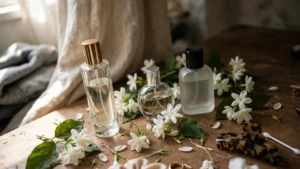
A woody perfume is the quiet confidence of the fragrance world. It does not shout with citrus or bloom with flowers. It smells like warm timber, dry earth, polished wood and skin, and it tends to last longer than almost any other family. The problem is that “woody” is used so loosely that it tells you very little on its own. A woody perfume can be dry and crisp like cedar, creamy and soft like sandalwood, green and earthy like vetiver, or dark and smoky like oud.
That is why this guide explains the family from the inside, rather than just listing bottles. Once you know which wood is doing the work, and whether it is dry, creamy or smoky, you can tell in one spray whether a woody perfume will suit you. A sandalwood-led scent can be the easiest daily wear you own, while an oud-led scent can be far too much for a warm office. Price is a poor guide on its own. Some of the most wearable woody perfumes are mid-priced, and some of the most expensive are the hardest to wear every day.
Below are nine things worth knowing about woody perfumes in 2027, from the three woods that matter most to how to test one before you buy it.
Key takeaways
- A woody perfume is built around woods such as sandalwood, cedarwood, vetiver and oud, and the dominant wood decides whether it smells dry, creamy or smoky.
- Sandalwood is creamy and soft, cedarwood is dry and crisp, vetiver is green and earthy, and oud is dark, rich and the most intense of the four.
- Woody perfumes usually last six to ten hours, longer than most florals and citrus scents, because woods are heavy, slow-evaporating materials.
- Test a woody perfume on skin and give it at least two hours, because the opening is often the brightest part and the woods only show themselves in the dry-down.
- No woody perfume smells the same on everyone, and a woody that turns sharp, dusty or medicinal on your skin will not improve with more sprays.
What a woody perfume actually is
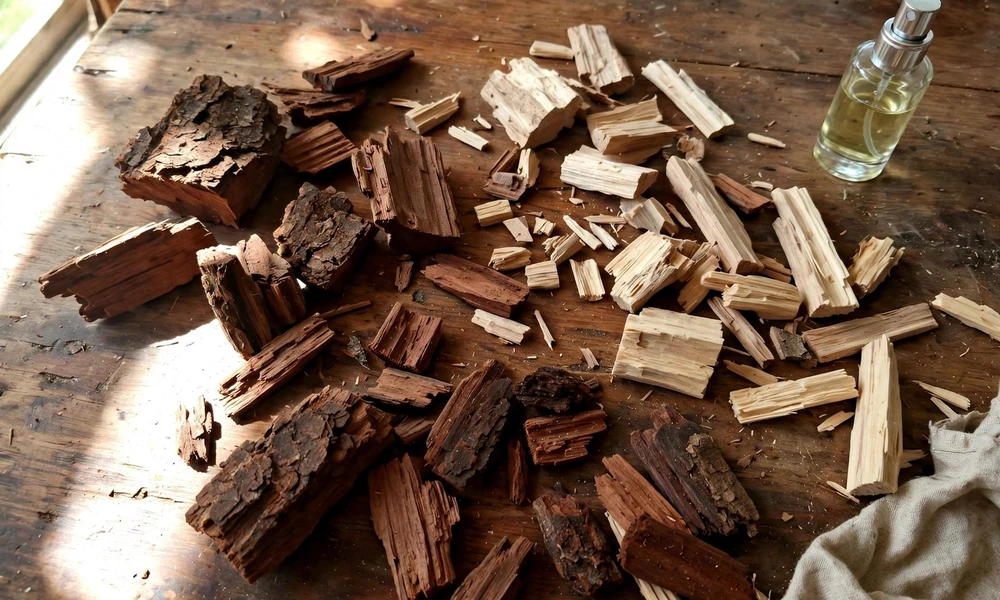
A woody perfume is a fragrance whose main character comes from wood-derived materials. That sounds simple, but the materials themselves are very different. Some come from real wood, some from roots and grasses, and some from synthetic molecules designed to smell like woods that are rare, protected or too expensive to use in large amounts. Sandalwood is the classic example. Real Mysore sandalwood is scarce and costly, so most modern perfumes use Australian sandalwood or a synthetic sandalwood material instead.
The family is usually divided into three moods. Dry woods, led by cedarwood, smell crisp, clean and slightly pencil-like, and they suit daytime and warm weather. Creamy woods, led by sandalwood, smell soft, milky and warm, and they suit almost any occasion. Smoky woods, led by oud and guaiac wood, smell dark, resinous and intense, and they suit evening and cool weather. Vetiver sits apart from all three, because it is a grass root that smells green, earthy and slightly smoky at once, and it can lean dry or creamy depending on the blend.
What matters most is that woods are base notes. They appear late in a perfume’s life and stay the longest, which is why a woody perfume can smell like citrus or spice for the first hour and like warm wood for the next six.
How to read a woody perfume and what to look for
Look first at the note list, and find the wood. If sandalwood is listed near the base and the opening is citrus or bergamot, expect a bright start and a soft, creamy finish. If cedarwood is listed with vetiver and grapefruit, expect a dry, clean scent that stays close to the skin. If oud is listed with rose, amber or saffron, expect a rich, warm scent with strong projection. The note list is not a promise, but it is a useful map.
Look next at concentration and strength. An eau de toilette with woody notes may last four to five hours and sit close to the skin, which is ideal for work and warm weather. An eau de parfum usually lasts seven to ten hours and projects further, which suits evening and special occasions. An extrait or parfum concentration can last twelve hours or more, but it is also the easiest to over-apply. One spray of a strong woody extrait is often enough. Our guide to how to make perfume last longer explains how to get the most from a woody base without drowning in it.
Finally, look at the dry-down on your own skin. Woods interact with skin chemistry more than most notes, because they sit on the skin for hours. A sandalwood that smells milky on one person can smell dusty on another. The only reliable test is to wear it for a full day before you buy it.
9 things to know about woody perfumes
A woody perfume is built around woods, not a single wood
What it shows: Almost every woody perfume is a blend of two or three wood materials, because a single wood on its own would smell flat and one-dimensional.
What to consider: Blends are harder to read from a note list, so do not assume a perfume is a cedar scent just because cedar is listed first. Best for: Anyone choosing their first woody perfume. Material: Sandalwood, cedarwood, vetiver, oud. Price range: Mid to luxury, around £70 to £250 for 50 ml. Standout feature: The blend is the perfume, and the balance between the woods decides its character.
Sandalwood, cedarwood and vetiver are the big three
What it shows: These three woods appear in most woody perfumes, and learning to tell them apart is the fastest way to understand the family.
What to consider: Sandalwood is creamy, cedarwood is dry, vetiver is green and earthy, and confusing them leads to buying the wrong mood entirely. Best for: Building a basic woody wardrobe. Material: Sandalwood, cedarwood, vetiver. Price range: Mid to premium, around £70 to £150 for 50 ml. Standout feature: Three woods, three moods, and a useful map for the whole family.
Woody families split into dry, creamy and smoky
What it shows: Dry woods smell crisp and clean, creamy woods smell soft and milky, and smoky woods smell dark and resinous, and each mood suits different weather and occasions.
What to consider: A smoky woody can feel overwhelming in summer, while a dry woody can feel thin in winter, so the mood matters as much as the brand. Best for: Matching a woody perfume to the season. Material: Cedarwood, sandalwood, guaiac wood. Price range: Mid to luxury, around £70 to £200 for 50 ml. Standout feature: The simplest way to sort any woody perfume you try.
Oud is a wood, but it is not the whole family
What it shows: Oud is the most famous woody material, but it is also the most intense, and many excellent woody perfumes contain no oud at all.
What to consider: Oud can smell medicinal, animalic or smoky, and it dominates any blend it joins, so a little goes a long way. Best for: Evening, winter and special occasions. Material: Oud, rose, amber, saffron. Price range: Luxury, around £150 to £300 for 50 ml. Standout feature: The most powerful wood in perfumery, and the one most often overused.
Our best oud perfumes guide is the right place to explore oud on its own terms, separate from the wider woody family.
Concentration changes how a woody wears
What it shows: The same woody blend smells lighter and closer in an eau de toilette, and richer and more projecting in an eau de parfum or extrait.
What to consider: A strong concentration is not automatically better, because woods build up on skin and can become heavy by the afternoon. Best for: Choosing between strengths of the same scent. Material: Woody base notes at different concentrations. Price range: Mid to luxury, rising with concentration. Standout feature: Concentration is the cheapest way to change a woody perfume without changing the scent.
Woods layer well with spices, amber and citrus
What it shows: Woody notes are team players, and they become more interesting when paired with cardamom, bergamot, amber or vanilla.
What to consider: Too many partners can muddy the woods, so the best woody perfumes keep the supporting cast small. Best for: Layering and building a fragrance wardrobe. Material: Sandalwood, cardamom, bergamot, amber. Price range: Mid to premium, around £70 to £150 for 50 ml. Standout feature: Woods make almost any other note smell more expensive.
Season and skin change how a woody reads
What it shows: Heat lifts the bright top notes and makes woods smell lighter, while cold air holds the scent close and makes the woods smell richer and deeper.
What to consider: Dry skin holds woody scents for less time than oily skin, and the same perfume can smell dry on one person and creamy on another. Best for: Choosing a woody perfume for your climate. Material: Cedarwood, sandalwood, vetiver. Price range: Mid to luxury, around £70 to £200 for 50 ml. Standout feature: The most climate-sensitive family in perfumery, and the most rewarding to get right.
A woody can be a signature scent, not just an evening one
What it shows: Woody perfumes are often sold as evening scents, but a soft sandalwood or a dry cedar can be worn every day, to work, and in any season.
What to consider: The key is strength and sweetness: a light, dry woody works daily, while a dark, sweet woody does not. Best for: Anyone looking for a daily signature scent. Material: Sandalwood, cedarwood, musk. Price range: Mid to premium, around £70 to £140 for 50 ml. Standout feature: Woody scents are the longest-lasting daily wear, and the least tiring over time.
Our guide to what a signature scent is explains how to tell whether a woody perfume is right for that role.
How to test a woody before buying
What it shows: Woody perfumes change more than most families as they wear, so a proper test takes a full day, not a minute at a counter.
What to consider: Testing on paper tells you almost nothing about a woody perfume, because paper does not warm the base notes the way skin does. Best for: Anyone about to spend on a woody perfume. Material: Woody base notes on skin. Price range: Any, because a bad test wastes money at every price. Standout feature: The most important fact in this guide, and the one that saves the most money.
How woody perfumes wear through the day
A woody perfume has three acts, and they are further apart than in any other family. The first hour belongs to the top notes, usually citrus, spice or a bright floral, and the woods are barely visible. The middle hours belong to the heart, where the woods begin to show, often joined by amber, iris or a soft floral. The last hours belong entirely to the base, where the woods are the whole story, warm, dry and close to the skin.
That long, slow change is the main reason woody perfumes last so well, and the main reason they disappoint people who buy on the first spray. Equally, a woody perfume that smells wonderful at first spray can become dusty or flat by the evening, once the supporting notes have gone and only the woods remain.
The practical lesson is simple. Do not judge a woody perfume until you have lived with it for a full day, and do not buy a second bottle of a woody perfume until you have finished the first.
The caveats that matter
Woody perfumes are generally well tolerated, but they cause a specific set of complaints. The most common is that a woody perfume smells dusty, dry or pencil-like on some skin, which usually comes from cedarwood and the synthetic woody materials rather than the wood itself. If that happens to you, try a sandalwood-led scent, which is usually softer. A second complaint is that a woody perfume smells medicinal or antiseptic, which usually comes from vetiver or oud at high strength, and is a sign to choose a lighter concentration or a different wood.
| Detail | What is known |
|---|---|
| Three main woods | Sandalwood is creamy, cedarwood is dry, vetiver is green and earthy |
| Three moods | Dry woods suit daytime, creamy woods suit any occasion, smoky woods suit evening |
| How long it lasts | Six to ten hours for a good eau de parfum, longer for an extrait |
| Best for warm weather | Dry cedarwood or vetiver, lighter concentrations, fewer sprays |
| Best for cool weather | Creamy sandalwood or smoky oud, richer concentrations |
| Who should test carefully | People sensitive to strong woods, and anyone who finds vetiver or oud medicinal |
| What to avoid | Buying on the first spray, testing only on paper, and over-spraying a strong extrait |
| What it does not do | It does not smell the same on everyone, and it does not stay bright all day |
If you are pregnant, breastfeeding, or sensitive to fragrance, check with your clinician before using a new perfume, especially a strong woody or oud scent, and patch-test on a small area first.
Checklist: choosing a woody perfume honestly
Use these checks before you buy, and again after a full day of wear.
- Check the dominant wood: is it dry cedarwood, creamy sandalwood, green vetiver or smoky oud?
- Check the mood: dry for daytime and summer, creamy for any occasion, smoky for evening and winter.
- Check the concentration: eau de toilette for work and warm weather, eau de parfum for evening, extrait only in small doses.
- Check the dry-down: wear it for a full day and judge the last three hours, not the first spray.
- Check your skin: if it turns dusty, sharp or medicinal on you, try another wood before giving up on the family.
- Check the sprays: start with one or two, because woody bases build up and last far longer than they seem to at first.
Frequently asked questions
What is a woody perfume?
It is a fragrance whose main character comes from wood-derived materials such as sandalwood, cedarwood, vetiver and oud. The dominant wood decides whether it smells dry, creamy or smoky, and the woods usually appear late and last the longest.
Are woody perfumes for men or women?
Both. Woody notes are among the most unisex in perfumery, and the same sandalwood or cedarwood base appears in perfumes marketed to men, women and everyone. Choose by the mood you like, not by the label on the bottle.
Do woody perfumes last longer than floral perfumes?
Usually yes.
Why does my woody perfume smell different in the evening?
Because the top notes have evaporated and only the base notes remain.
Can I wear a woody perfume in summer?
Yes, if you choose a dry woody such as cedarwood or vetiver, in a lighter concentration, and spray less. Save the smoky oud and heavy sandalwood scents for cooler weather.
What is the difference between woody and oud perfumes?
Oud is one wood within the woody family, and it is the darkest and most intense of them. A woody perfume may contain no oud at all, and an oud perfume is a woody perfume taken to its richest, smokiest extreme.
The bottom line
The best woody perfume in 2027 is not the most expensive or the most intense. It is the one whose dominant wood suits your skin, your climate and the occasions you actually have. For daytime and warm weather, a dry cedarwood or vetiver is the smarter choice. For evening and cool weather, a creamy sandalwood or a smoky oud will serve you better, and it will last longer too.
Learn the three main woods, test on skin for a full day, and judge the dry-down rather than the first spray. That is the honest way to find a woody perfume you will reach for again and again, rather than a beautiful bottle that slowly gathers dust.