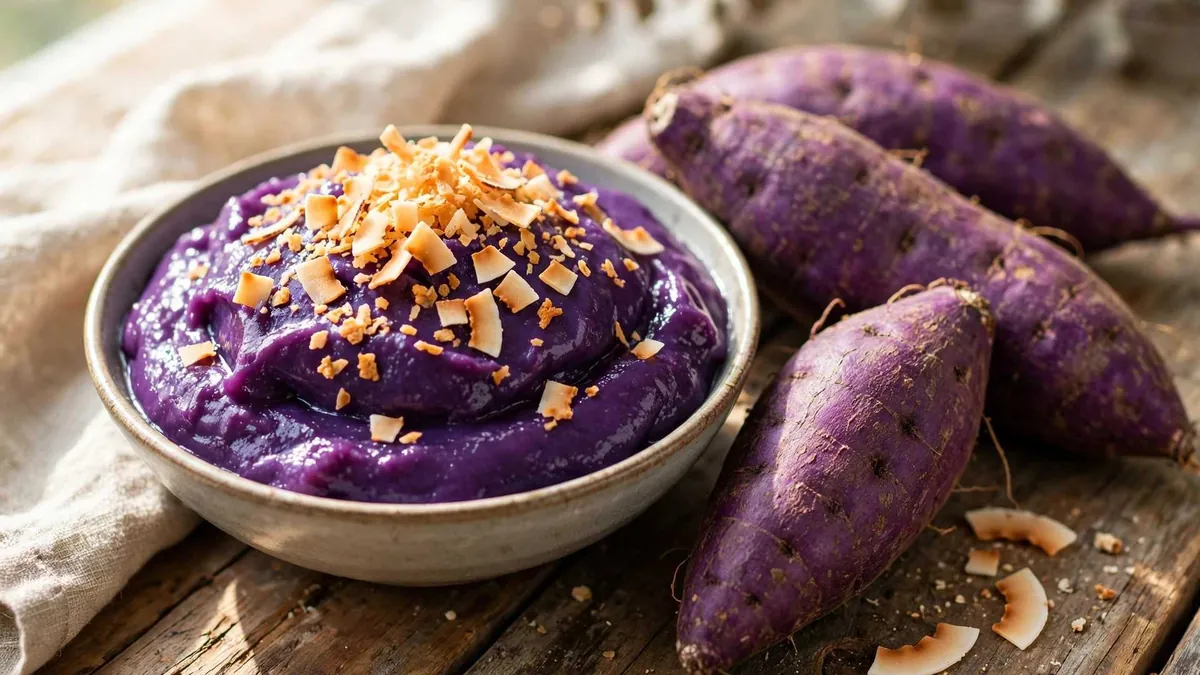

Ube is the vivid purple yam that has coloured desserts across the Philippines for generations and now turns up in bakeries, cafes and ice cream shops far beyond Southeast Asia. It is a starchy root vegetable with naturally deep violet flesh, and its sweet, earthy flavour has made it one of the most talked-about ingredients in modern baking.
So what exactly is ube, and how should you use it? It is a yam, not a potato, and it is most often cooked into a sweet jam called ube halaya, folded into cakes and ice cream, or spooned over shaved ice in halo-halo. This guide explains what ube is, what it tastes like, how it differs from taro and purple sweet potato, and how to buy, store and cook with it.
Key takeaways:
- Ube is a purple yam, Dioscorea alata, native to Southeast Asia and a staple of Filipino cooking.
- Its flavour is mild, sweet and earthy, with notes of vanilla and pistachio, and its colour is natural.
- Ube is not the same as taro or purple sweet potato, though the three are often confused.
- It is usually bought fresh, frozen and grated, or as a powder, extract or jam.
- The classic uses are ube halaya, halo-halo, cakes, ice cream and sweet breads.
What is ube?
Ube, pronounced oo-beh, is a variety of yam with deep purple flesh. Its botanical name is Dioscorea alata, and it is native to Southeast Asia, where it has been grown and eaten for a very long time. In the Philippines, where it is best known, ube is a familiar ingredient in everyday cooking and in celebration food, from family desserts to festival sweets.
The yam itself is long and rough-skinned, with bark-like brown skin and flesh ranging from pale lilac to a rich, almost ink-dark violet. The colour is natural, and it comes from the same family of pigments that colours blueberries, blackberries and red cabbage. When the yam is cooked and mashed, the colour deepens and becomes even more striking, which is a large part of its appeal in desserts.
What does ube taste like?
Ube tastes mild, sweet and earthy, with a flavour that is hard to pin down from description alone. The most common comparison is to vanilla with a nutty edge, and many people also pick up a hint of pistachio or white chocolate. It is gentler than chocolate and less sharp than fruit, which makes it easy to pair with cream, coconut, cheese and mild spices.
The texture matters as much as the flavour. Cooked ube is dense, smooth and starchy, and when it is mashed with coconut milk and sugar to make ube halaya, it becomes thick and spoonable, almost like a firm jam. In cakes it gives a soft, moist crumb and a delicate flavour that does not overpower the other ingredients.
Ube, taro and purple sweet potato: what is the difference?
Ube is often confused with taro and purple sweet potato, and the confusion is understandable: all three are starchy roots with purple flesh, and all three turn up in desserts. They are different plants, however, and they taste and behave differently in the kitchen. Knowing which one you have matters, because they cannot simply be swapped for one another.
Taro is paler and milder, with a nutty, almost floury flavour, and it is widely used across Asia and the Pacific in both sweet and savoury dishes. Purple sweet potato is a true sweet potato, sweeter and softer than ube, with a flavour closer to a regular sweet potato. Ube sits between the two in sweetness, with a richer colour and a more distinctive vanilla-like note than either.
| Root | Colour | Flavour | Best for |
|---|---|---|---|
| Ube | Deep violet | Sweet, earthy, vanilla-like | Halaya, cakes, ice cream, halo-halo |
| Taro | Pale lilac with flecks | Mild, nutty, floury | Bubble tea, puddings, savoury dishes |
| Purple sweet potato | Rich purple | Sweet, soft, potato-like | Roasting, mashing, pies, fries |
| Okinawan sweet potato | Deep purple | Sweet, creamy, mild | Baking, mash, chips, desserts |
Ube halaya and halo-halo

Ube halaya is the classic Filipino preparation, and it is the starting point for most ube desserts. Grated or mashed ube is cooked slowly with coconut milk, sugar and a little butter until it thickens into a smooth, glossy jam. It is served on its own, spread on bread, or used as a filling and topping, and a jar of it in the fridge is the basis for a dozen different desserts.
Halo-halo is the most famous dessert to feature ube, and it is a good way to understand how the flavour works. The name means mix-mix, and the dish is a tall glass of shaved ice layered with sweet beans, jellies, fruit, evaporated milk and a spoonful of ube halaya on top, usually with a scoop of ube ice cream. The ube adds colour, sweetness and a creamy richness that ties the many layers together.
Ube in baking and desserts
Ube has become a favourite of bakers because it does two jobs at once: it flavours a cake and colours it a striking violet without any artificial colouring. Ube layer cakes, chiffon cakes and cupcakes are now common in Filipino bakeries, and they have spread to bakeries well beyond the Philippines. The crumb stays soft and moist, and the flavour pairs naturally with cream cheese frosting, coconut cream and white chocolate.
Beyond cakes, ube works in a wide range of sweet baking. It flavours cookies, brownies, doughnuts, cinnamon rolls and sweet bread rolls, and it makes a vivid filling for pastries and steamed buns. The flavour is gentle enough to sit alongside chocolate, pandan and coconut, yet strong enough to carry a dessert on its own. Our guide to the best chocolate cake shows how a rich cake base works, and the same principles of a moist crumb and a balanced frosting apply to an ube cake.
When baking with ube, the form you choose affects the result. Fresh or frozen grated ube gives the most natural flavour and colour, but it needs cooking and mashing first. Ube powder is convenient and keeps well in the cupboard, and it gives a reliable colour, though the flavour is slightly more muted. Ube extract gives the strongest colour and a more perfumed flavour, and a little goes a long way. Many bakers use a combination, such as powder for flavour and a small amount of extract for colour.
Ube ice cream
Ube ice cream is one of the easiest ways to try ube, and it is how many people first meet the flavour. It is creamy and gently sweet, with the vanilla-like note of ube coming through clearly, and its violet colour makes it instantly recognisable in a freezer cabinet. It is sold by Filipino food brands and by specialist ice cream shops, and it is also easy to make at home with condensed milk, cream and ube halaya or powder.
How to buy and store ube
Fresh ube is sold in Asian grocery shops and Filipino food stores, usually in the root vegetable section, and sometimes in the frozen aisle as grated ube. Look for firm yams with unbroken skin and no soft spots, and choose smaller ones if you can — they are easier to peel and cook. Fresh ube keeps for a couple of weeks in a cool, dark place, much like other root vegetables.
Frozen grated ube is the most practical option for most home cooks, because it is already peeled and grated and can go straight into a pan. It is sold in bags or blocks in the freezer section of Asian supermarkets. Thaw it before cooking, and drain off any excess liquid. Ube powder and ube extract are sold alongside, and both keep for months in the cupboard, which makes them useful if you bake with ube often.
How to cook with ube at home
Cooking with ube at home is simpler than it looks, and ube halaya is the recipe to learn first. Peel and boil the yam until tender, then mash it smooth. Cook the mash gently with coconut milk, sugar and a knob of butter, stirring often, until it thickens into a glossy jam that holds its shape on a spoon.
Once you have halaya, the rest is easy. Spread it on toast, swirl it into porridge, layer it in a trifle, or use it as a filling for cakes and buns. For baking, add it to a sponge batter or a buttercream for colour and flavour, starting with a modest amount and tasting as you go. Our guide to the best buttercream frosting is a useful base for an ube buttercream, and our guide to gluten-free dessert recipes includes ideas that work well with ube’s naturally gluten-free starch.
A few practical points will save you trouble. Wear gloves when peeling raw ube, since the sap can stain hands and irritate skin. Cook ube thoroughly before eating, as raw yam is not pleasant to eat. Taste as you cook, because the sweetness of ube varies, and the amount of sugar you need will change with it. Start with less sugar than you think, since you can always add more.
Your ube checklist
Use this list before you buy, cook or bake with ube.
- Decide on your form: fresh yam, frozen grated ube, powder, extract or ready-made halaya.
- Buy from an Asian grocery or Filipino food store, and check the label before you buy.
- Remember that ube is not taro or purple sweet potato, and do not swap them without expecting a different result.
- Cook fresh ube thoroughly, and wear gloves when peeling it.
- Start with ube halaya, then use it in cakes, ice cream and halo-halo.
- Store fresh ube in a cool, dark place, and keep halaya sealed in the fridge.
Frequently asked questions about ube
Is ube a potato?
No, ube is a yam, not a potato. It belongs to the Dioscorea family, while potatoes and sweet potatoes belong to different plant families, and it is almost always used in sweet dishes.
Is ube the same as taro?
No, although the two are often confused. Taro is paler, milder and more floury, while ube is deeper purple and sweeter, with a vanilla-like flavour.
What does ube taste like?
Ube tastes mild, sweet and earthy, with notes of vanilla and pistachio, and its gentle flavour pairs well with cream, coconut and white chocolate.
Where can I buy ube?
Fresh and frozen ube is sold in Asian grocery shops and Filipino food stores, along with ube powder, extract and ready-made halaya. Frozen grated ube is the easiest option for most home cooks.
Do I need to peel ube before cooking?
Yes, peel it like any root vegetable, wearing gloves if you can, since the sap can stain your hands. Boil or steam it until tender, then mash it before using it in halaya or baking.
The bottom line on ube
Ube is a purple yam with a gentle, sweet flavour and a colour that needs no help from a bottle. It is a staple of Filipino cooking, the heart of ube halaya and halo-halo, and an ingredient now at home in bakeries and ice cream shops around the world. It is not taro, and it is not purple sweet potato, and once you have tasted the real thing, the difference is easy to remember.
The best way to understand ube is to try it. Pick up a jar of ube halaya, a tub of ube ice cream, or a bag of frozen grated ube, and start with something simple: halaya on toast or a plain ube sponge. That first taste is where every ube habit begins.