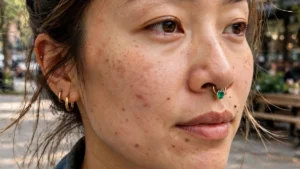
A turquoise septum ring is the opposite of a quiet piece of jewellery. Turquoise is a bright, blue-green stone with a colour that no metal can match, and set into a septum ring it sits right at the centre of the face, where it is impossible to miss. It has a relaxed, bohemian feel that suits summer, festivals, and anyone who likes their jewellery to have personality, but it also works as an everyday piece if the stone is small and the setting is simple.
The challenge is that turquoise is a softer stone than most gems used in septum rings, and it varies more than most stones too. Some turquoise is a clear sky blue, some is green-blue, and some is veined with dark lines of matrix that give it a completely different character. A ring that is the wrong size will sit badly no matter how beautiful the stone is.
Below are nine turquoise septum rings worth considering in 2027, from a classic silver ring to a tiny everyday piece and a bohemian design with matrix veining. Each one is described by what it is good at, what to watch for, and who it suits best, so you can choose with your face and your piercing in mind, not just a product photo.
Key takeaways
- Turquoise is a bright blue-green stone that adds colour and character to a septum ring, and it suits most skin tones because its blue is cool and clear.
- Clickers are the easiest septum style to open and close, while horseshoes and seamless rings suit people who prefer a simpler, lighter feel.
- Check the gauge and the inner diameter before you buy: a 16-gauge ring around 8 to 10 mm suits most healed septum piercings.
- Turquoise is softer than garnet or sapphire, so it needs a protective setting and gentle cleaning, and it should not be worn in a fresh piercing.
- No septum ring suits a fresh or irritated piercing, and a stone that looks pale in the shop will usually look paler against the skin, not brighter.
What turquoise septum rings actually are
A septum ring sits through the thin wall of tissue between the nostrils, and a turquoise septum ring is simply a septum ring with a turquoise set into it, either as a single centre stone or as a small cluster. The stone is usually a cabochon, with a smooth domed surface, because turquoise is rarely faceted. That smooth surface gives it a soft, opaque look that is very different from the sparkle of a faceted gem, and it is part of what makes turquoise feel relaxed rather than formal.
Turquoise is a hydrated phosphate mineral, and it is much softer than most jewellery stones, rating around 5 to 6 on the Mohs scale. That softness means it can scratch and chip more easily than garnet or sapphire, and it can absorb oils and chemicals, which can change its colour. That is why turquoise needs a protective setting, usually a bezel, and gentle handling.
The colour of turquoise ranges from a clear sky blue to a green-blue, and much of it has dark veins of matrix running through it. Matrix is the rock the turquoise formed in, and it gives the stone its character: a stone with fine brown or black veining looks earthy and bohemian, while a stone with no matrix at all looks clean and bright.
How we chose these turquoise septum rings and what to look for
Look first at the fit. Most septum piercings are done at 16 gauge, and the most comfortable inner diameter for a ring is usually 8 to 10 mm, depending on the thickness of your septum. A ring that is too small will pinch and sit high, while one that is too large will hang low and catch on clothing. If you are unsure, measure your current ring or ask your piercer before ordering, because a beautiful stone does not fix a bad fit.

Look next at the setting. A bezel setting, where the metal wraps around the edge of the stone, is the best choice for turquoise, because it protects the soft stone on every side and keeps it from chipping. A prong setting shows more of the stone, but it leaves the edges exposed, which is riskier for a soft gem. A glued stone, with no metal holding it in place, is the one to avoid. Our guide to the best nose rings for women explains why a solid setting matters, because a ring you wear every day needs to be built to stay together, not just to look good in a photo.
Finally, look at the colour of the stone in ordinary light. Turquoise can look very different under a shop lamp and in daylight, so ask for photos in natural light, and prefer a stone with a clear, even colour rather than one that is very pale or chalky.
The 9 best turquoise septum rings of 2027
The Classic Silver Turquoise Ring
What we like: A single round turquoise cabochon set in polished sterling silver, with a simple clicker clasp that is easy to open and close. The cool silver suits the blue stone perfectly. What to consider: Silver needs occasional polishing, and the clicker hinge needs a gentle touch. Best for: Everyday wear and cool skin tones. Material: Sterling silver, natural turquoise. Price range: $55 to $105. Standout feature: A clean, classic setting that lets the stone do the work.
The Gold Turquoise Clicker
What we like: A bright blue turquoise in a gold clicker, with a warm metal that makes the blue look richer and deeper. The hinged closure opens and closes without tools. What to consider: Gold costs more than silver, and the warm metal suits warm skin tones better than very cool ones. Best for: Warm skin tones and a richer, warmer look. Material: 14k gold, natural turquoise. Price range: $120 to $220. Standout feature: Warm gold that deepens the blue stone.
The Tiny Turquoise Septum Ring
What we like: A small 2 mm turquoise in a slim seamless ring, barely there but still catching the eye with its blue colour. It is the subtlest way to wear turquoise in a septum. What to consider: The stone is small, so it reads as a hint of colour rather than a statement, and the seamless ring needs a tool or a piercer to open. Best for: Minimal looks, work, and first-time stone wearers. Material: Implant-grade titanium, natural turquoise. Price range: $40 to $75. Standout feature: A tiny stone on a slim, comfortable ring.
The Bohemian Turquoise Septum Ring
What we like: A turquoise with bold matrix veining in a textured silver setting, with a free, bohemian feel that suits festivals, holidays, and relaxed styling. What to consider: The textured setting can trap cleanser and needs a soft brush to clean, and the veining means no two stones look alike. Best for: Bohemian styling and summer wear. Material: Sterling silver, matrix turquoise. Price range: $60 to $115. Standout feature: Bold matrix veining in a textured setting.
The Turquoise Bezel Ring
What we like: A turquoise held in a full bezel, with the metal wrapped right around the stone, so the soft gem is protected on every side and will not chip or catch on anything. What to consider: The bezel hides the edge of the stone, so the turquoise looks slightly smaller than the same stone in a prong setting. Best for: Active days, work, and anyone who wants a secure setting. Material: 14k gold, bezel-set turquoise. Price range: $110 to $200. Standout feature: A full bezel that protects the soft stone completely.
The Turquoise and Gold Accent Ring
What we like: A central turquoise flanked by two tiny gold beads, set in yellow gold, with a warm, jewel-like look that lifts the cool blue. What to consider: The gold beads add to the price, and the design is busier than a single-stone ring, so it suits people who like detail. Best for: Special occasions and people who like warm detail. Material: 14k gold, turquoise, gold bead accents. Price range: $130 to $240. Standout feature: Gold beads that warm the cool blue stone.
The Oval Turquoise Ring
What we like: An oval turquoise set lengthways, which makes the stone look larger than a round stone of the same weight and gives the ring a graceful, elongated shape. What to consider: The oval shape needs to sit straight, so check the alignment when you put it in, and it suits a slightly longer septum. Best for: People who want a larger-looking stone without a larger price. Material: Sterling silver, oval turquoise. Price range: $60 to $110. Standout feature: An elongated oval stone that looks bigger than it is.
The Green-Blue Turquoise Ring
What we like: A green-blue turquoise, deeper and more unusual than a sky-blue stone, set in silver with a calm, natural feel. The green tone suits people who find pure blue too bright. What to consider: The green-blue colour is less common, so it can be harder to match with other jewellery, and it looks best in natural light. Best for: People who prefer a softer, greener blue. Material: Sterling silver, green-blue turquoise. Price range: $55 to $100. Standout feature: A distinctive green-blue colour.
The Turquoise Ring with Matrix Veining
What we like: A turquoise with fine, even matrix veining in a simple gold bezel, where the dark lines give the stone depth and make it look natural rather than dyed. What to consider: The veining means the colour is not uniform, so it suits people who like natural variation, and the gold bezel adds to the price. Best for: People who like natural, earthy stones. Material: 14k gold, matrix turquoise. Price range: $115 to $210. Standout feature: Fine matrix veining that proves the stone is natural.
Which turquoise septum ring is right for you
Start with your piercing. If it is fully healed and you change jewellery often, a clicker is the easiest style to live with, because you can open and close it without tools. If your piercing is newer, or your skin is sensitive, choose implant-grade titanium and a simple setting. The stone matters less than the metal and the fit while a piercing is still settling.
Then think about how much colour you want. A single bright turquoise is a statement in itself, and it suits people who wear their septum ring as their main piece of jewellery. A tiny turquoise, or a turquoise with gold accents, suits people who want colour without it dominating their face. Our guide to the best septum rings for women is a useful place to compare styles, because the right shape depends on your nose as much as on your taste, and a ring that looks perfect in a photo can sit differently on your own septum.
Skin tone matters too, but not in the way people expect. Turquoise is a cool blue, so it flatters cool and neutral skin tones most easily, and it looks striking against deeper skin, where the contrast makes the blue glow. On very fair skin it can look strong, so a smaller stone or a silver setting softens the effect. Try the ring in daylight before you decide.
The caveats that matter
Turquoise is softer than most jewellery stones, so it needs more care than garnet or sapphire. A hard knock can chip it, and a prong setting can leave the edges exposed. Check the setting every few weeks, and take the ring out before contact sports. A loose stone will eventually fall out if it is not reset.
| Detail | What is known |
|---|---|
| Stone hardness | Turquoise rates 5 to 6 on the Mohs scale, softer than most gems, so it can scratch and chip more easily |
| Common gauge | Most septum piercings are 16 gauge; check your piercing before ordering a different gauge |
| Comfortable diameter | An inner diameter of 8 to 10 mm suits most healed septum piercings |
| Best metal for sensitive skin | Implant-grade titanium or solid 14k gold, not plated or nickel-heavy alloys |
| Best setting for turquoise | A full bezel, which protects the soft stone on every side; avoid glued stones |
| Colour in different light | Turquoise can look different under shop lamps and in daylight, so check it in natural light |
| When not to wear one | Do not put a stone ring in a fresh, irritated, or healing septum piercing |
| Cleaning | Warm water and mild soap only; avoid chemicals, oils, and ultrasonic cleaners, which can change the colour |
Turquoise can also change colour over time if it absorbs oils, creams, or chemicals, so keep it away from perfume, hairspray, and strong cleansers, and do not soak it. Clean it gently with warm water and mild soap, and store it away from other jewellery so the soft stone does not get scratched.
Checklist: buying a turquoise septum ring honestly
Use these checks before you buy, and again when the ring arrives.
- Check the gauge and diameter: 16 gauge and 8 to 10 mm inner diameter suits most healed septums, but measure your own piercing first.
- Check the metal: solid 14k gold, sterling silver, or implant-grade titanium, not plated metal or nickel-heavy alloys.
- Check the setting: a full bezel that protects the soft stone on all sides, never a glued stone.
- Check the colour in daylight: ask for natural-light photos, because turquoise can look very different under a shop lamp.
- Check the clasp: a clicker should snap shut firmly, and a horseshoe should have balls that screw in tightly.
- Check the return policy: buy from a seller who accepts returns, so you can try the fit and the colour on your own face.
Frequently asked questions
What gauge is a turquoise septum ring?
Most septum piercings are done at 16 gauge, and most turquoise septum rings are sold in 16 gauge. If your piercing was done at a different gauge, order to match it, because a ring that is too thin will move around and a ring that is too thick will not fit at all.
Can I wear a turquoise septum ring every day?
Yes, once your piercing is fully healed, but treat it gently. Turquoise is softer than most gems, so a bezel setting is the best choice for daily wear, and you should take it out for contact sports and keep it away from chemicals.
Does turquoise suit all skin tones?
Turquoise is a cool blue, so it flatters cool and neutral skin tones most easily, and it looks striking against deeper skin. On very fair skin it can look strong, so a smaller stone, or a silver setting, softens the effect. Try it in daylight before you decide.
How do I clean a turquoise septum ring?
Warm water and mild soap only, with a soft cloth. Rinse well and dry it before putting it back in. Avoid harsh chemicals, oils, perfume, and ultrasonic cleaners, which can change the colour of turquoise or loosen the setting.
Is turquoise a real gemstone or a dyed imitation?
Turquoise is a real, natural gemstone, but dyed imitations are common, especially in cheap jewellery. Natural turquoise has a slightly uneven colour and often has matrix veining, while dyed stone can look unnaturally bright and uniform. A guide to turquoise nose rings covers the same stone in a different setting, and the same checks apply: buy from a reputable seller, ask about the stone, and be wary of prices that look too good to be true.
Can I wear a turquoise septum ring if my piercing is new?
No, not yet. Wait until the piercing is fully healed, which usually takes two to three months, and let your piercer confirm it is ready. A stone ring in a fresh piercing can trap bacteria and slow healing, and turquoise is too soft to risk in a piercing that is still settling.
The bottom line
The best turquoise septum ring in 2027 is not the biggest stone or the most expensive metal. It is the one that fits your piercing, suits your skin, and is built to protect a soft stone through daily wear. A classic silver clicker is the safest first choice, a tiny turquoise suits a minimal look, and a bezel setting is the most practical if you wear your ring every day.
Choose one ring, check the gauge, the metal and the setting before you buy, and try it in daylight before you commit. Turquoise is a stone with real colour and character, and in a well-made septum ring it gives you a brightness that no plain metal can match.