A garnet bracelet is one of the easiest ways to wear January’s birthstone every day. The deep red beads catch the light with every movement of the wrist, and the stone is far more affordable than ruby, so a generous-looking bracelet does not need a four-figure budget. But bracelets are the hardest-working jewellery you own: they knock against desks and door frames all day, so the buying rules differ from rings or earrings.
Garnet is a forgiving stone to shop for. It sits at 6.5 to 7.5 on the Mohs scale, is almost never treated, and has no confusing grading certificate to decode. What matters most is colour first, then cut, setting, fit and clasp. This guide walks through each decision in that order, and it is written for bracelets specifically.
Get those five things right and a garnet bracelet will look expensive for years.
Key takeaways
- Colour matters most: choose a red that still glows in indoor light, not one so dark it reads almost black.
- Garnet measures 6.5 to 7.5 on the Mohs scale, but bezel settings and sturdy clasps protect it far better than delicate prongs.
- Garnet is almost never treated: one of the simplest coloured stones to buy with confidence.
- Measure your wrist and add 1 to 2 centimetres; too tight chips the stones, too loose catches on everything.
- Common red garnet is inexpensive per carat, while fine green tsavorite and demantoid cost many times more: know which garnet you are paying for.
Start with the garnet, not the bracelet
Garnet is not one stone but a family of related minerals, and the variety sets both the look and the price. The classic bracelet garnet is almandine or pyrope, deep red from crimson to purplish wine. Rhodolite, a blend of the two, is brighter raspberry-pink, often the prettiest in beads because it stays lively indoors. Spessartite is vivid orange; tsavorite and demantoid are rare greens costing many times more per carat.
Colour is the single most important quality factor. Look at the stones in daylight, near a window, not under shop spotlights. A good red garnet should be rich and glowing, not washed out and not so dark it looks black. The most common disappointment is a strand that looks magnificent in the shop and dull brown-red at home: almost always a tone problem. If the beads look black in ordinary room light, keep looking.
Clarity matters less for garnet than for diamond. Red garnets are typically eye-clean, with no flaws visible to the naked eye, and tiny inclusions are normal. Avoid visible cracks, cloudy patches or a milky look, which dull the stone and make it more likely to chip. Cut is what turns colour into sparkle: beads should be evenly round and smoothly polished, and faceted stones should return light evenly, with no dead, dark window in the centre.
Garnet varieties at a glance
Prices below are indicative per-carat ranges for loose, natural faceted stones of around one carat, from late-2026 market guides; the finished bracelet costs more once metal, setting and making are added.
| Garnet variety | Colour | Mohs hardness | Indicative price per carat |
|---|---|---|---|
| Almandine | Deep red to purplish red | 7.0–7.5 | Roughly $8–$150 |
| Pyrope | Blood red to crimson | 7.0–7.5 | Roughly $8–$150 |
| Rhodolite | Raspberry pink to purplish red | 7.0–7.5 | Roughly $20–$440 |
| Spessartite | Vivid orange to reddish orange | 6.5–7.5 | Roughly $40–$870 |
| Hessonite | Honey, cinnamon and orange-brown | 7.0–7.5 | Roughly $50–$300 |
| Tsavorite | Vivid green | 7.0–7.5 | Roughly $280–$2,100 |
| Demantoid | Brilliant green with high sparkle | 6.5–7.0 | Roughly $350–$4,000 |
The spread is the point: a classic red garnet bracelet can be beautiful at a modest price, while a green tsavorite bracelet of the same size is a serious purchase, and fine stones over two carats are rare. If a seller asks a premium price for a red bead bracelet, ask which variety it is: almandine and pyrope are plentiful, so a high price needs a reason.
Choose the style that fits your life
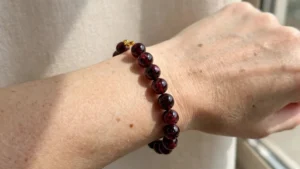
Bead bracelets are the classic garnet bracelet, and they suit the stone well. A single strand of round beads, usually 6 to 10 millimetres across, is comfortable and hard to damage, with no prongs to catch. Stretch bracelets are convenient but the elastic weakens, so check whether the strand can be restrung; knotted silk or wire lasts longer and can be repaired by any jeweller. Bangles and open cuffs are the other classic choice: a solid bangle must fit over the hand, while a cuff is easier to fit but can bend if caught.
Tennis bracelets, a continuous line of faceted stones in metal, are the dressier option, and the one where setting quality matters most. A bezel setting, a rim of metal around each stone, shields the edges from knocks far better than prongs. Six prongs hold a stone more securely than four, and tension settings are best avoided for garnet, because the pressure can stress an included stone. The same care that makes a diamond bracelet last applies here, only more so, because garnet is softer than diamond.
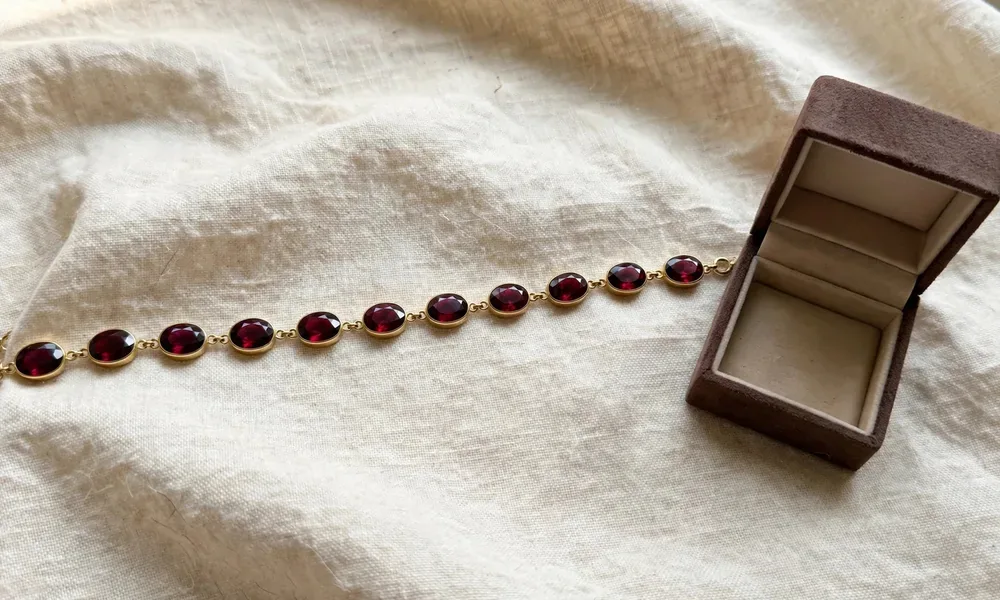
Metal choice changes both the look and the upkeep. Yellow gold warms red garnet; white gold and platinum give a cooler contrast; silver keeps the price down but needs more polishing. Rose gold flatters rhodolite’s raspberry tones. Whatever the metal, check the bracelet feels solid: a flimsy piece will not survive daily wear. Our guide to gold jewellery for everyday wear shows how a garnet piece can sit alongside the rest of your jewellery box.
Getting the size and fit right
Fit is where most bracelet purchases go wrong. Measure your wrist snugly just below the wrist bone, then add about 1 centimetre for a close fit, 1.5 for everyday comfort, or 2 or more for a loose bangle style. A tennis bracelet should sit close enough not to spin, while a bead bracelet needs a little slack so the string is never tight.
If you are buying online, do not guess. Ask the seller for the exact inner circumference and bead size, and compare it with a bracelet you own that fits well. When in doubt, size up by half a centimetre: a slightly loose bracelet is comfortable, while a tight one presses the stones against the wrist and against each other, which is how chips happen. Also keep garnet away from harder jewellery: next to a metal watch or a diamond bracelet it will be scratched, so give it its own wrist and its own pouch.
Check the clasp before you fall in love
The clasp is the part most likely to fail, so inspect it as carefully as the stones. A lobster clasp is secure and common; a box clasp with a safety latch is the most secure choice and worth asking for on a valuable piece. Toggle clasps can work loose, and magnetic clasps are the least secure. Open and close the clasp several times in the shop: it should snap shut crisply, with no wobble.
Look at the links and the stringing, too. In a tennis bracelet the links should move smoothly and the bracelet should lie flat, not twist. In a bead bracelet, ask what the beads are strung on: wire is strongest for heavier beads, silk wears through eventually, and elastic has the shortest life. A well-made bead bracelet has a knot between each bead, so a break loses one bead, not the strand.
Finally, ask for the paperwork. For a modest bead bracelet, a clear receipt stating the garnet variety, the metal and the bead size is enough. For a fine piece, especially one with tsavorite or demantoid, ask for an independent laboratory report confirming the identity of the stone; the GIA advises exactly this for any significant purchase. Garnet is rarely treated, so a seller who cannot answer the treatment question is a warning sign.
How to spot a fake garnet bracelet
Red glass is the usual imitation, and it is easier to spot than most people expect. Under a loupe, glass often shows round gas bubbles and swirl marks, and facet edges look rounded and worn, not crisp. Real garnet stays cool against the skin longer than glass or plastic. Beads that are all exactly the same colour, with no variation at all, are more likely to be glass or dyed stone than natural garnet, because natural material varies.
A price far below the market is a warning, not a bargain, and a seller who will not name the variety or the metal is selling a story, not a stone. The same judgement applies to rings, so our garnet ring buying guide is a useful companion.
What should you pay in 2027?
Price follows the variety, the size and the setting, in that order. A simple strand of small almandine beads in silver can be very affordable, while a gold tennis bracelet with matched rhodolite or spessartite costs several times more, mostly for the metal and making. Green tsavorite and demantoid bracelets are in a different league altogether.
There is no standard grading scale for garnet, so be wary of sellers who lean on their own AAA labels: the GIA notes such descriptions are created by individual companies, not a standard scale. Colour, clarity, cut and size, judged with your own eyes in daylight, are the real grades.
Your buying checklist
- Check the colour in daylight: lively red, never so dark it reads black.
- Confirm the garnet variety in writing, and know its price range first.
- Inspect the setting: bezels protect better than prongs, and six prongs beat four.
- Measure your wrist, add 1 to 2 centimetres, and compare with a bracelet you own.
- Test the clasp repeatedly; ask for a box clasp with a safety latch on valuable pieces.
- Ask about treatment, stringing and returns; get a lab report for fine tsavorite or demantoid.
Frequently asked questions
Is garnet hard enough for a bracelet worn every day?
Yes, with reasonable care. Garnet measures 6.5 to 7.5 on the Mohs scale, durable enough for daily wear, with no cleavage planes to split along. The risk is chipping from hard knocks, so a bezel setting and taking the bracelet off for heavy work will keep it looking good for years.
What is the best garnet colour for a bracelet?
For most buyers, a bright, medium to medium-dark red is best, because it stays lively in indoor light. Rhodolite’s raspberry pink-red is often the prettiest in beads, while deep almandine suits a more formal look. Green tsavorite is striking but expensive. Avoid stones that look black or muddy brown indoors.
How should a garnet bracelet fit?
Measure snugly, then add 1 centimetre for a close fit, 1.5 for everyday comfort, or 2 or more for a loose bangle. A tennis bracelet should sit close enough not to spin freely, while a bead bracelet needs a little slack. If you are between sizes, choose the larger one: a tight bracelet chips its stones.
How do I clean a garnet bracelet?
Warm water, mild soap and a soft brush: soak a few minutes, brush gently, rinse and pat dry. Avoid ultrasonic and steam cleaners, which can damage included stones, and sudden temperature changes. Store it in its own pouch, away from harder diamonds, rubies and sapphires.
How can I tell if a garnet bracelet is real?
Look for natural variation between the beads, crisp facet edges and no round gas bubbles under a loupe. Real garnet also stays cool against the skin longer than glass or plastic. Ask the seller to name the variety in writing, and for a valuable piece, ask for an independent lab report.
Is a garnet bracelet a good January birthday gift?
Yes, it is one of the best. Garnet is the traditional and modern birthstone for January, and a bracelet is easier to size and wear than a ring. A bead bracelet suits a casual gift; a gold tennis bracelet makes a milestone present. Choose the recipient’s favourite shade of red, and keep the receipt and the variety in writing.
The bottom line
A good garnet bracelet is bought with the eyes, not with a certificate: a colour that glows in daylight, a variety you understand, a setting that protects the stones, a clasp you trust and a fit with room to breathe. Do that, and the deep red on your wrist will be quiet luxury that gets noticed without announcing itself.
Note: Prices quoted are indicative loose-stone guide ranges from late-2026 market sources and will vary with quality, size, metal and maker; always confirm the garnet variety, treatment and returns policy in writing before buying.