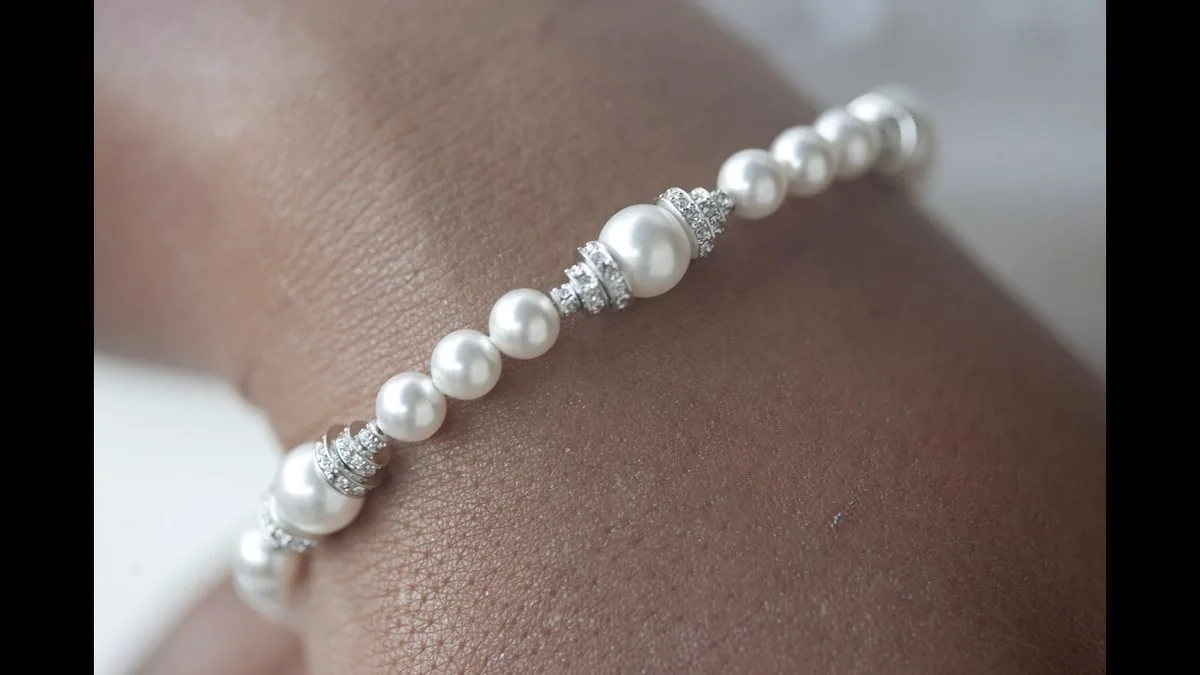

A pearl bracelet looks simple: a row of round white beads on a wrist. Yet two bracelets that look almost identical in a shop window can be worlds apart in quality, comfort and value, and the difference is rarely visible in a price tag.
The gap comes down to things you can learn to see in minutes: how sharply each pearl reflects light, how thick its nacre is, how evenly the pearls match, and how securely they are strung. A modest freshwater bracelet with bright luster will outshine a far more expensive strand of dull, poorly matched pearls.
This guide covers pearl type, size, clasp, stringing, certification and budget, so you can choose a piece you will wear for years.
Key takeaways
- Luster comes first: a pearl with sharp, bright reflections beats a larger, duller pearl.
- Freshwater is best value, Akoya has the sharpest shine, and South Sea and Tahitian are the luxury choice.
- Check nacre, surface, shape, colour and matching, not just size and price.
- Every pearl should be individually knotted, and the clasp should be solid silver or gold.
- Ask for the pearl type, treatments and certification in writing before you pay.
Start with the seven quality factors
Gemologists judge pearls on seven factors: size, shape, colour, luster, surface quality, nacre and matching. There is no worldwide grading scale, so letter grades such as AAA are set by each seller. Judge the pearls in front of you.
Of the seven, luster matters most: the sharpness of the light a pearl returns. A high-luster pearl shows a crisp, mirror-like reflection, while a low-luster pearl looks milky or chalky. Hold the bracelet in daylight and tilt it slowly. If your reflection stays clear, the luster is strong; if it fades, the nacre is thin or dull, and nothing else can rescue it.
Nacre decides how long the beauty lasts. It is the layered material a mollusk deposits around the nucleus, giving a pearl its glow. Thick nacre keeps a pearl glowing for decades; thin nacre turns chalky, yellows and can flake through to the bead underneath. For Akoya pearls, look for at least 0.4 millimetres where disclosed. South Sea and Tahitian pearls should exceed 2 millimetres, and freshwater pearls are usually solid nacre, which is why they wear so well.
Check surface quality next: look for spots, cracks, wrinkles, pits and flat patches. Minor blemishes are normal, but avoid deep cracks, heavy spotting or large flat areas, which weaken the pearl and trap dirt. Judge the pearls one at a time, since a pretty overall impression can hide a badly marked bead.
Choose the right pearl type for your wrist
Freshwater pearls grow in lakes and rivers, mainly in China. They are the most affordable, typically 5 to 8 millimetres, in white, pink and lilac. Their luster is good and improving, though they are rarely perfectly round. For a first bracelet or everyday wear, freshwater is usually the smartest choice.
Akoya pearls are saltwater pearls from Japan and China, known for high luster and near-perfect roundness, usually white or cream with rose overtones, averaging 6 to 9 millimetres. An Akoya bracelet looks sharper and more formal, ideal for work and weddings, but its nacre is thinner and its price higher.
South Sea pearls, from Australia, Indonesia and the Philippines, are the largest cultured pearls, typically 9 to 15 millimetres, in white through deep gold, with thick nacre and a soft, satiny luster. Tahitian pearls, from French Polynesia, are naturally dark, from grey to peacock black, usually 8 to 14 millimetres. Both are luxury choices. Our round-up of the best pearl bracelets of 2027 shows how each type looks on the wrist.
Compare pearl types at a glance
Use this table to match the pearl to your budget and how often you will wear the bracelet.
| Pearl type | Typical size | Luster | Colour | Best for | Price guide | Wearability |
|---|---|---|---|---|---|---|
| Freshwater | 5–8 mm | Good to high | White, pink, lilac | Everyday wear | $30–$150 | Very durable |
| Akoya | 6–9 mm | Very high, mirror-like | White, cream, rose overtone | Work, weddings | $100–$500 | Handle with care |
| South Sea | 9–15 mm | Soft, satiny glow | White to deep gold | Luxury statements | $1,000 and up | Heavier, occasions |
| Tahitian | 8–14 mm | High, with deep colour | Grey, green, peacock black | Bold, modern styling | $500 and up | Durable, thick nacre |
| Baroque freshwater | 6–10 mm | Good, varied | White, pastel, metallic | Relaxed, artistic looks | $40–$180 | Light and easy to wear |
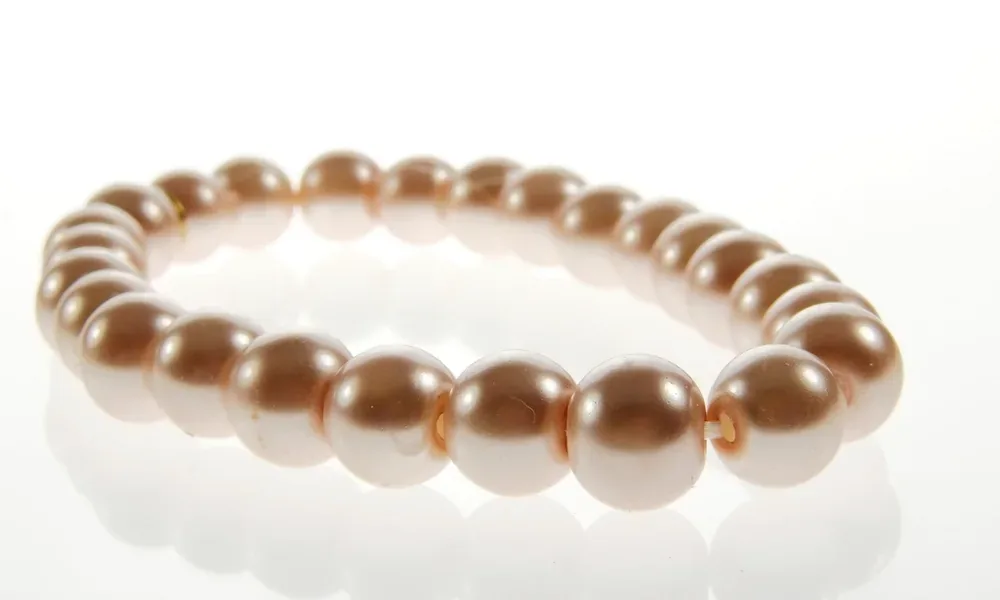
| Shelled or imitation | Any size | Flat, uniform gloss | Perfectly even white | Costume looks only | Under $30 | Coating can peel or chip |
| Natural pearls | Varies widely | Exceptional | White, cream, pink | Collectors | Many thousands | Buy only certified |
| Coin and button | 7–11 mm | Good | White, pink, gold | Modern styles | $50–$200 | Sits flat, comfortable |
Prices are broad 2027 guides, not quotes. Size, luster and matching move price more than type alone, which is why a top freshwater strand can cost more than a mediocre Akoya one.
Size, shape, colour and matching
For bracelets, the sweet spot is 6 to 10 millimetres. Smaller pearls suit delicate wrists, while 8 to 10 millimetres makes a bolder statement. Larger pearls cost more, but bigger is not better: a bright 7 millimetre bracelet looks more expensive than a dull 10 millimetre one, and it is lighter to wear.
Shape matters more on a bracelet than a necklace, because the pearls sit close together and any irregularity shows. Round is most prized, followed by near-round, oval and button. Baroque pearls are irregular, cost less and feel modern and artistic. Whatever shape you choose, consistency makes a strand look well made: lay it flat and check the pearls match end to end, with no one pearl larger, flatter or duller.
Colour is personal, but matching is not. Pearls come in white, cream, pink, silver, gold and black, with overtones of rose, green or blue. Warm skin often suits cream, gold and pink; cool skin suits white, silver and grey. Check every pearl shares the same body colour and overtone: a strand drifting from white to cream came from mixed batches. Hold it at arm’s length; the shine should be even end to end.
Clasp, stringing and construction
A beautiful strand is worthless if it falls off your wrist, so inspect the construction as carefully as the pearls. The clasp should be solid sterling silver, 14 karat gold or gold-filled, closing with a firm click. Lobster clasps are secure; toggle clasps are easy to fasten but should fit snugly, and magnetic clasps are least secure without a safety lock. Avoid plated base metal, which tarnishes and can irritate skin.
Stringing is just as important. A well-made bracelet is strung on silk or nylon with a knot between every pearl, stopping the pearls rubbing together and the whole strand scattering if the thread breaks. Look at the drill holes: a small knot should sit snugly against each pearl. Without knots, one break loses every pearl.
Check the fit: a bracelet should sit with about a centimetre of slack beyond your wrist measurement. Too tight, and the strand strains at the clasp; too loose, and it slides over the hand. Buying online, measure your wrist with a soft tape. The same care applies across fine jewellery, and our diamond buying guide for 2027 explains how to judge metal quality and certification.
Set your budget before you shop
Under $80 buys a good freshwater bracelet for everyday wear. From $80 to $250 you can expect a well-matched freshwater or entry-level Akoya strand with a solid silver clasp and proper knotting, the best value band for most people. From $250 to $600 you are in fine Akoya territory. Above $1,000 you are paying for South Sea or Tahitian pearls, exceptional matching or a designer name.
Be wary of prices that look too good: a bracelet advertised as South Sea pearls for $60 is not South Sea, and discounts of 70 percent or more usually mean the original price was invented. A daily bracelet should favour durability, a wedding bracelet can favour drama, and a gift should be a classic 7 to 8 millimetre white strand with an extender chain.
Spot fakes, treatments and misleading claims
Most bracelets sold today are cultured pearls, real pearls grown with human help. Natural pearls form without intervention, are extremely rare, and almost no ordinary bracelet contains them. The fakes to watch for are imitations made from glass, plastic or shell with a pearlescent coating. They look perfect at first glance, which is itself a clue: real pearls are rarely flawless.
The tooth test is the classic check: gently rub a pearl against a front tooth. A real pearl feels slightly gritty from its layered nacre, while an imitation feels smooth. Never bite a pearl or press hard enough to scratch it. Also check the drill holes: on a real pearl the hole is clean, while on an imitation the coating often flakes.
Ask about treatments. Pearls are routinely bleached, and some are dyed pink, black or gold. Bleaching is standard, but dyeing should be disclosed, because dyed pearls can fade and a dyed freshwater pearl should never be sold as a naturally coloured Tahitian. A reputable seller will state the type, origin and dyeing in writing; if a seller cannot, walk away. For a bracelet costing several hundred dollars or more, ask for a gemmological laboratory report, or at least a detailed receipt.
Your before-you-buy checklist
- Inspect luster in daylight: look for sharp, mirror-like reflections on every pearl.
- Check matching size, shape, colour and shine, with no dull or oversized pearl standing out.
- Look for knots between every pearl and a clean, undamaged drill hole on each one.
- Test the clasp: it should close firmly, be solid silver or gold, and suit the strand’s weight.
- Confirm the pearl type, any dyeing or treatments, and the clasp metal in writing before you pay.
- Measure your wrist, check length and returns, and keep the receipt and any certificate safe.
Frequently asked questions
What size pearl bracelet should I buy?
For most wrists, 7 to 8 millimetres is most versatile: noticeable without being heavy, and easy to wear with casual and formal clothes. Choose 6 to 7 millimetres for a delicate look, and 8 to 10 for a bolder statement. Add about a centimetre to your wrist measurement, and choose an extender chain for a gift.
Are freshwater pearls real pearls?
Yes. Freshwater pearls are real cultured pearls, grown in freshwater mussels over several years. They are usually solid nacre, so they are durable and good value, and a well-chosen freshwater bracelet is the best starting point for everyday wear.
How can I tell if a pearl bracelet is real?
Look for slight variations between pearls, a gritty feel in the gentle tooth test, and clean drill holes with no peeling coating. Real pearls show a deep glow that changes as you turn them, while imitations have a flat, uniform shine.
How much should a good pearl bracelet cost?
A good freshwater bracelet costs roughly $30 to $150, a fine Akoya bracelet $100 to $500, and a South Sea or Tahitian bracelet $500 to several thousand dollars. The best value for most buyers is the $80 to $250 band.
Should a pearl bracelet be knotted?
Yes, if it is strung on silk or nylon. A knot between every pearl stops the pearls rubbing together and prevents the whole strand scattering if the thread breaks. Elastic bracelets are not knotted, so they have a shorter life.
Can I wear a pearl bracelet every day?
You can, with the right one. Freshwater pearls with solid nacre, a secure clasp and knotted silk handle daily wear well. Put it on after perfume and moisturiser, wipe it after wearing, and avoid water and chemicals. Save very fine Akoya and South Sea bracelets for occasions.
The bottom line
The best pearl bracelet is not the most expensive or the biggest. It is the one whose pearls share bright, even luster, whose strand is well matched and honestly knotted, and whose clasp you trust. Choose freshwater for everyday value, Akoya for sharp classic shine, and South Sea or Tahitian for a luxury statement, then check the construction, paperwork and returns policy before you pay. To compare styles, browse our guide to the best pearl jewellery of 2027.
Note: Prices and size ranges in this guide are broad 2027 market guides, not quotes for a specific seller. Always inspect the actual bracelet, confirm the pearl type and treatments in writing, and check the returns policy before buying.