


Has your steering wheel vibrated at highway speed, leaving you unsure whether you need an alignment or a balance? Drivers often mix up these two services, and the mistake costs money. An alignment fixes how your wheels point. A balance fixes how they spin. Confuse the two and you may pay for the wrong repair while the real problem keeps wearing your tyres.
Here is the short version: wheel alignment adjusts the suspension angles so all four wheels track straight and sit flat on the road. Wheel balancing corrects the weight distribution of each tyre-and-wheel assembly so it spins smoothly without vibration. They sound similar. They solve completely different problems.
What Each Service Actually Does
Wheel alignment is really a suspension job, not a wheel job. A technician adjusts the angles at which your tyres meet the road back to the vehicle maker’s specification, so the contact patch stays square and the car tracks straight. Three angles matter: camber (the inward or outward tilt of the wheel viewed from the front), caster (the steering pivot angle that affects stability), and toe (whether the wheels point slightly inward or outward relative to each other). If you want the full breakdown of how these three angles interact, it helps to see tire alignment those three angles actually do your car explained in plain terms.
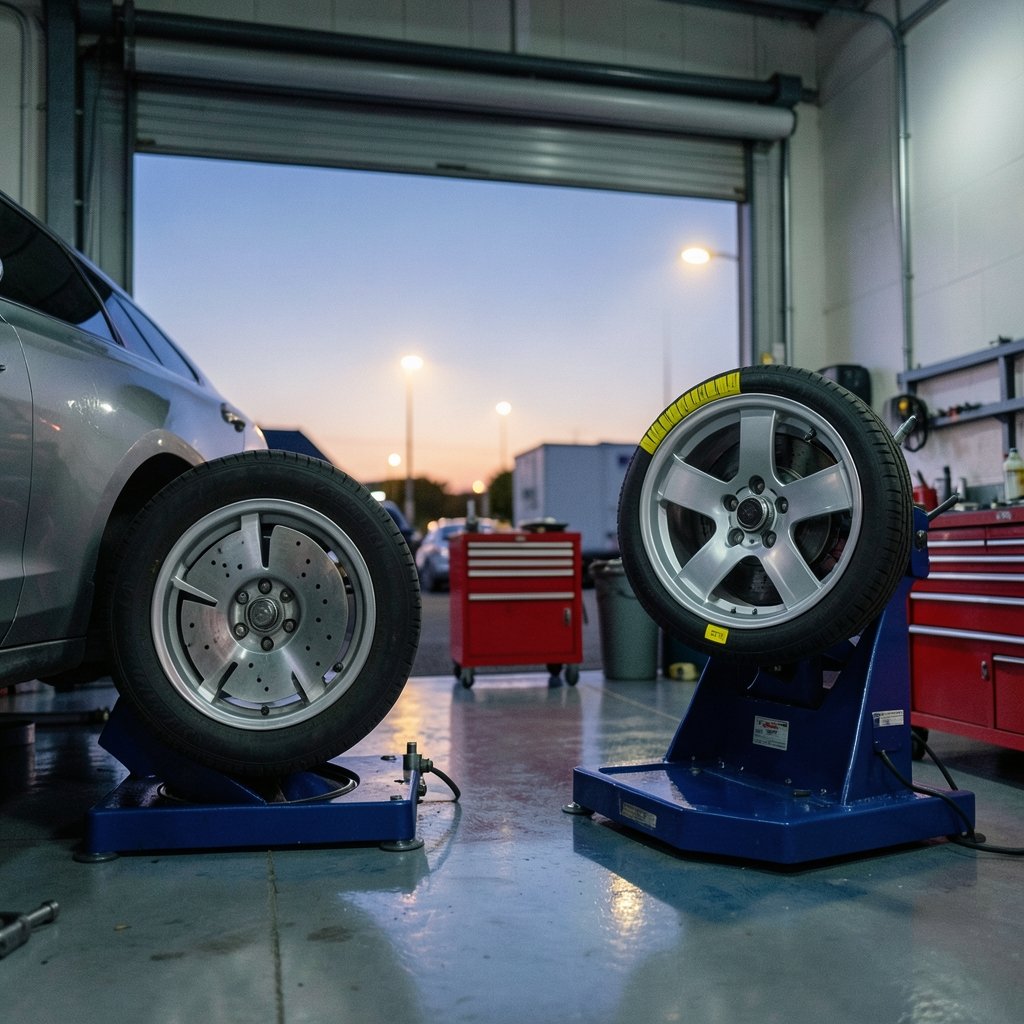
Wheel balancing happens off the car. The tyre and rim go onto a balancing machine that spins them and detects heavy and light spots. Even tiny manufacturing imperfections in a new tyre create uneven weight. The technician counteracts that by clipping small balancing weights onto the inside or outside of the rim, so the assembly rotates evenly at speed.
Side-by-Side Comparison
| Feature | Wheel Alignment | Wheel Balancing |
|---|---|---|
| What it adjusts | Suspension angles (camber, caster, toe) | Weight distribution around the tyre and rim |
| Where the work happens | On the car, on a lift or alignment rack | Off the car, on a balancing machine |
| Main symptom it fixes | Pulling to one side, crooked steering wheel, uneven tyre wear | Vibration through the steering wheel or seat at speed |
| Typical trigger | Potholes, kerb strikes, suspension work, new tyres | New tyre fitting, lost wheel weights, vibration |
| Tyre wear pattern | One-sided or feathered wear | Cupping or scalloped patches |
| Effect on fuel use | Poor alignment can reduce fuel efficiency | Unbalanced wheels can increase fuel use |
The single clearest difference: alignment is about direction, balancing is about rotation. A perfectly aligned car can still shake if its wheels are out of balance, and a perfectly balanced set of wheels can still pull left if the alignment is off.
How to Tell Which One You Need
Diagnosis is mostly about where you feel the problem. Vibration that comes and goes with speed and hums through the steering wheel or floor pan points to balancing. A car that drifts or a steering wheel that sits crooked while driving straight points to alignment.
Practical checks that work in the real world:
- Find a flat, empty road and drive straight at a steady speed. Let go of the wheel briefly. A steady pull to one side suggests alignment.
- Note the speed where vibration appears. Shaking that starts around 80 to 100 km/h and fades at other speeds is classic imbalance.
- Run your hand across the tread. Sharp edges on one side of the tread blocks or a feathered feel point to toe problems.
- Look for missing wheel weights. A clean rectangular patch on the rim where a weight used to sit is a giveaway.
- Check tyre pressures first. Uneven pressure mimics alignment faults and costs nothing to rule out.
Common Mistakes Drivers Make
The biggest one is asking for an alignment when the car shakes. That is a balancing job, and an alignment will not stop the vibration. The second biggest is skipping the balance after fitting new tyres. New rubber is rarely perfectly uniform, so weights are part of the fitting job, not an optional extra.
Another mistake is judging alignment by the steering wheel alone. A crooked wheel can be fixed by centring it, but if the toe is wrong underneath, the tyres will still scrub. And plenty of drivers get an alignment after a pothole hit but never check whether the impact also knocked a weight loose or bent a rim.
When Alignment and Balancing Come Together
Workshops often bundle the two because a single visit can catch both faults. According to tyre makers, alignment, balancing, mounting and wheel fitment work together to protect tyres, improve comfort and avoid unnecessary wear. Yokohama’s guidance notes that because the two jobs target different faults, understanding when you need one, the other, or both can save money and stop premature tyre wear.
The order matters in practice. Balance first when new tyres go on, then align. If you align a set of wheels that are badly out of balance, the vibration can mask whether the alignment actually fixed the pull. If you are chasing a problem that keeps coming back, it is worth reading up on how to tyre alignment spot bad geometry before it ruins your tyres so you know what the numbers on the printout mean.
How Often Should You Get Each Service?
There is no universal interval, and anyone quoting one number for every car is guessing. A sensible rule of thumb used by many workshops: check alignment after any significant pothole or kerb strike, after suspension or steering work, when you fit new tyres, or if you notice a pull or uneven wear. Balancing is done whenever a tyre is mounted on a rim, and again if vibration appears.
Signs your wheels may be unbalanced include wear on shocks, springs and bearings, higher fuel use than usual, and vibration at speed. Signs of bad alignment include a car that pulls to one side, a steering wheel that is off-centre, and tyres wearing on one edge.
What Actually Happens in the Workshop
For alignment, the car goes onto a rack with target plates or sensors on each wheel. The system reads camber, caster and toe and compares them with the maker’s spec. The technician then adjusts tie rods, shims or camber bolts until the numbers land in the green. A good shop shows you the before-and-after printout. Ask for it. If a workshop cannot produce one, you cannot verify the work.
For balancing, each wheel comes off and goes onto a balancer. The machine spins it, flags the heavy spot, and tells the tech where to place weights and how much. Some shops use a road-force balancer that also measures uniformity under load, which catches problems a basic spin balance misses.
Does Wheel Size Change the Advice?
It can. Bigger, lighter wheels with stiff sidewalls transmit vibration more directly into the cabin, so balance errors become more obvious. If you have upgraded to lightweight performance wheels, the margin for sloppy balancing shrinks. That is one reason enthusiasts care about how Enkei wheels makes them light strong track ready and why they pair that upgrade with a proper road-force balance rather than a quick static one.
Choose Alignment If…
- Your car pulls to one side on a flat road.
- The steering wheel sits off-centre while driving straight.
- Tyres wear on one inner or outer edge.
- You recently hit a pothole, kerb or speed bump hard.
- You just had suspension or steering components replaced.
Choose Balancing If…
- The steering wheel or seat vibrates at a specific speed band.
- You just fitted new tyres.
- A wheel weight has fallen off.
- You feel a rhythmic thump that scales with road speed.
- Tyres show cupped or scalloped patches.
Choose Both If…
You fitted new tyres after a pothole hit, or you have vibration plus a pull. In those cases, one visit covering both services is cheaper than two separate appointments and catches the fault in a single pass.
Conclusion
Alignment and balancing are not rivals. They are two halves of the same job, and the confusion between them is the most common reason drivers pay for the wrong fix. Alignment corrects the angles your suspension holds the wheels at, so the car tracks straight and the tread wears evenly. Balancing corrects the weight of each wheel-and-tyre assembly, so it spins without shaking. If your problem is direction, ask for alignment. If your problem is vibration, ask for balancing. If you are unsure, describe the symptom and the speed it happens at, and let the technician measure before anyone touches a spanner.
Frequently Asked Questions
Is wheel alignment the same as wheel balancing?
No. Alignment adjusts suspension angles so the wheels point in the right direction. Balancing adjusts the weight distribution of the tyre and rim so the assembly spins evenly. One is about geometry, the other about mass.
Can I get an alignment without balancing?
Yes, and many shops do exactly that. But if your wheels are out of balance, the vibration will continue after the alignment, and you may think the alignment failed when the real fault was never addressed.
Why does my steering wheel shake at high speed but not at low speed?
That pattern usually points to imbalance rather than alignment. A heavy spot in the tyre or rim creates a vibration that grows with rotational speed, which is why it shows up on the highway and disappears around town.
How long does each service take?
Balancing a set of four wheels is typically a quick job done alongside tyre fitting. A four-wheel alignment takes longer because each angle is measured and adjusted in sequence. Ask the shop for a time estimate when you book.
Do I need an alignment after new tyres?
It is worth checking, especially if the old tyres wore unevenly or you have hit anything hard recently. Fitting new tyres onto a car with poor geometry simply accelerates wear on the fresh rubber.
Can bad alignment or balancing damage other parts?
Yes. Unbalanced wheels stress shocks, springs and bearings over time, and misaligned geometry scrubs tyres and can reduce fuel efficiency. Left long enough, both turn a cheap service into an expensive repair.
The practical takeaway is simple: treat alignment and balancing as scheduled maintenance rather than emergency repairs. Mention both at every tyre rotation and ask the technician to note anything unusual on the invoice, so you build a history you can refer back to. Keep the before-and-after printouts with your service records; if a pull or vibration returns months later, that paperwork tells the next shop whether the geometry has drifted or a weight has simply come off. Small habits help too: check pressures monthly when the tyres are cold, avoid kerbing on tight turns, and slow down for potholes rather than bracing through them. None of this replaces a proper measurement, but it reduces the chance of needing one unexpectedly.
Finally, remember that both services protect the same investment. A set of quality tyres is one of the largest running costs a driver faces, and alignment and balancing are the cheapest way to make that investment last its full tread life. Ignore them and you pay twice: once for the service you skipped, and again for the premature replacement. Book the check, keep the printout, and let the measurements decide what your car actually needs.











