

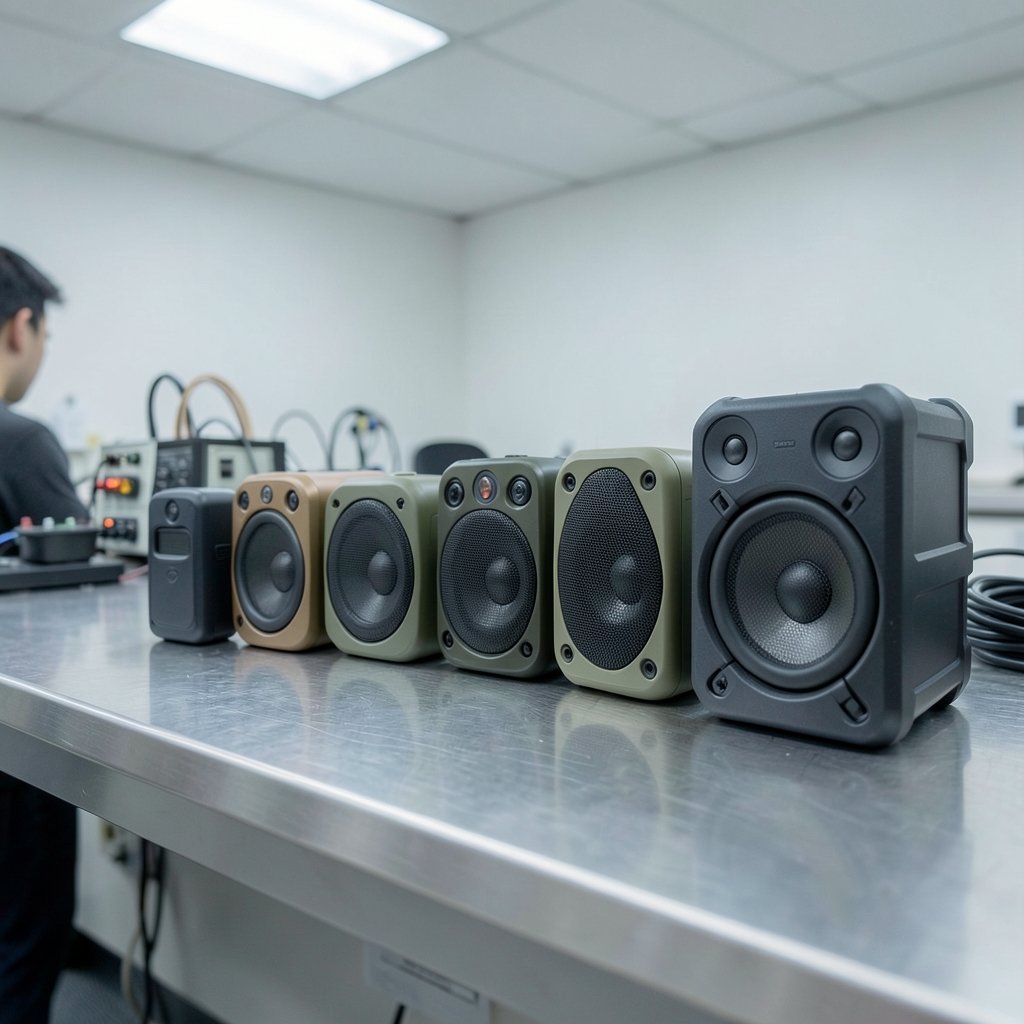
What if the only thing standing between your next beach day and a soundtrack that actually slaps is one small purchase? Portable speakers have quietly become one of the most competitive corners of consumer audio, which is great news for buyers and mildly confusing news for anyone who just wants good sound without a spreadsheet. The shortlist below covers the specific models that reviewers keep coming back to, from a $35 pocket speaker to a $499 bass monster, plus the practical details that decide whether a speaker survives a real summer.
Quick Comparison: The Shortlist at a Glance
| Speaker | Best for | Key specs | Price |
|---|---|---|---|
| JBL Flip 7 | All-round outdoor use | IP68, USB-C wired playback, Auracast, up to 16 hours | $150 / £130 |
| Bose SoundLink Flex (2nd gen) | Hikes and picnics | IP67, roughly 12-hour battery, balanced sound | Not stated |
| Anker Soundcore Boom 2 | Value bass | IPX7, companion EQ app | $129.99 |
| Anker Soundcore Motion X600 | Spatial audio | 50W output, IPX7, immersive mode | $199.99 |
| JBL Clip 5 | Clipping to a backpack | IP67, multipoint, EQ app | $79.95 |
| Soundcore Select 4 Go | Tight budgets | IP67, loop attachment, EQ options | $34.99 |
| JBL Charge 6 | Long weekends | Detachable handle, redesigned body | Not stated |
| Sony ULT Field 7 | Backyard parties | IP67, light show, ULT bass modes | Not stated |
Prices above come from published reviews; where no figure was listed, check the manufacturer’s page before buying.
JBL Flip 7: The Best Do-Everything Speaker for Most People

If someone wants one speaker for the garden, the shower, a campsite and a hotel room, this is the safest answer. The Flip 7 carries an IP68 rating, meaning it shrugs off dust and survives a dunk. Reviewers found it more detailed and rhythmically satisfying than any previous Flip, and it adds USB-C wired playback with 24-bit/96kHz support — a genuine first for the line. Auracast lets you link compatible speakers for bigger sound.
The honest limitation: there is no USB-C cable in the box, which feels stingy at this price. Older JBL speakers also aren’t supported by Auracast, so you can’t pair it with the Flip you bought three years ago. Battery life stretches to 16 hours with Playtime Boost. For $150/£130, the balance of sound, features and toughness is hard to beat.
Bose SoundLink Flex (2nd Gen): Best for Hikes and Picnics
Bose’s SoundLink line has expanded so much that choosing between models has become its own project. The second-generation Flex is the one reviewers reach for on trails and picnic blankets. Testers described fuller, more controlled bass than many compact rivals, with vocals and podcasts sounding clean and natural — the kind of tuning that stays pleasant over hours rather than impressing for five minutes.
It’s slightly larger and heavier than ultra-compact competitors, and it lacks a built-in microphone for speakerphone duty, so it won’t double as a conference call device. The IP67 rating and roughly 12-hour battery make it genuinely outdoor-ready. One caveat worth knowing: the bigger SoundLink Max costs about $130 more, so decide whether you need the extra volume before upgrading.
Anker Soundcore Boom 2: Best Bass for the Money
At $129.99, the Boom 2 is the pick for anyone who wants thump without spending flagship money. It’s lightweight, carries an IPX7 rating for water immersion, and pairs with a companion app offering a customizable EQ. That app matters more than spec sheets suggest — a nine-band or even simple preset EQ is the difference between a speaker that suits your music and one that fights it.
The trade-off is that at this size and price, the Boom 2 emphasizes low end over fine detail. Acoustic tracks and spoken word won’t feel as refined as on the Bose. For hip-hop, EDM and outdoor gatherings, though, it punches well above its price.
Anker Soundcore Motion X600: Spatial Audio Without the Flagship Price
The Motion X600 brings immersive spatial audio and 50W of output for $199.99, with an IPX7 rating. It’s the option for someone who wants a wider, room-filling presentation from a speaker that still fits in a tote bag. Spatial processing is divisive — some listeners love the sense of scale, others find it colors the mix — so it suits people who stream modern pop and film soundtracks more than critical listeners chasing accuracy.
JBL Clip 5: The Carry-Anywhere Pick
The Clip 5’s integrated carabiner is the whole pitch, and it’s a good one. At $79.95, it clips to a backpack strap, a bike frame or a tent loop and stays there. It offers IP67 protection, multipoint connection so two devices can stay paired, and EQ options through the JBL app.
Its limitation is physics: a speaker this small won’t fill a yard, and bass is modest. Treat it as a personal speaker for walks, showers and small rooms, not a party centerpiece.
Soundcore Select 4 Go: The Budget Champion
At $34.99, the Select 4 Go is the speaker to buy when the budget is genuinely tight or when you need a second one for the kitchen. It carries an IP67 rating, a loop attachment for hanging, and EQ options in the app — features that usually cost three times as much. Reviewers consistently describe the Soundcore 2 line as dependable and simple to pair, and this model follows that philosophy.
The obvious catch: at this price, volume and bass depth are limited, and there’s no dust-resistance rating on some budget siblings. It’s a great spare, not a primary system.
JBL Charge 6: Best for Long Weekends Away
The Charge 6 keeps the familiar portable form factor but adds a detachable handle and a redesigned body. It’s the speaker for someone who wants one charge to cover a long weekend. If you’re building a go-bag of gear for trips, it pairs naturally with other travel-ready kit — the same logic behind choosing the best portable power station for real-world backup or the best portable tire inflators tested for every kind of car, where reliability beats spec-sheet bragging.
Sony ULT Field 7: The Backyard Party Option
For gatherings rather than personal listening, the ULT Field 7 sits in a useful middle ground: big enough for a barbecue, light enough to carry one-handed thanks to built-in handles. It’s IP67 rated, includes an integrated light show, and its ULT modes push strong bass suited to pop, hip-hop and EDM. Reviewers described it as a true hybrid rather than a dressed-up home speaker.
The limitation is size and commitment. If you entertain rarely, a compact speaker plus a friend’s sound system will do. If you host often, this replaces a bulky tower.
Don’t Forget the Rest of the Setup
A portable speaker is one piece of a portable life. If you work from cafes or hotel desks, the same buying instincts apply to the best portable monitor for work, travel and play — check the ports before the pixels. And if your listening happens in a small, hot room, a portable air conditioner that actually cools a hot room will do more for your comfort than any EQ preset. For anyone assembling a full travel kit, from wireless speakers for a home system to portable exercises that fit in carry-on luggage, the rule is the same: buy for the situation you’re actually in, not the one in the marketing photos.
How to Choose Without Overthinking It
Start with where the speaker will live. A shower or campsite demands IP67 or better; a bedside table does not. Then decide whether you need to charge your phone from it — USB-C charge-out is a genuinely useful feature on a beach trip. Next, check the app: a customizable EQ extends a speaker’s useful life far more than an extra watt of rated power.
Common mistakes buyers make, based on what reviewers repeatedly flag:
- Trusting a waterproof claim without a dust rating. IPX7 means water only; IP67 covers both.
- Assuming Auracast or party-link works across brands and generations. It often doesn’t, even within one brand.
- Buying for peak volume instead of average listening. Most distortion complaints come from speakers pushed past 80% volume.
- Ignoring the cable situation. Several models ship without a charging cable.
- Skipping the app install. EQ and firmware updates are where budget speakers gain the most.
One practical tip that costs nothing: test stereo pairing before you leave the store or the return window. Multipoint and pairing bugs are the most common complaint in owner reviews, and they’re invisible on a spec sheet.
If your trips involve a vehicle, it’s worth thinking about the whole kit rather than the speaker alone — the same planning that goes into choosing portable car jump starters for a dead battery applies to audio: buy gear that works when conditions aren’t ideal.
Conclusion
The best portable speaker is the one that matches your actual week, not a reviewer’s test bench. For most people, the JBL Flip 7 at $150/£130 is the sweet spot: tough, detailed, and flexible enough for indoors and out. Bass lovers on a budget should look at the Soundcore Boom 2 at $129.99, while hikers and picnickers get the most balanced sound from the Bose SoundLink Flex. If the budget is under $50, the Soundcore Select 4 Go is a genuinely good speaker rather than a compromise. Pick one, install the app, and spend the saved research hours outside with it.
Frequently Asked Questions
What is the best portable speaker overall?
The JBL Flip 7 is the strongest all-round choice for most buyers. It combines an IP68 rating, USB-C wired playback with 24-bit/96kHz support, Auracast linking and up to 16 hours of battery life for $150/£130. Its main drawback is the missing USB-C cable in the box and no Auracast support for older JBL models.
How much should I spend on a portable speaker?
Useful options start around $35 with the Soundcore Select 4 Go and run past $499 for large party models. The $130 to $200 band is where sound quality, water resistance and app features improve sharply, so that’s where most buyers get the best value.
Is IP67 waterproof enough for the beach?
IP67 means the speaker is dust-tight and can survive immersion in water. That’s enough for splashes, rain and a dropped speaker in shallow water. Note that IPX7 covers water only, with no dust rating, so check the exact rating before taking a speaker onto sand.
Do portable speakers work with Wi-Fi as well as Bluetooth?
Most portable speakers are Bluetooth-only. Some premium models add Wi-Fi and features like Apple AirPlay 2, which allow higher-quality streaming and multi-room audio. If Wi-Fi matters to you, confirm it in the spec list, because it’s uncommon at lower prices.
Can I pair two portable speakers for stereo sound?
Sometimes, but only within the same brand and often only with compatible generations. JBL’s Auracast, for example, does not support older JBL speakers. Test pairing within the return window, since cross-brand pairing generally isn’t supported.
How long do portable speaker batteries last?
It varies widely. The JBL Flip 7 reaches up to 16 hours with Playtime Boost, while the Bose SoundLink Flex runs roughly 12 hours. Real-world figures drop at higher volumes, so plan on 60 to 70 percent of the rated number for loud outdoor use.











