Jasper is one of the oldest stones in jewellery, and also one of the most misunderstood. It has been carved into seals, beads and amulets for thousands of years, yet most shoppers meet it for the first time as a colourful cabochon in a ring and have no idea what they are actually buying. The problem is not finding a jasper ring. It is knowing which jasper you are looking at, whether the colour is natural, and whether the stone will survive daily wear on your hand.
That is why this guide is organised by stone type and setting, not just by price. A red jasper solitaire and a blue jasper cocktail ring may look equally striking in a photograph, but they are very different purchases. One is a natural, durable stone that has been used in rings for centuries. The other is almost certainly dyed, and the colour may be the most fragile thing about it.
Below are nine jasper rings worth considering in 2027, from a classic red jasper solitaire to bold patterned stones for people who want their ring to be noticed. Each one is described by what it is good at, what to watch for, and who it suits best, so you can choose with your eyes open, not just your wallet.
Key takeaways
- Jasper is an opaque variety of chalcedony quartz, hard enough for rings at Mohs 6.5 to 7, and it takes a smooth polish that suits cabochon cuts best.
- Red, yellow, brown and green jasper are usually natural, while bright blue, vivid green and electric pink jasper is almost always dyed, and the dye should be disclosed.
- Bezel and halo settings protect jasper best on a ring, because the stone sits on the hand and takes knocks that a necklace or earring never would.
- Clean jasper with warm water and mild soap only, and never put it in an ultrasonic or steam cleaner, which can crack the stone or loosen the setting.
- Jasper has no proven healing properties and is not an investment stone, so buy it because you love the pattern and the colour, not because it will gain value.
What jasper actually is
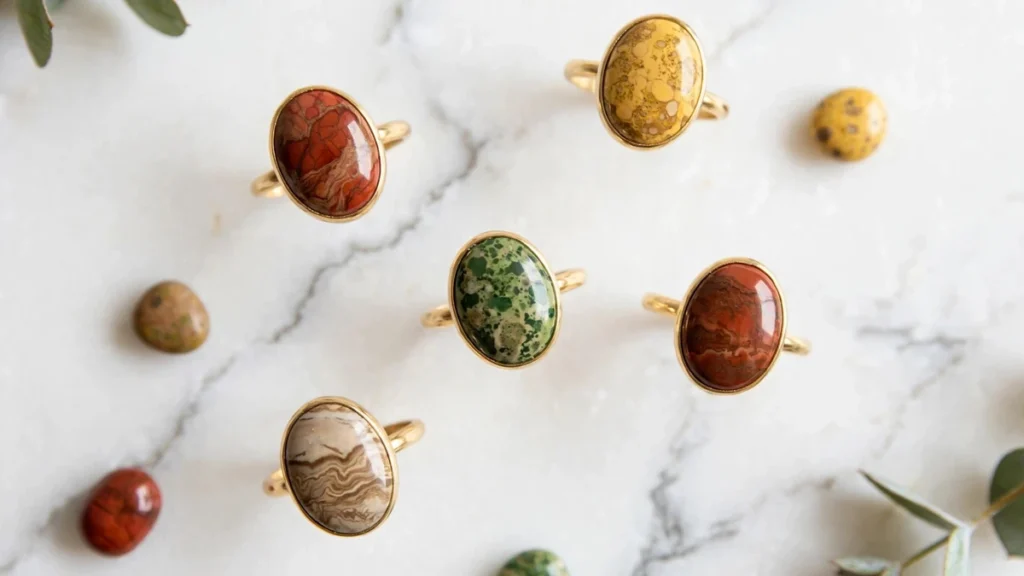
Jasper is a form of chalcedony, which is microcrystalline quartz. Unlike clear quartz or amethyst, it is opaque, which means light does not pass through it. Its colour comes from iron oxides and other minerals trapped inside the stone as it formed, which is why no two pieces of jasper ever look exactly alike. Red jasper gets its colour from hematite, yellow jasper from goethite, and green jasper from chlorite or iron silicates.
That natural variation is the whole point of the stone, and also the reason to buy it in person or from a seller with clear photographs of the exact ring. A stock photograph of “red jasper” can look nothing like the stone that arrives, because one red jasper can be a deep brick red and the next can be mottled with grey and cream. Patterned varieties have their own names: picture jasper shows landscape-like scenes, ocean jasper has orb-like circles, dalmatian jasper is cream with black spots, and bloodstone, also called heliotrope, is dark green jasper flecked with red.
On the hardness scale, jasper sits at Mohs 6.5 to 7, which puts it in the same range as many everyday ring stones. It is harder than turquoise, coral and opal, and it resists scratching from keys, coins and most daily contact. It is not as hard as sapphire or diamond, and a sharp knock against a hard surface can still chip an exposed edge. That is why the setting matters so much for a ring, and why jasper is usually cut as a smooth cabochon rather than a faceted stone.
How we chose these rings and what to look for
Look first at the colour and ask whether it is natural. Earthy reds, yellows, browns and soft greens are the colours jasper makes on its own, and they are the safest buys. If a ring is a bright, even blue or a vivid candy pink, the stone has almost certainly been dyed, and a good seller will say so. Dyed jasper is not necessarily a bad purchase, but it should not command the price of a natural stone, and the colour can fade with long exposure to strong sunlight.
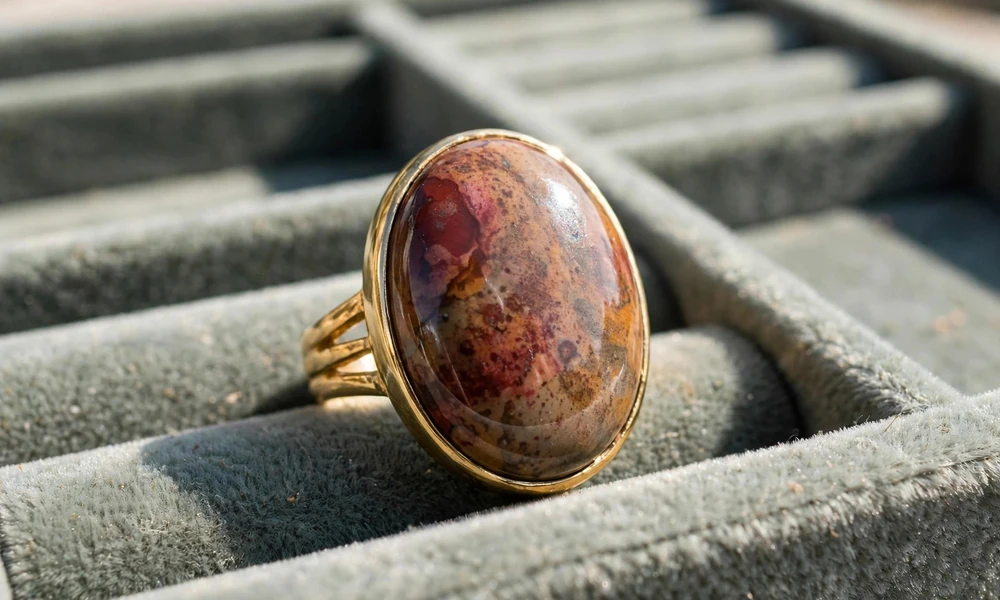
Look next at the setting and the cut. A bezel setting, where a rim of metal wraps around the stone, is the best choice for a ring you plan to wear often, because it protects the edges and keeps the stone secure. A halo of small diamonds or white sapphires around a jasper centre stone can look beautiful, but it adds height, and a high-set ring catches on clothing and door handles. A flat, low-profile cabochon is the most practical shape for daily wear, while a tall dome or a large cocktail ring is better kept for occasions. Our guide to jasper bracelets explains how the same stone behaves in a piece of jewellery that takes far fewer knocks than a ring.
Finally, look at the metal and the price. Jasper itself is an affordable stone, so most of what you pay for is the metal, the craftsmanship and the brand. A solid gold band with a well-cut natural jasper is a fair price at the mid-range. A very cheap ring with a vividly coloured stone is usually gold-plated, dyed jasper, or both, and the plating will wear through long before the stone gives up.
The 9 best jasper rings of 2027
Tiffany & Co. Red Jasper Solitaire
What we like: A deep red jasper cabochon in a clean 18-karat gold bezel, with the restrained proportions Tiffany does best and a stone chosen for an even, brick-red colour. What to consider: Premium price for a stone that is affordable on its own, and the red is a classic brick tone rather than a bright cherry. Stone: Natural red jasper cabochon. Setting: 18-karat gold bezel. Best for: Everyday wear and a first jasper ring. Price range: £1,200 to £1,800.
Cartier Jasper Cocktail Ring
What we like: A large oval jasper in a bold gold setting with a sculpted band, a ring that is meant to be noticed and that shows off the stone’s pattern at full scale. What to consider: A statement size that is not practical for typing or manual work, and the price is for the design and the name as much as the stone. Stone: Natural jasper, oval cabochon. Setting: 18-karat gold, raised prong. Best for: Evening wear and collectors. Price range: £2,500 to £4,000.
David Yurman Jasper Cable Ring
What we like: A smooth jasper cabochon set into Yurman’s signature twisted cable band, a design that suits the earthy stone and gives the ring a handmade feel. What to consider: The cable band is wider than a plain band and can feel bulky on smaller fingers, and the stone is set higher than a bezel. Stone: Natural jasper cabochon. Setting: Sterling silver or 14-karat gold cable. Best for: Casual luxury and everyday wear. Price range: £600 to £1,100.
Mejuri Jasper Dome Ring
What we like: A smooth dome of jasper in a slim gold vermeil band, an affordable entry point with a clean, modern shape and a stone chosen for a warm, even colour. What to consider: Gold vermeil wears through faster than solid gold, and the dome is a softer polish that can show small scratches over time. Stone: Natural jasper dome. Setting: Gold vermeil bezel. Best for: A first jasper ring on a budget. Price range: £120 to £220.
Monica Vinader Jasper Signet Ring
What we like: A flat jasper face in a signet shape, with a slim gold band and a stone that sits flush, so it never catches on clothing or bags. What to consider: The flat face shows the pattern less dramatically than a domed cabochon, and the signet shape suits some hands better than others. Stone: Natural jasper, flat cut. Setting: 18-karat gold vermeil signet. Best for: Work wear and minimal styling. Price range: £150 to £280.
Missoma Jasper Stacking Ring
What we like: A small jasper cabochon on a fine band, designed to stack with plain gold bands, so you can wear jasper as an accent rather than a statement. What to consider: The stone is small, so the pattern is subtle, and the fine band is not as robust as a wider one. Stone: Natural jasper, small cabochon. Setting: Gold vermeil, prong. Best for: Stacking and layering. Price range: £95 to £180.
Maria Black Jasper Sculptural Ring
What we like: An irregular, sculptural setting that treats the jasper as a found object, with an oxidised silver band that makes the stone’s natural pattern the whole design. What to consider: An artistic shape that will not suit everyone, and the oxidised finish needs more care than polished silver. Stone: Natural jasper, freeform cabochon. Setting: Oxidised sterling silver. Best for: Bold, artistic styling. Price range: £200 to £380.
Astrid & Miyu Jasper Halo Ring
What we like: A jasper centre stone ringed by small white topaz, which lifts the earthy colour and makes the ring read as jewellery rather than a pebble on a band. What to consider: The halo adds height and small stones that need checking, and the white topaz is a harder stone than the jasper it surrounds. Stone: Natural jasper cabochon. Setting: Gold vermeil halo. Best for: Dressier occasions. Price range: £130 to £240.
Thomas Sabo Jasper Charm Ring
What we like: A jasper cabochon in a charm-style setting with a detailed band, a playful, collectible design that suits jasper’s bohemian reputation. What to consider: A detailed, decorative band that can feel busy next to plain jewellery, and the charm style is a trend that may date. Stone: Natural jasper cabochon. Setting: Sterling silver, charm detail. Best for: Casual and bohemian styling. Price range: £110 to £200.
Which jasper is right for you
Red jasper is the classic choice, and the easiest to buy well. It is the most widely available natural jasper, it suits most skin tones, and its deep brick-red colour works with both gold and silver. If you want one jasper ring and you want it to last, a red jasper solitaire in a bezel setting is the default answer, and it is the hardest one to get wrong.
Green and yellow jasper are quieter options that suit people who want colour without a statement. Green jasper reads as calm and earthy, especially in silver, while yellow jasper is warm and sunny without being loud. Both are usually natural, and both are durable enough for daily wear. Blue jasper is the one to be careful with, because natural blue jasper is rare and most blue stones on the market are dyed grey or white jasper. If you love the colour, buy it knowingly and pay a dyed-stone price, and keep it out of strong sunlight, which can fade the dye over time.
Your lifestyle matters as much as your taste. If you work with your hands, type all day, or play sport, choose a low-profile bezel or signet and a hard-wearing metal, and keep the stone small. A guide to jasper necklaces is a useful comparison here, because a necklace shows how the same stone looks when it is not being knocked against everything your hand touches.
The caveats that matter
Jasper is a forgiving stone, but it is not indestructible, and the things that damage it are the things most people do without thinking. It can chip if it hits a hard surface, it can scratch if it is stored loose with harder stones, and dyed jasper can fade in strong sunlight. None of these are reasons to avoid jasper, but they are reasons to choose the setting carefully and to treat the ring as jewellery rather than as a tool.
| Detail | What is known |
|---|---|
| What it is | Opaque chalcedony quartz, coloured by iron oxides and other minerals |
| Hardness | Mohs 6.5 to 7, hard enough for rings but can chip on a hard knock |
| Best colours | Red, yellow, brown and green are usually natural; bright blue is almost always dyed |
| Best setting | Bezel or signet, low profile, with the stone edges protected by metal |
| Best cut | Smooth cabochon, which shows the pattern and has no sharp edges to chip |
| Cleaning | Warm water and mild soap only, soft cloth, never ultrasonic or steam |
| What to avoid | Hard knocks, strong sunlight for dyed stones, storing loose with harder gems |
| What it does not do | It has no proven healing properties and is not an investment stone |
If you are buying a ring as a gift, check the return and exchange policy before you pay, because jasper varies so much that the exact stone matters more than the listing. A good seller will show photographs of the actual ring, name the variety, and say whether the colour is natural or dyed.
Checklist: choosing a jasper ring honestly
Use these checks before you buy, and again when the ring arrives.
- Check the variety: ask for the exact type of jasper by name, not just “jasper”.
- Check the colour: earthy reds, yellows and greens are usually natural; bright blue is almost always dyed.
- Check the setting: a bezel or signet protects the stone best for daily wear.
- Check the metal: solid gold or silver lasts longer than plated or vermeil finishes.
- Check the stone: look for an even polish, no cracks, and a pattern you actually like.
- Check the policy: confirm returns and exchanges, because no two jasper stones look alike.
Frequently asked questions
Is jasper durable enough for an everyday ring?
Yes, at Mohs 6.5 to 7 it is hard enough for daily wear, especially in a bezel or signet setting. It can still chip from a sharp knock, so a low-profile setting and sensible care matter more than the stone itself.
Is blue jasper natural?
Almost never. Natural blue jasper is rare, and most blue jasper on the market is dyed grey or white jasper. It can still be a good purchase if the dye is disclosed and the price reflects it, but it should not be sold as a natural stone.
Can I wear a jasper ring in water?
Brief contact with water is fine, but do not swim, shower or soak in a bath with a jasper ring on. Soap, chlorine and hot water can dull the polish, and dyed stones are more vulnerable. Clean it with warm water and mild soap, then dry it with a soft cloth.
How do I clean a jasper ring?
Use lukewarm water, a drop of mild soap and a soft cloth or soft brush, then rinse and dry thoroughly. Never use an ultrasonic or steam cleaner, and never use harsh chemicals or abrasive cleaners, which can crack the stone or damage the setting.
Is jasper a good choice for an engagement ring?
It can be, if the wearer loves the stone and understands its limits. It is not as hard as sapphire or diamond, so it needs a protective setting and more care. Our guide to engagement rings covers harder stones that suit daily wear with less maintenance, which is worth reading before you decide.
Does jasper have healing properties?
There is no scientific evidence that jasper, or any gemstone, has healing properties. Jasper has a long history in folk belief and amulet traditions, but those are cultural stories, not medical facts. Buy it because you love how it looks, not because it will improve your health.
The bottom line
The best jasper ring in 2027 is not the most expensive or the most vividly coloured. It is the one with a natural stone in a colour you genuinely like, set low in a bezel or signet that protects it, in a metal that will last as long as the stone. Red jasper in a simple gold bezel is the safest first choice, and a patterned stone in a sculptural setting is the most interesting one, but both work for the same reason: the stone is honest, and the setting lets it be.
Choose one ring, check the variety and the colour before you pay, wear it for a month before you decide whether jasper suits your life, and judge it on how it looks after real wear, not on how it looked in a photograph.