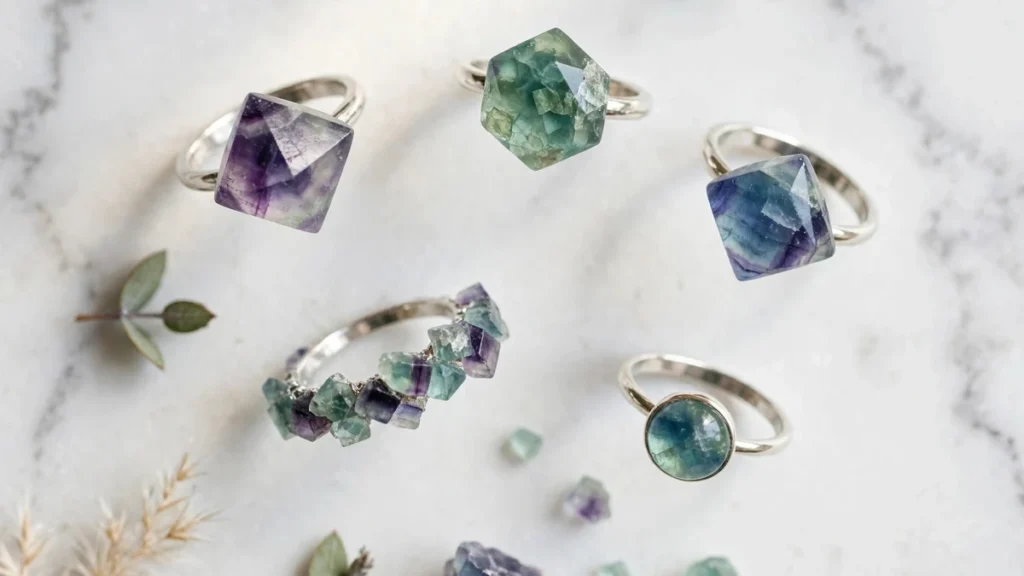
Fluorite is the most colourful stone in the jewellery box, and the most fragile one you can put on your hand. It comes in purple, green, blue, yellow, pink and rainbow bands, sometimes all in a single stone, and it glows in a way that few other gems can match. The problem is that fluorite is soft. It is softer than a steel nail, softer than a coin, and far softer than the sapphire or diamond rings it often sits next to. The challenge is not finding a beautiful fluorite ring. It is finding one that will still be beautiful in a year’s time.
That is why this guide is organised by setting and wear, not just by colour. A fluorite ring in an exposed prong setting is a different purchase from the same stone in a deep bezel, and a ring you wear once a week is a different purchase from one you never take off. Buy it with your eyes open, and it is a wonderful stone. Buy it blind, and it will chip.
Below are nine fluorite rings worth considering in 2027, from a classic purple fluorite solitaire to bold rainbow-banded statement rings. Each one is described by what it is good at, what to watch for, and who it suits best, so you can choose with your eyes open, not just your wallet.
Key takeaways
- Fluorite is calcium fluoride at Mohs 4, with perfect cleavage in four directions, which makes it one of the softest and most fragile stones used in rings.
- Bezel and channel settings protect fluorite best, because the metal absorbs the knocks that would chip an exposed stone, and a low profile keeps it out of harm’s way.
- Purple and green are the most common natural colours, while rainbow-banded fluorite shows several colours in one stone and is the most striking choice.
- Never put fluorite in an ultrasonic or steam cleaner, and never knock it against hard surfaces, because it can split along its cleavage planes.
- Fluorite has no proven healing properties and is not an investment stone, so buy it because you love the colour, not because it will gain value.
What fluorite actually is
Fluorite is calcium fluoride, a mineral that forms in perfect octahedral crystals and in massive, banded lumps that cutters slice into cabochons. Its colour range is wider than almost any other gemstone: deep purple, sea green, sky blue, sunny yellow, soft pink, colourless, and the famous rainbow banding where purple, green and blue flow into each other in a single stone. The colour comes from trace elements and from natural radiation in the earth, which is also why two fluorite stones from the same mine can look completely different.
That beauty comes with a real weakness. Fluorite sits at Mohs 4 on the hardness scale, which means it can be scratched by a steel nail, a coin, or even a hard countertop. More importantly, it has perfect cleavage in four directions, which means it can split cleanly along flat planes if it is knocked the wrong way. It will not scratch easily in normal wear, but a single sharp knock against a door handle or a stone worktop can crack it.
Because of that fragility, fluorite is usually cut as a smooth cabochon rather than a faceted stone. Facets create sharp edges and thin points that are the first things to chip, while a cabochon has a rounded dome with no weak corners, and its smooth surface shows off the colour and banding better than facets ever could. Most fluorite rings are also set low, with the stone sitting close to the band, because a tall setting is a lever that turns every knock into a crack.
How we chose these rings and what to look for
Look first at the setting, because it matters more for fluorite than for any other ring stone. A bezel setting, where a rim of metal wraps around the stone, is the best choice by a wide margin, because it protects the edges and holds the stone even if it does crack. A channel setting, where the stone sits in a groove between two rails of metal, is the next best option. Avoid high prong settings and tension settings entirely, because they leave the stone exposed and rely on pressure that fluorite cannot take.

Look next at the colour and the banding. Purple fluorite is the classic choice, and the most widely available, while green fluorite is softer and more subtle. Rainbow-banded fluorite is the most dramatic option, with purple, green and blue flowing through a single stone, but the bands are also where the stone is most likely to split, so a rainbow stone needs a bezel even more than a single-colour stone does. Our guide to fluorite bracelets explains how the same stone behaves in a piece of jewellery that takes far fewer knocks than a ring.
Finally, be honest about how you will wear it. Fluorite is a beautiful occasional ring, and a poor everyday ring. If you work with your hands, type all day, or play sport, a fluorite ring will chip, and no setting can fully prevent it. If you wear it for evenings, occasions and days when your hands are mostly free, it can last for years. A solid gold bezel with a well-cut natural fluorite is a fair price at the mid-range, while a very cheap ring is usually gold-plated with a coated stone.
The 9 best fluorite rings of 2027
Tiffany & Co. Purple Fluorite Pendant Ring
What we like: A deep purple fluorite cabochon in a clean 18-karat gold bezel, with the restrained proportions Tiffany does best and a stone chosen for an even, saturated colour. What to consider: Premium price for a soft stone, and the purple is a classic deep tone rather than a bright violet. Stone: Natural purple fluorite cabochon. Setting: 18-karat gold bezel. Best for: Occasional wear and a first fluorite ring. Price range: £1,100 to £1,700.
Cartier Fluorite Cocktail Ring
What we like: A large rainbow-banded fluorite in a bold gold setting with a sculpted band, a ring that is meant to be noticed and that shows off the stone’s banding at full scale. What to consider: A statement size that is not practical for daily wear, and the banded stone needs more care than a single-colour one. Stone: Natural rainbow fluorite, oval cabochon. Setting: 18-karat gold bezel. Best for: Evening wear and collectors. Price range: £2,400 to £3,800.
David Yurman Fluorite Cable Ring
What we like: A smooth green fluorite cabochon set into Yurman’s signature twisted cable band, a design that suits the soft, watery stone and gives the ring a handmade feel. What to consider: The cable band is wider than a plain band and can feel bulky on smaller fingers, and the green is a soft sea tone rather than a vivid emerald. Stone: Natural green fluorite cabochon. Setting: Sterling silver or 14-karat gold cable. Best for: Casual luxury and occasional wear. Price range: £550 to £1,000.
Mejuri Fluorite Dome Ring
What we like: A smooth dome of purple fluorite in a slim gold vermeil band, an affordable entry point with a clean, modern shape and a stone chosen for a warm, even colour. What to consider: Gold vermeil wears through faster than solid gold, and the dome is a softer polish that can show small scratches over time. Stone: Natural purple fluorite dome. Setting: Gold vermeil bezel. Best for: A first fluorite ring on a budget. Price range: £110 to £210.
Monica Vinader Fluorite Signet Ring
What we like: A flat fluorite face in a signet shape, with a slim gold band and a stone that sits flush, so it never catches on clothing or bags. What to consider: The flat face shows the colour less dramatically than a domed cabochon, and the signet shape suits some hands better than others. Stone: Natural fluorite, flat cut. Setting: 18-karat gold vermeil signet. Best for: Work wear and minimal styling. Price range: £140 to £260.
Missoma Fluorite Stacking Ring
What we like: A small fluorite cabochon on a fine band, designed to stack with plain gold bands, so you can wear fluorite as an accent rather than a statement. What to consider: The stone is small, so the colour is subtle, and the fine band is not as robust as a wider one. Stone: Natural fluorite, small cabochon. Setting: Gold vermeil bezel. Best for: Stacking and layering. Price range: £90 to £170.
Maria Black Fluorite Sculptural Ring
What we like: An irregular, sculptural setting that treats the fluorite as a found object, with an oxidised silver band that makes the stone’s natural banding the whole design. What to consider: An artistic shape that will not suit everyone, and the oxidised finish needs more care than polished silver. Stone: Natural fluorite, freeform cabochon. Setting: Oxidised sterling silver. Best for: Bold, artistic styling. Price range: £190 to £360.
Astrid & Miyu Fluorite Halo Ring
What we like: A fluorite centre stone ringed by small white topaz, which lifts the soft colour and makes the ring read as jewellery rather than a pebble on a band. What to consider: The halo adds height and small stones that need checking, and the white topaz is a much harder stone than the fluorite it surrounds. Stone: Natural fluorite cabochon. Setting: Gold vermeil halo. Best for: Dressier occasions. Price range: £120 to £230.
Thomas Sabo Fluorite Charm Ring
What we like: A fluorite cabochon in a charm-style setting with a detailed band, a playful, collectible design that suits fluorite’s colourful reputation. What to consider: A detailed, decorative band that can feel busy next to plain jewellery, and the charm style is a trend that may date. Stone: Natural fluorite cabochon. Setting: Sterling silver, charm detail. Best for: Casual and colourful styling. Price range: £100 to £190.
Which fluorite is right for you
Purple fluorite is the classic choice, and the easiest to buy well. It is the most widely available natural fluorite, it suits most skin tones, and its deep violet colour works with both gold and silver. If you want one fluorite ring and you want it to last, a purple fluorite solitaire in a bezel setting is the default answer, and it is the hardest one to get wrong. Green fluorite is the quieter option, with a soft sea-green colour that suits people who want colour without a statement, and it is usually natural and affordable.
Rainbow-banded fluorite is the most dramatic choice, with purple, green and blue flowing through a single stone, but it is also the most fragile, because the bands are where the stone is most likely to split. Blue fluorite is the one to be careful with, because natural blue fluorite is uncommon and some blue stones are coated or treated to deepen the colour. If you love the colour, buy it knowingly, check whether the stone is coated, and keep it out of strong sunlight and harsh chemicals.
Your lifestyle matters more for fluorite than for any other ring stone. If you work with your hands, type all day, or play sport, a fluorite ring will chip, and no setting can fully prevent it. A guide to fluorite necklaces is a useful comparison here, because a necklace shows how the same stone looks when it is not being knocked against everything your hand touches.
The caveats that matter
Fluorite is a beautiful stone, but it is not a forgiving one, and the things that damage it are the things most people do without thinking. A sharp knock can split it along a cleavage plane, a steel nail or a coin can scratch it, and an ultrasonic cleaner can crack it in seconds. None of these are reasons to avoid fluorite, but they are reasons to choose the setting carefully, to wear the ring only when your hands are free, and to store it separately from harder stones.
| Detail | What is known |
|---|---|
| What it is | Calcium fluoride, coloured by trace elements and natural radiation |
| Hardness | Mohs 4, with perfect cleavage in four directions, so it can split on a knock |
| Best colours | Purple and green are the most common natural colours; rainbow banding is the most dramatic |
| Best setting | Deep bezel or channel, low profile, with the stone edges protected by metal |
| Best cut | Smooth cabochon, which shows the colour and has no sharp edges to chip |
| Cleaning | Warm water and mild soap only, soft cloth, never ultrasonic or steam |
| What to avoid | Hard knocks, ultrasonic and steam cleaners, acids, storing loose with harder gems |
| What it does not do | It has no proven healing properties and is not an investment stone |
If you are buying a ring as a gift, check the return and exchange policy before you pay, because fluorite varies so much that the exact stone matters more than the listing. A good seller will show photographs of the actual ring, name the colour, and say whether the stone is natural, treated or coated.
Checklist: choosing a fluorite ring honestly
Use these checks before you buy, and again when the ring arrives.
- Check the setting: a deep bezel or channel protects fluorite best; avoid high prongs and tension settings.
- Check the colour: purple and green are usually natural; ask whether vivid blue stones are coated or treated.
- Check the stone: look for an even polish, no cracks, and banding you actually like.
- Check the metal: solid gold or silver lasts longer than plated or vermeil finishes.
- Check your lifestyle: fluorite is an occasional ring, not a daily one, if you work with your hands.
- Check the policy: confirm returns and exchanges, because no two fluorite stones look alike.
Frequently asked questions
Is fluorite durable enough for an everyday ring?
Honestly, no, not for most people. At Mohs 4 with perfect cleavage, it can scratch and split from ordinary knocks, so it is best as an occasional ring. If you want a stone you never have to think about, a harder gem such as sapphire is a better choice, and our guide to gold jewellery for everyday wear covers pieces designed for daily use.
Why is fluorite so fragile?
Fluorite has perfect cleavage in four directions, which means its crystal structure has flat planes where it can split cleanly. A sharp knock in the wrong direction can crack the stone even when the force seems small.
Can I wear a fluorite ring in water?
Brief contact with water is fine, but do not swim, shower or soak in a bath with a fluorite ring on. Soap, chlorine and hot water can dull the polish, and coated stones are more vulnerable. Clean it with warm water and mild soap, then dry it with a soft cloth.
How do I clean a fluorite ring?
Use lukewarm water, a drop of mild soap and a soft cloth, then rinse and dry thoroughly. Never use an ultrasonic or steam cleaner, and never use harsh chemicals or abrasive cleaners, which can crack the stone or damage the setting.
Is rainbow fluorite natural?
Yes, rainbow banding is natural, and it happens when different colours form in layers as the crystal grows. The bands are real, but they are also the stone’s weakest points, so a rainbow fluorite ring needs a deep bezel and gentle wear more than any other fluorite.
Does fluorite have healing properties?
There is no scientific evidence that fluorite, or any gemstone, has healing properties. Fluorite has a long history in folk belief, but those are cultural stories, not medical facts. Buy it because you love how it looks, not because it will improve your health.
The bottom line
The best fluorite ring in 2027 is not the most expensive or the most vividly coloured. It is the one with a natural stone in a colour you genuinely like, set low in a deep bezel that protects it, in a metal that will last as long as the stone, and worn on the days when your hands are free. Purple fluorite in a simple gold bezel is the safest first choice, and a rainbow-banded stone in a sculptural setting is the most interesting one, but both work for the same reason: the stone is honest, and the setting respects it.
Choose one ring, check the setting and the colour before you pay, wear it for a month on gentle days before you decide whether fluorite suits your life, and judge it on how it looks after real wear, not on how it looked in a photograph.