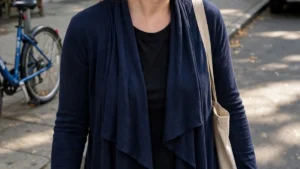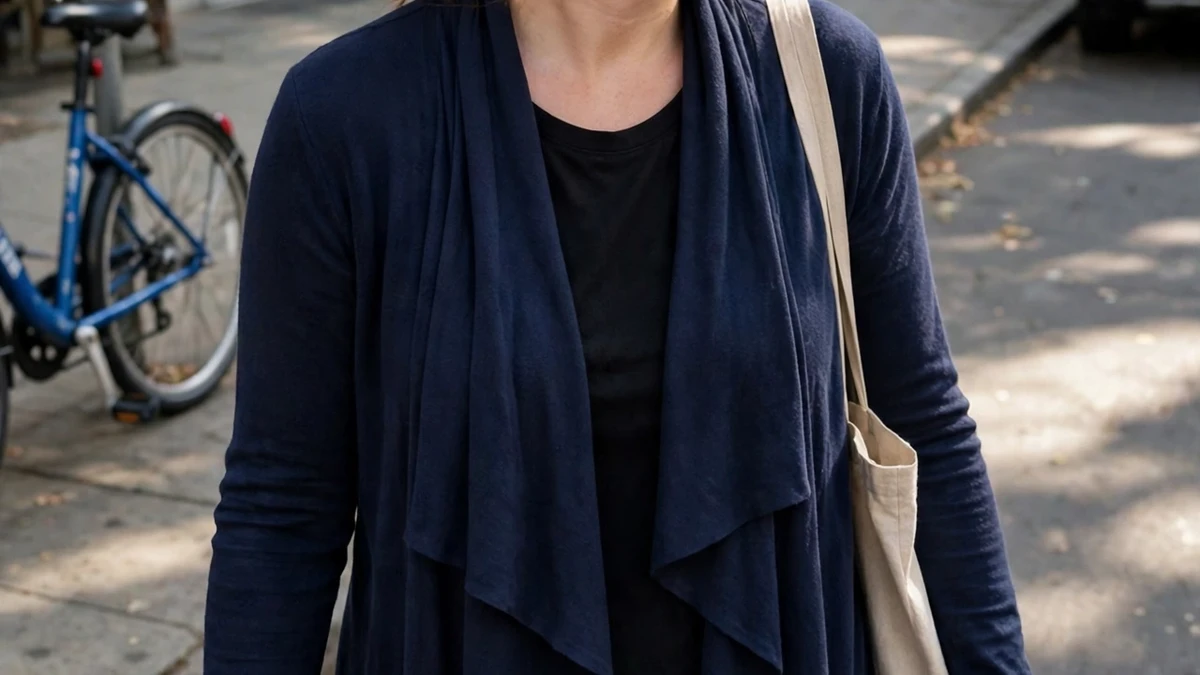
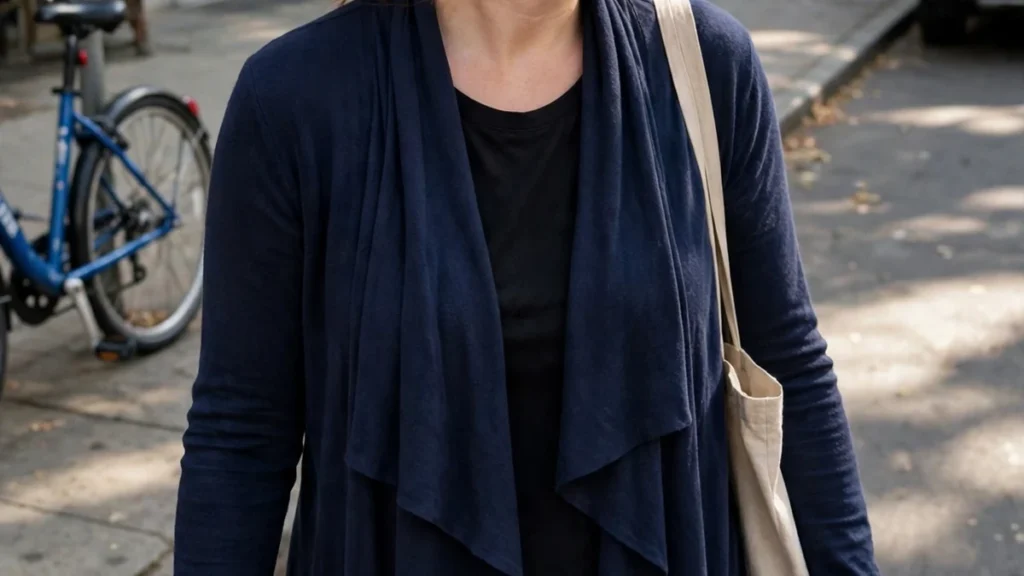
A waterfall cardigan is one of the easiest cardigans to put on and one of the easiest to get wrong. It has no buttons to fasten, no zip to close, no belt to tie. You simply slip it on and let the front panels fall. That simplicity is the appeal, and it is also the trap. Because nothing holds the garment in place, the drape does whatever it wants, and if the layers underneath are wrong, the whole outfit can look shapeless before you have left the house.
Styling one comes down to a few clear principles. Keep the layer underneath slim. Keep the bottom half narrow. Let the panels fall where they want to fall instead of fighting them. Match the length to your height. Once those principles are in place, the cardigan does most of the work itself.
Below are nine steps that cover the whole process, from choosing what goes underneath to checking the finished silhouette. Each step explains what to do, what to avoid, and how long it takes, so you can style a waterfall cardigan with confidence rather than guesswork.
Key takeaways
- Keep the layer underneath slim and plain, because a bulky top under a draped front doubles the volume in the same place.
- Let the front panels fall freely — pinning, tucking, or belting through them breaks the cascade the style is built on.
- Balance the drape with a narrow bottom half and a shoe with a little height, so the silhouette stays long and clean.
- Match the cardigan length to your height: hip length suits most people, while knee length needs a taller frame or heels.
- No single styling rule fits every body, and a very long, heavy waterfall can overwhelm a petite frame however you style it.
What makes a waterfall cardigan different to style
Most cardigans give you something to fasten: a button-front closes, a zip-front closes, a belted cardigan pulls the waist in. A waterfall cardigan gives you none of those controls. The front is open by design, the panels hang where gravity puts them, and the shape of the outfit comes from the layers underneath.
That changes how you build the outfit. With a button-front cardigan, the cardigan is the structure. With a waterfall cardigan, the top underneath is the structure and the cardigan is the softening layer on top. If the top is slim and plain, the drape falls cleanly. If it is loose or bulky, the outfit looks unfinished.
The drape also moves. When you walk, the panels swing. When you sit, they pool. When you reach for something, they fall forward. That movement is part of the charm, but it means the cardigan will not stay exactly where you put it. Accept the movement and build the outfit around it. Our guide to styling an open-front cardigan covers the wider family, and the same principle applies there.
What to wear underneath a waterfall cardigan
The layer underneath does the structural work, so choose it first. A fitted camisole is the simplest choice: it stays close to the body, adds no bulk, and lets the drape fall cleanly. A plain fitted tee works the same way for daytime, and a fine-knit top adds a little warmth without volume. All three are slim, plain, and free of ruffles or heavy embellishment.
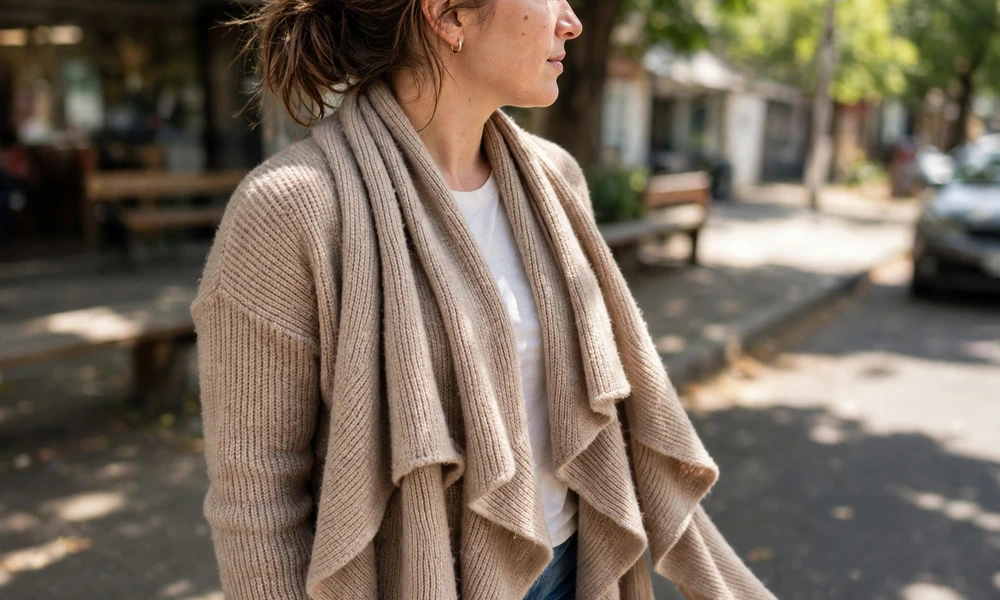
Avoid anything bulky or heavily detailed under a waterfall cardigan. A chunky jumper fights the drape and adds volume in the same place. A ruffled blouse catches in the folds and makes the front look lumpy. A wide, boxy top removes the contrast between the slim layer and the soft drape, which is what makes the outfit work. If you want warmth, add it as a thin thermal layer close to the body, not as a thick middle layer.
Colour matters too. A top in the same tone as the cardigan creates a long, unbroken line and makes the outfit look taller. A contrasting colour creates a clear vertical stripe, which can be striking but needs the rest of the outfit to be simple. Do not mix both, and avoid a busy patterned top under a draped front.
The 9 steps to styling a waterfall cardigan
Put a slim top on first
What to do: Choose a fitted camisole, a plain tee, or a fine-knit top that sits close to the body. What to avoid: Bulky jumpers, ruffled blouses, and wide boxy tops that add volume under the drape. Best For: Every waterfall outfit, as the foundation layer. Time Needed: Two minutes to choose and put on. Standout Tip: If the top feels loose at the waist, it is too loose for a waterfall cardigan.
The top underneath is the foundation of the whole outfit. Put it on first, check that it sits flat, and only then add the cardigan. If the top bunches or billows, change it.
Let the panels fall where they may
What to do: Slip the cardigan on, shake the panels gently, and let them settle where they fall. What to avoid: Pinning the panels, tucking them in, or belting through them, which breaks the cascade. Best For: Keeping the drape natural and the outfit relaxed. Time Needed: One minute. Standout Tip: Give the panels a small shake after putting the cardigan on, and they will fall into their natural folds.
The cascade only works if the panels are free to move. Resist the urge to pin them back or tuck them in. If a panel falls forward when you reach for something, push it back gently and let it fall again.
Keep the bottom half narrow
What to do: Pair the cardigan with slim jeans, narrow trousers, or a straight skirt. What to avoid: Wide-leg trousers and full skirts worn with a long waterfall, which make the silhouette shapeless. Best For: Balancing the volume of the drape. Time Needed: Two minutes to choose. Standout Tip: If the bottom half is wide, the cardigan should be short; if the cardigan is long, the bottom half should be narrow.
The waterfall adds volume at the front, so the bottom half needs to stay narrow. Slim jeans are the easiest choice; straight-leg trousers and straight skirts work well too. Wide-leg trousers can work with a hip-length waterfall, but not with a knee-length one.
Wear heeled shoes with a long waterfall
What to do: Wear a heeled ankle boot, a wedge, or a shoe with a small heel to lengthen the leg line. What to avoid: Completely flat shoes with a knee-length waterfall, which can shorten the leg line. Best For: Longer waterfall cardigans and petite frames. Time Needed: One minute to swap shoes. Standout Tip: Even a small heel changes how a long waterfall hangs, because it lifts the hem off the ground line.
A small heel is an easy fix for the one real drawback of a long waterfall: it can make your legs look shorter. A low block heel or a wedge is enough, and it is comfortable for a full day. With a hip-length waterfall, flat shoes are fine.
Add a long necklace to echo the fall
What to do: Wear a long pendant necklace that follows the same vertical line as the draped panels. What to avoid: Short, chunky necklaces that sit on top of the folds and compete with them. Best For: Smarter outfits and evening layering. Time Needed: One minute. Standout Tip: A pendant that ends at the same level as the cardigan hem ties the whole outfit together.
A long necklace works with the drape instead of against it. It follows the same vertical line as the falling panels and draws the eye down, which lengthens the torso. Keep it simple: a single pendant on a fine chain is enough.
Layer the waterfall over a fitted dress
What to do: Layer a hip-length waterfall over a fitted dress, letting the panels frame the dress rather than cover it. What to avoid: A loose, full dress under a long waterfall, which hides the dress and doubles the volume. Best For: Smart daytime outfits and evening events. Time Needed: Three minutes to try the combination. Standout Tip: A dress that ends above the cardigan hem keeps the layers visible and the outfit balanced.
The dress provides the slim structure, the cardigan softens the shoulders and adds movement, and the open front frames the dress instead of hiding it. Choose a dress that ends above the cardigan hem, so both layers stay visible.
Push the sleeves up to the elbow
What to do: Push or roll the sleeves to just below the elbow to show the wrists and keep the arms looking slim. What to avoid: Letting long, heavy sleeves hang past the wrists, which adds bulk at the arms. Best For: Warmer days and casual outfits. Time Needed: One minute. Standout Tip: A slim bracelet or a watch at the wrist gives the rolled sleeve a finished look.
The sleeves are often long and loose, which can make the arms look heavy. Rolling them to just below the elbow fixes that in seconds: it shows the wrist, a naturally slim point, and keeps the sleeves out of the way.
Match the cardigan length to your height
What to do: Choose a hip-length waterfall if you are petite, and a mid-thigh or knee-length one if you are tall. What to avoid: A knee-length waterfall on a petite frame, which can overwhelm the silhouette. Best For: Getting the proportions right before you buy. Time Needed: Five minutes with a full-length mirror. Standout Tip: The hem should end at a narrow point on your body: the hip, the knee, or just above it, never at the widest part of the thigh.
A hip-length waterfall suits almost everyone, because it ends at a narrow point and leaves the legs visible. A knee-length waterfall needs height to carry it, or heels to restore the proportion. Check where the hem falls: if it ends at the widest part of your thigh, it will make that area look wider.
Look at the finished outfit from across the room
What to do: Stand back from a full-length mirror and look at the whole outfit, not just the cardigan. What to avoid: Judging the outfit from close up, where the drape looks fine but the proportions are off. Best For: A final check before you leave the house. Time Needed: Two minutes. Standout Tip: Turn sideways and check the profile: the drape should fall in a smooth line from shoulder to hem.
Stand well back and look at the shape of the outfit as a whole: front, side, and back. The panels should fall in smooth folds, the bottom half should look narrow, and the hem should end at a flattering point. If something looks off, change one thing at a time.
Styling a waterfall cardigan for different occasions
For everyday wear, keep it simple: a plain fitted tee, slim jeans, and a hip-length waterfall in a neutral colour. Add flat shoes or low boots and a simple bag, and the outfit is done. The cardigan adds softness to an otherwise plain outfit, and the drape gives it movement without any extra effort. This is the combination you will reach for most often, so it is worth getting the fit right.
For work, choose a finer knit in a dark colour, worn over a fitted top and straight-leg trousers. Keep the accessories minimal: a long pendant necklace, a slim watch, and a structured bag. Our guide to styling a wrap cardigan is a useful companion here, because the two styles share the same soft, draped feel.
For evening, a waterfall cardigan over a fitted dress is the strongest choice. Choose a wool or cashmere blend with a neat shoulder line, a long pendant necklace, and heeled shoes. Avoid a very long waterfall if you will be sitting for a long time, because the panels pool when you sit.
The caveats that matter
A waterfall cardigan will not keep you warm on its own. The open front lets heat escape, and the panels are too light to act as a coat. Treat it as a layering piece: wear it over a warm top indoors, and put a coat on over it outdoors. A fine knit sits under a coat without bulk; a heavy one will bunch.
| Detail | What is known |
|---|---|
| Best layer underneath | A slim, plain top: a camisole, a fitted tee, or a fine-knit top |
| Best bottom half | Slim jeans, narrow trousers, or a straight skirt |
| Best shoes with a long waterfall | A small heel or wedge, which lengthens the leg line |
| Best accessory | A long pendant necklace that follows the vertical line of the drape |
| Best length for petite frames | Hip length in a fine knit |
| What to avoid | Pinning or belting through the panels, which breaks the cascade |
| Warmth | A layering piece, not outerwear; the open front lets heat escape |
| Final check | Stand back from a full-length mirror and check the whole silhouette |
The other caveat is care. Viscose blends can shrink or lose their drape if washed hot, and wool blends need a gentle cycle or hand washing. A waterfall cardigan that has lost its drape is no longer a waterfall cardigan: it is just a shapeless open front. Read the care label before you buy, wash it gently, and dry it flat so the panels keep their shape.
Checklist: styling a waterfall cardigan honestly
Use these checks each time you wear one, until they become habit.
- Check the top underneath: slim, plain, and sitting flat against your body.
- Check the bottom half: narrow, so the silhouette stays clean under the drape.
- Check the panels: free to fall, not pinned, tucked, or belted through.
- Check the length: the hem should end at a narrow point, not at the widest part of the thigh.
- Check the shoes: a small heel helps with a long waterfall, especially on a petite frame.
- Check the mirror: stand back and look at the whole silhouette, front, side, and back.
Frequently asked questions
Can I wear a belt with a waterfall cardigan?
Not through the panels. A belt pulled across a waterfall cardigan breaks the cascade and turns it into a belted cardigan, which is a different style. If you want a defined waist, choose a belted cardigan instead, or wear a belt at the waist over the top underneath and let the cardigan hang open above it.
What shoes go with a waterfall cardigan?
A small heel or wedge works best with a long waterfall, because it lengthens the leg line. With a hip-length waterfall, flat shoes, trainers, and low boots all work. Avoid very flat shoes with a knee-length waterfall, which can shorten the legs.
Can I wear a waterfall cardigan to work?
Yes, in a fine knit and a dark colour, over a fitted top and straight-leg trousers. Keep the accessories minimal and the shoes polished. Avoid very long, heavy drapes for work, which can look too casual.
How do I stop the panels falling forward?
You cannot stop them completely, and you should not try. The panels move when you move, and that is part of the style. Push a panel back gently and let it fall again. If it bothers you constantly, the cardigan may be too long or too heavy for you.
Does a waterfall cardigan suit a petite frame?
Yes, if you choose a hip-length style in a fine knit. Avoid knee-length, heavy drapes, which can swamp a small frame. A shorter waterfall gives the same soft effect in better proportion, especially with a small heel. Our longline cardigan styling guide covers the same length question for another long style.
What is the best colour for a waterfall cardigan?
A plain, dark colour is the most versatile: it is forgiving, it makes the drape read as a clean line, and it matches almost anything. A light colour shows the folds more clearly, which is beautiful in a fine knit. Avoid busy patterns, which break up the folds and make the drape look messy.
The bottom line
Styling a waterfall cardigan is simpler than it looks, once you accept how the garment works. The top underneath does the structural work, the bottom half stays narrow, and the panels are left free to fall. Get those three things right and the cardigan will soften any outfit.
Choose the length for your height, check the silhouette in a full-length mirror before you leave, and do not fight the drape. A waterfall cardigan is at its best when it looks effortless, and the quickest way to ruin that is to pin, tuck, or belt it into submission.