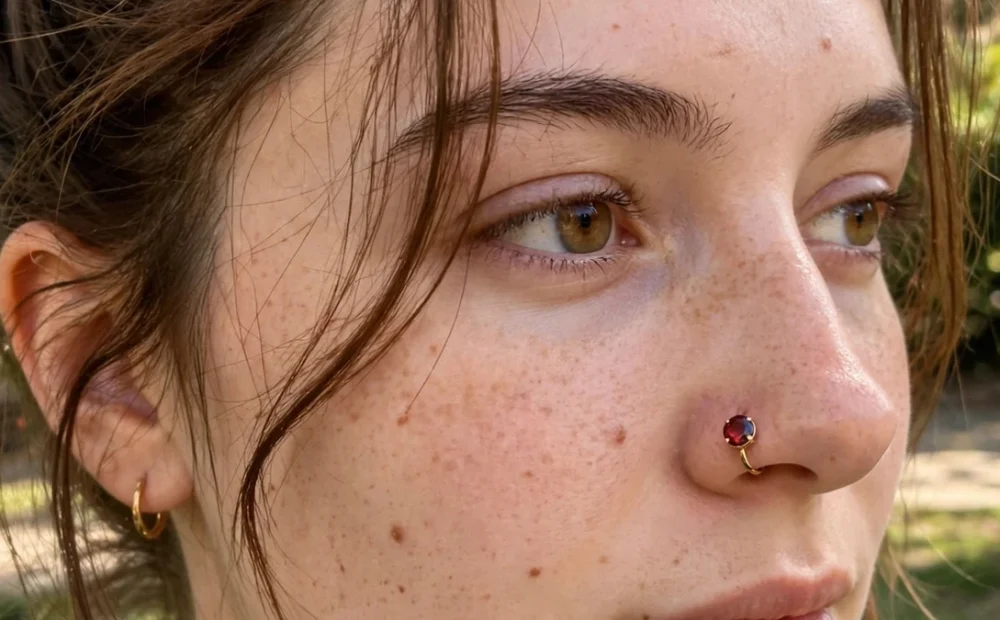
An amethyst nostril ring is one of the easiest ways to add colour to a piercing without making it loud. Amethyst comes in deep violet, soft lilac, smoky purple and pale lavender, and it has been worn as a February birthstone for centuries, which gives it a familiarity that newer stones do not have. The problem is not finding a pretty ring. It is finding one where the stone is set securely, the metal suits your skin, and the size and gauge actually fit your nostril.
That is why this guide is organised by stone and setting, not just by price. A deep purple amethyst stud in solid gold behaves very differently from a cheap plated hoop with a glued-in stone, even when the two look similar in a photograph. Gauge, post length, setting style and metal quality all decide whether a ring feels comfortable after a week or ends up sitting in a drawer. A ring that pinches, spins, or sits at the wrong angle will annoy you all day, and no stone colour makes up for a bad fit.
Below are nine amethyst nostril rings worth considering in 2027, from a classic violet stud to a pale lilac screw and a vintage-style ring. Each one is described by what it is good at, what to watch for, and who it suits best, so you can choose with your piercing in mind, not just a bestseller list.
Key takeaways
- Amethyst is the purple variety of quartz, widely available, affordable, and a natural fit for a small nostril stone.
- Choose the right gauge and post length first, then the stone colour; a ring that does not fit will not be worn, however pretty it is.
- Solid gold, implant-grade titanium and solid sterling silver are the safest metals for a healed piercing; plated bases wear through fastest.
- Bezel and prong settings hold small stones more securely than glue-set stones, which can loosen with water and heat.
- No nostril ring suits a fresh or irritated piercing, and amethyst colour varies a lot, so expect differences in depth and tone.
What amethyst nostril rings actually are
An amethyst nostril ring is a small piece of jewellery worn through the nostril, with an amethyst stone as its centrepiece. It comes in three main forms: a stud with a straight post and a flat or ball back, an L-shaped or screw post that curves inside the nostril, and a small hoop with the stone set on the front. All three sit in the same piercing, but they feel different, catch the light differently, and suit different face shapes.
Amethyst is a variety of quartz, rated 7 on the Mohs hardness scale. That makes it softer than topaz and sapphire, but still hard enough for a small nostril stone that is worn daily, provided the setting protects it. Its colour comes from iron in the crystal, and it ranges from pale lilac to deep, almost inky violet. The most valued stones are a rich, even purple with a hint of red; pale stones are softer and more subtle, and smoky amethyst has a grey-brown undertone.
The stone is usually small, between 1.5 and 3 millimetres, because a nostril piercing cannot carry a large stone comfortably. At that size the colour reads as a flash rather than a statement, which is exactly why amethyst works so well here: a small purple stone catches the eye without competing with the rest of your face, and it pairs easily with everyday clothes and other jewellery.
How we chose these amethyst nostril rings and what to look for
Look first at gauge and fit. Most nostril piercings are 18 gauge, with 20 gauge common for a finer look. A ring in the wrong gauge will either slide around or feel tight, and neither is comfortable. Post length matters too: a standard 6 to 7 millimetre post suits most nostrils, but a shorter post sits neater if your nostril is thin, and a longer one is kinder while a piercing is still settling.

Look next at the metal and the setting. Solid 14k gold, implant-grade titanium and solid sterling silver are the reliable choices for a healed piercing, and they age well. Gold-filled is a reasonable middle ground, while thin plating over a base metal wears through fastest and can irritate sensitive skin. A bezel setting wraps the stone in metal and protects its edges, which matters for amethyst because it is softer than topaz; a prong setting shows more of the stone but needs checking now and then to make sure the prongs are still tight. Our guide to nose rings for women covers shapes and settings in more detail, and it is a useful second read before you buy.
Finally, look at the stone itself. Ask whether the amethyst is natural or lab-created, and expect real variation in colour between individual stones: two violet stones from the same batch can look quite different in daylight. Avoid stones that look cloudy, glassy or unevenly coloured in photographs, and avoid rings where the stone appears glued rather than set. A secure setting, a sensible gauge and a metal your skin tolerates matter far more than a brand name.
The 9 best amethyst nostril rings of 2027
The Classic Violet Amethyst Stud
What we like: A 2 millimetre deep violet amethyst in a simple prong setting, rich in colour without being loud, and easy to wear every day. What to consider: The prongs need a quick check every few months. Best for: A first amethyst nostril ring. Material: 14k solid gold. Price range: $75 to $130. Standout feature: A classic, even violet that suits every skin tone.
This is the safe starting point, and the one most people end up wearing the most.
The Deep Purple Amethyst Hoop
What we like: A deep purple stone set on a slim seamless hoop, with more colour than a stud and a modern feel. What to consider: Hoops catch on fabric more easily than studs. Best for: Healed piercings and a bolder look. Material: Implant-grade titanium with a gold finish. Price range: $40 to $75. Standout feature: The richest purple in this roundup.
A good choice if you want the stone to be noticed rather than whispered.
The Pale Lilac Amethyst Screw
What we like: A soft lilac stone on a screw post that stays put and suits fair skin and light hair. What to consider: Screw posts take a little practice to insert. Best for: Everyday wear with a soft, light look. Material: Solid sterling silver. Price range: $35 to $65. Standout feature: The palest, most delicate colour here.
The screw shape is practical: once it is in, it rarely moves.
The Amethyst Bezel Stud
What we like: A violet stone fully wrapped in a smooth bezel, with no prongs to catch and a neat, modern outline. What to consider: The bezel hides the edges of the stone, so slightly less light gets through. Best for: Active days and sensitive skin. Material: Implant-grade titanium. Price range: $30 to $60. Standout feature: The smoothest, snag-free design here.
This is the practical pick: nothing to catch, nothing to loosen, easy to clean.
The Rose Gold Amethyst Hoop
What we like: A violet stone on a rose gold hoop, warm, flattering on warm skin, and softer than yellow gold. What to consider: Rose gold is a plated finish on some cheaper hoops, so check the metal. Best for: Warm skin tones and romantic styling. Material: 14k rose gold. Price range: $70 to $115. Standout feature: Warm rose gold against cool violet.
The contrast between warm metal and cool stone is what makes this one stand out.
The Amethyst and Diamond Accent Stud
What we like: A violet amethyst centre stone flanked by two tiny diamond accents, the most luxurious ring in this list. What to consider: The highest price here, and the accents need care. Best for: A gift or a milestone. Material: 14k solid gold with diamond accents. Price range: $150 to $230. Standout feature: Real diamond accents beside the amethyst.
If one ring in this list is a treat rather than a staple, this is it.
The Vintage-Style Amethyst Ring
What we like: A small violet amethyst in a milgrain-edged setting with vintage detailing, characterful without being costume-like. What to consider: The detailing needs gentle cleaning to stay bright. Best for: Vintage lovers and second piercings. Material: 14k yellow gold. Price range: $85 to $150. Standout feature: Old-fashioned charm in a modern size.
It looks like a piece with a story, which is rare at this size and price.
The Oval Amethyst Stud
What we like: An oval-cut amethyst that sits lengthways on the nostril, elegant and slightly different from the usual round stone. What to consider: The oval shape shows colour unevenly if the stone is pale. Best for: A refined, understated look. Material: 14k white gold. Price range: $80 to $135. Standout feature: An oval cut that flatters the shape of the nostril.
A quiet variation that feels considered rather than flashy.
The Light Amethyst L-Shape
What we like: A light lavender stone on an L-shaped post, subtle, easy to put in, and gentle on the eye. What to consider: The colour is pale, so it reads as neutral rather than colourful. Best for: Workdays and minimal jewellery. Material: Solid sterling silver. Price range: $35 to $65. Standout feature: A soft lavender that works like a neutral.
If deep violet feels too strong for you, this is the amethyst to try first.
Which amethyst nostril ring is right for you
Start with your piercing, not the stone. If your piercing is fully healed and you want the easiest daily wear, a stud or a bezel-set ring is the sensible choice. A bezel-set ring is the most forgiving choice if you are still learning what suits you, because it has no prongs to catch and no hoop to spin. If you like movement and a little more presence, a slim hoop works well, provided the piercing is settled and you are comfortable with a ring that catches the light, and occasionally a scarf. Screw and L-shaped posts sit between the two: secure, low-profile, and easy once you know how to put them in.
Then match the colour to your skin and your wardrobe. Deep violet suits most skin tones and reads as rich and confident. Pale lilac and lavender are softest on fair skin and light hair, and they pair well with silver and white gold. Smoky amethyst has a grey undertone that works with cooler wardrobes, while a violet stone in rose gold is the warmest combination here. Our guide to nostril rings for women covers shapes and sizes in more detail, and it is a useful second read before you buy.
Finally, be honest about your budget and your habits. A solid gold stud costs more than a plated one, but it will still look good in two years, while plating wears thin in months. If you change jewellery often, a well-made titanium or silver piece is good value. If you wear one ring for months at a time, spend the extra on solid gold and a secure setting.
The caveats that matter
Amethyst is hard enough for daily wear, but it is softer than topaz and sapphire, so it needs a little more care. A sharp knock can chip a small stone, and a loose prong can lose one altogether, so check the setting now and then and take the ring out before rough sport or heavy work with your hands near your face. A small stone is also easier to lose, so check the setting after cleaning and keep a spare back or post at home. Amethyst can also fade with long, strong sun exposure, so do not leave the ring on a sunny windowsill or in a hot car.
| Detail | What is known |
|---|---|
| Stone hardness | Amethyst rates 7 on the Mohs scale, hard enough for daily wear with a protective setting |
| Common colours | Deep violet, lilac, pale lavender and smoky purple |
| Usual gauge | 18 gauge is most common, with 20 gauge for a finer look |
| Best metals | Solid 14k gold, implant-grade titanium and solid sterling silver for healed piercings |
| Most secure settings | Bezel and prong settings hold small stones better than glue-set stones |
| Who should wait | Anyone with a fresh, irritated or unhealed piercing should wait until it is fully settled |
| Cleaning | Warm water, mild soap and a soft cloth; avoid harsh chemicals and ultrasonic cleaners at home |
| What it does not do | It does not suit a fresh piercing, and colour varies a lot between individual stones |
If your piercing becomes red, swollen, painful or starts discharging after you change jewellery, take the ring out, clean the area gently, and speak to your piercer or a clinician. Do not keep wearing a ring that irritates your skin in the hope that it will settle. A reaction to a metal or a poor fit is a reason to change the jewellery, not to endure it.
Checklist: buying an amethyst nostril ring honestly
Use these checks before you buy, and again when the ring arrives.
- Check the gauge and post length: 18 gauge and a 6 to 7 millimetre post suit most nostrils.
- Check the metal: solid gold, implant-grade titanium or solid silver, not thin plating over a base metal.
- Check the setting: bezel or prong, with the stone firmly held, not glued in.
- Check the colour: ask whether the amethyst is natural or lab-created, and expect real shade differences.
- Check the size: a 1.5 to 3 millimetre stone sits neatly; larger stones overwhelm a nostril piercing.
- Check the return policy: a reputable seller accepts returns, so you can check the fit at home.
Frequently asked questions
What gauge is an amethyst nostril ring?
Most nostril piercings are 18 gauge, and most amethyst nostril rings are sold in 18 gauge, with 20 gauge available for a finer look. Check your piercing before you order, because a ring in the wrong gauge will not sit properly.
Can I wear an amethyst nostril ring every day?
Yes, once your piercing is fully healed. Amethyst is durable enough for daily wear in a good setting, and a well-made ring in solid gold or titanium is made to be worn, not stored. Take it out for rough sport and keep harsh chemicals away from it.
Is amethyst a real gemstone?
Yes. Amethyst is the purple variety of quartz, a genuine gemstone, and it is also the traditional birthstone for February. Lab-created amethyst is chemically the same stone, grown rather than mined, and it is usually more evenly coloured and less expensive.
Will an amethyst nostril ring irritate sensitive skin?
It should not, if the metal is right. Implant-grade titanium and solid 14k gold are the safest choices for sensitive skin. Plated jewellery is the most common cause of irritation, so avoid thin plating if your skin reacts easily.
How do I clean an amethyst nostril ring?
Warm water, mild soap and a soft cloth are enough. Rinse well, dry it fully, and check the setting while you clean it. Avoid ultrasonic cleaners and harsh jewellery dips at home, which can loosen small stones.
Is amethyst better than other stones for a nostril ring?
For colour and value, often yes. Amethyst gives you a rich purple at a modest price, and it is harder than pearl and garnet. Topaz is harder still, but amethyst wins on colour depth for the money. Our roundup of amethyst nose rings compares it with other stone options if you want a wider view.
The bottom line
The best amethyst nostril ring in 2027 is not the darkest or the most expensive. It is the one in the right gauge, in a metal your skin tolerates, with a securely set stone in a colour you will still like in a year. For most people that means a deep violet stud in solid gold or titanium, with a bezel or prong setting that holds the stone properly.
Choose one ring, check the fit when it arrives, and wear it for a few weeks before you judge it. A nostril ring lives close to your face, so comfort and fit matter more than any photograph. Get those right, and amethyst is one of the easiest coloured stones to wear every day.