Emeralds are the most romantic of the green stones. Their colour, a deep, slightly blue-green that no other gem quite matches, has made them a favourite for centuries, from Cleopatra’s mines to the emerald suites worn at royal weddings. A good emerald bracelet is a piece of jewellery that draws the eye without shouting, and it pairs beautifully with gold, which warms the green and makes it look richer.
The problem is that emeralds are also one of the trickiest stones to buy well. Almost every emerald on the market has been oiled, a standard treatment that fills tiny surface cracks and improves clarity, and the quality of that treatment matters as much as the stone itself. A poorly oiled emerald can look cloudy within a year, and an emerald that has been dyed or heavily treated can lose its colour. The difference between a bracelet you treasure and one you regret is usually in details that are not visible in a product photo.
Below are nine emerald bracelets worth considering in 2027, from classic line bracelets to bolder statement pieces. Each one is described by what it does well, what to watch for, and who it suits best, so you can choose with your eyes open, not just your heart.
Key takeaways
- Emeralds are softer than diamonds and sapphires, at 7.5 to 8 on the Mohs scale, so they need a protective setting and gentle handling.
- Almost all emeralds are oiled to improve clarity; the treatment is standard, but it must be disclosed, and heavily oiled stones need more care.
- Colombian emeralds are prized for their vivid, slightly blue-green colour, while Zambian emeralds are often a deeper, more bluish green.
- Never clean an emerald bracelet in an ultrasonic or steam cleaner, and never wear it swimming or in a chlorinated pool.
- No emerald is an investment on its own, and a very cheap emerald is almost always dyed, synthetic, or heavily treated.
What an emerald bracelet actually is
An emerald bracelet is any bracelet whose main stones are emeralds, the green variety of the mineral beryl. The most common styles are line bracelets, where a row of matched emeralds runs around the wrist, and bangle or cuff bracelets, where one or more larger emeralds sit in a gold band. Tennis-style emerald bracelets, with a continuous line of small stones, are the most popular, because they show the colour as a single, unbroken band of green.
Emerald colour is judged differently from diamond colour. The most valued emeralds are a vivid, slightly bluish green with good saturation and even tone. A stone that is too dark looks almost black in low light, while a stone that is too pale looks washed out and more like green beryl. The trade calls the finest colour “Muzo green”, after the famous Colombian mine, but a good Zambian or Brazilian emerald can be just as beautiful at a lower price.
Clarity is the other key factor, and it works differently for emeralds than for diamonds. Emeralds almost always contain inclusions, the tiny fractures and veils that the trade calls the “jardin”, French for garden. A few fine inclusions are normal and even expected. What matters is whether they affect the stone’s durability or its transparency. A heavily included emerald can be fragile, while a very clean emerald is rare and expensive.
How we chose these bracelets and what to look for
Look first at the oiling. Almost every emerald is treated with colourless oil, usually cedar oil, to fill surface-reaching fractures and improve clarity. This is a standard, accepted treatment, but it should be disclosed, and the amount matters. A lightly oiled emerald is stable and easy to care for. A heavily oiled emerald can look cloudy if the oil dries out, and it should never go near an ultrasonic cleaner, steam, or strong solvents, which can strip the oil out. Ask the seller how the stone was treated and whether it comes with a laboratory report.
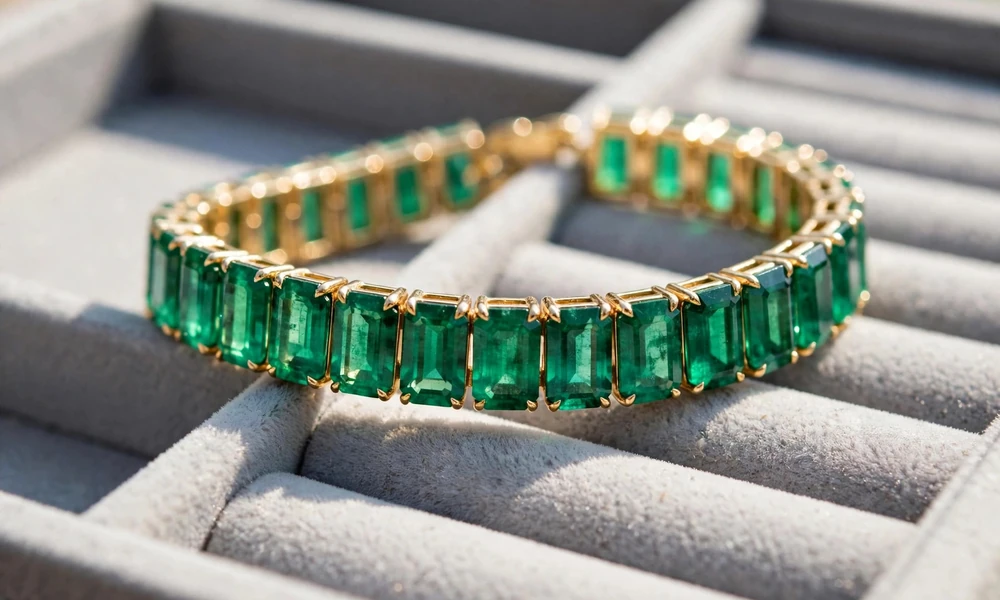
Look next at the setting. Emeralds are softer than diamonds and more brittle, so they need protection. A bezel setting, where gold wraps around the edge of each stone, is the safest choice for a bracelet that will be worn often. A four-prong setting shows more of the stone and more sparkle, but leaves the corners exposed to knocks. A line bracelet with a secure box clasp and a safety catch is essential, because a lost emerald is hard to replace with an exact match. Our guide to emerald necklaces covers the same oiling and origin questions in more detail, because the rules for buying an emerald are the same whatever the piece.
Finally, look at the origin and the price. Colombian emeralds command the highest prices, followed by Zambian and Brazilian stones. A very cheap emerald, especially one sold without any information about treatment or origin, is almost always dyed quartz, glass, or a synthetic stone. That does not make it worthless as fashion jewellery, but it should be sold and priced as what it is, not as a fine emerald.
The 9 best emerald bracelets of 2027
Tiffany & Co. Emerald Line Bracelet
What we like: A classic line of matched Colombian emeralds in 18-karat yellow gold, with a secure box clasp and Tiffany’s strict stone-matching standards. What to consider: Premium price, and the stones are natural, so the cost is far higher than a lab-created equivalent. Stone: Natural Colombian emeralds. Setting: Four-prong, 18-karat yellow gold. Best for: A milestone gift or a once-in-a-lifetime purchase. Price range: £6,000 to £18,000 and above, depending on total carat weight.
Cartier Emerald Line Bracelet
What we like: A refined line of emeralds in 18-karat gold with Cartier’s precise setting work, a discreet clasp, and a slim profile that layers well with a watch. What to consider: Very premium pricing, and the slim design suits smaller wrists best. Stone: Natural emeralds, Colombian or Zambian. Setting: Four-prong, 18-karat gold. Best for: Someone who wants a house-name piece with a slim, elegant line. Price range: £7,000 to £22,000 and above.
David Yurman Emerald Bracelet
What we like: A well-made emerald line in 14-karat or 18-karat gold, with a sturdy clasp and a design that sits comfortably flat on the wrist. What to consider: Still a luxury price, and the range of total carat weights is narrower than at some specialists. Stone: Natural emeralds. Setting: Four-prong, 14-karat or 18-karat gold. Best for: Everyday luxury with a designer name. Price range: £3,000 to £9,000.
Mejuri Emerald Tennis Bracelet
What we like: A lab-created emerald line in 14-karat gold at a fraction of the price of mined stones, with a secure box clasp and a clean, modern line. What to consider: Lab-created emeralds have very little resale value, and the colour can be more uniform than a natural stone. Stone: Lab-created emeralds. Setting: Four-prong, 14-karat gold. Best for: A first emerald bracelet on a realistic budget. Price range: £600 to £2,800.
Monica Vinader Emerald Tennis Bracelet
What we like: A delicate lab-created emerald line in 14-karat gold vermeil or solid gold, with a neat clasp and a light, comfortable feel. What to consider: The vermeil version is gold-plated silver and will need replating with heavy wear, so choose solid gold for daily use. Stone: Lab-created emeralds. Setting: Four-prong, 14-karat gold or gold vermeil. Best for: A light, everyday bracelet at an accessible price. Price range: £350 to £1,600.
Missoma Emerald Tennis Bracelet
What we like: An affordable lab-created emerald line in 14-karat gold vermeil or solid gold, with a simple, elegant design that layers well with other bracelets. What to consider: The entry version is vermeil, not solid gold, and the stones are small. Stone: Lab-created emeralds. Setting: Four-prong, gold vermeil or 14-karat gold. Best for: Stacking and everyday wear on a modest budget. Price range: £250 to £900.
Maria Black Emerald Bracelet
What we like: A modern, slightly edgier take on the emerald bracelet, with lab-created emeralds in solid 14-karat gold and a secure clasp. What to consider: The design is less traditional, so it suits a contemporary wardrobe better than a classic one. Stone: Lab-created emeralds. Setting: Four-prong, 14-karat gold. Best for: A contemporary take on a classic. Price range: £300 to £1,000.
Maria Black’s bracelet is for someone who likes the emerald bracelet idea but wants a less formal version. The proportions are modern, the gold is solid, and the price is fair for what you get.
Astrid & Miyu Emerald Tennis Bracelet
What we like: A slim, affordable lab-created emerald line in solid gold or gold vermeil, with a delicate profile that suits smaller wrists. What to consider: The stones are small and the bracelet is delicate, so it is not the best choice for very active wear. Stone: Lab-created emeralds. Setting: Four-prong, gold vermeil or solid gold. Best for: A first, delicate emerald bracelet. Price range: £200 to £700.
This is the most delicate bracelet in this list, and that is its appeal. It reads as a fine line of green on the wrist rather than a bold statement, and it works well layered with a plain gold bangle.
Thomas Sabo Emerald Tennis Bracelet
What we like: A well-priced lab-created emerald line in 14-karat gold, with a secure clasp and a classic, even stone line. What to consider: The brand is better known for silver, so the gold range is smaller and less widely stocked. Stone: Lab-created emeralds. Setting: Four-prong, 14-karat gold. Best for: A classic look at a mid-range price. Price range: £250 to £800.
Thomas Sabo’s emerald bracelet is a straightforward, honest piece. The stones are evenly matched in colour, the clasp is secure, and the price sits in a sensible middle ground between fashion jewellery and high jewellery.
Which emerald bracelet is right for you
Start with how often you will wear it. If the bracelet is for every day, choose a bezel or shared-prong setting in 14-karat gold, with a box clasp and a safety catch. The stones will be better protected, the gold will resist scratches, and the clasp will give you a second layer of security. If the bracelet is for occasions, a four-prong setting in 18-karat gold will show more of the stone and more of its colour.
Next, decide between natural and lab-created emeralds. A natural emerald bracelet holds more resale value and carries the traditional appeal of a mined stone, but the price is far higher and the oiling needs more care. A lab-created emerald bracelet looks the same on the wrist, costs far less, and is usually cleaner, with fewer inclusions. Our guide to gold jewellery for everyday wear explains how to weigh metal and stone choices together, because the right combination depends on how often the piece will be worn.
Finally, look at the colour in daylight, not just under shop lights. An emerald that looks vivid in a brightly lit store can look dark or dull in natural light, especially if the stone is heavily included. Ask to see the bracelet by a window, and compare it with another emerald if you can. The best emerald is the one whose colour you still love in ordinary light.
The caveats that matter
Emeralds need more care than diamonds or sapphires. They should never go in an ultrasonic cleaner or a steam cleaner, because the vibration and heat can strip out the oil and crack the stone. They should never be worn in a chlorinated pool, a hot tub, or while using household chemicals. Cleaning is simple: warm water, a drop of mild soap, and a very soft brush, then dry with a soft cloth.
| Detail | What is known |
|---|---|
| Hardness | 7.5 to 8 on the Mohs scale, softer and more brittle than diamond or sapphire |
| Standard treatment | Almost all emeralds are oiled to improve clarity; the treatment must be disclosed |
| Best colour | Vivid, slightly bluish green with even tone; Colombian stones are the most prized |
| Best setting for daily wear | Bezel or shared-prong, which protects the stone edges |
| Best setting for colour | Four-prong, which shows more of the stone |
| Cleaning | Warm soapy water and a soft brush only; never ultrasonic, steam, or solvents |
| When to check it | Clasp and prongs checked by a jeweller at least once a year |
| What it does not do | It does not hold its value like a diamond, and a very cheap emerald is almost always dyed, synthetic, or heavily treated |
If you are buying a natural emerald, ask for a laboratory report from a recognised lab, and check what it says about treatment. A report that says “minor oil” is a good sign. A report that says “moderate” or “significant” oil means the stone needs more care and should cost less. If a seller cannot tell you how the stone was treated, do not buy it at a fine-jewellery price.
Checklist: choosing an emerald bracelet honestly
Use these checks before you buy, and again after a month of wear.
- Check the colour in daylight: it should be vivid and even, not dark, pale, or patchy.
- Check the treatment: ask whether the stone is oiled, how much, and whether it comes with a lab report.
- Check the setting: a bezel setting protects the stone best; a four-prong setting shows more colour but needs more care.
- Check the clasp: it should be a box clasp with a safety catch, and it should close with a firm click.
- Check the gold: confirm whether it is 14-karat or 18-karat, and whether it is solid gold or vermeil.
- Check the price: a very cheap emerald is almost always dyed, synthetic, or heavily treated, so ask what you are actually buying.
Frequently asked questions
Are emeralds durable enough for a bracelet?
Yes, with care. Emeralds are 7.5 to 8 on the Mohs scale, which is hard enough for jewellery, but they are more brittle than diamonds because of their natural inclusions. A bezel setting, a secure clasp, and gentle handling make an emerald bracelet perfectly wearable every day.
What does oiled mean for an emerald?
Oiling is a standard treatment where colourless oil is used to fill tiny surface fractures and improve clarity. Almost all emeralds are oiled to some degree. It is not a flaw, but it must be disclosed, and heavily oiled stones need more care and should cost less than lightly oiled ones.
Can I wear an emerald bracelet every day?
Yes, if it is well made and you treat it gently. Choose a protective setting, take it off for the gym, swimming, and housework, and have the prongs checked once a year. Keep it away from ultrasonic cleaners, steam, and harsh chemicals.
Are lab-created emeralds real emeralds?
Yes. Lab-created emeralds are chemically and optically the same as natural emeralds. They are grown in a laboratory rather than mined, and they are usually cleaner, with fewer inclusions. They should always be sold as lab-created, at a much lower price than a natural stone.
How do I clean an emerald bracelet?
Soak it in warm water with a drop of mild dish soap, then brush very gently with a soft toothbrush and rinse. Dry it with a soft cloth. Never use an ultrasonic cleaner, a steam cleaner, or solvents, and never wear it in a chlorinated pool.
What should I pair an emerald bracelet with?
An emerald bracelet pairs well with gold, with a simple watch, or with a single diamond line. A statement necklace in a contrasting colour can work for an evening, but for everyday wear, a plain gold bangle or a single emerald line on its own is usually the most elegant choice.
The bottom line
The best emerald bracelet in 2027 is not the most expensive one. It is the one with an even, vivid green, honest disclosure about oiling, and a setting that protects the stone. For daily wear, a lab-created emerald line in 14-karat gold is the most sensible choice. For a milestone or a piece you hope to keep for decades, a natural Colombian emerald line in 18-karat gold from a house with strong aftercare is worth the extra cost.
Choose one bracelet, look at the colour in daylight before you buy, and have the clasp and prongs checked once a year after that. An emerald bracelet looked after properly is a piece you can wear for decades, and the right green will still catch your eye the same way in ten years as it does on the day you buy it.