



Braids are a protective style, but they are not a set-and-forget style. The hair tucked inside a braid still needs moisture, the scalp still needs care, and the edges still need a gentle hand. Oil is the simplest tool for all three jobs, but only when it is the right oil, used in the right amount, in the right place.
The mistake most people make is treating braids like loose hair. With loose hair, oil goes on the lengths and ends. With braids, the lengths are already covered, so the work shifts to the scalp, the parts, and the exposed ends. A good braid oil is light enough to sink in, gentle enough for a scalp that is already under tension, and easy to apply precisely, a few drops at a time, rather than poured on in a rush.
Below are nine hair oils worth considering for braids in 2027, from a light rosemary scalp oil to a rich castor blend for dry ends. Each one is described by what it is good at, what to watch for, and who it suits best, so you can choose with your braid style and your scalp in mind, not just a bestseller list.
Key takeaways
- Braids need oil most on the scalp, along the parts, and on the exposed ends, not on the braided lengths themselves.
- Light oils such as rosemary, jojoba, and grapeseed absorb well and suit most scalps, while heavy castor oil is best used sparingly on dry ends.
- Apply a few drops at a time with your fingertips or a nozzle tip, and massage gently rather than rubbing hard.
- Oil does not repair split ends, regrow hair, or fix breakage on its own, and it cannot replace washing and proper braid care.
- Too much oil causes build-up, itching, and a dull film on braids, and tight braids plus heavy oil is a combination that can irritate the scalp.
Why braids need a different kind of oil
A braid changes where your hair can and cannot be reached. The lengths are woven away, which protects them from daily friction and weather, but it also means conditioner, water, and oil cannot reach them in the usual way. What stays exposed is the scalp between the parts, the hairline, and the ends that stick out or are tucked at the bottom. Those three areas dry out first, and they are where oil earns its place.
The scalp is the most important of the three. Braids pull, even gently installed ones, and a pulled scalp is a sensitive scalp. A light oil massaged along the parts keeps the skin supple and reduces the dry, tight feeling that makes people scratch.
The ends matter too, because they are the oldest and driest part of the hair. In box braids and knotless braids, the natural ends are often tucked inside the braid or left out at the tip. A small amount of a slightly richer oil on those ends keeps them from drying out and snapping off when the braids come out. The braided lengths in between need almost nothing. Oil applied there mostly sits on the surface, collects dust, and makes the braids look dull. Our guide to what a hair oil is explains the basic idea behind these products, and the same logic applies here: a little, placed well, beats a lot, placed anywhere.
How we chose these oils and what to look for
Look first at the weight and the applicator. A braid oil should be light enough to sink into the scalp without leaving a greasy film, and it should come with a nozzle, dropper, or pointed tip that lets you place drops exactly along a part. A wide-mouth jar or a spray that mists everything is harder to control, and control is what keeps build-up away. If an oil feels thick and sticky between your fingers, it is probably better suited to the ends than to the scalp.
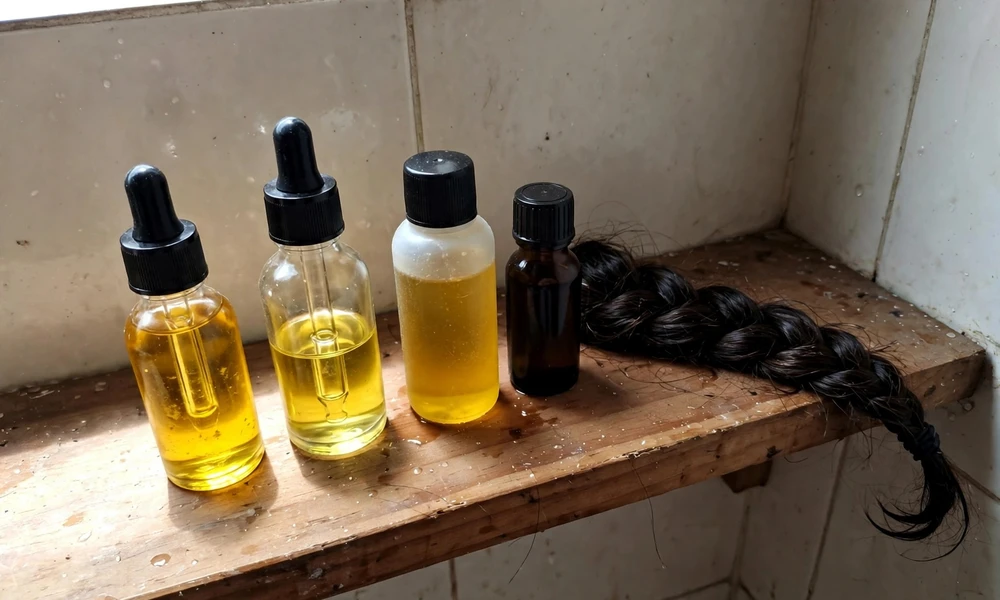
Look next at the ingredients. Rosemary, peppermint, and tea tree are common in scalp oils because they feel refreshing and are often used in formulas aimed at a dry, itchy scalp. Jojoba and grapeseed are light carriers that absorb easily and suit most skin. Castor oil, especially Jamaican black castor oil, is much heavier and is best kept for the ends or for very dry, coarse hair.
Finally, look at how the oil behaves over a week of wear. A good braid oil should keep the scalp comfortable for two to three days between applications, without flaking, without a heavy smell, and without making the braids look greasy. Prices below are approximate and reflect typical retail listings in 2027.
The 9 best hair oils for braids of 2027
Mielle Organics Rosemary Mint Scalp & Hair Strengthening Oil
What we like: A light rosemary and mint oil with a pointed applicator tip that places drops exactly along the parts. It feels cooling on the scalp, absorbs well, and is one of the easiest oils to use on fresh braids without making them look greasy.
What to consider: The mint tingle can feel strong on a very sensitive or freshly braided scalp, so use fewer drops at first. Best for: Knotless and box braids, normal to oily scalps. Material: Rosemary oil, mint, biotin. Price range: Around $10 to $12. Standout feature: The precision applicator tip, which keeps oil off the braided lengths.
Camille Rose Cocoa Nibs & Honey Ultimate Growth Serum
What we like: A soft, honey-scented serum that feels more like a light treatment than a heavy oil. It spreads easily along the parts and leaves the scalp feeling moisturised rather than coated.
What to consider: It is richer than a pure carrier oil, so a little goes a long way, and it can feel heavy if you use too much. Best for: Dry scalps and coarse, thick hair. Material: Cocoa nibs, honey, castor and coconut oils. Price range: Around $15 to $18. Standout feature: The soft, non-greasy finish that suits daily use on braids.
SheaMoisture Jamaican Black Castor Oil Strengthen & Restore Treatment
What we like: A rich castor oil blend with shea butter and peppermint, made for hair that needs serious moisture. On braid ends it is excellent, and it helps dry, rough ends stay supple until takedown day.
What to consider: It is heavy, so keep it off the scalp and the braided lengths, where it can cause build-up. Best for: Dry ends and coarse, thick hair. Material: Jamaican black castor oil, shea butter, peppermint. Price range: Around $12 to $15. Standout feature: The richness that makes it ideal for ends rather than scalps.
Carol’s Daughter Goddess Strength 7 Oil Blend
What we like: A blend of seven oils, including castor, black cumin, and grapeseed, that feels lighter than a pure castor oil. It works on the scalp and the ends, and the scent is soft rather than medicinal.
What to consider: It is still a blend with castor oil in it, so use small amounts on the scalp and check for build-up after a week. Best for: Weak or breakage-prone hair in braids. Material: Castor, black cumin, grapeseed, and four more oils. Price range: Around $14 to $17. Standout feature: The seven-oil blend that balances richness with easy absorption.
As I Am Jamaican Black Castor Oil Water
What we like: A water-based castor oil spray that refreshes braids without the heaviness of a pure oil. It is easy to mist over the scalp and ends, and it helps with the dry feeling that builds up between washes.
What to consider: Because it is water-based, it does not seal in moisture the way a pure oil does, so it works best as a refresher between oilings. Best for: Refreshing braids between washes, all hair types. Material: Jamaican black castor oil, water, vitamin E. Price range: Around $8 to $11. Standout feature: The spray format that reaches the scalp without pouring or dripping.
Olaplex No. 7 Bonding Oil
What we like: A very light, concentrated oil that adds shine and softness to the exposed ends without weighing them down. A few drops go a long way, and it leaves braids looking polished rather than greasy.
What to consider: Premium price for a small bottle, and it is best used on the ends rather than the scalp. Best for: Smoothing flyaways and dry ends on braids. Material: Bis-aminopropyl diglycol dimaleate, grapeseed and fermented oils. Price range: Around $28 to $32. Standout feature: The concentrated formula, where two to three drops are enough for the whole head of braids.
Kérastase Elixir Ultime L’Huile Originale
What we like: A light, fragrant oil with camellia, marula, and argan oils that gives braids a soft sheen and a pleasant scent. It absorbs quickly and does not leave a sticky residue on the braided lengths.
What to consider: It is fragranced, so it is not the best choice for a very sensitive scalp, and the price is high for the amount you get. Best for: Adding shine and softness to braids before an event. Material: Camellia, marula, and argan oils. Price range: Around $55 to $65. Standout feature: The fine, fast-absorbing texture that leaves no residue.
Verb Ghost Oil
What we like: A weightless oil with moringa that smooths frizz and flyaways without flattening the braids. It is one of the lightest oils on this list, and it works well on fine hair that gets weighed down easily.
What to consider: It is very light, so it may not be enough on its own for very dry scalps or coarse hair. Best for: Fine hair, flyaways, and daily smoothing. Material: Moringa oil, soybean oil. Price range: Around $18 to $22. Standout feature: The weightless finish that never looks greasy, even on fine hair.
Briogeo B. Well Organic Cold-Pressed Castor Oil
What we like: A pure, cold-pressed castor oil with no added fragrance, useful for the ends and for anyone who wants a single-ingredient product. It is thick, so it stays where you put it, and it is excellent for sealing moisture into dry braid ends.
What to consider: It is very thick and can be hard to spread, so warm a few drops between your palms first, and keep it away from the scalp. Best for: Sealing dry ends and very coarse hair. Material: 100 percent cold-pressed castor oil. Price range: Around $26 to $30. Standout feature: The single-ingredient purity, with nothing added to dilute it.
Matching the oil to your braid style
Box braids and knotless braids are the most common styles, and they are also the easiest to oil, because the parts are wide and the scalp is accessible. A light oil with a nozzle tip works best here. Cornrows are similar, but the parts are often narrower, so use even less oil and a lighter formula, or the oil can pool along the rows and attract dust.
Feed-in braids and stitch braids sit close to the scalp, which means the scalp is already under more tension than with box braids. For these styles, choose the lightest oil you own, use only a few drops, and avoid anything with a strong tingle, such as a high-menthol formula, until the braids have settled for a few days.
Protective styles that include added hair, such as braids with extensions, need oil mainly on your own scalp and on the ends where your natural hair meets the added hair. Our guide to hair oils for wigs covers a similar idea, because in both cases the added hair does not need the oil, your own hair does.
The caveats that matter
Oil is a helper, not a treatment. It does not repair split ends, it does not regrow hair, and it does not undo damage from braids that were installed too tightly. If your scalp is painful, if you have bumps, sores, or hair loss along the hairline, that is a sign to remove the braids and let the scalp rest, not a sign to add more product.
| Detail | What is known |
|---|---|
| Where to apply it | Scalp along the parts, the hairline, and the exposed ends, not the braided lengths |
| How much to use | A few drops per part, two to three times a week, more is not better |
| Best scalp oils | Light oils such as rosemary, jojoba, grapeseed, and mint blends |
| Best ends oils | Richer oils such as castor oil blends, used sparingly on the tips only |
| When to wash | Every one to two weeks, or sooner if there is itching, flaking, or build-up |
| What to avoid | Heavy oil on the scalp, scratching with nails, and tight braids plus heavy oil |
| Who should be careful | Sensitive scalps, people with scalp conditions, and anyone with painful braids |
| What oil does not do | It does not repair split ends, regrow hair, or fix damage from tight braids |
Patch-test any new oil before using it on a full head of braids. Apply a small amount behind your ear or on your inner arm, wait 24 hours, and check for redness or itching. If you have a scalp condition such as eczema or psoriasis, check with your clinician before adding a new oil to your routine.
Checklist: oiling braids without the build-up
Use these checks each time you oil your braids, and again before wash day.
- Choose a light oil for the scalp and a richer oil for the ends, and keep them separate in your mind.
- Apply a few drops at a time along the parts, using a nozzle tip or your fingertips, never a pour.
- Massage gently with the pads of your fingers for a minute, and do not scratch with your nails.
- Keep oil off the braided lengths, where it collects dust and makes braids look dull.
- Oil two to three times a week, and wash every one to two weeks, or sooner if there is build-up.
- Stop and reassess if the scalp is painful, itchy after oiling, or flaking, and remove braids that hurt.
Frequently asked questions
How often should I oil my braids?
Two to three times a week is enough for most people. Apply a few drops along the parts and on the ends, massage gently, and let it absorb. Daily oiling is usually unnecessary and is the fastest route to build-up.
Can I oil my scalp with braids in?
Yes, that is exactly what braid oil is for. Use a light oil with a nozzle tip, place drops along the parts, and massage with your fingertips. Keep the oil off the braided lengths so they stay clean.
Does hair oil help braids last longer?
It helps the scalp and ends stay comfortable, which makes it easier to keep braids in for the full wear period.
Should I use castor oil on my scalp with braids?
Castor oil is very heavy, so it is better suited to the ends than the scalp. If you do use it on the scalp, use a tiny amount, warm it between your palms first, and watch for build-up. A lighter oil is usually a better daily choice for the scalp.
Why do my braids look greasy after oiling?
Usually because too much oil was used, or because it was applied to the braided lengths instead of the scalp and ends. Use fewer drops, place them precisely along the parts, and wipe any excess off the lengths with a damp cloth.
Can I wash my braids if I have been oiling them?
Yes, and you should. Wash every one to two weeks with a diluted shampoo, focusing on the scalp and rinsing well. Our guide to fall protective hairstyles includes styles that work well with a regular wash routine, and the same washing logic applies to braids in any season.
The bottom line
The best hair oil for braids in 2027 is not the most expensive or the heaviest. It is the one that suits your scalp, that you can apply precisely in small amounts, and that keeps your scalp comfortable without leaving a film on the braids. For most people, that means a light rosemary or jojoba-based oil for the scalp, and a richer castor blend saved for the ends.
Choose one scalp oil and one ends oil, use them two to three times a week, wash regularly, and pay attention to what your scalp is telling you. If the scalp is sore, itchy, or flaking, no oil will fix it, and the braids need attention, not more product.


