A nose hoop should be the easiest piece of jewellery you own. It is small, it sits close to the skin, and once it is in, you mostly forget about it. That only works when the metal agrees with your skin. For many people, a hoop that looks perfect in the box starts to itch, redden, or feel sore within a day or two, and the culprit is almost always the metal, not the piercing.
Hypoallergenic, in plain terms, means a hoop made from a metal that rarely causes a reaction. Implant-grade titanium and niobium lead the list, followed by solid 14k gold and nickel-free sterling silver. What matters is not the label on the listing but the actual composition, the finish, and whether the hoop was made for a piercing rather than for costume wear. A cheap hoop can carry the word hypoallergenic while still containing nickel in the alloy or the plating.
Below are nine hoops worth considering in 2027, from a plain titanium seamless hoop to a fine gold hoop with a small crystal end. Each one is described by what it is good at, what to watch for, and who it suits best, so you can choose with your skin in mind, not just a product photo.
Key takeaways
- Implant-grade titanium and niobium are the safest starting points for sensitive skin, because both are nickel-free and resist corrosion.
- Solid 14k gold is a good option too, but gold-filled, gold-plated, and gold-tone hoops are not the same thing, and plating can wear through.
- Check the gauge and the diameter before you buy, because a hoop that is too tight or too loose will irritate a piercing even in the kindest metal.
- Only change a hoop once the piercing is fully healed, usually after four to six months, and never while it is sore, swollen, or still healing.
- No hoop is guaranteed reaction-free for everyone, and any hoop that causes persistent redness, swelling, or discharge should come out and a professional piercer should be seen.
What hypoallergenic nose hoops actually are
A hypoallergenic nose hoop is a hoop made from a metal with a very low chance of triggering contact dermatitis, the itchy, red reaction that nickel and some other metals cause. The metals that earn the label honestly are implant-grade titanium, niobium, solid 14k or 18k gold, and platinum. Nickel-free sterling silver can also work well for healed piercings, though silver tarnishes and needs more care than titanium.
The word itself is not regulated, which is the first thing to understand. Any seller can call a hoop hypoallergenic, and many do, even when the hoop is made from an unnamed alloy with a thin plating. The honest check is the material name and the grade: ASTM F-136 titanium, pure niobium, or solid gold with a stated karat. If a listing only says “hypoallergenic metal” without naming the metal, treat that as no information at all.
Finish matters as much as composition. A well-polished hoop has a smooth surface with no rough seam or sharp edge, so it moves in the piercing without scratching the skin inside. A rough seam on a cheap seamless hoop can irritate a piercing every time the hoop shifts, even when the metal itself is fine. Hold the hoop up to the light before you wear it. If the seam catches your eye, it will catch your piercing too.
How we chose these hoops and what to look for
Look first at the named metal and the grade. Implant-grade titanium, listed as ASTM F-136 or Grade 23, is the most widely recommended metal for sensitive piercings, because it contains no nickel and forms a stable oxide layer that resists corrosion. Niobium is similarly nickel-free and slightly softer, which makes it comfortable but also easier to scratch, so a niobium hoop needs a little more care.
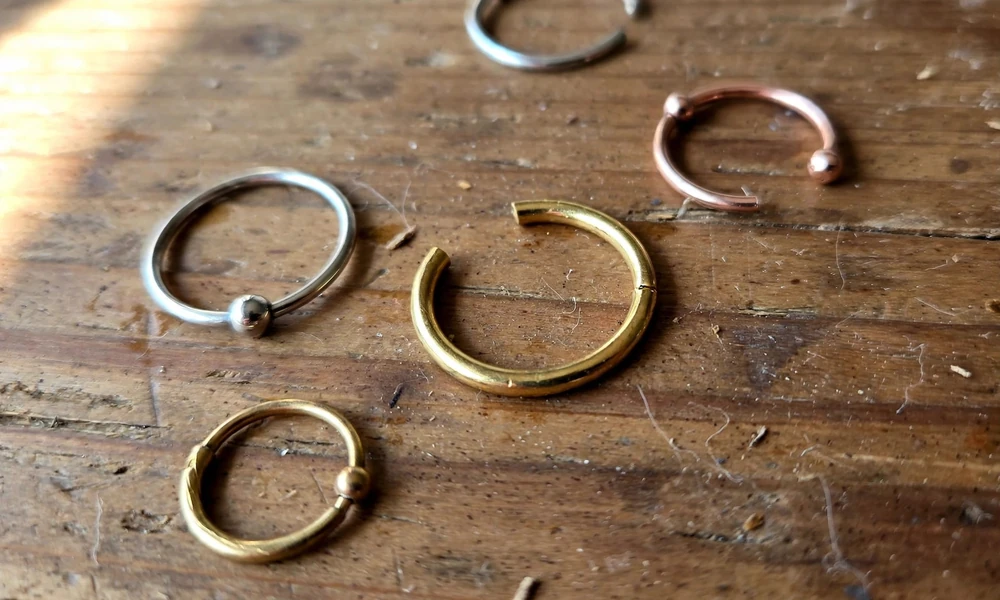
Look next at the gauge and the diameter. Most nostril piercings are done at 18 gauge, with 20 gauge as the finer option, and a hoop that is a different gauge from your piercing will either not fit or will stretch the hole. The diameter decides how the hoop sits: too small and it pinches, too large and it catches on everything. Our guide to the best nose hoops for women explains how diameter and gauge work together, because the right size matters as much as the right metal.
Finally, look at the closure. A seamless hoop twists open and closed, a hinged hoop clicks open at a small joint, and a clicker hoop has a segment that swings out. Hinged and clicker hoops are easier to change, which matters when you are swapping a hoop in a healed piercing. A seamless hoop needs more care to close neatly, and a gap that is not fully closed leaves a sharp edge against the skin.
The 9 best hypoallergenic nose hoops of 2027
The Classic Implant-Grade Titanium Hoop
What we like: ASTM F-136 titanium, nickel-free, lightweight, and available in both seamless and hinged versions, with a polished finish that sits comfortably in a healed piercing. What to consider: The plain silver-grey colour is less decorative than gold, and the metal is hard enough that a seamless version needs a firm twist to close neatly. Best for: Sensitive skin and first hoop changes. Material: Implant-grade titanium, ASTM F-136. Price range: Under $25. Standout feature: The safest default for reactive skin.
The Slim Gold-Tone Niobium Hoop
What we like: Pure niobium, nickel-free, anodised to a warm gold tone without any plating, and slim enough to look delicate rather than heavy. What to consider: Niobium is softer than titanium, so the hoop can pick up fine scratches, and the gold tone is a surface colour, not solid gold. Best for: People who want a gold look without gold prices. Material: Pure niobium, anodised. Price range: $15 to $30. Standout feature: Gold colour with no plating to wear off.
The Tiny Crystal Hoop
What we like: A small titanium hoop with a single tiny crystal set into the front, so it reads as jewellery rather than plain metal, while the part touching the piercing stays nickel-free titanium. What to consider: The crystal setting adds a small catch point, so it needs a gentle clean, and the crystal is decorative rather than a real gemstone. Best for: Everyday wear with a little sparkle. Material: Implant-grade titanium with a cubic zirconia crystal. Price range: $20 to $35. Standout feature: Sparkle without giving up a safe metal.
The Nickel-Free Sterling Silver Hinged Hoop
What we like: Nickel-free sterling silver with a hinged closure that clicks open and shut, so it is easy to change without tools, and a bright, classic silver finish. What to consider: Silver tarnishes and needs regular cleaning, and it is softer than titanium, so it can bend if it catches on clothing. Best for: Healed piercings and people who prefer silver. Material: Nickel-free 925 sterling silver. Price range: $25 to $45. Standout feature: The easiest closure on this list.
The Rose Gold-Tone Titanium Hoop
What we like: Implant-grade titanium anodised to a soft rose gold tone, so the colour is part of the metal and there is no plating to wear through, with a slim profile that suits most nostrils. What to consider: The rose tone is subtle and varies slightly between makers, and a seamless version needs care to close without a visible gap. Best for: Warm skin tones and a soft, everyday look. Material: Implant-grade titanium, anodised. Price range: $20 to $35. Standout feature: Rose gold colour in a nickel-free metal.
The Black Niobium Hoop
What we like: Pure niobium anodised to a deep black, nickel-free, lightweight, and a strong choice for people who want a hoop that reads as modern rather than traditional. What to consider: The black finish can show fine scratches over time, and it suits some outfits better than others, so it is less of an everyday neutral than silver or gold. Best for: A bold, minimal look. Material: Pure niobium, anodised. Price range: $15 to $30. Standout feature: A true black finish with no coating.
The Opal-Topped Hoop
What we like: A titanium hoop with a small opal cabochon on the front, giving a soft flash of colour while the piercing itself only touches polished titanium. What to consider: Opal is a soft stone and needs gentle handling, and the setting adds a small amount of weight compared with a plain hoop. Best for: Special occasions and softer, paler outfits. Material: Implant-grade titanium with a synthetic opal. Price range: $25 to $45. Standout feature: Colour and shimmer in a safe metal.
The Fine 14k Gold Seamless Hoop
What we like: Solid 14k gold, not plated or filled, in a fine seamless hoop that is light, smooth, and suitable for long-term wear in a healed piercing. What to consider: The highest price on this list, and solid gold is softer than titanium, so a very fine hoop can bend if it catches. Best for: Long-term wear and people who want real gold. Material: Solid 14k gold. Price range: $80 to $150. Standout feature: Real gold, with nothing to wear off.
The Tiny Two-Tone Titanium Hoop
What we like: Implant-grade titanium with a small two-tone detail, so it pairs with both silver and gold jewellery, while the whole hoop stays nickel-free. What to consider: The two-tone effect is subtle and best appreciated up close, and a very small hoop can be fiddly to open and close. Best for: Mixed-metal outfits and minimal wardrobes. Material: Implant-grade titanium, anodised two-tone. Price range: $20 to $35. Standout feature: Works with silver and gold alike.
Which nose hoop is right for you
Start with your skin. If your piercing has reacted to jewellery before, or if you react to earrings, belt buckles, or watch backs, choose implant-grade titanium or niobium first. Both are nickel-free and both are widely used in piercings for exactly that reason. Solid 14k gold is the next best option, and nickel-free sterling silver works well for healed piercings that have never reacted.
Then match the size. Most nostril piercings are 18 gauge, and the common hoop diameters are 6, 7, and 8 millimetres. A 6 millimetre hoop hugs the nostril, an 8 millimetre hoop hangs a little lower and is easier to change. If you are unsure, a piercer can measure your piercing in a minute, and it is worth asking rather than guessing. A guide to buying a nose hoop walks through gauge and diameter in more detail, because the two numbers together decide how a hoop will actually sit.
Finally, match the closure to your patience. Hinged and clicker hoops are the easiest to change, which matters if you swap hoops often. Seamless hoops look the cleanest, but they need a careful twist to open and close without leaving a gap. If you change your hoop once and leave it in for months, either style works. If you change it weekly, choose a hinge.
The caveats that matter
Hypoallergenic does not mean risk-free. A small number of people react even to titanium or gold, and a reaction can also come from a dirty hoop, a piercing that is not yet healed, or a hoop that is the wrong size and constantly rubbing. If a hoop causes itching, redness, or soreness that does not settle within a day or two, take it out, keep the piercing clean, and see a professional piercer or a clinician. Do not try to push through a reaction by wearing the hoop longer.
| Detail | What is known |
|---|---|
| Safest metals | Implant-grade titanium (ASTM F-136), niobium, solid 14k or 18k gold, platinum |
| What to avoid | Unnamed alloys, nickel, and plated or coated hoops where the coating can wear through |
| Common gauge | 18 gauge for most nostril piercings, 20 gauge for a finer fit |
| Common diameters | 6, 7, and 8 millimetres; smaller hugs the nostril, larger hangs lower |
| When to change a hoop | Only once the piercing is fully healed, usually after four to six months |
| Cleaning | Warm water and mild soap, or a saline rinse; avoid harsh chemicals and alcohol |
| What the label does not guarantee | “Hypoallergenic” is not regulated, so check the named metal and grade, not the word |
| When to get help | Persistent redness, swelling, pain, or discharge; see a professional piercer or clinician |
Be careful with plated hoops in particular. A gold-plated hoop can look identical to a solid gold hoop on the day you buy it, but the plating is thin and wears first where the hoop passes through the piercing, which is exactly where it matters. If a hoop is much cheaper than solid gold should be, it is almost certainly plated or filled, and the base metal underneath is often a nickel alloy.
Checklist: buying a hypoallergenic nose hoop honestly
Use these checks before you buy, and again when the hoop arrives.
- Check the named metal and grade: ASTM F-136 titanium, pure niobium, solid 14k gold, or nickel-free 925 silver, not just the word “hypoallergenic”.
- Check the gauge: 18 gauge for most nostril piercings, 20 gauge if your piercing is finer.
- Check the diameter: 6 millimetres for a close fit, 7 or 8 millimetres for a looser, easier change.
- Check the seam and the finish: smooth, polished, no rough edge or visible gap when closed.
- Check the closure: hinged or clicker if you change hoops often, seamless if you want the cleanest look.
- Check your piercing first: only change a hoop once it is fully healed, and see a piercer if it is sore, swollen, or unsure.
Frequently asked questions
What is the safest metal for a nose hoop?
Implant-grade titanium is the safest default for most people, because it is nickel-free, corrosion-resistant, and widely used in piercings. Niobium is a close second. Solid 14k gold is also a good option, but avoid plated or gold-filled hoops if your skin is reactive.
Can I wear a hypoallergenic hoop in a new piercing?
A new piercing should keep the jewellery it was pierced with until it is fully healed, usually four to six months. Changing to a new hoop earlier can reopen the wound and set healing back by weeks, even in the kindest metal.
Is sterling silver hypoallergenic?
Nickel-free sterling silver can work well for healed piercings, but it is not the safest choice for sensitive skin, because it tarnishes and some alloys contain nickel. If you choose silver, look for nickel-free 925 silver and clean it regularly. Gold and silver each have their own trade-offs, and our gold versus silver nose hoops comparison sets them out side by side.
How do I know if a hoop is really hypoallergenic?
Look for the named metal and the grade on the listing: ASTM F-136 titanium, pure niobium, or solid 14k gold with a stated karat. If the listing only says “hypoallergenic metal” without naming the metal, that tells you nothing, and you should ask the seller or choose another hoop.
Why does my nose hoop still irritate my piercing?
The metal may not be the problem. A hoop that is the wrong gauge or diameter, a rough seam, a piercing that is not yet healed, or a hoop that has not been cleaned can all cause irritation. If the problem continues after you have checked the size and the finish, take the hoop out and see a professional piercer.
How do I clean a hypoallergenic nose hoop?
Warm water and a drop of mild soap, then rinse and dry it fully before you wear it. A saline rinse works too. Avoid alcohol, hydrogen peroxide, and harsh jewellery cleaners, which can damage the finish and irritate the piercing.
The bottom line
The best hypoallergenic nose hoop in 2027 is not the most expensive or the most decorated. It is the one made from a named, nickel-free metal, in the right gauge and diameter, with a smooth finish and a closure you can manage. For most sensitive skin, that means implant-grade titanium or niobium first, solid 14k gold second, and nickel-free silver for healed piercings that have never reacted.
Choose one hoop, check the metal and the size before you buy, and only change it once the piercing is fully healed. If your skin reacts, stop, take the hoop out, and see a professional piercer rather than hoping the irritation settles on its own. That is the honest way to enjoy a nose hoop without the itch that makes people give up on one.