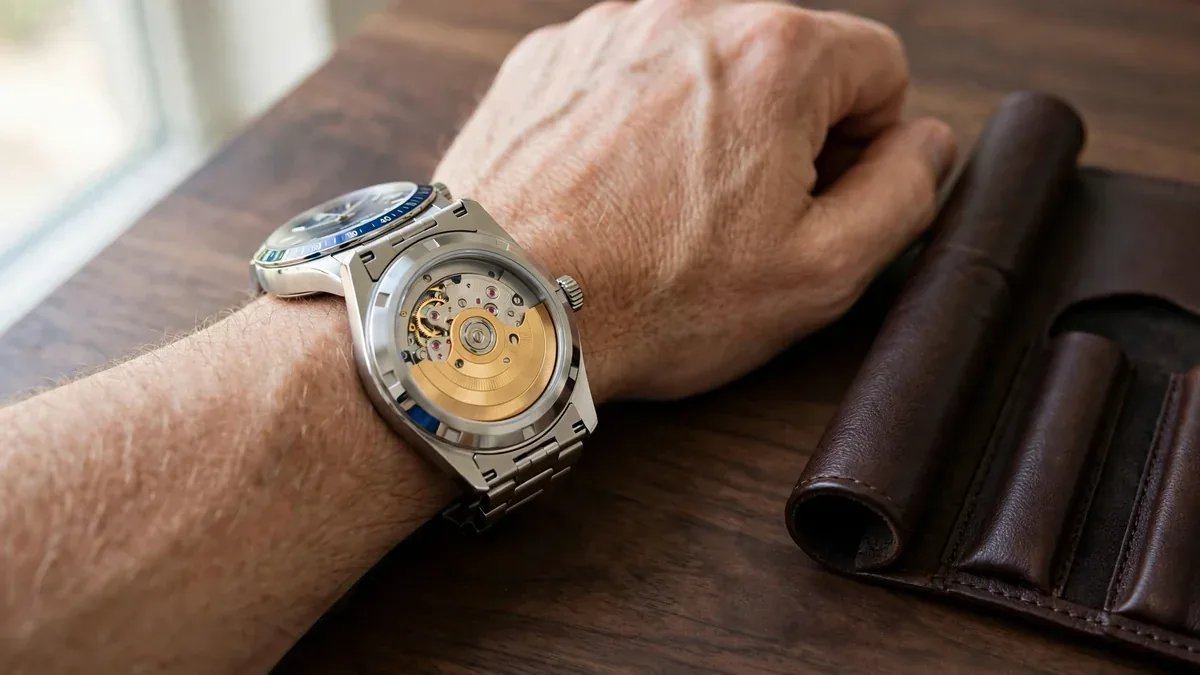

The Best Luxury Automatic Watch Brands share one quiet quality: they keep time with nothing but the motion of your wrist. There is no battery to replace and no daily winding ritual to remember. A small weighted rotor turns as you move, winding the mainspring, and a train of tiny gears releases that stored energy in measured steps. It is a nineteenth-century idea refined to a modern standard, and it still defines what a serious watch is.
Choosing among these brands is harder than it looks, because the names on the dial tell only part of the story. The movement inside, the metal of the case, and the quality of the finishing matter far more than the logo, and they are the things this guide compares directly.
Below are ten luxury automatic watch brands worth considering, from Rolex and Omega to Patek Philippe, Audemars Piguet and Grand Seiko. Each one is described by its signature movement, its power reserve, its materials, its price range, and who it suits best, so you can choose with the engineering in mind, not just the name on the dial.
Key takeaways
- An automatic watch is wound by a rotor that turns as you move, and its power reserve, usually 40 to 120 hours, is the time it keeps running once you take it off.
- Rolex, Omega and Grand Seiko offer the strongest balance of accuracy, durability and everyday wearability, while Patek Philippe, Audemars Piguet and A. Lange & Söhne lead on finishing and prestige.
- Expect to pay from about $4,000 for an entry-level luxury automatic to more than $100,000 for a high-complication piece from the top Geneva houses.
- Most luxury automatics need a full service every five to ten years, and the cost of that service varies widely, from a few hundred dollars to several thousand.
- Buy the size that fits your wrist, not the size that is fashionable, and check the power reserve and service interval before you check the price.
How an automatic watch actually works
An automatic watch, also called a self-winding watch, is a mechanical watch with a rotor. The rotor is a semicircular weight, usually in brass or gold, that pivots freely around the centre of the movement. Every movement of your wrist swings it, and a set of gears transfers that motion to the mainspring, winding it a little at a time.
The power reserve is the number of hours the watch keeps running after it is fully wound and left unworn. Modern luxury automatics are also far more accurate than the old standard: Rolex tests to within two seconds a day, Omega certifies to within five seconds a day, and Grand Seiko regulates to within five seconds a day.
How we chose these brands and what to look for
We chose brands with in-house automatic movements, a proven record of reliability, and a service network that can look after the watch for decades. A brand that buys its movements from another company can still make a fine watch, but the houses below design, build and finish their own calibres, which matters when a service is needed twenty years from now. For a wider view of the market before you narrow it down, our guide to the best watch brands for every wrist and budget is a useful starting point.
Look first at the movement, then at the case, then at the fit. Check the power reserve, the beat rate, and whether the movement is certified by an independent body such as COSC or METAS. Check the case material and water resistance, and try the watch on before you buy.
The best luxury automatic watch brands compared
| Brand | Signature automatic movement | Power reserve | Case materials | Price range |
|---|---|---|---|---|
| Rolex | Calibre 3235 | About 70 hours | Oystersteel, 18k gold, platinum | $7,000 to $50,000+ |
| Omega | Co-Axial Master Chronometer 8900 | About 60 hours | Steel, 18k gold, ceramic, titanium | $3,500 to $40,000+ |
| Patek Philippe | Calibre 324 S C | About 45 hours | 18k gold, platinum, steel | $20,000 to $200,000+ |
| Audemars Piguet | Calibre 3120 / 4302 | 60 to 70 hours | Steel, 18k gold, ceramic, titanium | $20,000 to $100,000+ |
| Vacheron Constantin | Calibre 2450 / 5100 | 40 to 60 hours | 18k gold, platinum, steel | $18,000 to $150,000+ |
| A. Lange & Söhne | Calibre L043.1 | About 72 hours | 18k gold, platinum, white gold | $30,000 to $200,000+ |
| Jaeger-LeCoultre | Calibre 899 | About 70 hours | Steel, 18k gold, pink gold | $6,000 to $50,000+ |
| IWC Schaffhausen | Calibre 32111 / 52010 | 120 hours to 7 days | Steel, 18k gold, ceramic, titanium | $5,000 to $40,000+ |
| Grand Seiko | Calibre 9S65 | About 72 hours | Steel, titanium, 18k gold | $4,500 to $30,000+ |
| Cartier | Calibre 1847 MC | About 48 hours | Steel, 18k gold, ceramic | $4,000 to $40,000+ |
The 10 best luxury automatic watch brands
1. Rolex
Rolex is the benchmark against which every other luxury automatic is measured, and the Calibre 3235 is the reason why. Its Calibre 3235 runs for about 70 hours and is tested to within two seconds a day after casing. Service is due about every ten years.
2. Omega
Omega pairs its Co-Axial escapement with METAS Master Chronometer certification, which tests the finished watch, not just the bare movement, for accuracy, magnetism and water resistance. The Calibre 8900 runs for about 60 hours and is rated to within five seconds a day. The Seamaster Diver 300M is the most versatile choice, with a ceramic bezel and 300 metres of water resistance. Prices run from about $3,500 for a steel De Ville to more than $40,000 for a gold Speedmaster, and Omega recommends a service every five to eight years.
3. Patek Philippe
Patek Philippe is the most prestigious name in this list, and its watches are finished to a standard few brands attempt. The Calibre 324 S C has a 21k gold rotor, Geneva Seal finishing, and a power reserve of about 45 hours. A Patek is bought for craft as much as for timekeeping. The Calatrava is the classic dress watch, slim and understated in gold. Prices start at about $20,000 and rise past $200,000 for perpetual calendars and minute repeaters. Most cases sit between 37 mm and 41 mm, and service is due every five to seven years.
4. Audemars Piguet
Audemars Piguet built its modern reputation on one watch, the Royal Oak, and its automatic movements are built to match. The Calibre 3120 runs for about 60 hours, the newer Calibre 4302 runs for about 70 hours, and both are finished with Geneva stripes and a 22k gold rotor. The Royal Oak in steel at 41 mm is the most recognised model, the Royal Oak Offshore is larger and bolder at 43 mm to 44 mm. Prices start at about $20,000 for a steel Royal Oak and rise past $100,000 for gold and ceramic versions. Budget for a service every five to seven years.
5. Vacheron Constantin
Vacheron Constantin is the oldest continuously operating watchmaker in the world, founded in 1755, and one of only three houses in the traditional Holy Trinity of Geneva watchmaking. Its movements carry the Geneva Seal, certifying their finishing and origin. The Calibre 2450 runs for about 40 hours while the Calibre 5100 runs for about 60 hours. The Overseas is the most practical choice, with a quick-change strap system. Prices start at about $18,000 for a steel Overseas and rise past $150,000 for complicated gold pieces. Cases are mostly 41 mm, and service is due every five to seven years.
6. A. Lange & Söhne
A. Lange & Söhne is the quietest brand on this list and, to many collectors, the finest. Its watches are made in Glashütte, Germany, and the movements are finished by hand to a standard that rivals anything in Geneva. The Lange 1 uses the Calibre L043.1, which runs for about 72 hours and shows its remaining power on a small indicator. The Lange 1 is the signature model, with its off-centre dial and outsized date. Prices start at about $30,000 and rise past $200,000, and almost every case is gold or platinum. Cases usually run 38 mm to 41 mm, service is due every five to seven years.
7. Jaeger-LeCoultre
Jaeger-LeCoultre is known as the watchmaker’s watchmaker, because it has supplied movements to Patek Philippe, Audemars Piguet and Vacheron Constantin over its history. The Calibre 899 runs for about 70 hours and is used across the Master range. The Reverso is the brand’s icon, a rectangular case that flips over to protect the dial. The Master Ultra Thin is the most versatile dress watch here, slim enough to slide under a cuff. Prices run from about $6,000 for a steel Master to more than $50,000 for complicated Reverso models. Cases are mostly 39 mm to 41 mm and wear slim.
8. IWC Schaffhausen
IWC is the brand to choose if power reserve is your priority. The Calibre 32111 runs for 120 hours, while the Calibre 52010 in the Portugieser runs for seven days, so the watch is still running after a full week unworn. The Portugieser Automatic is the most elegant choice, with a clean dial and a 42 mm case. Prices run from about $5,000 for a steel Portofino to more than $40,000 for gold Portugieser models, in steel, ceramic, titanium and gold. Cases tend to run large, from 40 mm to 43 mm, and service is due every five to eight years.
9. Grand Seiko
Grand Seiko is the Japanese answer to Swiss luxury, and its finishing is the equal of anything from Geneva at a lower price. The Calibre 9S65 is an automatic movement with a 72-hour power reserve, accuracy rated to within five seconds a day. Cases are polished by hand using the Zaratsu technique, which produces mirror-flat surfaces and distortion-free reflections. The Heritage Collection is the best place to start, with 40 mm steel cases that suit most wrists. Prices run from about $4,500 for a steel Heritage model to more than $30,000 for gold versions. Service is due every five years, and Zaratsu polishing should only be restored by Grand Seiko itself.
10. Cartier
Cartier is the jeweller among watchmakers, and its automatic watches are designed to be worn as jewellery as much as instruments. The in-house Calibre 1847 MC runs for about 48 hours and powers the Santos, the Tank and the Pasha. The designs are the draw: the Santos has exposed screws and a square case, the Tank is a rectangle that has barely changed since 1917. The Santos in steel at 39 mm is the most versatile model. Prices start at about $4,000 for a steel Tank and reach past $40,000 for gold models. Service every five to seven years is recommended.
Automatic vs quartz vs chronograph vs dive watches
These four terms describe different things, and confusing them is the most common mistake when buying a luxury watch. Automatic and quartz describe the movement: an automatic is mechanical and wound by a rotor, while a quartz watch is powered by a battery and regulated by a quartz crystal. Quartz is more accurate and cheaper to maintain, but it has no rotor or mainspring, which is why luxury buyers usually choose automatic.
Chronograph and dive describe the function and the style, not the movement. A chronograph is a watch with a stopwatch complication, and it can be automatic, manual or quartz. A dive watch is built for diving, with high water resistance, a rotating bezel and strong lume, and it too can be automatic or quartz. Our guide to the best luxury watches for every occasion and budget shows how these categories overlap in practice. Choose automatic for craft and longevity, quartz for accuracy and low maintenance, and a chronograph or dive watch for the function you need.
How to choose the right automatic watch for your wrist and wardrobe
Start with the size. Measure your wrist and look at the lug-to-lug length, not just the case diameter, because long lugs make a watch wear larger. A 36 mm to 39 mm case suits a wrist under 17 cm, a 40 mm to 41 mm case suits most wrists, and anything above 42 mm needs a wrist of 18 cm or more to look balanced.
Then match the watch to your wardrobe. A slim dress watch in gold or steel works with a suit, a steel sports watch works with almost everything, and a large pilot’s watch suits casual wear better than formal wear. For a men’s wardrobe, our guide to the best luxury watches for men ranks the same brands by how they wear day to day. Finally, check the boxes and papers, the warranty length, and the service cost before you pay.
Caring for an automatic watch
Wear the watch regularly and the rotor does the work for you. If you rotate between several watches, a watch winder keeps an unworn piece running, but it is not essential: a watch that stops can simply be wound by hand with the crown and set again. Never force the crown, and never set the date between nine in the evening and three in the morning.
Service is the one cost every automatic owner must accept. A full service strips, cleans, re-oils and regulates the movement, and it takes several weeks. The cost varies widely, from about $400 for a Grand Seiko or Cartier to more than $1,000 for a Rolex and several thousand for a Patek Philippe or A. Lange & Söhne.
Checklist: buying your first luxury automatic watch
- Measure your wrist and check the lug-to-lug length, not just the case diameter, before you choose a size.
- Compare power reserves, and favour 70 hours or more if you rotate between watches during the week.
- Check whether the movement is certified by COSC or METAS, and ask for the accuracy rating in writing.
- Confirm the full set of boxes and papers, the warranty length, and the authorised dealer or boutique you bought from.
- Ask for the service interval and the cost of a full service before you buy, and budget for it over the life of the watch.
- Try the watch on with the strap or bracelet you will actually wear, and check the case does not overhang your wrist.
Frequently asked questions
How long does a luxury automatic watch last?
A well-made luxury automatic can last for decades, and many watches from the 1960s and 1970s are still running today after regular servicing. The movement can be taken apart, cleaned and repaired. With a service every five to ten years, there is no fixed end to its life.
Do I need a watch winder for an automatic watch?
No, a watch winder is a convenience, not a necessity. If you wear the watch most days, the rotor keeps it wound, and if you leave it unworn for a few days it simply stops and can be wound by hand and reset in under a minute.
How accurate is a luxury automatic watch?
A modern luxury automatic is typically accurate to within a few seconds a day. Rolex tests to within two seconds a day, Omega certifies to within five seconds a day, and Grand Seiko rates its mechanical movements to within five seconds a day.
How often should an automatic watch be serviced?
Most brands recommend a full service every five to ten years, depending on the movement and how the watch is worn. Rolex now suggests about ten years, while Patek Philippe, Audemars Piguet and A. Lange & Söhne suggest five to seven years.
Can I swim with a luxury automatic watch?
Yes, if the watch is rated for it and the seals are in good condition. A watch rated to 100 metres is safe for swimming, and a dive watch rated to 300 metres is safe for serious water use, but the rating applies only when the seals are intact. Have the seals tested every two years.
Is a luxury automatic watch a good investment?
Some models hold their value well and a few rise in price, but most luxury watches lose value in the first years, and none should be bought purely as an investment. Steel sports models from Rolex, Patek Philippe and Audemars Piguet hold value best.
The Bottom Line
The Best Luxury Automatic Watch Brands all do the same essential thing well: they keep time with a movement you can see, hear and understand, and they are built to be serviced rather than replaced. Rolex and Omega are the safest first choices for everyday wear, Grand Seiko and Jaeger-LeCoultre offer the best value for the finishing you get, and Patek Philippe, Audemars Piguet, Vacheron Constantin and A. Lange & Söhne are the houses to choose when craft matters more than convenience. Pick the size that fits your wrist, and buy the watch you will still want to wear in ten years.