Opal is the most romantic stone in jewellery, and the least practical. No two opals look alike: a good one flashes green, blue, orange and violet as it moves, like oil on water, and that play of colour is something no diamond can imitate. For a couple who want a ring that is genuinely personal, an opal engagement ring is hard to beat on beauty alone.
The problem is that opal is soft, fragile and fussy about how it is treated. At 5.5 to 6.5 on the Mohs scale it scratches easily, chips if knocked, and can crack if it dries out or is heated suddenly. Many opals sold today are doublets or triplets, thin slices of opal glued to a backing, which are cheaper but far more delicate than a solid stone. An opal ring bought without understanding those limits can be a heartbreak within a year.
Below are nine opal engagement rings worth considering in 2027, from a classic solitaire to a sculptural modern design. Each one is described by what it is good at, what to watch for, and who it suits best, so you can choose with the stone’s limits in mind, not just its colour.
Key takeaways
- Opal is hydrated silica with a hardness of 5.5 to 6.5, which makes it the softest stone commonly used in an engagement ring.
- Play of colour is what matters most: look for bright, broad flashes of colour that move as the stone turns, not a dull or patchy stone.
- Black opal has the most valuable play of colour, while Ethiopian opal is affordable but absorbs water and can change colour temporarily.
- A bezel setting is almost essential for daily wear, and opal should be removed for manual work, sport and cleaning.
- Opal is not an investment stone, it will not hold its value, and a ring bought as an investment will disappoint.
What opal brings to an engagement ring
Opal is not a crystal but a solidified gel of silica and water, and its colour comes from tiny, regularly arranged spheres of silica that split light into its spectrum. That structure is what produces play of colour, the flashes of green, blue, orange and red that move across the stone as it turns. A fine opal shows broad, bright flashes across most of its face, while a poor one shows only a few small, dull patches.
There are several kinds of opal, and they behave very differently. Black opal, from Lightning Ridge in Australia, has a dark body that makes its colours look vivid, and it is the most valuable. White opal has a milky body and softer colours. Boulder opal is opal formed in cracks in ironstone, usually cut with its host rock still attached. Crystal opal is transparent, with colour floating inside it. Fire opal, from Mexico, is usually orange or red and often has no play of colour at all, which makes it a different kind of stone altogether.
Opal is also the birthstone for October, which gives it a personal meaning for autumn birthdays. It has no proven healing properties, despite the claims made for it in crystal shops, and it is worth saying so plainly: buy it because its colour moves you, not because it will protect you, heal you or bring you luck.
How we chose these rings and what to look for
Look first at the play of colour, in daylight, turning the stone slowly. A good opal shows bright, broad flashes that cover most of the stone, while a poor one shows only small pinpoints or a dull, milky surface. Colour matters more than size: a small stone with vivid colour is a better buy than a large stone with weak colour. Check the body tone too, because a dark body makes the colours look stronger, which is why black opal commands the highest prices.
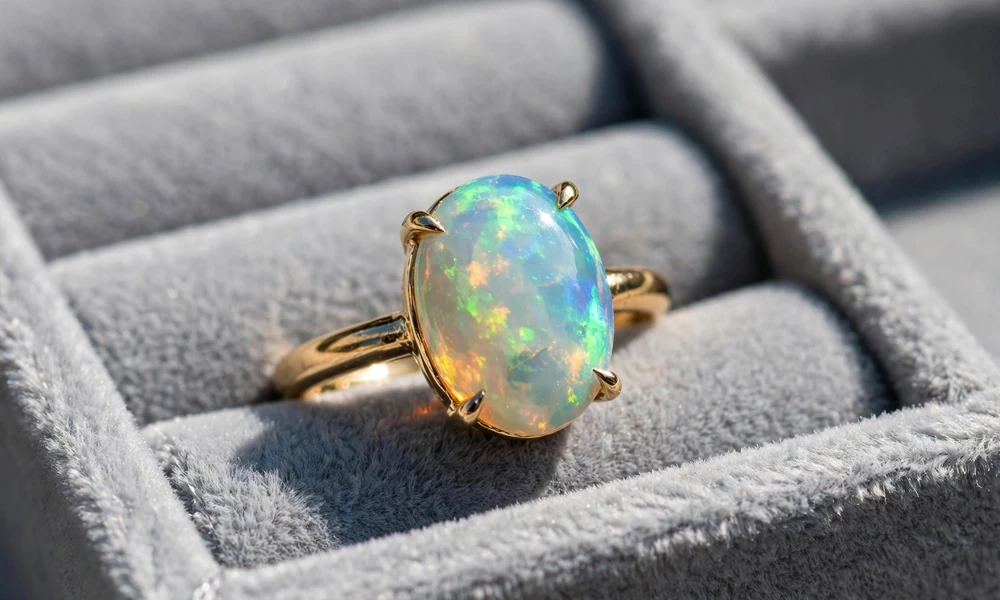
Look next at whether the stone is solid. A solid opal is cut from a single piece and is the most durable kind. A doublet is a thin slice of opal glued to a dark backing, and a triplet adds a clear dome on top. Doublets and triplets are much cheaper, but they are fragile, they must never be soaked in water, and they cannot be repolished if scratched. A reputable seller will state which kind it is, and a seller who will not answer the question should not be trusted. Our guide to opal rings explains how to tell the difference, because the distinction changes both the price and the care the ring needs.
Finally, look at the setting. A bezel setting is almost essential for opal, because it protects the edges, which are the most vulnerable part of the stone, and it keeps the opal in contact with the metal, which helps it stay stable. Prong settings leave the stone exposed and should be avoided for daily wear. If the ring will be worn every day, a solid Australian opal in a bezel is the only sensible choice.
The 9 best opal engagement rings of 2027
Tiffany & Co. Opal Solitaire
What we like: A solid white opal in a low platinum bezel, with a bright play of colour and the kind of careful setting that protects a soft stone properly.
What to consider: Premium price for the name, and the white body makes the colours softer than a black opal. Stone: White opal, oval cabochon, 1.5 carats. Setting: Bezel, platinum. Best for: A classic proposal with a soft, romantic feel. Price range: £2,000 to £3,000.
Cartier Opal Ring
What we like: A black opal with vivid green and blue flashes, set in 18-karat yellow gold that makes the colours look warmer and richer.
What to consider: Black opal is expensive for its size, and the yellow gold shows scratches more readily than platinum. Stone: Black opal, oval cabochon, 1.2 carats. Setting: Bezel, 18-karat yellow gold. Best for: A dramatic, high-value proposal. Price range: £3,000 to £5,000.
David Yurman Opal Cable Ring
What we like: The signature twisted cable band gives a familiar design a distinct identity, and the oval opal sits low and comfortably on the finger.
What to consider: The cable detail traps dirt and needs a soft brush to clean, and the stone is an Ethiopian opal that needs care with water. Stone: Ethiopian opal, oval cabochon, 1.1 carats. Setting: Cable band, sterling silver and 18-karat gold. Best for: Everyday wear with a designer signature. Price range: £900 to £1,400.
Mejuri Opal Bezel Ring
What we like: A slim bezel setting in 14-karat gold that protects the stone completely, at a price that leaves room in the budget for a wedding band.
What to consider: The stone is small, so the play of colour is subtle rather than obvious, and it is a doublet, so it must never be soaked. Stone: Opal doublet, round cabochon, 0.8 carats. Setting: Bezel, 14-karat yellow gold. Best for: A discreet, practical everyday ring. Price range: £300 to £500.
Monica Vinader Opal Signet Ring
What we like: A modern signet shape with a rectangular boulder opal, a design that feels current without chasing a trend that will date.
What to consider: The signet style suits wider fingers best, and boulder opal is heavier than other kinds, so the ring feels substantial. Stone: Boulder opal, rectangular cabochon, 1.3 carats. Setting: Signet, 18-karat gold vermeil. Best for: A bold, modern proposal. Price range: £350 to £550.
Missoma Opal Stacking Ring
What we like: A delicate stacking ring that works alone or layered with a wedding band, with a bright, clean opal at an accessible price.
What to consider: The band is thin and will bend if knocked, and the small stone is a doublet that needs gentle care. Stone: Opal doublet, round cabochon, 0.5 carats. Setting: Four-prong, 18-karat gold vermeil. Best for: A layered look or a smaller budget. Price range: £120 to £220.
Maria Black Opal Sculptural Ring
What we like: An asymmetric, sculptural setting that treats the opal as a piece of design rather than a conventional centre stone.
What to consider: The sculptural shape is not for everyone, and it catches on clothing more than a smooth band. Stone: White opal, freeform cabochon, 1 carat. Setting: Sculptural, sterling silver. Best for: A creative, design-led proposal. Price range: £280 to £450.
Astrid & Miyu Opal Halo Ring
What we like: A halo of small white stones around the opal makes the centre look larger and brighter, and the design reads clearly as an engagement ring.
What to consider: Halo stones need regular checking, as a loose pavé stone is easy to miss, and the opal itself still needs a bezel to be properly protected. Stone: White opal, oval cabochon, 1 carat, with white stone halo. Setting: Halo bezel, 18-karat gold vermeil. Best for: Maximum sparkle on a modest budget. Price range: £250 to £400.
Thomas Sabo Opal Charm Ring
What we like: A playful charm-style ring with a bright opal, an affordable way to propose with a coloured stone.
What to consider: The charm detail is decorative rather than fine jewellery, and the silver will tarnish without regular wear and cleaning. Stone: Opal doublet, round cabochon, 0.7 carats. Setting: Charm, sterling silver. Best for: A light-hearted, affordable proposal. Price range: £100 to £200.
Which opal is right for you
If you want the most vivid colour, choose a black opal, which has the strongest play of colour of any kind, and set it in a bezel in white gold or platinum, which keeps the colours cool and clear. Yellow gold warms the stone and suits white and boulder opal well. A guide to engagement rings is useful here, because the same questions about metal, size and setting apply to every stone, not just opal.
If the ring will be worn every day, a solid Australian opal in a bezel is the only sensible choice, and the ring should be removed for manual work, sport, gardening and cleaning. If the ring is for occasional wear, an Ethiopian opal or a doublet is perfectly fine, and the lower price leaves room for a more elaborate setting. For an October birthday, the personal meaning matters more than the kind of opal, and a smaller stone in a beautiful setting is the better buy.
Budget is where opal genuinely shines. A one-carat white or Ethiopian opal costs a fraction of a one-carat diamond, which means the money saved can go into a better setting, a better metal, or a wedding band to match. That is a sensible trade, provided you are buying the ring to wear and enjoy, not as a store of value, and provided you accept that opal needs more care than any other engagement stone.
The caveats that matter
Opal is the most delicate stone used in engagement rings, and it needs to be treated that way. It should be cleaned only with a soft, damp cloth, never with an ultrasonic cleaner, steam cleaner or harsh chemical, and it should be kept away from heat, sudden temperature changes and prolonged dryness, all of which can cause it to crack or craze. Ethiopian opal is hydrophane, which means it absorbs water and oils, and it can turn transparent or cloudy for a while after getting wet, although it usually returns to normal as it dries.
| Detail | What is known |
|---|---|
| What it is | Hydrated silica, coloured by tiny silica spheres that split light into colour |
| Hardness | 5.5 to 6.5 on the Mohs scale, the softest stone used in engagement rings |
| Best colour | Bright, broad flashes of colour across most of the stone, best on a dark body |
| Most valuable kind | Black opal from Lightning Ridge, Australia, with vivid play of colour |
| Best setting | Bezel, which protects the edges; prong settings should be avoided for daily wear |
| Cleaning | Soft damp cloth only; never ultrasonic, steam or harsh chemicals |
| Common imitations | Opalite glass, synthetic opal, and doublets or triplets sold as solid opal |
| What it does not do | It has no proven healing properties and is not an investment stone |
If you are buying a solid opal over a carat, or paying a premium for black opal, ask for a laboratory certificate and buy from a seller who will put the kind of opal, solid or assembled, in writing. A reputable jeweller will welcome the question. A seller who cannot answer it, or who describes a doublet as a solid stone, should be avoided.
Checklist: choosing an opal engagement ring honestly
Use these checks before you buy, and again when the ring arrives.
- Check the play of colour in daylight: bright, broad flashes across most of the stone, not dull patches.
- Check whether it is solid: ask if it is a solid opal, a doublet or a triplet, and get the answer in writing.
- Check the setting: bezel for daily wear, and never a high prong setting for a soft stone.
- Check the kind: black opal for the best colour, Ethiopian opal for value, boulder opal for character.
- Check the care: if you will not remove the ring for manual work and cleaning, opal is the wrong stone.
- Check the certificate: an independent laboratory report for any solid opal over a carat or any black opal claim.
Frequently asked questions
Is opal durable enough for an engagement ring?
It can be, with care, but it is the least durable engagement stone. At 5.5 to 6.5 on the Mohs scale it scratches and chips easily, and it should be removed for manual work, sport and cleaning. A solid Australian opal in a bezel setting is the most durable combination, and even then it needs more care than a diamond, sapphire or aquamarine.
Is opal a good alternative to a diamond?
It is a good alternative if you want colour, character and value rather than hardness and resale. A one-carat opal costs a fraction of a one-carat diamond, and its play of colour is unique. It is not a good alternative if you want a stone you can wear hard every day without thinking about it.
What is the difference between a doublet and a solid opal?
A solid opal is cut from a single piece of opal. A doublet is a thin slice of opal glued to a dark backing, usually ironstone or black glass, and a triplet adds a clear quartz or glass dome on top. Doublets and triplets are cheaper and more fragile, they must never be soaked in water, and they cannot be repolished if scratched.
Does Ethiopian opal change colour in water?
Yes, temporarily. Ethiopian opal is hydrophane, which means it absorbs water, and it can turn transparent or cloudy for a while after getting wet. It usually returns to normal as it dries, but repeated soaking can stain it, so it should be kept dry and removed before washing hands or swimming.
How do I clean an opal engagement ring?
A soft, damp cloth is all it needs for regular cleaning, followed by a pat dry. Never use an ultrasonic cleaner, a steam cleaner or a chemical dip, and never soak a doublet or triplet. A diamond buying guide covers the same care questions for harder stones, but opal needs a gentler routine than any of them.
Is opal expensive?
Compared with diamonds it is affordable. A good one-carat white or Ethiopian opal costs a few hundred pounds, and even a fine boulder opal is usually under a thousand, before the setting. Only top black opal commands high prices, and at that level a certificate matters more than the name.
The bottom line
The best opal engagement ring in 2027 is not the largest or the cheapest. It is the one with bright, broad play of colour, a solid stone honestly described, and a bezel setting that protects it. A solid Australian opal in a bezel, in white gold or platinum, is the safest all-round choice, while a black opal gives the most vivid colour for the money.
Choose the stone whose colour moves you, in a setting you will enjoy wearing, and accept that opal asks more of its owner than any other engagement stone. That care is part of the deal, and for the couples who love opal, it is a small price for a ring that no one else will ever have.