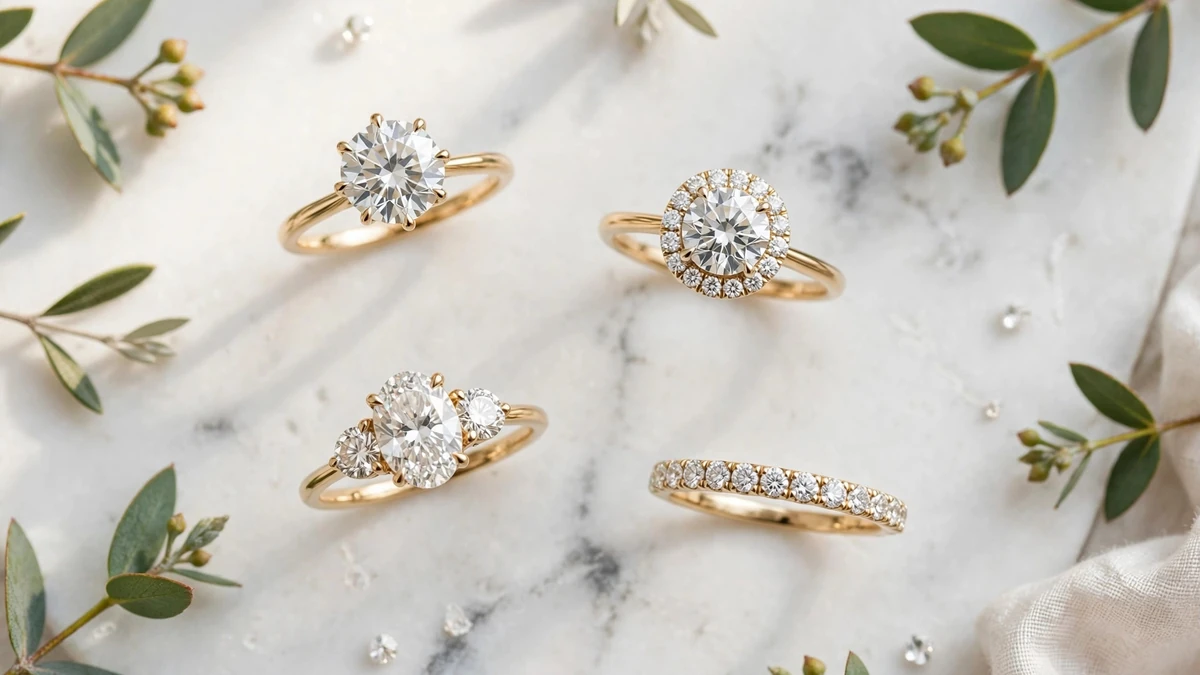

Two hundred and fifty dollars buys a different kind of engagement ring than a hundred does. It is the price where moissanite becomes a centre stone rather than an accent, where a small lab-grown diamond enters the picture, and where the band can be solid 14k gold rather than vermeil or silver. It is still a budget, but it is a budget with real choices in it, and the rings below show how far that money can go when it is spent on the stone and the setting rather than the brand name.
The most important change at this price is the stone. Moissanite, a lab-created silicon carbide, is harder than any other diamond alternative, at 9.25 on the Mohs scale, and it has more fire than a diamond, throwing off rainbow flashes in bright light. A one-carat moissanite centre stone in a solid gold setting is comfortably under $250, which is why so many couples who want a large, bright stone without a large bill choose it. Lab-grown diamonds are the other option: chemically and optically identical to mined diamonds, at a fraction of the price, with a small stone in a simple setting now available under $250.
Below are nine engagement rings under $250 worth considering in 2027, from moissanite solitaires to small lab-grown diamond rings and white sapphire designs. Each one is described by what it does well, what to watch for, and who it suits best, so you can choose with your budget in mind, not against it.
Key takeaways
- Under $250, moissanite becomes a centre stone, a small lab-grown diamond becomes possible, and the band can be solid 14k gold rather than vermeil or silver.
- Moissanite is the hardest and sparklier diamond alternative, with more rainbow fire than diamond, while a lab-grown diamond is a real diamond at a much lower price.
- Look for a grading report or a certificate for any lab-grown diamond, and a warranty that covers the stone as well as the setting.
- Solid 14k gold outlasts vermeil and plating, and it can be resized and repaired by any jeweller.
- No ring under $250 holds its value as an investment, and moissanite and lab-grown diamonds both lose value on resale, so judge it on how it looks and wears.
What a ring under $250 actually buys you
The first thing $250 buys is a better stone. A one-carat moissanite centre stone, cut to a high standard, is the headline purchase at this price: bright, hard, and large enough to look like a serious engagement ring rather than a placeholder. A half-carat lab-grown diamond in a simple gold solitaire is the second headline, and it is a real diamond, with the same hardness, the same sparkle, and the same care requirements as a mined stone, at roughly a tenth of the price of a comparable mined diamond.
The second thing it buys is a better band. Solid 14k gold, in yellow, white, or rose, is available at this price in a simple solitaire, and it changes the ring’s whole character. Gold does not tarnish, it can be polished and repaired indefinitely, and it can be resized by any jeweller. That matters, because an engagement ring is worn every day for years, and a band that cannot be repaired is a band with a short life.
The third thing it buys is choice. At this price you can pick between a large moissanite and a small diamond, between a classic solitaire and a halo, and between gold and platinum-plated silver, and each of those choices is a real one, with real trade-offs. That is what this guide is for: to lay out those trade-offs plainly, so the choice is yours rather than the seller’s.
How we chose these rings and what to look for
Look first at the stone’s credentials. A lab-grown diamond should come with a grading report from a recognised laboratory, such as the GIA or IGI, stating the cut, colour, clarity, and carat weight. A moissanite should be described as such, with its size in carat equivalent, and the seller should be clear about whether it is a branded stone or a generic one. If a seller will not say what the stone is, or will not provide a report, walk away.

Look next at the metal. Solid 14k gold is the best band metal at this price, and it should be stamped 14k or 585. Gold vermeil over sterling silver is a reasonable second choice, but it will wear at the edges with daily use, and it cannot be resized as freely. Sterling silver is durable and repairable, but it is softer than gold and needs regular polishing. Avoid plated brass for a ring that will be worn every day.
Finally, look at the setting and the aftercare. A bezel setting protects the stone best, a four-prong solitaire shows it off best, and a halo makes a small stone look larger. A warranty that covers stone loss, a free resizing, and a cleaning service are worth real money over the life of a ring. Our guide to moissanite engagement rings explains how the stone behaves over time, which is the most useful thing to know before buying at this price.
The 9 best engagement rings under $250 of 2027
Mejuri Moissanite Solitaire
What we like: A one-carat moissanite centre stone in solid 14k gold, with a slim band and a clean, classic profile that looks far more expensive than it is. What to consider: Moissanite shows more rainbow fire than diamond, which some people love and some do not, and larger stones can show a faint warm tint. Stone: Moissanite, one carat. Setting: Four-prong solitaire. Best for: A large, bright stone on a modest budget. Price range: Under $250.
Monica Vinader Moissanite Signet
What we like: A signet-style band with a moissanite centre stone, in solid 14k gold, with a modern, architectural feel and a stone that sits low and protected. What to consider: The signet shape is a statement, and it will not suit a wearer who wants a traditional solitaire. Stone: Moissanite. Setting: Signet with a flush-set stone. Best for: A modern ring that is not a traditional solitaire. Price range: Under $250.
Missoma Moissanite Stacking Ring
What we like: A slim moissanite stacking band in solid 14k gold, designed to sit beside a wedding band or on its own, with a single bright centre stone. What to consider: The slim band is delicate, and the stone is modest, so it reads as understated rather than dramatic. Stone: Moissanite. Setting: Bezel-set stacking band. Best for: A minimalist ring that pairs with a wedding band. Price range: Under $250.
Astrid & Miyu Moissanite Halo
What we like: A halo of small moissanite stones around a larger centre stone, in solid 14k gold, giving a bigger, sparklier look than the centre stone alone would manage. What to consider: Halo stones can loosen, so check the setting regularly, and the ring needs cleaning more often to stay bright. Stone: Moissanite. Setting: Halo. Best for: Maximum sparkle on a small budget. Price range: Under $250.
Maria Black Moissanite Sculptural Ring
What we like: A sculptural, slightly asymmetric band in solid 14k gold with a moissanite centre stone, for a wearer who wants a ring with a point of view. What to consider: The sculptural shape is not for everyone, and it can catch on clothing if the edges are sharp. Stone: Moissanite. Setting: Sculptural prong setting. Best for: A design-led ring that looks nothing like a high-street solitaire. Price range: Under $250.
Thomas Sabo Moissanite Charm Ring
What we like: A charming, slightly vintage-feeling ring with a moissanite centre stone, in solid 14k gold, with a detailed band. What to consider: The detailed band can trap dirt and needs cleaning, and the stone is modest in size. Stone: Moissanite. Setting: Four-prong solitaire with a detailed band. Best for: A vintage-inspired look with a durable stone. Price range: Under $250.
Brilliant Earth Lab-Grown Diamond Solitaire
What we like: A half-carat lab-grown diamond in solid 14k gold, with a grading report, from a brand known for traceable stones and clear sourcing. What to consider: The stone is small, so it reads as understated, and a lab-grown diamond has little resale value. Stone: Lab-grown diamond, half carat. Setting: Four-prong solitaire. Best for: A real diamond at a budget price. Price range: Under $250.
The only real diamond on this list, and the one to choose if the word diamond matters. It is chemically and optically identical to a mined diamond, and the grading report proves it.
James Allen Lab-Grown Diamond Solitaire
What we like: A half-carat lab-grown diamond in solid 14k gold, with a grading report and a 360-degree view of the stone before purchase, so you can see exactly what you are buying. What to consider: The stone is small, and the ring is a simple design, so it will not feel unique. Stone: Lab-grown diamond, half carat. Setting: Four-prong solitaire. Best for: A carefully chosen diamond with full transparency. Price range: Under $250.
Being able to see the actual stone before buying is a real advantage at this price. It removes the guesswork, and the grading report backs up what you see.
Mejuri Lab-Grown Diamond Accent Ring
What we like: A solid 14k gold band with a small lab-grown diamond centre stone and pavé accents, giving a delicate, sparkling look with a real diamond at its heart. What to consider: The centre stone is small, and the pavé accents need regular checking. Stone: Lab-grown diamond with pavé accents. Setting: Pavé accent solitaire. Best for: A delicate diamond ring with extra sparkle. Price range: Under $250.
A pretty, delicate ring that suits a wearer who wants a diamond without a large stone. The pavé accents add sparkle, and the gold band gives it real substance.
Which budget ring is right for you
Choose moissanite if you want the largest, brightest stone for the money. A one-carat moissanite in solid gold is the most ring $250 can buy, and it will stay bright and hard for years. The trade-off is the rainbow fire, which is stronger than a diamond’s, and the fact that it is not a diamond, which matters to some people and not at all to others.
Choose a lab-grown diamond if the word diamond matters, and you are happy with a smaller stone. A half-carat lab-grown diamond in gold is a real diamond, with a grading report to prove it, and it will be treated by any jeweller exactly like a mined diamond. The trade-off is size, and the fact that lab-grown diamonds have little resale value, though at this price that is a small consideration.
Choose the metal by how the ring will be worn. Solid 14k gold is the best choice for daily wear, because it can be resized and repaired by any jeweller. Our diamond buying guide explains the four Cs in plain terms, which is useful whether the stone is mined or lab-grown, because the same rules apply to both.
The caveats that matter
A ring under $250 is not an investment, and it should not be sold as one. Moissanite and lab-grown diamonds both lose value on resale, and that is fine, provided you know it going in. The real risks are practical: a stone that is not what it claims to be, a setting that loosens, or a band that cannot be resized. Buy from a named brand, ask for a grading report for any diamond, and keep the receipt.
| Detail | What is known |
|---|---|
| Best stones under $250 | Moissanite centre stones, small lab-grown diamonds, white sapphire |
| Best band metal | Solid 14k gold, stamped 14k or 585; it can be resized and repaired by any jeweller |
| What a grading report proves | Cut, colour, clarity, and carat weight for a lab-grown diamond, from a recognised laboratory |
| Moissanite vs diamond | Moissanite is harder-wearing and sparklier, with more rainbow fire; a lab-grown diamond is a real diamond |
| Safest setting | Bezel, which protects the stone’s edges and cannot snag |
| What to check on arrival | Prongs grip evenly, the stone does not wobble, the band is solid not hollow, the report matches the stone |
| Care | Warm soapy water and a soft brush; avoid ultrasonic cleaners and harsh chemicals |
| What it does not do | It does not hold resale value, and neither moissanite nor a lab-grown diamond is an investment |
If you are choosing between a larger moissanite and a smaller diamond, look at both in daylight before deciding. Moissanite’s rainbow fire is most visible in bright sun, and a lab-grown diamond’s quieter sparkle suits some wearers better. There is no wrong answer, only a preference, and it is worth discovering before the ring is bought. Our guide to lab-grown diamond engagement rings goes deeper into how the stones are made and graded.
Checklist: buying an engagement ring under $250 honestly
Use these checks before you buy, and again when the ring arrives.
- Check the stone: moissanite, a lab-grown diamond with a grading report, or white sapphire, not glass or plastic.
- Check the metal: solid 14k gold stamped 14k or 585, or sterling silver stamped 925, not plated brass.
- Check the setting: prongs grip evenly, the stone does not wobble, and a bezel sits flush.
- Check the seller: a clear returns window, a warranty that covers stone loss, and a free resizing if the size is uncertain.
- Check the size: measure the finger at the end of the day, when it is warmest, and confirm the ring can be resized.
- Check the care: warm soapy water and a soft brush, no ultrasonic cleaner, and store it in a pouch away from other jewellery.
Frequently asked questions
Is moissanite a good choice for an engagement ring?
Yes. Moissanite is harder than any other diamond alternative, at 9.25 on the Mohs scale, and it stays bright for years. Its main difference from diamond is its stronger rainbow fire, which some people love and some do not. Look at one in daylight before deciding, and choose a smaller stone if the fire bothers you.
Is a lab-grown diamond a real diamond?
Yes. A lab-grown diamond is chemically, physically, and optically identical to a mined diamond. The difference is origin, not quality. It should come with a grading report from a recognised laboratory, and any jeweller will treat it exactly like a mined diamond for cleaning, resizing, and repair.
How big a stone can I get for under $250?
A one-carat moissanite centre stone in solid gold is comfortably under $250. A lab-grown diamond at that price is usually around half a carat in a simple setting. A white sapphire can be larger still, but it is softer in sparkle than either.
Can a ring under $250 be resized?
Usually yes, if the band is solid 14k gold or sterling silver. Rings with a full pavé band or a hollow band are harder to resize, so check before buying if the size is uncertain. Most reputable sellers offer one free resizing.
Will a moissanite ring pass as a diamond?
At a normal distance, usually yes, though a jeweller can tell, and the rainbow fire is a giveaway in bright sunlight. Most people will not inspect a ring closely, and a well-cut moissanite in a good setting passes comfortably in everyday life.
Should I spend $250 on one ring, or less and save the rest?
That depends on what matters to you. Two hundred and fifty dollars buys a solid gold band and a stone that will last, which is a real step up from a hundred. If the ring will be worn every day for years, the extra money is well spent. If it is a placeholder, spend less and save the difference.
The bottom line
The best engagement ring under $250 in 2027 is a one-carat moissanite solitaire in solid 14k gold, or a half-carat lab-grown diamond solitaire in gold if the word diamond matters more than size. Either one is a real, durable, beautiful ring, from a brand with a grading report or a warranty to back it up, and either one costs less than a single month of most car payments.
Choose the stone for how it will be worn, the metal for how it will be kept and repaired, and the seller for how they will look after you if something goes wrong. Do that, and a ring under $250 can be the start of a marriage, not the start of a debt.