

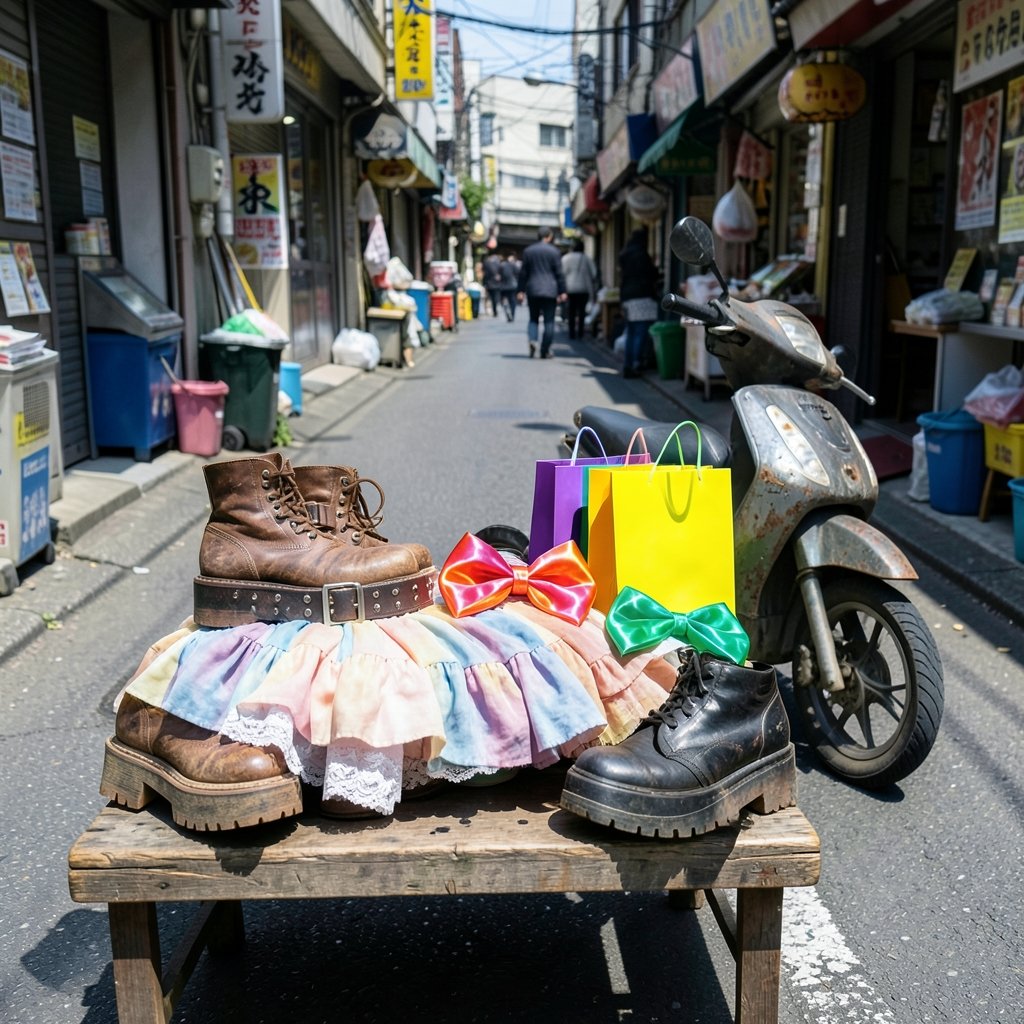
Ever wonder why a single Tokyo street keeps showing up in fashion magazines, music videos, and runway mood boards decades after it first became famous? Harajuku fashion is one of the most photographed and least understood style movements in the world. Outsiders see a blur of ruffles, neon, platform boots, and pastel hair. What’s actually happening on the ground is more interesting: a district where dozens of distinct subcultures share a few narrow blocks, and where the rules of “good taste” get rewritten every few years.
This guide separates the real scene from the exported myth. It covers the history, the major sub-styles, the retail reality, and the practical details that tourists and fashion students usually get wrong.
Where Harajuku fits in Tokyo’s style map
Harajuku is a district in Shibuya, Tokyo. Its fashion identity centers on Takeshita Street (Takeshita-dōri), a narrow pedestrian shopping strip near Harajuku Station. The street’s link to youth street fashion is generally dated to the 1970s and 1980s, though sources disagree on precise start dates.
That geography matters more than people expect. Harajuku sits next to Omotesando, a broad avenue lined with luxury flagship stores, and close to Aoyama, a quieter design district. So a teenager in a handmade decora outfit, a luxury shopper, and a vintage dealer hunting 1990s archive pieces can end up on the same block within minutes. The district’s identity comes from that collision, not from any single look.
The 1970s and early 1980s also brought the Takenoko-zoku, or “bamboo shoot tribe,” a youth street-dance and dress phenomenon on and around Takeshita Street. Groups danced in coordinated outfits on the road itself. Historians differ on exact years, but the Takenoko-zoku are widely cited as an early marker of Harajuku’s identity as a youth-style zone, and they set a template: dress loudly, perform in public, and treat the street as a stage.
A short history of Harajuku style

Harajuku fashion didn’t arrive as one movement. It accumulated in layers, and each layer left a mark on retail and street culture.
Lolita fashion is usually traced to the late 1970s and 1980s in Japan, with Harajuku as a key retail and display area. The look borrows from Victorian and Rococo silhouettes: bell-shaped skirts, petticoats, bonnets, lace. It is not costume. Many wearers treat it as a serious everyday style with its own etiquette, and the community has strong norms about silhouette and quality.
Shoichi Aoki’s street-snapshot magazine Fruits, first published in 1997, became a widely cited primary visual record of Harajuku street fashion. Aoki stopped strangers and photographed them against plain backgrounds, letting the clothes speak. For a generation of designers and stylists outside Japan, those pages were the first real look at the district. The magazine’s exact end year is less certain across sources, so treat any specific closing date with caution.
Kawaii culture is closely linked to Harajuku in both popular and academic writing. The term is used loosely, and its boundaries are genuinely contested in scholarship. That fuzziness is why “Harajuku style” so often gets flattened into “cute Japanese fashion” abroad, which misses most of what’s actually there.
The 2000s and 2010s brought another shift: Harajuku’s retail landscape moved toward international chains and fast fashion. Japanese and English media have both noted the change. Some of the small independent boutiques that defined the district closed or relocated, and the mix of storefronts on Takeshita Street today looks different from the scene Aoki photographed.
The main sub-styles, decoded
Harajuku style is plural, not a single look. Common sub-styles include the following.
| Sub-style | Signature elements | What it signals |
|---|---|---|
| Sweet Lolita | Pastel colors, bows, bell skirts, petticoats | Softness and craft; strong community etiquette |
| Gothic Lolita | Black and white, lace, corset details | Elegance with dark romanticism |
| Punk | Tartan, studs, band tees, safety pins | DIY attitude and music lineage |
| Decora | Layered accessories, bright colors, hair clips | Maximalist self-expression, often handmade |
| Visual kei influenced | Dramatic makeup, androgynous tailoring, dyed hair | Performance and theatricality |
A practical note for anyone trying to identify these in photos: decora is the easiest to spot because the accessories are the outfit. Lolita is the easiest to get wrong, because cheap imitations often skip the petticoat and the proportions that make the silhouette work. If you’re shopping for a Lolita piece, the shape of the skirt matters more than the print.
What actually happens on Takeshita Street
Takeshita Street is short, crowded, and loud. It is also a designated no-smoking street, generally reported as Tokyo’s first such designation, in 2002. Verify the exact year against official Shibuya Ward sources before quoting it in print, but the designation itself is well established.
For visitors, the practical realities are less glamorous than the photos suggest:
- Go early. The street is packed by late morning on weekends. Photographs that look empty were almost certainly shot before 9 a.m.
- Ask before photographing people. Many wearers are happy to pose, but some are not, and a few are minors. A quick gesture toward your camera and a smile is the norm.
- Don’t block the flow. Takeshita Street is a working shopping street, not a set. Stopping mid-street for a full photoshoot irritates shopkeepers and locals.
- Look past the first block. The famous stretch is dominated by crepe stands and souvenir shops. Independent boutiques cluster on the side streets and in the backstreets toward Cat Street.
- Bring cash. Some smaller shops still don’t take foreign cards.
The most common mistake visitors make is treating Harajuku as a costume rental. Dressing up for a day is fine and lots of people do it, but the people whose style gets photographed are usually wearing clothes they own and wear regularly. The difference shows.
How Harajuku became a global export label
“Harajuku” now functions as a marketing label abroad, often applied to Japanese-inspired streetwear that has little to do with the district’s current scene. That divergence is real and worth naming. A brand can sell a “Harajuku girl” aesthetic without ever touching the retail ecology that produced it.
This is not new. The 2010s wave of athleisure and Instagram-driven streetwear absorbed and remixed Japanese references constantly, a shift tracked in this look at how 2010s fashion athleisure streetwear Instagram rewrote rules. Harajuku was one of the reference points in that remix, usually stripped of context.
The same flattening happens in luxury. Italian luxury fashion has long borrowed from street style, and Japanese youth subcultures have fed runway collections for decades. For readers tracking how those references travel now, this piece on Italian luxury fashion is a useful comparison point.
Illustrators and image-makers play a big role in this translation too. When a runway moment gets redrawn and shared, the details that made it specific often disappear, a process explored in how Angelica Hicks turns runway moments into shareable visual shorthand. Harajuku has been through that filter many times.
Harajuku in 2026: what’s changed and what hasn’t
The district’s current scene is smaller and more dispersed than its 1990s peak. Fast fashion and international chains took over much of the prime real estate. Vintage and archive shopping grew in response, and the backstreets now carry more of the experimental energy than the main drag.
What hasn’t changed is the underlying logic: Harajuku rewards people who dress for themselves. The district has always been a place where a look can exist for a season and then vanish, and where the next one is already forming in a side street.
If you’re mapping Harajuku’s influence onto current wardrobes, it helps to see how broader cycles work. This 2026 fashion trends female roundup shows how subcultural signals get absorbed into mainstream womenswear, usually within a year or two. For a wider view of the season, the 2026 Fashion Trends Guide: What’s In, Out & Worth Wearing covers the commercial side, and the fashion trends 2026 tag collects ongoing coverage. Readers who want to follow the niche publications driving these conversations can use this guide to find best fashion substacks without wasting your inbox.
Pop culture keeps recycling the aesthetic as well. The Barbie world tour book delivers fashion movie only hinted at is a good example of how a mainstream property packages playful dress-up energy that Harajuku has been doing for decades with more edge.
Practical advice for wearing Harajuku style well
First-hand experience from people who dress this way regularly points to a few consistent lessons.
Start with one strong piece. A single dramatic item, a printed skirt or an oversized accessory, reads better than five competing ones. Maximalism works when there’s a structure underneath it.
Learn the silhouette rules of the sub-style you’re borrowing. Lolita has proportions. Punk has proportions. Decora is the exception where more is genuinely more, but even there, the accessories are usually placed with intent.
Buy fewer, better pieces. The wearers whose outfits get photographed tend to own a small rotation of well-made garments rather than a closet of fast-fashion copies. Quality shows in photographs.
Respect the community. If you’re buying into a subculture, learn its norms. Lolita communities in particular have clear expectations about authenticity and behavior at meetups.
Don’t fake the history. Wearing the clothes is fine. Claiming to be part of a scene you’ve just discovered is where people get side-eye.
Conclusion
Harajuku fashion is not one look and never was. It’s a district-level ecosystem: Takenoko-zoku dancers, Lolita wearers, decora maximalists, punk kids, vintage dealers, and now international chains, all sharing a few narrow blocks in Shibuya. The exported version, all ruffles and neon, captures maybe a tenth of it.
The useful takeaway is simpler than the mythology. Harajuku’s real contribution to fashion is a method, not a mood board: dress for yourself, treat the street as a place to be seen, and let the look change when it stops being true. That approach travels anywhere. The clothes are optional.
Frequently asked questions
What is Harajuku fashion?
Harajuku fashion refers to the street style associated with the Harajuku district in Shibuya, Tokyo, centered on Takeshita Street. It is not a single look. It covers multiple sub-styles, including Lolita, punk, decora, and visual kei influenced dress, and it developed across the 1970s through the 2000s.
When did Harajuku street fashion begin?
The district’s association with youth street fashion is generally dated to the 1970s and 1980s. The Takenoko-zoku, a youth street-dance and dress phenomenon, appeared in roughly the late 1970s to early 1980s and is often cited as an early marker. Exact dates vary by source.
What is the difference between Lolita and decora?
Lolita focuses on structured, historical silhouettes: bell skirts, petticoats, lace, and careful proportions. Decora is maximalist and accessory-driven, built from layered hair clips, bright colors, and mismatched pieces. Lolita has strict community norms; decora is more free-form.
Is Harajuku fashion still a real scene today?
Yes, but it has changed. Retail shifted toward international chains and fast fashion across the 2000s and 2010s, and much of the experimental energy moved to side streets and backstreets. The main drag is more commercial than it was in the 1990s.
Why do people photograph Harajuku street style?
Street-snapshot photography made the district globally famous. Shoichi Aoki’s magazine Fruits, first published in 1997, is the most widely cited visual record. Photographers still work the area, though most now ask permission before shooting.
Can visitors wear Harajuku style?
Yes. Dressing up for a day is common and generally welcomed. The main etiquette points are to ask before photographing others, avoid blocking the street, and treat the sub-styles you borrow with respect rather than as costumes.














