
A necklace that is half an inch too short can sit awkwardly at the collarbone, and one that is an inch too long can disappear under a neckline or tangle with a pendant. The difference between a necklace that looks made for you and one that feels slightly wrong is almost always length, and length is something you can measure at home in a few minutes with nothing more than a piece of string and a ruler.
The trouble is that necklace lengths are sold in inches that do not always mean the same thing. A 16-inch chain sits differently on a slender neck than on a broader one, a choker length depends on where your collarbones sit, and a pendant adds drop that the stated length does not account for. Knowing your own neck measurement and the length you actually want takes the guesswork out of every order.
Below is a plain, step-by-step method for measuring your necklace length in 2027, from finding your neck size to choosing a length that works with your neckline, your pendant, and the way you actually wear jewellery.
Key takeaways
- Measure your neck first, then add two to four inches for a comfortable chain that does not sit tight.
- A soft tape, a strip of paper, or a piece of string and a ruler are all you need, and the string method is the most reliable for most people.
- Standard lengths run from 14 inches for a choker to 36 inches for a long rope, and each length sits at a different point on the neckline.
- Pendants add drop, so measure the chain and the pendant together if you are buying a finished necklace.
- Lengths vary slightly between brands and chains stretch a little with wear, so treat any measurement as a guide, not a guarantee.
What necklace length actually means
Necklace length is the total length of the chain when it is laid flat and measured end to end, clasp included, in inches or centimetres. A 16-inch necklace is 16 inches around, and on most people it sits at the base of the neck, just above the collarbones. A 20-inch necklace falls to the top of the bust, and a 24-inch necklace sits at the centre of the chest. Those positions shift with your neck size, your build, and where the clasp sits, which is why two people can wear the same 18-inch chain and have it land in different places.
Length also interacts with the chain itself. A fine chain with a small pendant hangs straight and true to its stated length. A heavy chain with a large pendant pulls down and can sit a little lower than expected. None of this makes measuring pointless. It makes measuring more useful, because once you know your neck size and the length that lands where you want it, you can adjust for the chain and the pendant before you buy.
The standard lengths are worth knowing by heart. A 14-inch chain is a choker, sitting high on the neck. Sixteen inches is a collar length, at the base of the neck. Eighteen inches is the most common length, sitting at the collarbones. Twenty inches falls just below the collarbones, and 22 to 24 inches reaches the top of the bust. Thirty inches and above is a long necklace, falling to the waist or below.
How to measure at home and what you need
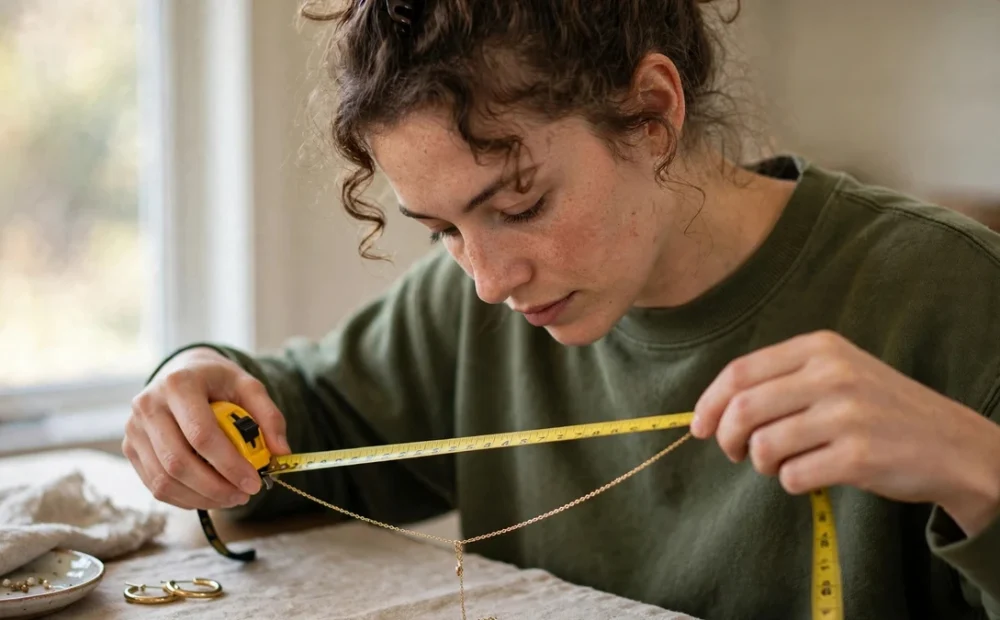
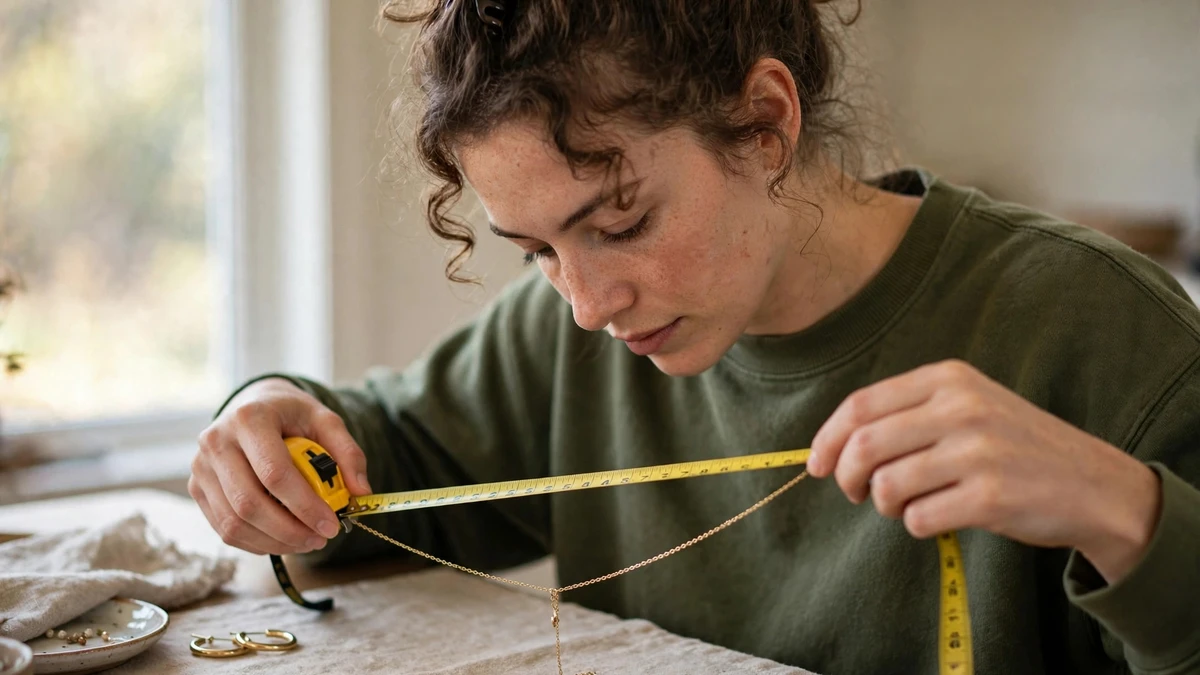
You need very little. A soft fabric tape measure is ideal, because it follows the curve of your neck. If you do not have one, a strip of paper, a ribbon, or a piece of string works just as well, as long as you mark it and measure it flat against a ruler afterwards. You also need a mirror, so you can see where the tape sits, and a pen to mark the string if you use one.
Measure where you want the necklace to sit, not at the thinnest part of your neck. For a choker, measure high, close under the jaw. For a collar length, measure at the base of the neck, where it meets the shoulders. For a longer chain, measure around the neck and then let the tape hang down your chest to the point where you want the necklace to fall, and note the length where it lands. That second method, draping the tape, is often more useful than a neck measurement alone, because it shows you the finished look directly.
Do the measuring in the morning, before your neck has had a day of heat and activity, and stand up straight with your shoulders relaxed. A tape pulled tight will give you a number that is too small, and a tape held while you are slouching will give you a number that is too large. Measure twice, and if the two numbers differ, take the larger one. Our guide to measuring your ring size follows the same principle, because the same small errors, a tape pulled too tight, a measurement taken once, cause most sizing mistakes across all jewellery.
The 9 steps to measure your necklace length
Measure your neck with a soft tape
What to Do: Wrap a soft fabric tape around your neck at the point where you want the necklace to sit, keeping it level and snug but not tight, and read the number where the tape meets itself. What to Avoid: Do not pull the tape tight like a collar, and do not measure over a high collar or a scarf. Best For: Anyone buying a choker, collar, or 16-inch chain. Time Needed: One minute. Standout Tip: Slip two fingers under the tape before you read it, so the necklace will have room to move.
Measure with a strip of paper or string
What to Do: Wrap a strip of paper or a piece of string around your neck in the same way, mark where it overlaps, then lay it flat and measure it with a ruler. What to Avoid: Do not use a stretchy ribbon or elastic, and do not guess the length by eye. Best For: Anyone without a soft tape measure. Time Needed: Two minutes. Standout Tip: Use a paper strip at least an inch wide, so it does not twist and give a false reading.
Add the right amount of ease
What to Do: Add two inches to your neck measurement for a close-fitting chain, three inches for a comfortable everyday length, and four inches for a looser fit. What to Avoid: Do not add less than two inches, or the chain will sit tight and catch on your collarbones. Best For: Choosing between standard lengths, especially 16, 18 and 20 inches. Time Needed: Less than a minute. Standout Tip: If you are between two standard lengths, choose the longer one, because an extender can shorten a chain but cannot lengthen it.
Measure at the right time of day
What to Do: Measure in the morning, standing upright, with your shoulders relaxed and your chin level. What to Avoid: Do not measure after exercise, in hot weather, or while lying down, when your neck and shoulders sit differently. Best For: Anyone whose neck measurement sits close to a size boundary. Time Needed: One minute. Standout Tip: Measure on two different mornings and use the larger number.
Drape the tape to find your ideal drop
What to Do: Hold one end of the tape at the back of your neck and let it hang down your chest to the point where you want the necklace to fall, then double that number. What to Avoid: Do not hold the tape at the front of your neck, or you will halve the true length. Best For: Choosing longer lengths, 20 inches and above, and for pendant necklaces. Time Needed: Two minutes. Standout Tip: Do this in front of a mirror wearing the neckline you plan to pair the necklace with.
Measure a necklace you already love
What to Do: Lay your favourite necklace flat on a table, straighten it fully, and measure from one end of the clasp to the other. What to Avoid: Do not measure it while it is hanging, or the weight of the pendant will stretch the reading. Best For: Replacing a lost necklace, or matching a length that already works for you. Time Needed: Two minutes. Standout Tip: Note the length on a card and keep it in your jewellery box for future orders.
Account for the pendant and the clasp
What to Do: Add the pendant’s drop, from the chain to the bottom of the pendant, to the chain length, and remember that a large clasp adds a little length too. What to Avoid: Do not buy a chain and a pendant separately without checking how they hang together. Best For: Pendant necklaces, lockets, and statement pieces. Time Needed: Two minutes. Standout Tip: Hang the pendant on the chain and measure the whole piece flat before you decide.
Size differently for children and for men
What to Do: For children, measure the neck and add two inches, then check the length against their chest, because children’s proportions change quickly. For men, measure the same way but expect a longer base, usually 16 to 18 inches, and a preferred chain length of 20 to 24 inches. What to Avoid: Do not buy an adult length for a child, and do not assume a men’s chain will fit a woman, or the reverse. Best For: Buying necklaces as gifts for children or for men. Time Needed: Two minutes. Standout Tip: For a child, choose a chain with an extender, so it can grow with them for a year or two.
Write it down and keep a size card
What to Do: Write down your neck measurement, your preferred lengths for choker, collar and long styles, and the length of any necklace you already love, and keep the card where you shop. What to Avoid: Do not rely on memory, because a number remembered wrong is worse than no number at all. Best For: Anyone who buys jewellery online, where trying it on first is not an option. Time Needed: One minute. Standout Tip: Add your ring and bracelet sizes to the same card, so one card covers every future jewellery purchase.
Which necklace length suits you
Your neck and your frame matter more than any chart. A 16-inch chain on a petite frame with a slender neck sits at the collarbones and looks like a collar. The same chain on a broader frame can sit high and tight, more like a choker. If your neck is long, longer lengths tend to look more balanced, because they echo the line of the neck rather than cutting across it.
Your neckline matters too. A choker suits a strapless or off-the-shoulder top, because there is nothing for it to compete with. A 16- or 18-inch chain suits a crew neck or a V-neck, sitting just above or just below the collar. A 20- to 24-inch chain suits a high neckline or a shirt, because it falls below the fabric and stays visible. The same habit of matching length to neckline is what makes a bracelet sit well, and our guide to measuring your bracelet size uses the same approach of measuring first and choosing second.
Your pendant matters as well. A small pendant suits a shorter chain, where it sits near the collarbones and catches the light. A large pendant needs a longer chain, so it has room to hang and move without crowding the neckline. A locket, which is heavier than it looks, suits a chain one length longer than you would choose for a bare chain, because the weight pulls it down.
The caveats that matter
Measuring is simple, but a few things can still go wrong. Chains stretch slightly with wear, especially fine chains, so a necklace that fits perfectly when new may sit a little lower after a year. Brands measure differently, and some measure the chain without the clasp, so a stated 18 inches can be 17 and a half in practice. Handmade and beaded necklaces vary more than machine-made chains.
| Detail | What is known |
|---|---|
| Standard lengths | 14 inches choker, 16 collar, 18 at the collarbones, 20 below, 22 to 24 at the bust, 30 and above long |
| How much ease to add | Two inches for a close fit, three for everyday comfort, four for a loose fit |
| Best tool | A soft fabric tape, or a paper strip or string measured flat against a ruler |
| Best time to measure | In the morning, standing upright, shoulders relaxed, chin level |
| What changes the fit | Neck size, build, pendant weight, chain type, and the neckline you wear it with |
| What brands get wrong | Some measure without the clasp, and handmade pieces vary more than machine-made chains |
| When a length fails | When the chain is too tight to move, catches on collarbones, or disappears under a neckline |
| What to do instead | Measure twice, keep a size card, and choose a chain with an extender when you are unsure |
Checklist: measuring your necklace length honestly
Use these checks before you order, and again when a new necklace arrives.
- Measure your neck with a soft tape or a paper strip, at the point where you want the necklace to sit.
- Add two to four inches of ease, depending on whether you want a close, comfortable, or loose fit.
- Drape the tape down your chest to check where the length will actually fall, in front of a mirror.
- Measure a necklace you already love, flat on a table, and use its length as your reference.
- Add the pendant’s drop to the chain length, and check how the finished piece hangs.
- Keep a size card with your neck measurement and your preferred lengths, and share it when someone buys you jewellery.
Frequently asked questions
What is the most common necklace length?
Eighteen inches is the most common length, because it sits at the collarbones on most people and suits most necklines. Sixteen inches is the next most common, and 20 inches is the usual choice for a slightly longer everyday chain.
How do I measure my neck for a choker?
Wrap a soft tape high around your neck, close under the jaw, snug but not tight, and add half an inch to one inch of ease.
Does a pendant change the length I need?
Yes. The pendant adds drop below the chain, so a two-inch pendant on an 18-inch chain sits like a 20-inch necklace.
Can I measure a necklace length with a normal ruler?
Yes, if you use a piece of string or a strip of paper first. Wrap it around your neck, mark it, lay it flat, and measure it with the ruler. A ruler alone cannot follow the curve of your neck, so the string step matters.
Why does the same length sit differently on different people?
Because neck size, build, and shoulder shape all change where a chain lands. A 16-inch chain on a slender neck sits lower than the same chain on a broader neck.
What if I am between two standard lengths?
Choose the longer one, or buy a chain with an extender. An extender adds one to three inches when you want them and removes them when you do not, which makes it the simplest fix for a length that sits between sizes. Our guide to the best pendant necklaces includes several styles sold with extenders, which is worth checking before you settle on a fixed length.
The bottom line
Measuring your necklace length takes five minutes and a piece of string, and it is the difference between a necklace that looks made for you and one that spends its life in a drawer. Measure your neck, add two to four inches of ease, drape the tape to check the drop, and keep a size card so you never have to guess again.
Start with a length you already know works, and adjust from there for the pendant, the neckline, and the way you wear it. Once you know your number, every necklace you buy will fit the way you expected it to.