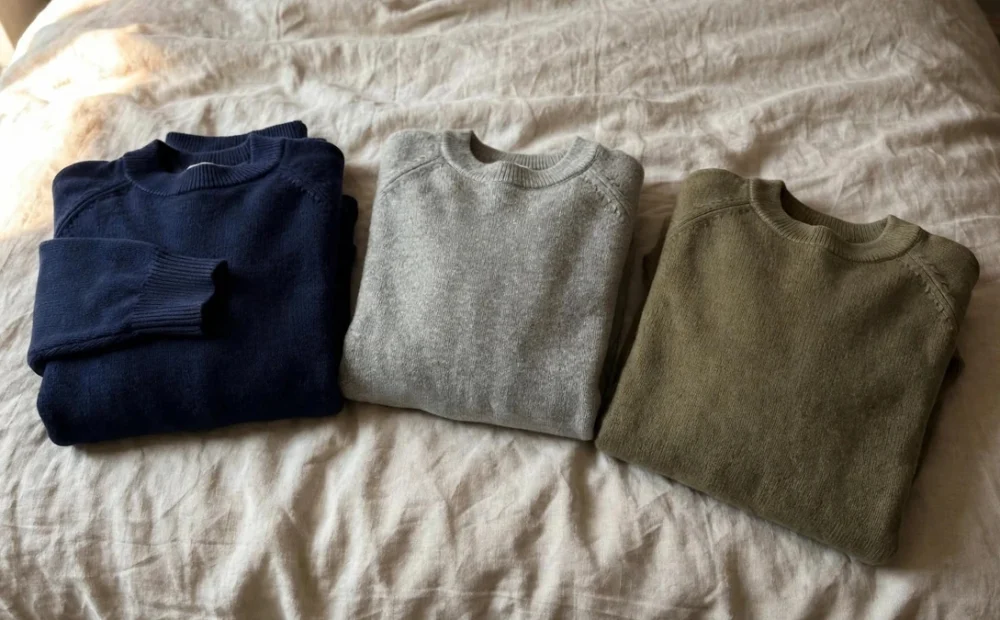
Cotton blend sweaters are the easiest knits to style, and that is exactly why they can look dull. They are soft, comfortable and forgiving, which means they disappear into an outfit instead of making it. A cotton blend sweater will not do the work for you the way a bright cashmere or a chunky fisherman knit does. It needs a little intention: a tuck here, a structured bottom there, a colour chosen with the wash in mind.
The good news is that cotton blends are also the most forgiving knits to experiment with. They breathe well, they drape rather than cling, and they come in every blend from light cotton-acrylic to soft cotton-cashmere, so there is a version for almost every outfit and every season. Once you know what each blend does, you can use it deliberately instead of reaching for the same sweater and jeans combination every time.
Below are nine ways to style a cotton blend sweater for women in 2027, from reading the blend ratio before you plan an outfit to choosing shoes that match the weight of the knit. Each one is built around how cotton blends actually behave, so the advice works with the sweater you already own, not just the one in the picture.
Key takeaways
- Cotton blend sweaters are easy to style because they drape well and breathe, but they need intention or they can look flat and shapeless.
- The blend ratio decides the outfit: a cotton-wool blend suits structured looks, while a cotton-modal blend suits soft, flowing ones.
- A tuck or half-tuck gives a cotton blend sweater shape, because the knit itself has little natural structure.
- Balance a soft, relaxed knit with a structured bottom, and a neat, fitted knit with something softer below.
- No styling trick fixes a sweater that pills badly, sags at the hem or has lost its shape, so check the knit before you build an outfit around it.
Why cotton blend sweaters are easy to style
Cotton blend sweaters drape rather than cling, which is the first reason they are easy to wear. A cotton-acrylic blend falls in a soft line from the shoulder, a cotton-modal blend has a silky fall that skims the body, and a cotton-wool blend holds a little more structure without feeling stiff.
The second reason is breathability. Cotton is a breathable fibre, and most blends keep enough of that quality to be comfortable indoors all day. A cotton blend sweater will not leave you overheated in a warm office the way a heavy pure wool knit can, and it will not feel clammy the way a fully synthetic sweater does.
The third reason is variety. Cotton blends come in every weight, from a fine cotton-cashmere crewneck that layers under a blazer to a chunky cotton-wool knit that works as an outer layer on a cold day. That range means you can use the same styling ideas across the whole year, adjusting only the weight of the sweater and the layers around it.
How to plan a cotton blend outfit and what to look for
Start with the label, not the mirror. Read the fibre content and the blend ratio before you decide what to wear the sweater with, because the ratio tells you how the knit will behave. A high-cotton blend will breathe well and drape softly, which suits relaxed outfits. A cotton-wool blend will hold its shape and keep you warm, which suits structured outfits. A cotton-cashmere blend will feel soft and look refined, which suits smarter outfits.

Next, check the weight of the knit. Hold the sweater by the shoulders and feel how heavy it is. A light cotton-acrylic blend is a mid-layer that needs a jacket or coat on a cold day, and it pairs well with lighter bottoms. A heavier cotton-wool blend can stand on its own as the warmest layer, and it needs a bottom with enough presence to balance it, such as wide-leg trousers or a heavy denim.
Finally, look at the shape the sweater makes when you wear it. Cotton blends have little natural elasticity, so a sweater that is too big will look shapeless, and one that is too small will pull at the seams. The right fit skims the body without clinging, and the hem sits at or just below the waistband of your trousers or skirt. Our roundup of the best cotton blend sweaters for women is a good place to start if you are still choosing the sweater itself, because it compares the main blends side by side.
9 ways to style a cotton blend sweater
Read the blend ratio before you plan the outfit
What to do: Check the fibre label and let the blend decide the outfit. A cotton-wool blend suits structured trousers and a blazer, while a cotton-modal blend suits a flowing skirt and soft layers. What to avoid: Treating every cotton blend sweater as the same, because a light cotton-acrylic knit and a heavy cotton-wool knit behave completely differently. Best For: Building an outfit around a new sweater. Time Needed: Two minutes, before you get dressed. Standout Tip: A blend with more than 30 percent wool or cashmere is a smart-outfit sweater; a blend with more than 40 percent acrylic is a casual one.
Let the cotton breathe on in-between days
What to do: Wear a cotton blend sweater on its own on mild days, with no coat and no extra layer, and let the breathability do the work. What to avoid: Adding a heavy jacket over a light cotton blend on a mild day, which traps heat and hides the sweater. Best For: Spring and autumn days when the temperature changes by the hour. Time Needed: No extra time, just leave the coat at home. Standout Tip: A cotton blend sweater is at its best between 12 and 18 degrees, when a pure wool knit would be too warm and a T-shirt too cold.
Tuck or half-tuck to give the knit some shape
What to do: Tuck the front of the sweater into your trousers or skirt, or do a half-tuck at one side, to define your waist and show the shape of the bottom. What to avoid: Leaving a long, straight sweater hanging loose over wide trousers, which hides your shape and makes the outfit look shapeless. Best For: Straight-cut and relaxed-fit cotton blend sweaters. Time Needed: Thirty seconds in front of a mirror. Standout Tip: A half-tuck works best with a soft cotton-modal blend, because the silky drape falls neatly instead of bunching.
Balance a soft knit with a structured bottom
What to do: Pair a soft, relaxed cotton blend sweater with tailored trousers, a pleated skirt or a structured denim, so the bottom gives the outfit its shape. What to avoid: Wearing a soft, slouchy sweater with soft, slouchy bottoms, which leaves the outfit with no shape at all. Best For: Relaxed-fit and oversized cotton blend sweaters. Time Needed: Five minutes to swap the bottom. Standout Tip: A cotton-cashmere sweater with tailored trousers looks smarter than the same sweater with leggings, even though the sweater has not changed.
Layer a cotton blend under a jacket without the bulk
What to do: Choose a fine or medium-weight cotton blend as your mid-layer, and wear it under a blazer, a denim jacket or a light coat, with the collar and cuffs sitting neatly. What to avoid: Layering a chunky cotton-wool knit under a fitted blazer, which bunches at the shoulders and sleeves and looks uncomfortable. Best For: Fine cotton-cashmere and cotton-modal blends. Time Needed: Five minutes to check the layers in a mirror. Standout Tip: A fine cotton blend is a better mid-layer than a chunky knit, because it adds warmth without adding bulk.
Use a cotton-cashmere blend for your smartest outfits
What to do: Save your softest cotton-cashmere blend for the outfits that need to look polished, such as work meetings, dinners and smart daytime events, and pair it with tailored pieces. What to avoid: Wearing a cotton-cashmere blend for gardening, cleaning or rough everyday chores, which pills and wears it out faster than it should. Best For: Workwear, dinners and smart occasions. Time Needed: No extra time, just choose the right sweater for the day. Standout Tip: A cotton-cashmere crewneck with tailored trousers and loafers looks as polished as a blouse, with far less effort.
Choose colour with the wash in mind
What to do: Pick colours you are happy to wash cold and lay flat to dry, and remember that dark cotton blends can fade slightly while pale ones can show stains. What to avoid: Buying a pale cotton blend sweater in a colour you will worry about every time you wear it, or a dark one you will wash with light colours. Best For: Building a practical, repeat-wear wardrobe. Time Needed: A minute at the rail, thinking about your laundry. Standout Tip: Mid-tones such as sage, camel and grey marl are the most forgiving cotton blend colours, because they hide both fading and light marks.
Let a cotton blend carry a print or a pattern
What to do: Use a patterned cotton blend sweater, such as a stripe, a fair isle or a subtle check, as the focal point of the outfit, and keep everything else plain. What to avoid: Pairing a patterned sweater with a patterned skirt or busy trousers, which competes with the knit and makes the outfit look noisy. Best For: Striped, fair isle and checked cotton blend knits. Time Needed: Five minutes to simplify the rest of the outfit. Standout Tip: A striped cotton blend sweater with plain dark jeans and simple shoes is one of the easiest good outfits there is.
Finish with shoes that match the weight of the knit
What to do: Match the shoes to the weight of the sweater: light cotton blends with trainers, loafers or ballet flats, and heavy cotton-wool blends with boots or chunky shoes. What to avoid: Wearing heavy boots with a fine, light cotton blend, or delicate flats with a chunky fisherman knit, because the balance of the outfit feels wrong. Best For: Any cotton blend outfit, as the finishing touch. Time Needed: Two minutes to swap shoes. Standout Tip: If the shoes feel too heavy or too light for the sweater, they probably are, and swapping them is the fastest way to fix an outfit.
Cotton blend sweaters through the seasons
In spring, a cotton blend sweater is at its best. A light cotton-acrylic or cotton-modal blend works on its own on mild days, and it layers easily under a light jacket when the morning is cool.
In summer, a fine cotton blend sweater is useful for cool evenings and air-conditioned rooms, even though it is not a summer garment in the usual sense. A cotton-linen blend is the best choice for warm weather, because the linen adds extra breathability, and a light cotton blend in a pale colour works well over a dress or with linen trousers.
In winter, a cotton blend sweater works best as a mid-layer or as a lighter option for heated indoor days. A chunky cotton-wool blend can stand on its own on a cold day, but a fine cotton-cashmere blend is usually better under a coat, where its softness is close to the skin and its warmth is protected from the wind. Our guide to styling a wool blend sweater covers the heavier winter end of the spectrum, and it is a useful companion if you want a knit that does more of the warming work on its own.
The caveats that matter
Cotton blend sweaters are forgiving, but they are not indestructible, and the most common styling problem is a sweater that has lost its shape. A cotton blend with a low wool or synthetic share can stretch at the neckline and hem, especially if it is hung to dry or stored on a hanger.
| Detail | What is known |
|---|---|
| Best all-round blend | Cotton-wool, warm enough for cold days and structured enough to hold its shape |
| Softest blend to style | Cotton-cashmere, which suits smart outfits and tailored bottoms |
| Easiest blend to wash | Cotton-acrylic, which tolerates a cold gentle cycle and dries quickly |
| Best for mild weather | A light cotton blend on its own, between roughly 12 and 18 degrees |
| Simplest shape fix | A tuck or half-tuck, which defines the waist in under a minute |
| Best bottom pairing | A structured bottom with a soft knit, and a soft bottom with a structured knit |
| What to avoid | Chunky knits under fitted jackets, and patterned sweaters with patterned bottoms |
| When to retire it | When pilling, sagging or thinning cannot be fixed, or the shape no longer recovers |
Pilling is the other problem to watch. Blends with a large acrylic or polyester share pill where fabric rubs, especially under the arms and along the sides, and a badly pilled sweater will undermine even the best styling. A fabric comb removes pills in a few minutes, and washing the sweater inside out in a mesh bag slows them down, but if a sweater pills after every wear, it is not a styling problem, it is a quality problem. Our roundup of the best hemp blend sweaters for women is worth a look if you want a blend that pills less and holds its texture longer than a cotton-acrylic knit.
Checklist: styling a cotton blend sweater honestly
Use these checks before you leave the house.
- Read the label and let the blend ratio decide whether the outfit is relaxed, structured or smart.
- Check the weight: the shoes and the bottom should match the weight of the knit.
- Tuck or half-tuck the sweater if it hangs straight and hides your shape.
- Balance a soft knit with a structured bottom, and a structured knit with something softer below.
- Keep the rest of the outfit plain if the sweater has a print or a pattern.
- Check the sweater for pilling, sagging and stretching before you build an outfit around it.
Frequently asked questions
Can I wear a cotton blend sweater to work?
Yes, especially a cotton-cashmere or cotton-modal blend, which looks refined and layers neatly under a blazer. Pair it with tailored trousers or a neat skirt, and keep the rest of the outfit polished.
Should I tuck in a cotton blend sweater?
Usually yes, at least a front tuck or a half-tuck, because cotton blends have little natural structure and a tuck defines your waist. A full tuck works best with a fine knit, while a chunky knit suits a half-tuck.
What bottoms go best with a cotton blend sweater?
Structured bottoms such as tailored trousers, pleated skirts and straight-leg jeans work well with a soft knit, while softer bottoms such as a flowing skirt suit a more structured cotton-wool blend.
Can I layer a cotton blend sweater under a coat?
Yes, if the knit is fine or medium weight. A chunky cotton-wool knit is too bulky under a fitted coat, so wear it as the outer layer instead, or choose a looser coat.
How do I stop a cotton blend sweater looking shapeless?
Use a tuck or half-tuck, choose a structured bottom, and make sure the sweater fits well. If the knit has stretched at the neckline or hem, no styling trick will fix it, and it is time to replace it.
Are cotton blend sweaters good for all seasons?
They are most useful in spring and autumn, when their breathability suits changeable weather. In winter they work best as a mid-layer or as a lighter indoor option, and in summer a fine cotton blend suits cool evenings.
The bottom line
Styling a cotton blend sweater is mostly about working with what the blend does, rather than against it. Read the label, let the blend ratio decide whether the outfit is relaxed, structured or smart, and use a tuck, a structured bottom and shoes that match the weight of the knit to give the outfit its shape. Those few decisions are what turn a comfortable sweater into a good outfit.
Start with the sweater you already own, check it against the ideas above, and try one change at a time: a half-tuck, a different bottom, a swap of shoes. A cotton blend sweater does not need a new wardrobe to look good. It needs a little intention, and that is the easiest kind of styling there is.