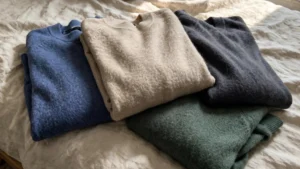

A linen blend cardigan is one of the easiest layers to own and one of the easiest to get wrong. Worn well, it looks relaxed, breathable and quietly expensive, the kind of layer that makes jeans and a plain top feel finished. Worn badly, it sags at the pockets, creases in the wrong places, and hangs like something you grabbed from the back of a chair.
The difference is rarely the price. It is the blend, the fit, and the way you style it. A linen blend cardigan is not a wool cardigan, and it does not behave like one. It does not hold a sharp shape, it does not hide creases, and it does not forgive a tight fit.
Below are nine steps that make a linen blend cardigan work, from reading the label to caring for it after the wash. Each step is practical, and each one is specific to linen blends, not generic cardigan advice.
Key takeaways
- A linen blend cardigan needs room to move. Buy it slightly relaxed, with the shoulder seam on your shoulder, or it will bag out at the elbows and pockets.
- Match the blend to the moment: linen-cotton for hot days, linen-viscose for evenings, linen-wool for cool spring and autumn.
- Creases are part of the fabric. Choose natural shades and relaxed outfits, and the creases look intentional instead of careless.
- Pair it with bottoms that hold a line, because a soft, creased knit needs something structured underneath it.
- No styling trick will fix a poor blend or a tight fit, and a very cheap cardigan will stretch out of shape whatever you do with it.
What makes a linen blend cardigan different
A linen blend cardigan is knitted from linen mixed with cotton, viscose or wool, and that mix changes everything about how it wears. The linen gives it a dry, cool hand and a slightly uneven, slubbed surface. The second fibre decides whether it drapes, holds its shape, or adds warmth. Cotton softens it and makes it easy to wash. Viscose smooths the drape and adds a gentle sheen. Wool adds insulation for cooler days.
That fibre mix is why linen blend cardigans do not behave like wool ones. Wool springs back when you stretch it, so a wool cardigan keeps its shape. Linen relaxes, so a linen blend cardigan grows with wear. A fit that feels snug in the shop will feel loose by the third wear, and a front that pulls at the buttons will only pull more. Buy for the fit you will have after a week of wear, not the fit you see in the mirror on day one.
The texture is the other difference. Linen has a visible slub and a matte, dry surface, which reads as relaxed and natural. It does not suit sharp tailoring or glossy fabrics, and it looks best with textures that share its easy character: denim, cotton twill, washed linen, suede, and soft leather.
How to tell a good linen blend from a poor one
Start with the label. A good linen blend cardigan lists linen at 40 to 70 percent, with the rest cotton, viscose or wool. If the label shows less than a third linen, or a large share of acrylic or polyester, the cardigan will feel warmer, pill faster, and lose the dry, airy quality that makes linen worth wearing. The label is the cheapest quality check you have, and it takes ten seconds.

Next, feel the knit. A good linen blend feels cool and dry, with a fine, even weave and a little slub. It should spring back slowly when you squeeze a fold, not stay crushed and not bounce back like foam. A poor blend feels slippery or plasticky, and the surface looks glazed rather than matte. Hold it up to the light too: thin patches mean a loose, uneven knit that will not last. Our guide to styling a linen blend sweater covers the same fibre family in a pullover shape, which is a useful comparison when you are choosing between the two.
Finally, check the construction. Buttons should be sewn on firmly with a little thread behind them, so the front does not pucker when you do them up. Pockets should lie flat and sit high enough that they do not drag the front down.
The 9 steps that make a linen blend cardigan work
Choose the linen share for the season you are dressing for
What to Do: Pick linen-cotton with a linen share above half for hot days, linen-viscose for mild evenings, and linen-wool for cool spring and autumn. Read the composition label before you plan the outfit, because the blend decides how the cardigan will feel by midday.
What to Avoid: Do not buy one cardigan and expect it to cover every season. A linen-wool blend will feel warm in July, and a light linen-cotton knit will leave you cold in October.
Best For: Anyone building a small, hard-working wardrobe. Time Needed: Ten seconds at the label. Standout Tip: A linen share of 40 to 70 percent is the sweet spot for most weather.
Let the open cardigan sit like a linen jacket, not a shrug
What to Do: Wear it open over a plain camisole or a fitted T-shirt, with the fronts hanging straight and the hem ending at the hip or just below. Treat it as a light jacket, and the outfit gains a layer without gaining bulk.
What to Avoid: Do not push it back off your shoulders like a shrug, because a linen blend knit will not stay there and the fronts will bunch at your sides.
Best For: Warm days and layered outfits. Time Needed: A minute in front of a mirror. Standout Tip: If the fronts swing when you walk, the cardigan is doing its job.
Wear linen-cotton by day and linen-viscose after dark
What to Do: Reach for a linen-cotton cardigan for daytime, when you want breathability and easy washing, and switch to a linen-viscose one in the evening, when its smoother drape and gentle sheen suit smarter outfits.
What to Avoid: Do not wear a matte, slubbed linen-cotton cardigan to a smart evening event and expect it to look dressy, because the texture reads as daytime.
Best For: Days that run into evenings. Time Needed: None, once the wardrobe is sorted. Standout Tip: Keep one of each blend and you cover most occasions.
Pair the crease-prone knit with trousers that hold a line
What to Do: Wear the cardigan with straight-leg jeans, tailored cotton trousers, or a crisp linen skirt, so the structured bottom balances the soft, creased top. The contrast is what makes the outfit look deliberate.
What to Avoid: Do not pair a creased linen blend cardigan with soft, shapeless bottoms, because two relaxed pieces together look unfinished rather than relaxed.
Best For: Smart casual days and office outfits. Time Needed: A minute of planning. Standout Tip: If the trousers hold a crease of their own, the outfit holds together.
Let a long cardigan fall past the hip over a short top
What to Do: With a long, open-front cardigan, wear a short camisole or a fitted top underneath and let the cardigan fall past the hip, so the length of the cardigan becomes the line of the outfit.
What to Avoid: Do not wear a long cardigan over a long, loose top, because the two lengths blur together and the outfit loses its shape.
Best For: Dresses and wide-leg trousers. Time Needed: A minute in front of a mirror. Standout Tip: The cardigan should be the longest layer you are wearing.
Keep the neckline open so the linen can breathe
What to Do: Leave the top button undone, or wear the cardigan open at the neck, so air moves through the knit and the V shape lengthens your neck. A linen blend cardigan is at its best when it is not buttoned to the chin.
What to Avoid: Do not button a linen blend cardigan right up to the neck on a warm day, because it will feel hot, look stiff, and crease in a hard line across the chest.
Best For: Hot days and layered looks. Time Needed: None. Standout Tip: One open button at the neck changes the whole outfit.
Take it on holiday as the one layer that does three jobs
What to Do: Pack a midweight linen blend cardigan as your plane layer, your evening cover-up, and your cool-morning jacket. It folds small, shakes out easily, and the creases it picks up in a bag look like part of the fabric.
What to Avoid: Do not pack three separate light layers when one cardigan does the job, because each extra layer is weight and space you do not need.
Best For: Travel and holidays. Time Needed: A minute to fold it. Standout Tip: Choose a natural or dark shade so marks from travel do not show.
Shake it out after washing and wear the creases in
What to Do: Wash the cardigan cold, shake it out while it is still damp, reshape it on a towel, and let it dry flat. The creases that remain are soft folds, and they settle into the knit as you wear it.
What to Avoid: Do not iron a linen blend cardigan flat, because a pressed, crisp finish fights the relaxed character of the fabric and the creases come back within an hour anyway.
Best For: Anyone who hates ironing. Time Needed: Five minutes after the wash. Standout Tip: A light steam is enough if you want to soften the worst folds.
Let it air on a chair overnight instead of washing it after every wear
What to Do: Hang the cardigan over a chair overnight so it airs out, and wash it only when it actually needs it. Linen blends freshen up well with air, and less washing keeps the knit in shape for longer.
What to Avoid: Do not wash a linen blend cardigan after every single wear, because each wash softens the knit a little more and the shape loosens a little faster.
Best For: Keeping a favourite cardigan in shape. Time Needed: None. Standout Tip: A night of air does more for a linen blend than a hot wash does.
Linen blend cardigans through the seasons
Spring is the best season for a linen blend cardigan, because the weather changes through the day and the cardigan changes with it. Wear it open over a shirt in the morning, button it up when the wind picks up, and take it off in the afternoon sun. A linen-wool blend is the right choice for early spring, when the mornings are still cold, and a linen-cotton blend takes over once the days warm up.
Summer is where linen earns its keep. A light linen-cotton cardigan is the layer for air-conditioned rooms, cool evenings, and places where bare shoulders feel out of place. It breathes, it dries quickly, and it packs small, which is why it is the cardigan most people reach for on holiday.
Autumn is the season to switch blends rather than retire the cardigan. A linen-wool blend over a thermal, under a coat, carries you through mild autumn days, and the cardigan’s relaxed texture suits the season’s softer palette. In winter, a linen blend cardigan is a middle layer, not an outer one, so wear it under a proper coat and let the coat do the warming. Our guide to styling a hemp blend cardigan covers a similar warm-weather fibre, and the layering logic works the same way.
The caveats that matter
Linen blend cardigans are forgiving, but they have limits. The most common mistake is buying a tight fit, because the knit relaxes with wear and a snug cardigan soon looks baggy at the elbows and the pockets.
| Detail | What is known |
|---|---|
| Best blend for hot weather | Linen-cotton, with a linen share above half |
| Best blend for evenings | Linen-viscose, for a smooth drape and a soft sheen |
| Best blend for cool days | Linen-wool, warm enough to skip a coat on mild days |
| Fit to buy | A relaxed fit that still sits on the shoulder |
| Creasing | Softer folds than pure linen; natural shades hide them |
| Washing | Cold wash, dry flat; gentler care for linen-wool and linen-viscose |
| What to avoid | Tight fits, low-linen blends, and pressing it flat with an iron |
| What it does not do | It will not stay crisp, and it will not warm you in deep winter |
Washing is straightforward. Use cold water, skip the tumble dryer, and dry the cardigan flat on a towel after shaking it out. Linen-wool blends want the coolest wash of all, and linen-viscose blends should never see hot water. A light steam fixes a limp cardigan faster than an iron ever will.
Checklist: styling a linen blend cardigan honestly
Use these checks before you get dressed, and again when you buy.
- Check the blend on the label: linen at 40 to 70 percent, partnered with cotton, viscose or wool.
- Check the shoulders: the seam should sit on your shoulder, not slide down your arm.
- Check the neckline: leave the top button undone so air moves through the knit.
- Check the outfit balance: a soft, creased cardigan needs bottoms that hold a line.
- Check the blend against the weather: linen-cotton for heat, linen-viscose for evenings, linen-wool for cool days.
- Check the care routine: cold wash, shake out, dry flat, and air between wears.
Frequently asked questions
Can I wear a linen blend cardigan with a suit?
Yes, if the suit is relaxed and the cardigan is fine-knit. A linen blend cardigan under an unstructured linen or cotton suit jacket works well, because the textures agree. Skip it with a sharp, formal suit, where the cardigan’s relaxed knit clashes with the tailoring.
Should a linen blend cardigan be tucked in or left loose?
Left loose, almost always. Tucking a cardigan in bunches the knit at the waist and fights the relaxed shape. If you want a waist, button the cardigan and wear a slim belt over it, or choose a shorter cardigan that ends at the waistband.
What shoes go best with a linen blend cardigan?
Shoes that match the relaxed mood: loafers, clean trainers, espadrilles in summer, and suede ankle boots in autumn. Avoid very formal shoes, because a polished Oxford next to a slubbed linen knit looks like two different outfits.
Can I wear a linen blend cardigan with a belt?
Yes, a slim belt over a buttoned cardigan gives an open, relaxed knit a waist without tucking it in. Keep the belt simple, in leather or woven fabric, and skip wide or statement belts, which fight the soft lines of the knit.
How do I stop a long linen blend cardigan from looking shapeless?
Wear a short, fitted top underneath and let the cardigan be the longest layer, so its length reads as a line rather than a drape. A slim bottom, straight-leg jeans or a pencil skirt, keeps the proportions in check.
Is a linen blend cardigan too casual for a smart dinner?
Not if the blend is right. A fine linen-viscose cardigan in a dark shade, worn over a silk camisole with tailored trousers, is smart enough for most dinners. A slubbed linen-cotton cardigan in a pale shade is the one that reads as daytime.
The bottom line
A linen blend cardigan works when you style it on its own terms. Buy it slightly relaxed, match the blend to the season, keep the neckline open, and pair it with bottoms that hold a line. Accept the creases, wash it cold, dry it flat, and let it air between wears, and the cardigan will keep its shape and its relaxed character for years.
Start with one cardigan in a blend that suits your weather and a colour you already wear, and wear it for a week before you buy a second. The honest test is simple: if it is the layer you reach for without thinking, it was worth buying, and if it sits in the wardrobe while you reach for something else, the blend or the fit was wrong. Our guide to styling a linen sweater covers the same layering idea for the pullover shape.