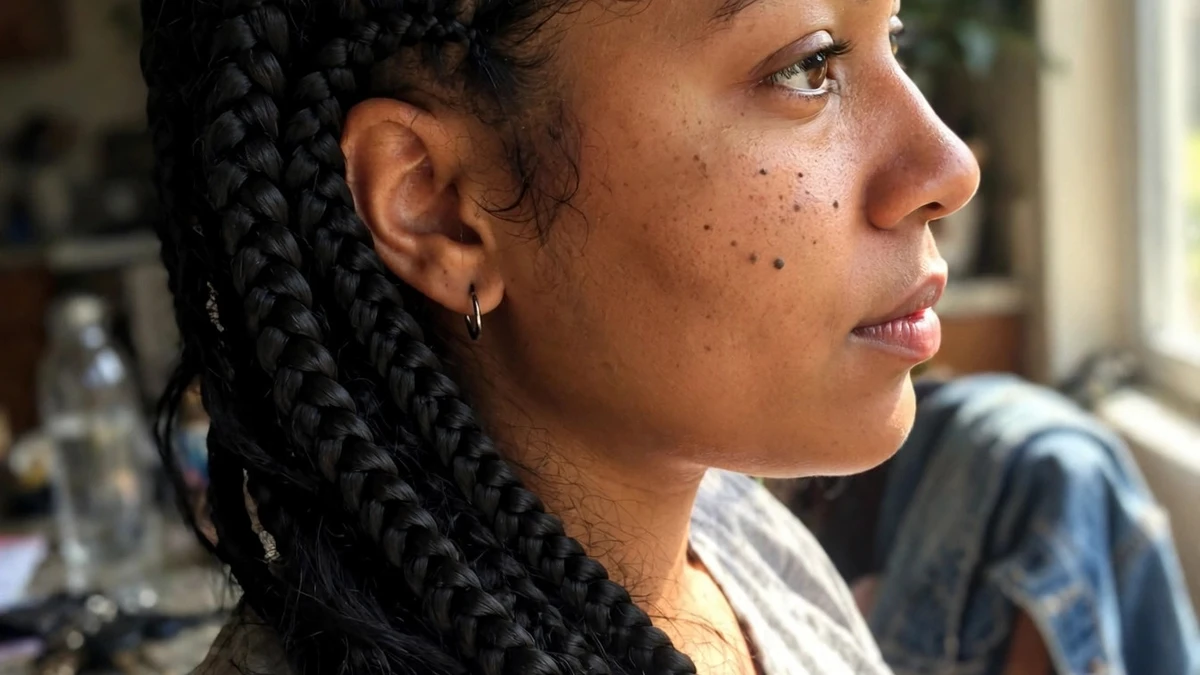
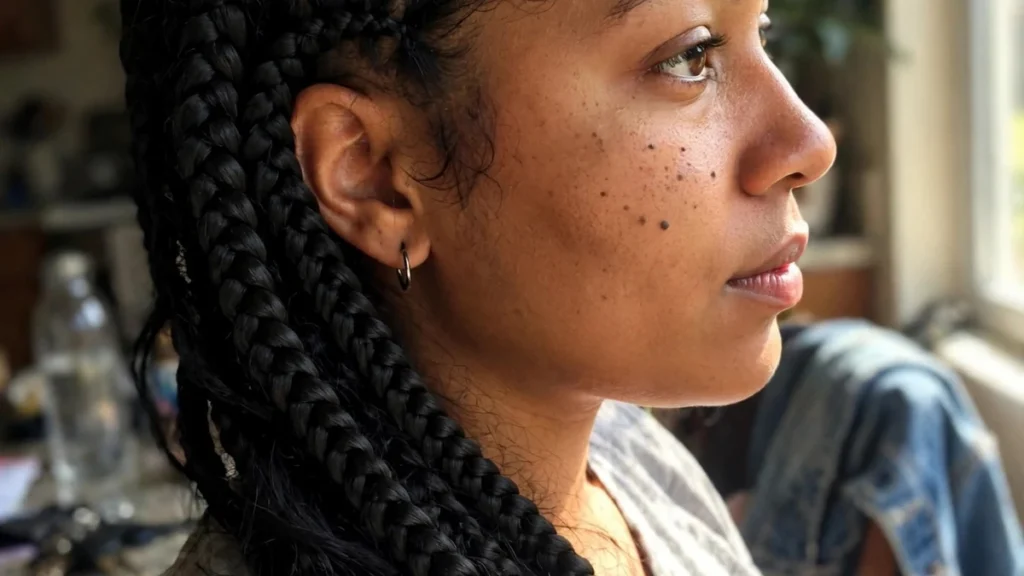
A lemonade braid is a set of cornrows sweeping to one side, the style Beyoncé wore on the cover of her 2016 album Lemonade. Every row starts on the parting side, crosses the crown, and finishes over the opposite shoulder, so the hair has one clear direction. Oiling it means working with that direction: oil goes along each parting first, then down each row, and the edges stay dry.
Oil matters so much here because cornrows hold the scalp taut for weeks. The partings show more skin than a loose style does, and that skin dries out, itches, and flakes if ignored. The braids also need shine, because a cornrow without it looks flat and dusty by the second week. Oil is the tool for both jobs, but it punishes guesswork: too much loosens the edges, and too little leaves the scalp sore.
This guide walks through the whole routine, from clean hair to the finished sweep, in nine steps, each saying what to do, what to avoid, and how long it takes.
Key takeaways
- A lemonade braid sweeps to one side, so oil the partings first, then the rows, always in the direction of the sweep.
- Use one drop at a time, placed with a fingertip or a dropper, never poured from the bottle.
- Keep oil off the hairline edges and the first inch of each row, where it loosens the braids.
- Oil the scalp every one to two days and the braids only when they look dull, not on a fixed daily schedule.
- No oiling routine fixes a braid that is too tight, and a sore or bumpy scalp means the braids should come out.
What a lemonade braid is and why oil changes it
A lemonade braid is made of cornrows, braids worked close to the scalp with hair fed in from the sides as the row moves. Every row is fed from the same side and leans the same way, so the whole head sweeps from one temple across the crown to the opposite shoulder. It is usually worn long, often with feed-in extensions. It is a protective style: the hair is tucked away, but the scalp is not, and every parting faces air and friction from pillows and scarves.
Oil changes a lemonade braid in two ways. On the scalp, it keeps the skin along the partings supple, which matters because cornrows pull the skin taut and dry skin under tension itches and flakes. A drop worked into a parting softens the skin and calms the itch. On the braids, oil adds shine to the raised rows, which makes the sweep visible; without it, the rows look matte and the pattern disappears.
Oil can also undo the style if used carelessly. Cornrows stay in place because the hair grips itself at the root, and oil softens that grip. A drop that runs onto the hairline will loosen the edges within a day, and a heavy pour onto the crown will flatten the rows. That is why the routine below uses small amounts, placed precisely.
What you need before you start
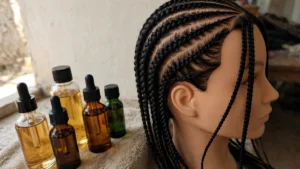
You need a light oil for the braids, a scalp oil for the partings, and a heavier oil for the ends, or one versatile oil that can do all three jobs in different amounts. A dropper bottle or a narrow nozzle is essential, because the routine depends on placing single drops. You also need a rat-tail comb, a hand mirror for the back, and a satin scarf or bonnet for the night after oiling.
Start with clean, dry hair. Wash it, dry it fully, and decide which side the sweep will fall on before you pick up a comb. The sweep usually falls opposite the parting, so a parting on the right sends the braids over the left shoulder. Our guide to using hair oil on a herringbone braid starts the same way, with the parting decided first, because a braid that starts in the wrong place cannot be fixed later.
How to use hair oil on a lemonade braid, step by step
Start on clean, dry hair with the sweep side already decided
What to do: Wash and dry the hair completely, then choose the sweep side and mark the deep part.
What to avoid: Starting on damp hair, which shrinks as it dries and pulls the rows tighter than planned. Starting without a sweep side decided, or the rows drift and look lopsided.
Best For: Every lemonade braid. Time Needed: Ten minutes to wash and dry. Standout Tip: The sweep side is a decision, not a guess — pick it before the first parting.
One drop, spread thin across both fingertips first
What to do: Put a drop of light oil on your fingertips and rub them together until it feels thin.
What to avoid: Tipping the bottle over the head, because one tip is three drops too many on a cornrow parting. Do not use a heavy oil here, or it will sit on the scalp.
Best For: Fine or medium hair that wants a light touch. Time Needed: A few seconds per drop. Standout Tip: If you can see the oil on your fingertip, you have too much — rub it in until it disappears.
Draw the first cornrow parting from the temple to the crown
What to do: Draw a clean, even parting with the rat-tail comb from the temple to the crown. The first row sets the angle for the rest, so take your time.
What to avoid: Rushing it, because a crooked first row makes every row after it crooked too. Do not make it too wide, or the row will look sparse.
Best For: The first row of any lemonade braid. Time Needed: A minute for the parting. Standout Tip: A straight first parting beats a fast one — the whole sweep copies it.
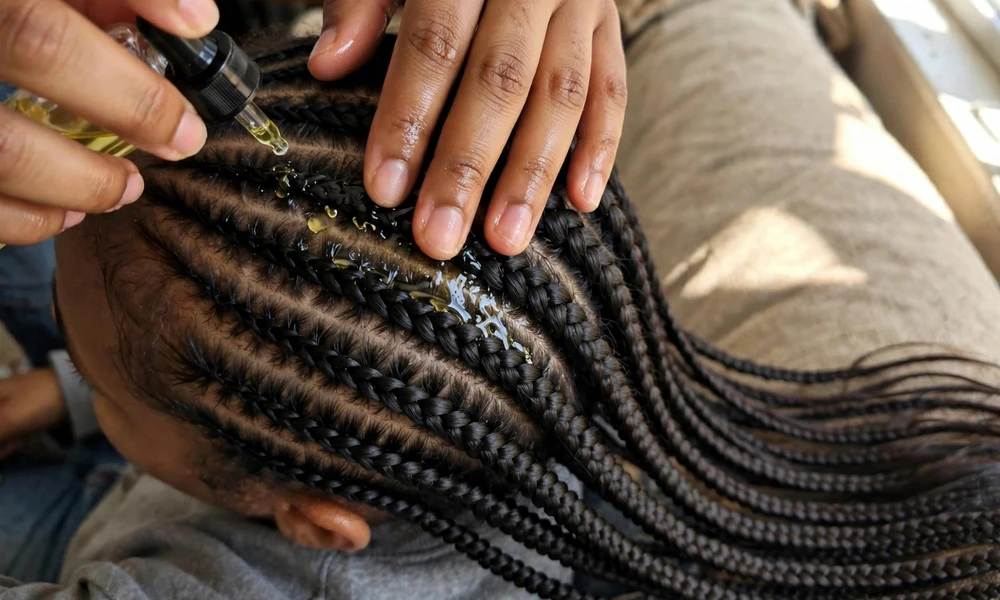
Run one oiled fingertip down the parting before braiding
What to do: Run one oiled fingertip along the fresh parting from temple to crown, pressing gently so the oil reaches the skin. The parting should look lightly sheened, not wet.
What to avoid: Oiling the hair beside the parting too, because the braid needs dry hair to grip. No second drop on the same parting, or the oil pools at the temple.
Best For: Every parting, as soon as it is drawn. Time Needed: Seconds per parting. Standout Tip: Oil the skin, not the hair — the fingertip belongs on the line.
Braid the first row across the crown, feeding hair from one side only
What to do: Start the cornrow at the temple and braid across the crown, feeding hair from the parting side only, so the row leans towards the sweep. Keep the tension even and the row close to the scalp.
What to avoid: Feeding from both sides, which turns the row into a straight-back cornrow and kills the sweep. Do not pull the first row too tight, or the temple aches by evening.
Best For: The first row, which sets the sweep. Time Needed: Three to four minutes per row. Standout Tip: One-sided feeding makes it a lemonade braid — feed from the parting side only.
Keep every row leaning the same way as you work down the head
What to do: Draw each parting parallel to the last, oil it, and braid with the same one-sided feeding, so every row leans towards the sweep. Check the angle from the front after each row.
What to avoid: Letting the rows drift straighter down the head, the most common mistake in this style. Do not skip oiling a parting, or that row will itch first.
Best For: The middle rows, where the sweep is made. Time Needed: Three to four minutes per row. Standout Tip: Check the angle after every row — an early drift takes a minute to fix, a late one means a restart.
Smooth a light coat down each finished row in the sweep’s direction
What to do: Once a row is braided, spread a thin coat of light oil across your palms and smooth it down the row from crown to tail, in the sweep’s direction. The ridges should catch the light without looking wet.
What to avoid: Smoothing against the sweep, which pushes the ridges out of line and frizzes the row. Do not use a heavy oil on the rows, or they flatten into cords.
Best For: Finished rows that look dull or dry. Time Needed: Seconds per row. Standout Tip: Smooth with the sweep, never against it — the direction is the style.
Press castor oil into the tail ends, then tie them off
What to do: Warm a drop of heavier oil, such as Jamaican black castor oil, between your palms and press it into the last inch of the tail. Then tie it off with a fabric tie, not a rubber band.
What to avoid: Oiling the whole tail, which makes it heavy and pulls the rows loose. Do not use a rubber band, which snaps the oiled ends.
Best For: Long tails that need a seal. Time Needed: A minute for the ends. Standout Tip: The ends are the only place a heavy oil belongs — keep it off the rows and roots.
Stand between two mirrors and check the sweep from behind
What to do: Hold a hand mirror behind your head and look into the bathroom mirror, checking that every row leans the same way. Fix any row out of line now, while the oil is still fresh.
What to avoid: Skipping the back check, because the sweep is judged from behind more than from the front. Do not re-oil a row you just fixed, or the extra oil loosens it again.
Best For: The final check before the style is done. Time Needed: Two minutes with the mirrors. Standout Tip: The back view is the real test — if the sweep reads clearly from behind, it is right.
Which method fits your lemonade braid length
Short lemonade braids, ending above the shoulder, need the least oil. The partings are the main job, and a single light coat covers the short rows. Use a light oil for everything, skip the heavy end oil, and oil the scalp every other day. The style stays fresh for two to three weeks; keep oil well away from the hairline.
Medium braids, ending at the shoulder or just below it, are the most forgiving. The rows show the sweep clearly, and the tail is light enough not to pull. Oil the partings daily, smooth a light coat down the rows every few days, and seal the ends once a week. Our guide to using hair oil on an infinity braid uses the same rhythm for a looped braid, because at a medium length the routine settles into a habit.
Long braids, ending past the shoulder blades, need the most care. The heavy tail pulls on the rows at the crown, so the scalp needs oil every day and the ends a seal twice a week. Tie the tail up at night so it does not drag across the pillow, and check the crown rows for loosening every few days. A long braid can last six weeks, but only if the scalp stays comfortable and the ends sealed.
The caveats that matter
The biggest risk in a lemonade braid is not the oil, it is the tension. Cornrows pull the scalp taut, and a braid that is too tight hurts on the first day and can damage the hairline. Oil cannot fix that, and oiling a sore scalp makes it worse by trapping heat and sweat against irritated skin. If the braids hurt, you cannot raise your eyebrows, or you see small bumps along a parting, the style is too tight and should come out.
| Detail | What is known |
|---|---|
| How much oil per parting | A single drop, placed with a fingertip or dropper |
| How often to oil the scalp | Every one to two days, as dry as it feels |
| How often to oil the braids | Only when they look dull, usually every few days |
| Best oil for the partings | A light oil, or a castor-based scalp oil for itching |
| Best oil for the ends | A heavier castor oil, pressed into the last inch only |
| Where oil must not go | The hairline edges and the first inch of each row |
| Signs of too much oil | Wet-looking partings, heavy braids, lint along the rows |
| When to take the braids out | Sore scalp, bumps along a parting, or thinning edges |
Buildup is the second risk. Oil, sweat, and dead skin collect along the partings over weeks, and if the braids are never washed, the scalp will itch no matter how much oil you add. Wash them with diluted shampoo in an applicator bottle when the partings feel coated, and let them dry fully before oiling again. A clean scalp holds oil better than a coated one.
Checklist: oiling a lemonade braid without flattening it
Use these checks each time you oil, and again after a week of wear.
- Check the amount: one drop per parting, never a pour from the bottle.
- Check the direction: partings first, then the rows, always with the sweep.
- Check the edges: keep oil off the hairline and the first inch of each row.
- Check the finish: the ridges should catch the light, not look wet.
- Check the scalp: if it itches despite oiling, wash the braids instead.
- Check the night routine: tie the braids up in satin.
Frequently asked questions
How do I wash oil out of a lemonade braid?
Put diluted shampoo in an applicator bottle, apply it along the partings, and rinse gently so the braids stay in place. Do not scrub the rows, and let the braids dry fully before oiling again, because oil on damp braids traps moisture.
Will oil loosen a lemonade braid at the edges?
It will, if it reaches the edges. Oil softens the braid’s grip at the root, and the hairline is where it matters most. Keep oil on the partings and lengths, away from the hairline and the first inch of each row, and the edges will hold.
Can I re-oil a lemonade braid the next day?
Yes, if the scalp needs it. Oil the partings again with a drop each, but do not re-oil the braids unless dull. The rows only need a fresh coat every few days; re-oiling them daily flattens the pattern.
How long does an oiled lemonade braid last?
Two to six weeks, depending on length, tension, and scalp care. Short braids last about two to three weeks, medium braids three to four, and long braids up to six. The style is finished when the partings look grown out, the edges loosen, or the scalp needs a wash.
Does oiling work on a lemonade braid with extensions?
Yes, and extensions make oiling more important, because the added hair pulls harder on the scalp and the partings dry out faster. Oil the natural hair at the partings the same way, and use a light coat on the extension rows. Do not oil the knots where the extensions attach, or they will slip.
Can I sleep on a lemonade braid with oil in it?
Yes, if you tie the braids up first. Gather the tail over one shoulder, wrap it in satin, and sleep on a satin pillowcase. Our guide to using hair oil on a five-strand braid gives the same night routine, because any long braid tangles and loses oil to a cotton pillowcase overnight. Never sleep with the braids loose and freshly oiled, or the oil ends up on the pillow.
The bottom line
Oiling a lemonade braid is a routine of small amounts and precise placement, not a generous rub. One drop per parting, a thin coat down the rows in the sweep’s direction, and a heavier drop on the ends only: that is the whole method, and it works because it respects how the style is built. The braids stay shiny, the scalp stays comfortable, and the sweep stays visible.
Start with clean, dry hair, decide the sweep side before the first parting, and oil little and often rather than heavily and rarely. If the scalp stays comfortable and the ridges still catch the light after a week, it is right. If the edges loosen or the scalp itches, use less oil, keep it from the hairline, and wash the braids before reaching for the bottle.