How to Use Hair Oil on a Five-Strand Braid 2027
A five-strand braid looks complicated, but the pattern is simple once your hands learn it: the outer strand passes under one neighbour and over the centre, then the other side does the same. The hard part is keeping five strands smooth enough to cross without catching. Hair oil sits right on that line.
Used well, oil is what makes a five-strand braid possible on dry hair. The centre strand carries the most tension, because every cross passes over or under it, and dry hair drags until the braid tightens unevenly and leans to one side. A single drop on the mid-lengths lets the strands glide, so the tension stays even from crown to tie.
Used badly, oil ruins the braid. Five strands rely on friction to hold their shape, and oil removes friction — so the same drop that stops the snagging can let the outer strands creep out of the pattern. This guide works through the dose, the order, and the nine steps that keep five strands sliding and staying put.
Key takeaways
- A five-strand braid weaves under one, over the centre, mirrored on both sides.
- Oil goes on the mid-lengths before braiding, never on the roots, because the crown is where the five strands start.
- One drop warmed between the palms is the starting dose; the tail can take one more.
- Five strands use more hair per inch than three, so a five-strand braid eats length fast and short hair makes a short braid.
- No oil can fix a braid started on tangled hair: detangle first, because five strands magnify every knot.
What a five-strand braid is and why oil changes it
A five-strand braid is five sections woven in a repeating pattern: left strand under strand two, over strand three, then right strand under strand four, over strand three. The result is a flat, wide plait like a ribbon, very different from the round rope of a three-strand braid. It suits long hair best, because five strands consume length quickly.
Oil changes the braid in two opposite ways. It adds slip, which helps the strands cross without catching — essential when the centre strand is under tension from every cross — and it removes the grip that holds the pattern together. The whole skill is finding the dose where the slip helps and the grip survives.
The width is what makes the dose so fussy. A three-strand braid hides a heavy spot inside its round shape, but a five-strand braid lies flat, so oil that pools on the outer strands reads as wet hair while the inner strands stay dry. Only a light oil spread thin coats all five strands the same way.
Choosing the right oil for five strands
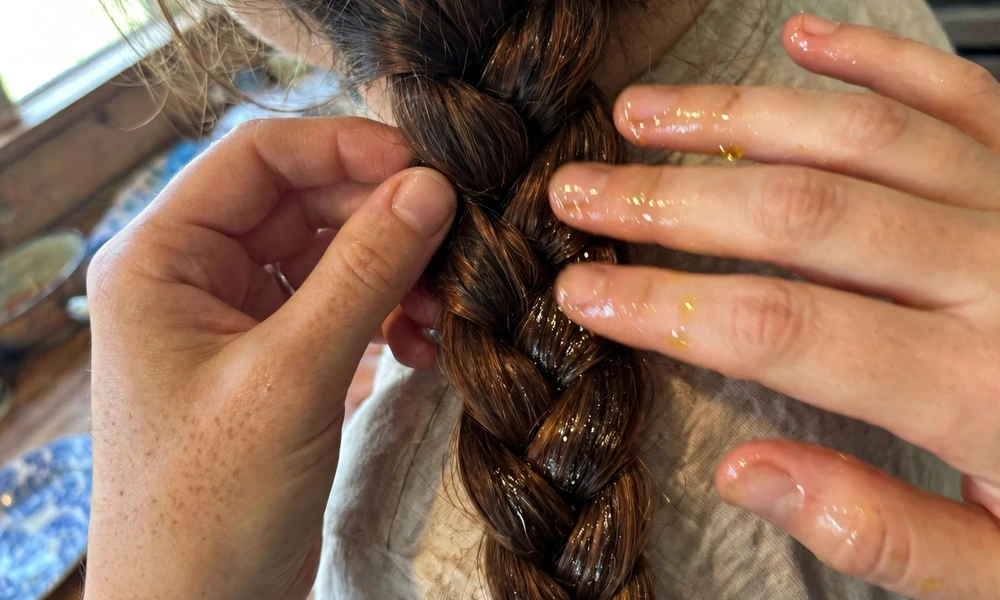
Pick a light or medium oil for the mid-lengths: jojoba, argan, or a thin ayurvedic blend. These spread across five strands in one pass and dry down without a film, so the braid keeps one even texture. Keep a thick oil like castor for the tail only, where its grip stops the last inch from fraying.
Match the oil to your hair, not to the bottle. Fine hair needs the thinnest oil you own, because a wide braid has no bulk to hide a heavy oil inside. Thick hair can take argan on the mid-lengths, but the crown still wants almost nothing. If your scalp runs oily, choose jojoba, which sinks in like the scalp’s own sebum. A rope braid takes a heavier oil than a five-strand braid, so do not carry the dose across from a twist.
How to use hair oil on a five-strand braid, step by step
Wash the hair, let it dry fully, then comb it smooth
What to do: Wash the hair, dry it fully, then comb it from crown to ends until it falls in one smooth sheet with no knots. A five-strand braid magnifies every tangle, so the combing matters more here than on any simpler braid.
What to avoid: Starting on damp hair, because it shrinks as it dries and pulls the outer strands loose. Do not start on day-old hair either: the roots are already oily, so the braid looks greasy before you add a drop.
Best For: Every five-strand braid, whatever the length. Time Needed: Three minutes to wash, dry, and comb the front sections. Standout Tip: A knot at the start becomes a kink in the middle of the braid.
Give the strands slip without giving them shine
What to do: Put one drop of a light oil on one palm, rub your palms together for a few seconds, then press your hands down the mid-lengths from the ears to the ends. The oil should feel thin on your skin, not slick.
What to avoid: Pouring oil straight from the bottle onto the hair, because one pour is three drops too many across five strands. Do not touch the crown with oiled hands — the roots need no oil.
Best For: Fine and medium hair that needs slip without weight. Time Needed: Half a minute to warm the drop and press it in. Standout Tip: If the oil still feels slick on your palms, wipe your hands and start again.
Divide the crown hair into five matching ribbons
What to do: Gather the hair at the crown and divide it into five sections of equal width, like five ribbons laid side by side. Run a finger between each pair so the sections stay separate.
What to avoid: Splitting by feel alone, because uneven sections make an uneven braid — the thick strand bulges and the thin one disappears. Do not start with three sections and split two of them later; the pattern will not hold.
Best For: Thick hair, where five even sections are easy to see. Time Needed: One minute to part five clean sections. Standout Tip: The outer two sections set the braid’s width, so make them match.
Name the strands in your head before the first cross
What to do: Number the five sections from left to right — one, two, three, four, five — and say the pattern to yourself: left under one, over the centre; right under one, over the centre.
What to avoid: Starting without a plan, because the first cross sets the rhythm and a wrong one doubles the work of fixing it. Do not swap hands mid-pattern; keep the left hand on the left and the right hand on the right.
Best For: A first five-strand braid, or any braid after a long break. Time Needed: Twenty seconds to count the strands and learn the pattern. Standout Tip: Say the pattern out loud for the first three crosses.
Take strand one under strand two, then over strand three
What to do: Lift strand one from the far left, pass it under strand two, then over strand three — the centre strand. Lay it flat against strand four and let it rest there. That single move is half the pattern, and it should feel smooth.
What to avoid: Pulling strand one tight as you cross it, because a tight outer strand pinches the braid and the plait leans left. Do not let strand one twist as it passes over the centre — a twisted strand shows as a bump.
Best For: Long hair, where the left cross has room to travel. Time Needed: A few seconds per cross once the rhythm sets in. Standout Tip: Keep the crossing strand flat like a ribbon, not rolled like a rope.
Mirror it on the right: under one, over the centre
What to do: Lift strand five from the far right, pass it under strand four, then over strand three — the new centre strand. Lay it flat against strand two. The two crosses should mirror each other, so the braid stays straight down the back.
What to avoid: Crossing the right side looser than the left, because the braid will drift sideways within three crosses. Do not rush the mirror cross — it is the one most people get wrong, and a wrong one makes the braid lean.
Best For: Keeping the braid straight down the centre of the back. Time Needed: A few seconds per cross once the rhythm sets in. Standout Tip: Glance in a mirror after each pair of crosses — a lean caught early is a tug, not a restart.
Keep the five strands flat like a ribbon as you work down
What to do: As you repeat the pattern down the head, keep each strand flat and wide instead of letting it roll into a rope. Smooth each strand with your thumb before you cross it.
What to avoid: Letting the strands roll, because rolled strands make a narrow, lumpy braid instead of the wide flat plait it should be. Do not pull harder on one side to compensate — even tension is the only fix.
Best For: Thick hair, where the flat ribbon shape shows best. Time Needed: Two minutes to work the pattern down to the nape. Standout Tip: Flatten a rolling strand with your thumb before the next cross — never after.
Finish the tail with a last drop and a fabric tie
What to do: When the braid reaches the ends, warm one more drop — a thick oil like castor works here — and smooth it over the tail, then tie the braid with a soft fabric band. The tail is where five strands become five separate ends, and the oil keeps them together.
What to avoid: Tying the braid with a thin elastic, because it dents the tail and snaps fine hairs. Do not use the thick oil above the tail — it will glue the outer strands together and the pattern will vanish.
Best For: Dry ends that fray as soon as the braid is tied. Time Needed: Half a minute to oil the tail and tie the band. Standout Tip: A fabric band grips five strands instead of pinching them.
Fan the outer edges gently for a fuller five-strand look
What to do: Once the braid is tied, pinch the outer edge of each cross very gently and pull it out a fraction, working from the tail upward. This fans the braid wider and makes the pattern easier to read.
What to avoid: Pulling hard, because the outer strands are the loosest in the pattern and they will slide out entirely. Do not fan the braid before it is tied — it will loosen from the bottom up.
Best For: A finished braid that looks too narrow for five strands. Time Needed: One minute to fan the edges from tail to crown. Standout Tip: Fan the tail first and the crown last.
Which approach fits your braid length
Long hair is the natural home of a five-strand braid: the pattern has room to repeat, the width shows, and the tail is long enough to fan. On long hair, oil the mid-lengths before you start and the tail when you finish, and the braid will hold its pattern all day. A side braid uses less hair per inch than a five-strand braid, so hair long enough for a side braid is long enough for five strands — but the five-strand version ends higher up the back.
Medium hair, around shoulder length, can hold a five-strand braid if the sections are oiled lightly and the crosses stay flat. The braid will be short, so skip the fanning step — pulling the edges out on a short braid loosens the whole thing. Keep the dose to half a drop, because there is less length to absorb it.
Short hair, above the shoulders, rarely holds five strands for long. The sections are too short to cross more than a few times, and the tail barely exists. If you try it, braid tightly, skip the oil on the mid-lengths, and use one drop on the tail only — the grip matters more than the slip when the braid is this short. A pull-through braid suits short hair better than a five-strand braid, because it builds volume from elastics instead of length.
The caveats that matter
A five-strand braid punishes small oiling errors more than a simpler braid does. The table below is the short version: who should skip an oil, what to test first, and where the dose goes wrong.
| Detail | What is known |
|---|---|
| Patch test | Try any new oil behind the ear for a day first, because a five-strand braid holds oil against the scalp for hours. |
| Scalp oil | Scalp oils stay on the scalp; a cooling ayurvedic oil worked down the lengths coats the outer strands and dulls the plait. |
| Fine hair | Fine hair takes half the dose in this guide, because a wide braid has no bulk to hide a heavy oil. |
| Thick hair | Thick hair takes argan on the mid-lengths, but the crown still takes almost nothing. |
| Allergies | Almond and argan are tree-nut oils — avoid them with a tree-nut allergy. |
| Sun | Oil on the outer strands warms up in strong sun, so keep an oiled braid out of direct midday light. |
| Sleeping | Sleeping in a freshly oiled five-strand braid leaves the crown greasy and the tail dry by morning. |
| Washing out | Castor oil takes two washes to lift, so wash the day you plan to oil the tail. |
Checklist: oiling a five-strand braid without flattening it
- Comb every knot out before you oil — five strands magnify tangles, and oil locks them in place.
- Warm one drop between the palms and press it through the mid-lengths only.
- Split the hair into five even sections and number them before the first cross.
- Cross under one, over the centre, mirrored on both sides, keeping each strand flat.
- Seal the tail with one more drop and a soft fabric band.
- Fan the outer edges gently from the tail upward.
Frequently asked questions
Can I braid five strands on hair that is already oiled?
Yes, if the oil is light and went on hours ago. Fresh oil makes the strands too slippery, so oil the hair the night before and braid in the morning.
Will oil make five strands slide out of place?
Yes, with too much of it. The pattern holds because the strands grip each other, and oil takes that grip away. One drop on the mid-lengths is the safe dose; two drops will let the outer strands creep out within an hour.
How much oil do five strands actually need?
One drop for the mid-lengths and one more for the tail if the ends are dry. The centre strand takes almost none, because each cross passes over it and brings oil along. Three drops is the most this braid should take.
Is a five-strand braid harder to oil than a three-strand braid?
Yes. A round three-strand braid hides a heavy spot inside, while a flat five-strand braid puts every strand on display, so a heavy spot shows at once. The pattern is also harder to learn, which is why numbering the strands matters.
How do I wash oil out of a five-strand braid?
Undo the braid first, then wash twice: once to lift the oil, once to clean the scalp. Castor oil on the tail needs both washes, so do not wash while the braid is still tied — the water cannot reach the inner strands.
Can I wear a five-strand braid to sleep with oil in it?
You can, but it will not look the same by morning. Oil moves along the strands overnight, leaving the crown greasy and the tail dry. If you must sleep in it, braid loosely, keep the dose to one drop, and wash it out first thing.
The bottom line
A five-strand braid is a flat, wide plait woven under one and over the centre, mirrored on both sides, and oil is what lets the strands cross without catching. One drop on the mid-lengths before you start, one more on the tail when you finish, and nothing on the crown — that is the whole routine.
If you take one idea from this guide, make it the numbering. Five strands are easy to lose track of, and a wrong cross early on doubles the work of fixing it later. Number the sections, say the pattern out loud for the first three crosses, and keep each strand flat. The oil does the sliding; the numbers do the staying put.