A linen blanket is a bed blanket woven from flax fibre. It looks too thin to keep you warm, too wrinkled to look expensive, and too plain to justify its price. Then you sleep under one on a warm night, and the argument ends: it feels cool and never turns clammy.
The confusion starts with the word linen itself. On a label, linen can mean pure flax woven in the traditional way, or a cloth that is mostly cotton or viscose with just enough flax to borrow the name. A blanket sold as linen can also be a throw in disguise, sized for one person on a sofa rather than for a bed. Price settles none of this.
This guide gives the definitions, the numbers, and the care facts you need before you buy one. For the smaller sofa-sized pieces, our guide to the best luxury linen throws covers them in the same fibre.
Key takeaways
- A linen blanket is a bed blanket woven from flax fibre, sized to cover a mattress edge to edge rather than one person on a sofa.
- Real linen feels cool to the touch and slightly textured, with tiny irregularities called slubs in the yarn, and it softens with every wash.
- Weave and weight decide how a linen blanket behaves, and weight in grams per square metre matters more than thickness.
- Linen breathes better than cotton, wool, or silk, but it gives less insulation than wool, so it will not carry a cold night alone.
- A blanket sold as linen can be mostly another fibre, so check the exact fibre percentage, and expect wrinkles: they are part of the cloth, not a fault.
What a linen blanket actually is
A linen blanket is a blanket woven from linen, and linen is the cloth made from the fibre inside the stem of the flax plant. A blanket is a bed covering, large enough to cover a mattress and the people sleeping on it. Linen is not a style or a colour: it is a specific fibre, flax, prepared and spun in a specific way.
What you feel when you touch one is the fibre itself. Flax fibres are long, strong, and slightly stiff when new, which is why a new pure linen blanket can feel crisp on the first night. The yarn carries tiny thickenings called slubs, where the fibre varies in thickness. Those slubs are not flaws. They are the signature of real linen, and a cloth with no slub at all is worth a second look. Linen also feels cool the moment it touches skin, because flax fibre conducts heat away from the body and the weave lets air move through it. A linen blanket is not a duvet, a coverlet, or a bedspread. It is a single woven layer, or two layers stitched together, used as the sleeping cover itself or as a layer under a duvet.
From flax plant to blanket
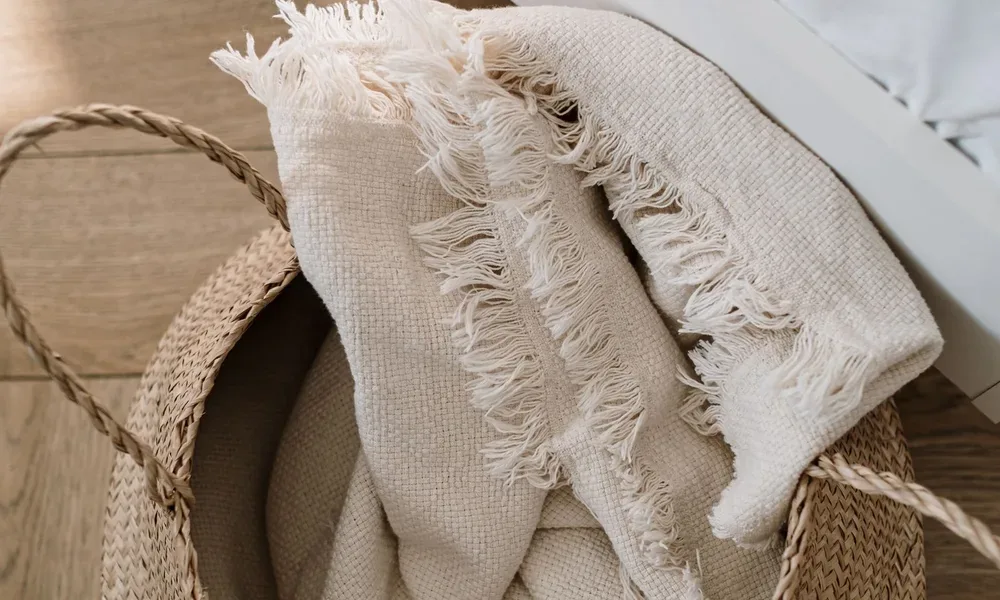
Linen starts as flax, a tall, slender plant with blue flowers, grown mainly in the cool, damp climate of Western Europe, in France, Belgium, and the Netherlands. The fibre lives in the stem, and getting it out is slow work. After harvest, the stems are laid in the field to ret, letting dew, rain, and microbes break down the pectin that glues the fibres to the stem. Field retting takes weeks, and the weather decides the pace. Once retted, the stems are dried, scutched, combed, spun, and woven into cloth on a loom.
Finishing is where a new linen blanket gets its first softness. Pure linen can be washed, stonewashed, or garment-washed before it reaches you, and each treatment relaxes the fibres a little. A pre-washed blanket feels softer on the first night and looks more relaxed. An untreated blanket feels crisper and needs a handful of washes before it relaxes. What matters most is the fibre on the label, the weave, and the weight. Our roundup of the best linen bedding sets covers sheets and duvets in the same fibre.
A blanket is not a throw
The most common mistake with linen blankets is size, and makers blur the line on purpose. A throw is a small, sofa-sized piece, made for one person: about 50 by 60 inches, big enough to cover your legs, small enough to fold over an arm. A bed blanket is a different object. It is wider and longer, made to cover a mattress edge to edge and stay put through the night. A twin blanket runs about 66 by 90 inches, a queen about 90 by 90, and a king about 108 by 90. If a piece labelled a blanket barely covers half the mattress, it is a throw with a grander name.
Size is not the only difference. A throw is a decorative layer as much as a warm one: it lives on a sofa arm or the foot of a bed, and it is picked up and put down all day. A blanket is a sleeping layer. It is washed more often, pulled and tucked every night, and judged on whether it stays in place and keeps its shape after dozens of washes.
Weave and weight: how a linen blanket behaves
The weave decides almost everything about how a linen blanket behaves: how it drapes, how much air it lets through, how it washes, and how long it lasts. A plain weave is the simplest, with yarns crossing over and under in a regular pattern. It lies flat, feels crisp, and dries quickly, which suits warm rooms. A waffle weave traps air in small raised pockets, which adds warmth without much weight. A double-layer weave joins two thin layers of linen, which holds warmth without weight. A leno weave twists pairs of warp yarns around each other, making an open, airy cloth for very warm rooms.
Weight is the number that cuts through the marketing. Linen blankets are weighed in grams per square metre, or gsm, and the number tells you more than thickness does, because a thick, loosely woven blanket can weigh less than a thin, dense one. Around 150 to 200 gsm is light and airy, suited to summer and warm rooms. Around 200 to 280 gsm suits most bedrooms for most of the year. Around 300 gsm and above is for cool rooms and layering. Weight and weave work together, and neither should be read alone: a 250 gsm waffle weave feels warmer than a 250 gsm plain weave, because the pockets trap air.
Care basics
Linen is one of the easiest luxury fibres to care for. It can be machine washed, it tolerates warm water better than silk or wool, and it does not need dry cleaning. The standard routine is simple: wash in cool or warm water with a mild detergent, avoid bleach, and tumble dry on low or line dry where the label allows. It comes out of the wash looking rumpled, which is normal.
The first wash matters most. A new pure linen blanket often softens noticeably after its first few washes, as the fibres relax and the yarn loosens. Expect a little shrinkage on the first wash, usually a few percent, which is why a good maker cuts the blanket slightly large. Avoid chlorine bleach, which weakens flax fibre over time and can yellow white linen, and skip fabric softener, which coats the fibres and reduces breathability. Keep the dryer on low, and take the blanket out while it is still slightly damp.
When a linen blanket works, and when it does not
A linen blanket works best where breathability matters most. In a warm bedroom, on a summer night, or under a light duvet that needs a breathable layer, linen is hard to beat: it moves air, it wicks moisture, and it never feels clammy against the skin. It suits warm sleepers, the people who kick off a wool blanket at two in the morning, and anyone who washes bedding often, because linen tolerates frequent washing better than silk or cashmere.
There are rooms where linen is the wrong answer. A cold, draughty bedroom in midwinter wants insulation, and linen gives less of it than wool: a linen blanket alone will not carry a cold night, and pairing it with a wool blanket or a proper duvet is the honest solution. Linen is also the wrong choice if you want a crisp, pressed, perfectly smooth bed. It wrinkles, it relaxes, and it will never look like starched cotton percale.
The caveats that matter
| Detail | What is known |
|---|---|
| First-night feel | New pure linen can feel crisp; it softens over the first handful of washes. |
| Warmth | Linen breathes better than cotton, wool, or silk, but insulates less than wool. |
| Weight | 200 to 280 gsm suits most bedrooms; below 200 gsm is summery, above 300 gsm is for cool rooms. |
| Blends on the label | A blanket sold as linen can be mostly cotton or viscose; check the exact fibre percentage. |
| Size | A true bed blanket covers the mattress edge to edge; a piece covering half the bed is a throw. |
| Wrinkles | All linen wrinkles. A relaxed, rumpled look is normal, not a fault. |
| Care | Machine wash cool or warm, avoid chlorine bleach, tumble dry low or line dry. |
| Who should pause | Sleepers in cold rooms, and anyone who wants a crisp, pressed bed, should consider wool or cotton percale. |
Checklist: before you buy a linen blanket
- Check the fibre: look for 100 percent linen, and note the exact percentage if it is a blend.
- Check the size against your bed: a queen blanket should run about 90 by 90 inches, with drop over each side.
- Check the weight: around 200 to 280 gsm suits most bedrooms, lighter for warm rooms, heavier for cool ones.
- Check the weave: plain for crisp and cool, waffle or double-layer for more warmth, leno for very warm rooms.
- Check the finish: pre-washed or stonewashed means softer from the first night; untreated linen needs a few washes.
- Check the care label and returns policy: confirm it is machine washable, and that you can return it if the feel is wrong.
Frequently asked questions
What is a linen blanket made of?
Linen, the cloth woven from flax fibre. Pure linen blankets are 100 percent flax. Blends mix flax with cotton, viscose, or lyocell.
Is a linen blanket warm?
Moderately. Linen breathes well and regulates temperature, but it insulates less than wool. In a warm room it is ideal on its own; in a cold room it works best as a layer under a duvet.
What is the difference between a linen blanket and a linen throw?
Size and job. A throw is about 50 by 60 inches, made for one person on a sofa. A blanket is bed-sized, about 90 by 90 inches for a queen, made to cover a mattress edge to edge.
Does a linen blanket get softer over time?
Yes. Linen softens with every wash. Pre-washed blankets start softer; untreated linen takes a handful of washes to relax.
How do I wash a linen blanket?
Machine wash in cool or warm water with a mild detergent, avoid chlorine bleach, and tumble dry on low or line dry where the label allows. Expect wrinkles: they are normal for linen.
Why is a linen blanket so expensive?
Flax is slower and more labour-intensive to grow and process than cotton: retting, scutching, and spinning take weeks. For a method that works across fibres, our guide on how to choose a luxury blanket walks through use, size, fibre, weight, weave, and care in order.
The bottom line
A linen blanket is a simple thing once the label is decoded: a bed-sized cloth woven from flax fibre, cool to the touch, slightly textured, and better with every wash. Its strengths are breathability and durability, and the way it ages. Its limits are just as plain: it gives less warmth than wool, it wrinkles, and it will not carry a cold night on its own.
If you sleep warm, wash bedding often, or want a blanket that improves with age, linen is one of the best choices in a luxury bedroom. If you sleep cold or want a crisp, pressed bed, look elsewhere: the right blanket is the one that fits how you actually sleep.
Note: Fibre percentages, weights, and care instructions vary by maker, so check the label on the exact blanket you buy, and confirm the returns policy before the first wash.
Meet Our Experts: Our home and lifestyle editors research bedding from published specifications, certifications, and independent reviews.
Why Trust BrassSmile: We describe only products we can verify from published sources, list trade-offs as well as strengths, and do not invent test results or prices.
Sources: The Good Trade, Real Simple, Homes and Gardens, Apartment Therapy, The Linen Works, and European flax industry guidance on flax growing and retting.