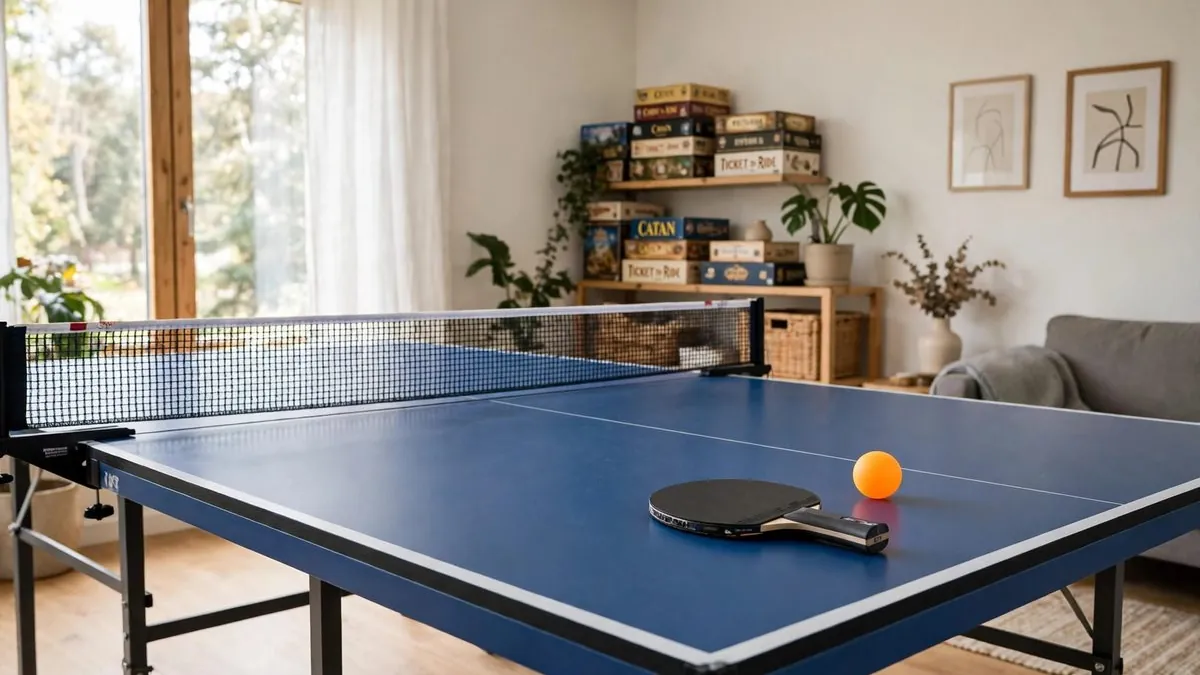

A table tennis table, often called a ping pong table, is one of the simplest ways to bring a fast, sociable game into your home. It folds away neatly and suits players of every age. So how do you choose the right one?
The short answer is that most households are best served by a sturdy rollaway table with a good, even bounce, a reliable net and enough space around it to play properly. This guide covers types, sizes, indoor and outdoor tables, what to check before buying, and how to care for your table.
Key takeaways:
- A full-size table tennis table measures 2.74 metres long, 1.525 metres wide and 76 centimetres high, with a 15.25-centimetre net.
- Rollaway tables fold for storage and suit most homes; fixed tables suit clubs and dedicated games rooms.
- Indoor tables give the truest bounce, while outdoor tables are built to resist weather but play slightly differently.
- Allow room to move around the table, not just room for the table itself.
- A thick, well-supported top and a sturdy frame matter more than extras.
What is a table tennis table?
A table tennis table is a flat, rectangular playing surface divided across the middle by a net, with a white line marking each edge. The game is played with small paddles, often called bats, and a light hollow ball. Players stand at opposite ends and take turns hitting the ball over the net so it bounces once on the other side.
The game began in England in the late nineteenth century as a parlour pastime, played on dining tables with improvised equipment. It grew into an organised sport with standard dimensions, and it became an Olympic sport in 1988. Ping pong is the older, informal name; table tennis is the name the sport itself uses.
Table tennis table types
The most common type in homes is the rollaway table. It splits into two halves on wheels, and the halves fold upright for storage or for solo practice. They are easy to move and set up, and the better ones lock firmly into place.
Fixed tables are built for clubs, schools and dedicated games rooms. They are heavier and sturdier, and are often left set up permanently. If you have a room that can hold a table full-time, a fixed table is the most solid option.
Conversion tops are table tops without legs, designed to sit on a pool table or a large dining table. They are a good compromise when space is very tight, but they depend on the table underneath being level and stable. A wobbly base means a wobbly game, so a conversion top is best seen as a space-saving solution rather than a replacement for a proper table.
Table sizes and what fits your space
A full-size table measures 2.74 metres long, 1.525 metres wide and 76 centimetres high. The net stands 15.25 centimetres above the surface and stretches across the full width. These are the standard dimensions used in the sport. Compact tables are smaller, and their dimensions vary by maker.
The table itself is only part of the space you need. Players need room to step back from each end, move sideways and swing freely. As a rough guide, allow a couple of metres behind each end and around a metre at each side for comfortable casual play. A room that leaves players pressed against the walls will not be much fun.
Measure before you buy, and measure twice. Check the size of the room with the table open, and check the size of the storage spot with the table folded. Rollaway tables fold to roughly half their playing length, but they are still tall and fairly wide when upright. Doorways and tight corners matter too, and ceiling height is worth checking, since a low beam can spoil a lobbed shot. Bright, even light without glare makes the ball easier to follow.
Indoor vs outdoor tables
Indoor tables are made for dry rooms. Their tops are usually made from wood-based board with a smooth coating, which gives a true, lively bounce. They suit a games room, a hall or a heated garage, but they are not built to cope with rain or damp, and leaving one outside will warp the top and rust the frame.
Outdoor tables are built for the garden, the patio or a covered terrace. Their tops are made from weather-resistant materials, and their frames are treated against rust. They can be left outside, although a cover is still wise. The bounce is usually a little different from an indoor table, slightly less lively, but for garden games the difference hardly matters.
The choice comes down to where the table will live. If it will be used indoors and only occasionally wheeled outside on a dry day, an indoor table is the better buy. If it will stay outside, an outdoor table is the sensible choice. Do not expect an indoor table to survive a winter outdoors.
| Feature | Indoor table | Outdoor table |
|---|---|---|
| Top material | Wood-based board with a smooth coating | Weather-resistant composite or resin |
| Bounce | True and lively | Slightly less lively |
| Weather resistance | None; keep dry indoors | Built to resist rain and sun |
| Best for | Games rooms, halls, heated garages | Gardens, patios, covered terraces |
| Care needed | Dust and wipe; avoid damp | Cover when not in use; wipe down |
What to look for when choosing a table

The top is the heart of the table. A thicker top generally gives a more even, reliable bounce, and a well-braced top stays flat over time. Look for a top that feels solid rather than hollow, with supports running underneath. A top that sags in the middle will send the ball in unexpected directions.
The frame and legs matter almost as much. A sturdy steel frame with wide feet keeps the table steady when players lean on it or bump it during a fast rally. Locking castor wheels stop a rollaway table creeping across the floor. Check that the folding mechanism is easy to use and locks firmly in both the playing and storage positions.
The net and posts deserve attention too. Many tables come with a net included, and the better sets clamp firmly to the table and hold the net taut at the right height. A sagging net is a constant annoyance, so if the included net is flimsy, a simple clip-on replacement is an easy upgrade.
Think about how the table will be used. A family table needs to be easy to fold and move, since it will be set up and put away often. For practice, one half may be raised as a playback board, so check it folds up and locks securely. Extras such as ball holders and a cover are useful, but they should never come before a solid top and a sturdy frame.
Bats, balls and the basics of play
A table tennis bat, or paddle, has a wooden blade covered on each side with rubber. The rubber gives the ball grip and spin. A comfortable, mid-weight bat is the right starting point, and the shakehand grip, held as if shaking hands, is the most common style.
Balls are light, hollow and usually white or orange, with a diameter of 40 millimetres. Keep a few spare balls handy, because they crack if stepped on and they roll into the furthest corner of the room.
The basic rules are simple. A rally starts with a serve, the ball tossed up and hit so that it bounces once on each side. Players then take turns hitting the ball over the net so it lands on the other side. If the ball misses the table or hits the net and drops, the point goes to the other player. Games are usually played to eleven points, with the serve changing every two points.
Good posture helps more than most beginners expect. Standing with feet shoulder-width apart, knees slightly bent and weight on the balls of the feet makes it easier to move quickly. Our guide to how to improve your posture covers the basics that carry over to the table. Short, controlled strokes beat wild swings.
Looking after your table
A table tennis table needs little care, but a little care goes a long way. Keep the top clean and dry, wiping it with a soft, slightly damp cloth to remove dust and marks. Avoid harsh cleaners and abrasive pads, which can damage the coating, and never leave drinks or wet items standing on it. Store the table somewhere dry and level, and use the locks or straps provided when it is folded upright. A cover is worth having, especially in a garage.
Check the table from time to time: tighten loose bolts, make sure the wheels roll and lock, and check that the net posts clamp firmly. A deep scratch or dent can change the bounce in that spot, so protect the surface when the table is not in use.
Table tennis table buying checklist
- Measure the room with the table open and the storage spot with it folded.
- Decide indoor or outdoor based on where the table will actually live.
- Choose a full-size table unless the players are very young.
- Check the top for thickness, flatness and solid under-top bracing.
- Look for a sturdy steel frame, wide feet and locking castor wheels.
- Test the folding mechanism and make sure it locks firmly in both positions.
- Check the net and posts: the net should sit taut at the right height.
- Check the lighting and make sure the floor is level.
- Keep spare balls handy; they crack easily and disappear quickly.
Frequently asked questions
What size is a full-size table tennis table?
A full-size table measures 2.74 metres long, 1.525 metres wide and 76 centimetres high, with a net 15.25 centimetres high. These are the standard dimensions used in the sport.
Can you play table tennis on your own?
Yes. Most rollaway tables let you fold one half upright as a playback board, so you can practise strokes and footwork alone.
Is an outdoor table as good as an indoor table?
An outdoor table is built to survive weather, and its bounce is usually slightly less lively than a good indoor table. For garden games the difference is small.
How much room do you need around a table tennis table?
As a rough guide, allow a couple of metres behind each end and around a metre at each side for comfortable casual play.
How do you clean a table tennis table?
Wipe the top with a soft, slightly damp cloth to remove dust and marks, then dry it. Avoid harsh cleaners and abrasive pads, which can damage the coating, and never leave wet items standing on the surface.
Is table tennis good exercise?
Yes, in a gentle and sociable way. It keeps you moving, sharpens reactions and hand-eye coordination, and is easy on the joints. Our guide to how to lose belly fat explains how light, regular movement fits into a wider routine.
The bottom line
A table tennis table is one of the best-value additions to a home. It costs little to run, needs almost no maintenance, and brings together players of all ages. The right table is the one that fits your space and gets used often.
Start with the measurements, choose indoor or outdoor based on the table’s real home, and put the top and frame ahead of extras. Then set it up, find a spare bat, and play. If you enjoy games that reward quick thinking and a steady hand, our guide to how to solve a Rubik’s cube is a good next challenge for quieter evenings.