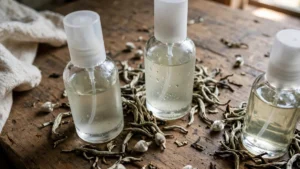
Ask ten people what a black tea perfume smells like and you will get ten different answers.
The confusion starts with the name. Black tea in perfume is not tea from a pot. It is an accord, a blend of molecules chosen to suggest the dried, oxidised leaf. The leaf itself comes from Camellia sinensis, the same plant as green tea, but the process is different. Green tea leaves are steamed or pan-fired to stop oxidation. Black tea leaves are left to oxidise fully, which darkens them and builds the malty, slightly astringent compounds that give black tea its character. A perfumer building a black tea accord is trying to capture that oxidised character, not the drink.
This guide explains what black tea actually is in a perfume, how the note is built, why it pairs so well with bergamot and smoke, and how to tell the different versions apart.
Key takeaways
- Black tea in perfume is an accord built to suggest the oxidised leaf, not brewed tea in a bottle.
- Oxidation is the whole story: it is what separates black tea from green tea, and what gives the note its malty, dry, slightly smoky character.
- Black tea is a heart note that carries a perfume, and it pairs naturally with bergamot, smoke, leather and amber.
- It lasts longer than green tea notes, reads warm and unisex, and behaves differently at Eau de Toilette, Eau de Parfum and extrait strength.
- Black tea is a scent, not a remedy: it does not calm, energise or heal, and a perfume that turns sour or flat on your skin is a bad match, not a faulty bottle.
What black tea is, and what it is not
Black tea starts as a fresh green leaf and ends as a dark, curled, oxidised one. The oxidation is a chemical change, not just a colour change.
In a perfume, none of that chemistry is poured from a teapot. Perfumers build an accord from woody, smoky, slightly sweet and faintly leathery molecules, and they tune the balance until it suggests the dried leaf.
It is also worth saying what black tea is not. It is not Russian tea, which is a specific style, black tea with amber and a clean, almost vodka-like clarity.
How a black tea accord is built, and what to listen for
A black tea accord is built in layers. The middle is the tea itself, malty, dry and warm, with a faint smokiness. Our guide to what a floral perfume is explains how accords work in general, and the same idea applies here: a note is a construction, not a single ingredient, and the construction is where the perfumer’s taste shows.

When you smell a black tea perfume, listen for three things. First, the malt, that warm, slightly sweet, grainy depth that is the most recognisable part of the note. Second, the smoke, which can be a whisper or a shout, and which tells you whether the perfumer leaned into the roasting of the leaf. Third, the dry-down, which is where the base shows itself.
The other thing to listen for is balance. A poor one feels like separate pieces, a sharp citrus top, a flat middle, a sweet base that does not belong.
9 facts about black tea perfume
The tea in the bottle is an accord, not brewed tea
What it shows: Black tea perfumes contain no brewed tea. They contain a constructed accord of woody, smoky and slightly sweet molecules, chosen to suggest the dried leaf. What to consider: Because the accord is constructed, every house builds it differently, so two perfumes with the same note can smell very different. Best For: Anyone who wants to understand what they are actually smelling. Material: A blend of aroma molecules, not a tea infusion. Price Range: The accord itself costs little; the price comes from the rest of the composition and the brand. Standout Feature: The fact that a note can be recognisable without containing the thing it names.
It is the natural result of different perfumers building the same idea in different ways, with different supporting notes and different balances.
Oxidation is the whole story behind the note
What it shows: Black tea and green tea come from the same plant. Black tea leaves are fully oxidised, which builds theaflavins and thearubigins, the compounds behind the malty, dark character. What to consider: Oxidation also makes the note heavier and longer-lasting than green tea, so a black tea perfume behaves differently on skin. Best For: Anyone choosing between a black tea and a green tea perfume. Material: Camellia sinensis leaves, fully oxidised and dried. Price Range: The leaf itself is inexpensive; the cost is in the composition. Standout Feature: One plant, two notes, separated only by how long the leaf was left to oxidise.
They are the same plant at two different points in a process, and the process is what makes black tea warm and green tea fresh.
The malt is the most recognisable part of the note
What it shows: The malty depth, warm, grainy and slightly sweet, is the signature of black tea in perfume. It is what makes the note read as tea rather than as wood or smoke. What to consider: The malt can be buried under smoke, leather or amber, so a perfume can list black tea and still smell mostly of something else. Best For: Anyone trying to learn the note by smelling it. Material: A blend of warm, grainy aroma molecules. Price Range: Present in perfumes at every price, from colognes to niche extraits. Standout Feature: The malt, which is the one part of the accord that is almost always there.
If you are learning to recognise black tea, look for the malt first.
Black tea sits in the heart of a perfume, not the opening
What it shows: Black tea is usually a heart note. It arrives after the bright opening and carries the perfume through its middle hours. What to consider: A perfume that opens with citrus and then turns warm and malty is doing exactly what a black tea perfume should do. Best For: Anyone wondering why the tea does not appear in the first spray. Material: Heart-note molecules, heavier than citrus, lighter than the base. Price Range: The position is the same at every price. Standout Feature: The way the tea takes over in the second hour, when the opening has faded.
This is why a paper strip can mislead you. On skin, after an hour, you smell the heart, and that is where the tea lives. Give a black tea perfume two hours before you judge it.
Bergamot is the natural partner, and Earl Grey is the proof
What it shows: Earl Grey is black tea scented with bergamot oil, and perfumers borrow the same pairing. Bergamot lifts the tea, keeps it bright, and stops it from feeling heavy. What to consider: A black tea perfume with bergamot will smell fresher and more wearable in the daytime than one without it. Best For: Anyone who wants a black tea perfume for the office or for spring. Material: Bergamot oil, from the rind of the bergamot orange. Price Range: Present in perfumes at every price. Standout Feature: The oldest and most reliable pairing in the tea family.
It is chemistry. Bergamot and black tea complement each other, and the pairing has survived for two centuries because it works.
The smoke in black tea is part of the note, not an accident
What it shows: Black tea leaves are dried and sometimes roasted, and that process leaves a faint smokiness in the leaf. Perfumers often keep that smoke in the accord, and some push it further. What to consider: The smoke varies enormously. In some perfumes it is a whisper. In others it is the dominant character. Always sample a smoky version on skin. Best For: Anyone who likes incense, campfire or resinous perfumes. Material: Smoky woods and resinous molecules in the accord. Price Range: Smoky versions exist at every price, from colognes to niche extraits. Standout Feature: The smoke, which is the most divisive part of the note, and the part that makes it memorable.
Smoke is the reason black tea perfumes can be so polarising. One person smells warmth and depth. Another smells a bonfire. The smoke is real, it is deliberate, and it is the part of the note you should test most carefully before buying.
Black tea outlasts green tea, and the reason is molecular weight
What it shows: The molecules that make up a black tea accord are heavier than the light, volatile molecules in a green tea accord, so they evaporate more slowly and stay on skin longer. What to consider: A black tea perfume will usually last six to ten hours, while a green tea perfume often fades after three to five. Best For: Anyone who wants a tea perfume that lasts through the day. Material: Heavier aroma molecules in the heart and base. Price Range: Longevity is similar at every price, though concentration matters more than brand. Standout Feature: The staying power, which is the practical difference between the two tea notes.
This is the most useful fact for a buyer. It is the note. Black tea is simply built to last longer, because its molecules are heavier and slower to leave the skin.
Black tea, chai and Russian tea are three different ideas
What it shows: Black tea focuses on the leaf. Chai focuses on spice, cinnamon, cardamom, clove and ginger, with tea as a background. Russian tea is black tea with amber and a clean, almost vodka-like clarity. What to consider: A perfume labelled chai will smell spicy and sweet. A perfume labelled Russian tea will smell amber and polished. A perfume labelled black tea will smell malty and dry. Best For: Anyone shopping by name and wanting to avoid a surprise. Material: Three different accords built around three different ideas. Price Range: All three exist at every price. Standout Feature: The fact that one word, tea, covers three very different perfumes.
These three are often confused, and the confusion is understandable, because all three contain tea. But they are different perfumes with different characters, and knowing the difference saves you from buying a spicy chai when you wanted a dry black tea, or an amber Russian tea when you wanted spice.
The same black tea accord smells different at every concentration
What it shows: At Eau de Toilette strength, a black tea accord reads bright and dry. At Eau de Parfum strength, it reads warmer and smokier. At extrait strength, it reads deep and leathery. What to consider: The strongest version is not always the best one. An extrait can feel too heavy in warm weather, while an Eau de Toilette can feel too light in winter. Best For: Anyone choosing between concentrations of the same perfume. Material: The same accord at different dilutions. Price Range: Extrait is usually the most expensive per millilitre, but a little goes a long way. Standout Feature: The way concentration changes the balance between smoke and warmth.
With black tea, it matters more than usual, because the note has both bright and dark parts, and concentration decides which one you notice first. A guide to bergamot perfumes is a useful companion here, because bergamot behaves the same way, bright at low strength and deeper as the concentration rises.
Who black tea perfume suits, and when to wear it
Black tea suits anyone who likes warmth without sweetness. It is unisex in the truest sense, not because it is neutral, but because its warmth is not gendered.
Black tea is at its best in autumn and winter, when its warmth feels welcome and its weight sits well on cold air. In summer, only the lightest versions, such as a cologne or a tea with citrus, feel comfortable, and the smoky and amber-led versions are better saved for cooler days. A guide to saffron perfumes is worth reading alongside this one if you like warm, unisex notes, because saffron and black tea share a similar warmth and a similar talent for carrying a perfume through the evening.
Occasion matters too. Black tea is a good office perfume when it is light and close to the skin, and a good evening perfume when it is dark and rich. Match the weight to the room, not just to your mood, and you will get far more from the note.
The caveats that matter
Black tea is a well-established note, but it is not a simple one, and the caveats are practical rather than medical.
| Detail | What is known |
|---|---|
| What the note is | An accord built to suggest oxidised black tea leaf, not brewed tea |
| What makes it black tea | Full oxidation of Camellia sinensis leaves, building malty theaflavins |
| Main character | Warm, dry, malty, a little smoky, with a leathery depth |
| Position in a perfume | Usually a heart note, arriving after the opening and lasting for hours |
| Best season | Autumn and winter; lighter, bergamot-led versions work in spring and summer |
| Longevity | Usually 6 to 10 hours, longer than most green tea perfumes |
| Who should sample first | Anyone who dislikes smoke, and anyone buying a niche or extrait version |
| What it does not do | It does not calm, energise or heal; it is a scent, not a remedy |
If you have sensitive skin, a fragrance allergy, or you are pregnant or breastfeeding, patch-test any new perfume on your inner arm for a day before wearing it more widely, and speak to a clinician if you are unsure.
Checklist: understanding a black tea perfume before you buy
Use these checks before you buy, and again after a full day of wearing.
- Identify the direction: smoky, leathery, amber-led, or bright with bergamot.
- Smell for the malt first: it is the warm, grainy depth that marks the note as tea.
- Test on skin for two hours, so you smell the heart note, not just the opening.
- Check the concentration: Eau de Toilette for lightness, Eau de Parfum for warmth, extrait for depth.
- Try it in the right season: a smoky tea perfume bought in summer can disappoint in the heat.
- Ask whether it is tea, chai or Russian tea: three different ideas, three different perfumes.
Frequently asked questions
Why does black tea perfume cost more than green tea perfume?
It usually does not, at the same concentration and from the same brand. The price comes from the rest of the composition, the brand, and the concentration, not from the tea accord itself.
Does black tea perfume stain skin or clothes?
No, not in any meaningful way. The tea in the bottle is an accord of aroma molecules, not actual tea, so there is no tannin to stain.
Can I layer a black tea perfume with another perfume?
Yes, and it layers well, because the note is warm and dry rather than sweet. A black tea perfume over a vanilla or amber perfume adds depth. Under a citrus perfume, it adds warmth.
Is black tea perfume okay for a first date?
Yes, and it is a good choice, because it is warm and interesting without being loud or sweet. Choose a lighter version, such as a bergamot-led tea, and use one or two sprays.
Why does my black tea perfume smell different on me than on my friend?
Skin chemistry changes how the smoky and woody molecules in the accord develop. Warm skin brings out the malt and the smoke. Cooler, drier skin can make the same perfume read flatter or sharper. That is why the same perfume can be warm on one person and sour on another, and why testing on your own skin matters more than any review.
How do I store a black tea perfume so it stays true?
Keep it in a cool, dark place, away from heat and sunlight, and keep the cap on when you are not using it. A bathroom cabinet is fine if it is not steamy, but a bedroom drawer is better.
The bottom line
A black tea perfume is not a cup of tea in a bottle. It is an accord built to suggest the oxidised leaf, warm, malty, dry and a little smoky, with a depth that comes from the same process that turns a green leaf dark.
If you want to understand the note, start with the malt, test on skin for two hours, and choose by direction, smoky, leathery, amber-led or bright with bergamot, rather than by brand.