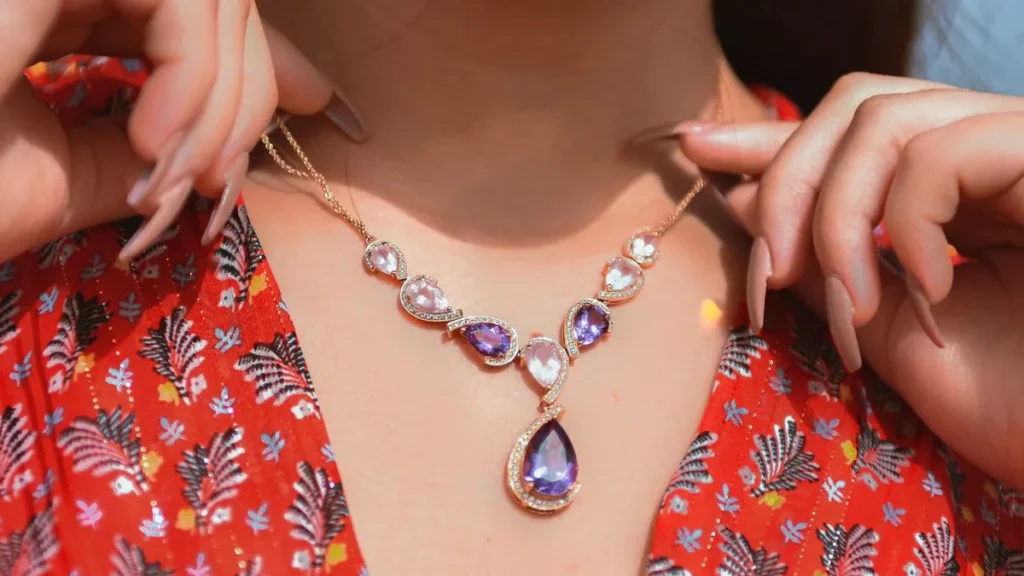
Open a jewellery box that is full and still reach for the same two pieces every morning. Most of us know that feeling, and it rarely has anything to do with owning too little. It comes from owning pieces that do not work together: the necklace that only suits one neckline, the earrings that clash with every other metal you own, the bracelet bought for one occasion and never worn again.
A capsule jewellery collection is a small, deliberate set of pieces that all work with each other. Every piece earns its place because it can be worn in several combinations and alongside the other pieces already in the collection. It is not a fixed number, a brand, or a shopping list.
This guide explains what a capsule jewellery collection is, how many pieces it usually holds, what belongs in one, and how to build one from the pieces you already own.
Key takeaways
- A capsule jewellery collection is a small set of versatile pieces that mix and match with each other, not a fixed list.
- Most capsules hold between five and fifteen pieces, and five to eight is enough for everyday life.
- The best capsule starts with the pieces you already wear most, not with a shopping trip.
- One metal and one style language make a small collection feel large, because every piece pairs with the rest.
- A capsule jewellery collection is a tool for easier mornings, not a test of discipline, and it should bend to fit real life.
What a capsule jewellery collection actually is
The capsule idea comes from clothing. In the 1970s, London boutique owner Susie Faux described a wardrobe built from a handful of essential, well-made pieces, and in the 1980s Donna Karan made the idea famous with her Seven Easy Pieces. The principle has not changed: fewer pieces, chosen well, worn more often.
What makes a collection a capsule is not its size but its internal logic. Every piece should combine with most of the others. A fine gold chain that layers under a pendant, sits neatly beside a tennis bracelet, and looks right with both studs and hoops is a capsule piece. If a piece only works on its own, or only with one outfit, it is not pulling its weight.
A capsule also reflects one person’s real life, not a generic ideal. Someone who works in an office, someone who works from home, and someone who travels constantly would all build different capsules. The pieces need to cover the days you actually live: work, weekends, evenings out, and the ordinary days in between.
The phrase has a second meaning worth knowing. Jewellery brands also release capsule collections: a small, limited group of designs built around one motif or material, usually five to ten designs. This guide is about the personal kind, the collection you wear. It is also distinct from its cousins, the capsule wardrobe and the capsule makeup bag: a jewellery capsule is judged by how its pieces work with each other, not by how many outfits it can match.
What goes in a capsule jewellery collection

Most jewellery capsules land somewhere around five to eight core pieces, enough to cover everyday wear, work, and evenings out without turning the box into a warehouse. The shape is usually the same: a base necklace, one or two layering pieces, a pair of everyday earrings, a bracelet, a ring or two, and one statement piece saved for dressier days.
The base necklace is the workhorse. A fine chain or a small pendant in your main metal, around 16 to 18 inches long, sits well with most necklines and layers neatly under other chains. It is the piece you put on without thinking.
Layering pieces sit on top of the base. A delicate second chain, a small gemstone pendant, or a slightly longer chain adds depth without competing. The layers should differ in length by at least two inches, so they sit separately instead of tangling. Learning how to layer jewellery without tangling makes the whole capsule easier to wear, because tangled chains are the fastest way to stop reaching for a piece.
Everyday earrings do the most work of any piece in the collection. Diamond or plain metal studs and small hoops are the usual choices, because they move from desk to dinner without a change. The bracelet and rings finish the set: a tennis bracelet or slim bangle, stackable rings or a single signet, and one statement piece, a cluster necklace, drop earrings, or a bold cuff, that lifts an evening outfit. One is enough, because its job is contrast, not volume.
How many pieces should a capsule jewellery collection have?
There is no fixed number, and anyone selling a magic count is selling something. Most guides put the range at five to fifteen core pieces, and the sweet spot is five to eight. A five-piece capsule can cover almost everything: a base necklace, a layering chain, everyday earrings, a bracelet, and one ring.
Count a pair of earrings as one piece, and a matching set as one choice, or the numbers stop meaning anything. What matters is the ratio of pieces worn to pieces owned. If you wear eight pieces out of ten every week, the capsule is working. If you wear eight out of forty, the other thirty-two are decoration.
Start small on purpose. Three pieces you love and wear daily, a necklace, earrings, and a ring, are a better capsule than twelve bought in one rushed order. Add one piece at a time, and each new piece should pass the same test as the first: it must work with at least two or three pieces you already own.
How to build a capsule jewellery collection
Begin with what you already own. Empty the jewellery box and sort every piece into three piles: worn weekly, worn rarely, and never worn. The weekly pile is the seed of your capsule, and it usually already shares a metal, a scale, and a level of sparkle.
Next, find the gaps, not the duplicates. Hold your weekly pieces together and ask what is missing for the life you live. If you have three necklaces and no bracelet, the gap is a bracelet. Buy to fill a gap, and buy the best version of that one piece you can afford.
Choose one main metal and stick to it for the core. Gold, silver, and rose gold can all work, but a single dominant metal is what makes pieces interchangeable without thought. Gold jewellery for everyday wear is a popular starting point because warm gold suits many skin tones, though silver and platinum are equally valid if they are what you already reach for.
Then set the style language and give the capsule a home that makes it easy to use. A capsule can be minimal, vintage, bohemian, or bold, but it should not try to be all four at once. Pick the adjectives that describe your weekly pile, such as fine, clean, warm, or classic, and use them as a filter for future purchases. Store the everyday pieces where you can see them in the morning.
What a capsule jewellery collection is not
It is not minimalism as a punishment. A capsule is not about owning as little as possible, and it is not a competition to see who can live with the fewest pieces. Minimalist jewellery works because it removes visual noise, not because it removes joy, and a capsule keeps the same spirit: fewer pieces, each one chosen with care and worn often.
It is not a matching set, either. A set is a group of pieces designed to be worn together, usually bought together. A capsule is broader: a personal edit of pieces, possibly from different makers, eras, and styles, chosen because they coordinate with each other and with your wardrobe.
And it is not a one-time purchase or a budget trick, though it can save money. A capsule is a living collection that changes as your life changes, and the discipline is in asking, each time you add or remove something, whether the change makes the whole collection work better. Buying fewer, better pieces usually costs less over time than buying many cheap pieces that break or go unworn, but the saving is a side effect. The point is that every piece you own is one you love wearing.
Capsule jewellery at a glance
| Detail | What is known |
|---|---|
| Definition | A small, deliberate set of versatile jewellery pieces that all work together |
| Typical size | Five to fifteen core pieces, with five to eight suiting most people |
| Core pieces | Base necklace, layering chain, everyday earrings, bracelet, ring, one statement piece |
| Key rule | Every piece should pair with at least two or three others |
| Metal | One dominant metal for the core, so pieces are interchangeable without thought |
| Starting point | The pieces you already wear weekly, not a new shopping trip |
| Brand meaning | A limited group of five to ten designs built around one motif or material |
| Upkeep | Review seasonally, add one piece at a time, remove pieces that stop being worn |
Checklist: building your capsule
- Empty the jewellery box and sort every piece into worn weekly, worn rarely, and never worn.
- Keep the weekly pile as the seed of the capsule and note the metal and style it already shares.
- Find the gap before you shop, and buy one piece that fills it rather than three that duplicate it.
- Choose one main metal for the core and make every new piece match it.
- Test each addition: it must work with at least two or three pieces you already own.
- Store the everyday pieces where you can see them, and review the capsule every season.
Frequently asked questions
How many pieces are in a capsule jewellery collection?
There is no fixed number. Most capsules hold five to fifteen pieces, and five to eight is enough for most people. Count a pair of earrings as one piece, and judge the capsule by how often each piece is worn.
Do I have to throw away jewellery to start a capsule?
No. A capsule starts with the pieces you already wear most. Put rarely worn pieces aside for a month and see which ones you miss. The rest can be stored, gifted, or sold later.
Can a capsule jewellery collection include colour and gemstones?
Yes, if the colour works with the rest of the set. One gemstone colour, such as sapphire blue or emerald green, running through several pieces ties them together. A different bright stone in every piece breaks the shared language of the capsule.
Can I mix gold and silver in a capsule?
Yes, but keep one dominant metal for the core and treat the second as an accent. A mostly gold capsule with one silver ring still reads as coherent, while an even split needs more thought to look deliberate.
How often should I change my capsule jewellery collection?
Review it seasonally, changing one or two pieces at a time when your life or taste shifts. A capsule is meant to be stable, not frozen. A piece unworn for three months is a candidate for storage, and a new gap is worth one considered purchase.
Is a capsule jewellery collection cheaper than a normal collection?
Often, over time. Fewer, better-made pieces last longer and get worn more, so the cost per wear falls. The saving is a side effect: the real benefit is a collection where every piece earns its place.
The bottom line
A capsule jewellery collection is a small set of pieces that work hard together, built from what you already wear and finished with one thoughtful purchase at a time. Five to eight versatile pieces, in one metal and one style language, will cover more days than a box full of orphans. The test is simple: if a piece does not pair with at least two others, it does not belong yet.
Start where you are. Sort the box, keep the weekly favourites, find the one gap that matters, and fill it well. A capsule is not a shopping list to finish, it is a way of choosing that pays you back every morning.
Note: Piece counts and typical capsule sizes here are starting points from jewellery makers and stylists, not rules. Your capsule should fit your life, your wardrobe, and your taste, so treat the numbers as a guide and your wearing habits as the final check.