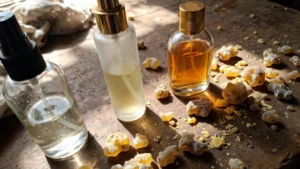
A frankincense perfume is a perfume built around frankincense, the dried resin of Boswellia trees. The resin is tapped by hand, left to harden in the sun, and distilled into an oil that smells warm, resinous, faintly citrusy and a little smoky. Perfumers use it as a heart or base note, where it adds depth, warmth and staying power, and it appears in everything from bold, smoky statement scents to quiet, wearable daytime perfumes.
The idea is older than perfumery itself. Frankincense was burned in temples in Egypt, Rome and Arabia thousands of years ago, and it was traded along the same routes as gold and myrrh. Today frankincense is as likely to appear in a minimal, modern blend as in a traditional incense perfume, and it is often paired with citrus, woods and amber rather than with church smoke.
This guide explains what a frankincense perfume actually is, how the resin is made, why it smells the way it does, and how to tell a good one from a poor imitation.
Key takeaways
- A frankincense perfume is built around the resin of Boswellia trees, distilled into an oil that smells warm, resinous and faintly citrusy.
- Frankincense usually sits in the heart or base of a perfume, where it adds warmth, texture and staying power.
- Real frankincense oil is expensive and limited in supply, so many perfumes use synthetic substitutes that mimic the smoky top but not the warm drydown.
- Frankincense pairs well with amber, woods, citrus and myrrh, and it is almost always used in unisex perfumes.
- No two frankincense perfumes smell alike, and the same perfume can smell smoky on one person and golden on another, so always test on your own skin before buying.
What frankincense actually is
Frankincense is a resin, not a flower, a wood or a spice. It comes from Boswellia trees, which grow in dry, rocky places in Oman, Somalia, Ethiopia and Yemen. Harvesters cut shallow slits in the bark, and the tree weeps a milky sap that hardens into golden tears in the sun. Those tears are collected by hand, sorted by size and colour, and steam-distilled into an essential oil.
The oil itself is a complex mixture of natural compounds. Alpha-pinene and limonene give it a fresh, pine-like brightness, while heavier resinous molecules give it warmth and depth. That combination is what makes frankincense unusual in perfumery. Frankincense is both at once, which is why it can bridge the top and the base of a fragrance, and why a small amount of it can change the character of a whole blend.
It is worth knowing that frankincense is not the same as incense. Incense is a broad word for any material burned for its scent, including frankincense, myrrh, benzoin and sandalwood. Frankincense is one specific resin.
How perfumers use frankincense
Perfumers use frankincense in two main ways. In some perfumes it is the star, the note the whole composition is built around, as in a classic incense scent where the resin is front and centre. In others it is a supporting player, a small dose that adds warmth and depth to a woody, amber or citrus blend without ever announcing itself.

The dose matters more than most people expect. A little frankincense adds a warm, resinous grain to a perfume, the opposite of a smooth floral or a sweet vanilla. A lot of frankincense can dominate everything else, turning a blend smoky, medicinal or overpowering. Our guide to woody perfumes explains the family frankincense most often sits in, and it is a useful frame for understanding why a frankincense perfume with a woody backbone usually wears more formally than one built on citrus.
Frankincense also works as a fixative, which is a less glamorous but important job. Because resin evaporates slowly, it holds lighter notes such as citrus and herbs on the skin for longer, so the perfume lasts. That is one reason frankincense perfumes often have outstanding longevity, and why a perfume with a frankincense base can still be noticeable eight hours after you spray it.
9 facts about frankincense perfume
Frankincense comes from the resin of Boswellia trees
What it shows: A frankincense perfume is built on a real, natural material with a long history, not a lab invention. What to consider: The trees grow slowly and yield little resin each year, so supply is limited and prices are high. Best for: Anyone who cares about natural ingredients and traditional perfumery. Material: Boswellia sacra or Boswellia carterii resin, steam-distilled into oil. Price range: £120–£350 for 100 ml, depending on the house and the dose. Standout feature: One of the oldest perfume materials in the world, still harvested by hand.
The trees grow in some of the driest places on earth, and the harvesting has barely changed in thousands of years.
It smells resinous, woody and slightly citrusy
What it shows: Frankincense is a complex note, fresh and warm at the same time, which is why it works in so many styles. What to consider: The citrus lift fades quickly, so the drydown is warmer and smokier than the opening. Best for: Anyone who likes woody, resinous scents with a fresh edge. Material: Alpha-pinene and limonene for brightness, heavier resin molecules for warmth. Price range: £130–£300 for 100 ml. Standout feature: The rare combination of fresh and warm in a single note.
On a blotter, frankincense smells clean and resinous.
It usually sits in the heart or base of a perfume
What it shows: Frankincense is a structural note, not a top note, and it shapes how a perfume develops over hours. What to consider: A perfume that lists frankincense as a top note is probably using a small dose or a synthetic accord. Best for: Anyone choosing a perfume for longevity rather than a first impression. Material: Frankincense oil, usually paired with amber, woods or myrrh in the base. Price range: £120–£350 for 100 ml. Standout feature: The note that decides how a perfume smells after three or four hours.
Frankincense works there because it evaporates slowly, holding the blend together long after the bright top notes have gone.
Frankincense and myrrh are cousins, not twins
What it shows: The two resins are often paired, but they smell different, and knowing the difference helps you choose. What to consider: Myrrh is darker, sweeter and more balsamic, while frankincense is brighter and drier. Best for: Anyone who has tried one and wants to understand the other. Material: Frankincense from Boswellia, myrrh from Commiphora trees. Price range: £120–£320 for 100 ml. Standout feature: A classic pairing that has been used together for thousands of years.
Frankincense is the brighter, drier resin, and myrrh is the darker, sweeter one, and together they cover more ground than either could alone.
It pairs best with woods, amber and citrus
What it shows: Frankincense is a team player, and its partners decide whether a perfume feels warm, dry or bright. What to consider: Amber and vanilla make it warm, woods make it dry, and citrus makes it bright, so check the supporting notes before you buy. Best for: Anyone building a small perfume wardrobe around versatile, resinous scents. Material: Frankincense with cedarwood, vetiver, amber, bergamot or myrrh. Price range: £120–£350 for 100 ml. Standout feature: One of the most versatile base notes in perfumery.
The same resin can feel completely different beside amber than it does beside cedarwood, and the partner notes are usually the reason you love one bottle and not another.
It can smell smoky, sacred or medicinal depending on the blend
What it shows: Frankincense is a chameleon, and the same note can read as church, campfire or medicine cabinet. What to consider: Heavy, smoky blends can feel overpowering indoors, while medicinal edges appear when the dose is too high. Best for: Anyone testing a frankincense perfume for the first time, who should try it in different settings. Material: Frankincense oil, with the character set by the dose and the partners. Price range: £120–£350 for 100 ml. Standout feature: The widest range of characters of any single perfume note.
It can also smell like a warm room, a dry forest or a clean, resinous skin scent, depending on the blend.
Real frankincense oil costs more than synthetic copies
What it shows: The price of a frankincense perfume often reflects the quality of the raw material inside it. What to consider: Synthetic incense accords mimic the smoky top well but often fade to a flat note, while real oil keeps a warm, balsamic depth. Best for: Anyone deciding whether a premium frankincense perfume is worth the price. Material: Real Boswellia oil versus lab-made incense accords. Price range: £120–£350 for 100 ml for real oil, often under £100 for synthetic-led blends. Standout feature: The drydown is the honest test of what is inside the bottle.
The difference usually shows up after three or four hours. Real frankincense keeps a warm, resinous depth, while a synthetic accord often goes flat.
Frankincense perfumes are almost always unisex
What it shows: Frankincense reads as warm and resinous rather than masculine or feminine, so it suits everyone. What to consider: The rest of the blend decides the character, so a frankincense perfume with vanilla feels softer and one with leather feels more austere. Best for: Anyone shopping without gendered categories, and couples who share a bottle. Material: Frankincense with amber, woods, citrus or myrrh. Price range: £120–£350 for 100 ml. Standout feature: One of the most genuinely unisex notes in perfumery.
The resin itself has no gender, and the perfume is decided by everything around it.
How to test a frankincense perfume before buying
What it shows: A proper test saves money and disappointment, because frankincense changes more on skin than most notes. What to consider: Paper strips lie, shop lighting flatters, and a first spray tells you almost nothing about the drydown. Best for: Anyone about to spend over £100 on a niche bottle. Material: A sample vial or a single spray on the wrist, worn for a full day. Price range: Samples usually cost £3–£8, or come free with an order. Standout feature: The most important fact on this list, because it protects every other one.
The scent after three or four hours is the real perfume, and it is the one you will be living with.
Frankincense, myrrh and the other resins
Frankincense is part of a family of resins that perfumers have used for centuries. Myrrh, from Commiphora trees, is its closest companion, darker and sweeter and more balsamic. Benzoin, from Styrax trees, is warm and vanilla-like, and it is often used to soften frankincense. Elemi, from Canarium trees, is fresh and lemony, and it is used to brighten a resinous blend.
The family also includes woods that are often confused with resins. Sandalwood, cedarwood and vetiver are woods and roots, not resins, but they sit in the same part of a perfume and they pair naturally with frankincense. Our roundup of vetiver perfumes shows how a woody partner can change a resin, because vetiver makes frankincense feel drier and more tailored than amber ever could.
What ties the family together is longevity. Resins and woods evaporate slowly, so they form the base of a perfume and decide how long it lasts. That is why a frankincense perfume can still be noticeable in the evening, and why the base notes are worth more attention than the bright top notes that disappear in an hour.
The caveats that matter
Frankincense is generally well tolerated, but it is not a note to buy blind. Resin-heavy perfumes can smell very different on skin than they do on paper, and a scent that is warm and golden on one person can turn sharp, smoky or medicinal on another.
| Detail | What is known |
|---|---|
| What it is | A resin from Boswellia trees, distilled into oil for perfumery |
| How it smells | Warm, resinous, slightly citrusy, with a dry, smoky edge |
| Where it sits | Usually a heart or base note, where it adds depth and longevity |
| Best partners | Amber, woods, citrus, myrrh, vanilla and leather |
| How long it lasts | Often 8 hours or more in an eau de parfum, because resin is slow to evaporate |
| Who should test first | Anyone sensitive to smoke or resin, and anyone buying a heavy, smoky blend |
| What to avoid | Buying a full bottle untested, and over-spraying a resin-heavy scent |
| What it does not do | It does not smell the same on everyone, and it does not suit every occasion |
If you are sensitive to smoke, resin or strong perfume in general, start with a lighter frankincense perfume and spray once, not three times. Our guide to making perfume last longer is useful here, because the same habits that extend a perfume, spraying on moisturised skin and avoiding rubbing your wrists together, also keep a resin scent from turning sharp.
Checklist: choosing a frankincense perfume honestly
Use these checks before you buy, and again after a full day of wearing.
- Test on skin, not paper: spray once on your wrist and wait at least an hour, because frankincense changes a lot as it warms up.
- Check the drydown: the scent after three or four hours is the real perfume, and it should still smell warm and resinous, not flat or sharp.
- Check the company it keeps: amber and vanilla make it warm, woods make it dry, citrus makes it bright, so choose the partner notes you actually like.
- Start with one spray: resin-heavy perfumes are strong, and two sprays are usually enough for a full day.
- Try it in different weather: a frankincense perfume that feels perfect in winter can feel heavy in summer, so test it in the season you will wear it.
- Buy the smallest size first: a 50 ml bottle, or a discovery set, is the sensible way to live with a resin scent before committing to a full bottle.
Frequently asked questions
What is a frankincense perfume?
A perfume built around frankincense, the resin of Boswellia trees. The resin is distilled into an oil that smells warm, resinous and faintly citrusy, and it is used as a heart or base note to add depth, warmth and staying power to a blend.
What does frankincense smell like?
Warm, resinous and slightly citrusy, with a dry, smoky edge. On its own it smells like golden resin, but in a perfume it picks up the character of its partners, so it can smell smoky with oud, warm with amber, or bright with citrus.
Is frankincense a masculine or feminine note?
Neither, really. Frankincense is almost always used in unisex perfumes, and it reads as warm and resinous rather than masculine or feminine. The rest of the blend decides the character.
How long does a frankincense perfume last?
Usually a long time. Resin is slow to evaporate, so most frankincense perfumes last eight hours or more on skin, and longer on clothes. Two sprays in the morning are often enough for the whole day.
Is frankincense the same as incense?
Not exactly. Frankincense is one specific resin, from Boswellia trees. Incense is a broader word for any material burned for its scent, including frankincense, myrrh, benzoin and sandalwood. A perfume labelled incense may contain frankincense, but it may also be built from other resins or synthetic accords.
Can I wear a frankincense perfume every day?
Yes, if you choose a lighter one and spray sparingly. A bright, citrus-led frankincense perfume works well every day, while a heavy, smoky one is better kept for evenings and cooler weather.
The bottom line
A frankincense perfume is a perfume built on one of the oldest materials in perfumery, a tree resin that smells warm, resinous and faintly citrusy, and that gives a blend depth and staying power few other notes can match. It usually sits in the heart or base, it pairs well with amber, woods and citrus, and it is almost always unisex. The quality of the resin, and the dose, decide whether a bottle smells golden and warm or flat and smoky.
Test before you buy, judge the drydown rather than the first spray, and start with a lighter frankincense perfume if you are new to the note. The right bottle will smell better in the evening than it did in the morning, and that is the honest sign you have found a resin scent worth keeping.