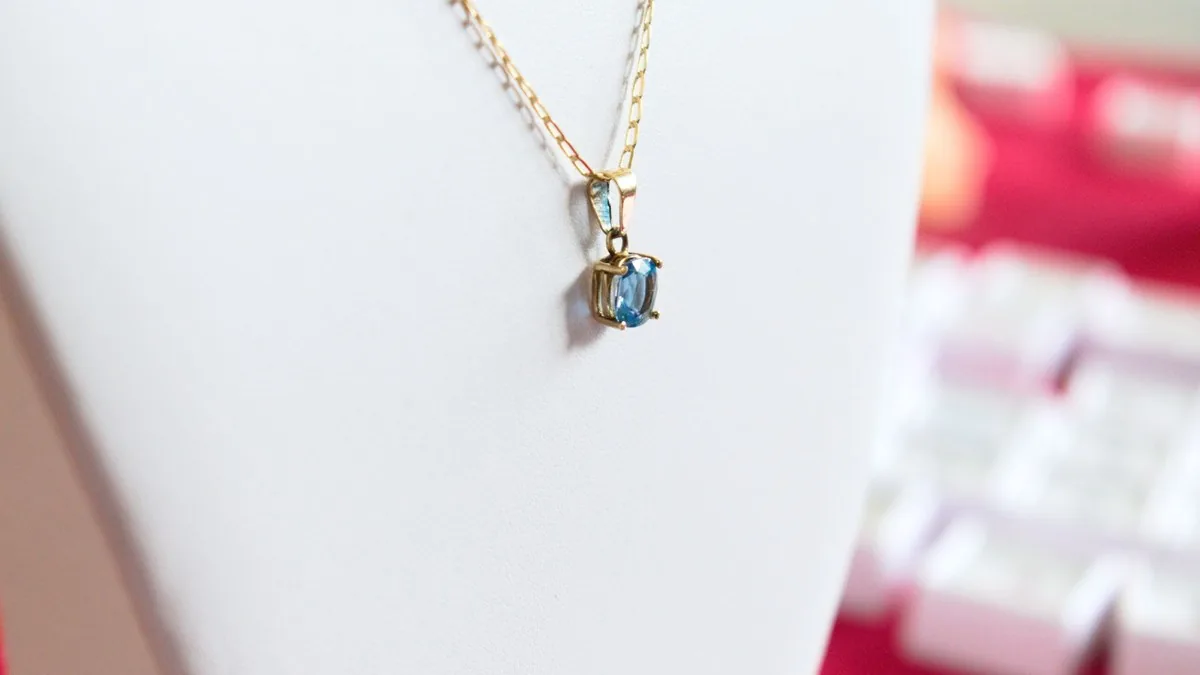

A topaz necklace is one of the easiest fine jewellery buys to get right, and one of the easiest to overpay for. Two pendants can look identical yet differ enormously in value: topaz is really two stones wearing one name, affordable blue topaz, which is almost always treated, and imperial topaz, a warm golden-orange stone that is genuinely scarce.
A necklace is kinder to topaz than a ring: a pendant hangs free, so it almost never takes the sharp knock that topaz fears. Chain length, pendant style, setting and metal matter as much as the stone itself.
This guide walks through each check.
Key takeaways
- Colour decides almost everything: blue topaz is a matter of taste; imperial topaz is valued for a rich orange with a pink or red overtone.
- Almost every blue topaz has been irradiated and heated to create its colour. The treatment is permanent and accepted, but it must be disclosed.
- Topaz is 8 on the Mohs scale but has perfect cleavage, so a bezel setting still protects it, even though a pendant rarely takes a knock.
- Topaz is usually eye-clean, so a cloudy or heavily included stone is a poor buy at any price.
- Chain length and weight matter as much as the stone: 18 inches is the default, and the chain must carry the pendant.
Colour first: the three blues and imperial
With topaz, colour comes first, but how you judge it depends on which topaz you are buying. A good topaz holds its colour in daylight, not only under shop spotlights, so ask to see it by a window and hold it against your skin.
Blue comes in three trade names that describe depth, not origin. Sky blue is the lightest, a pale, icy blue that flatters fair skin and looks crisp with silver and white gold. Swiss blue is a vivid medium blue, the most common and versatile shade. London blue is the deepest, a rich, inky blue, though the darkest stones can look almost black in dim light. Natural blue topaz is rare and usually pale, so vivid blues are the product of treatment. Our guide to what to look for in a topaz ring covers the same three blues for a ring.
Imperial topaz is the most valuable variety, a warm golden-orange to pinkish-orange stone. The most valued stones are a rich orange with a distinct pink or red overtone, and the price gap between that and a plain orange stone is very wide. A smaller imperial pendant with vivid warm colour beats a larger one with a weak, brownish colour. The name is not universally defined, so judge the stone itself: a rich orange with a pink or red overtone is what you are paying for. Topaz is the November birthstone; blue topaz is a modern December birthstone.
Clarity and cut: the pendant checks
Topaz is a Type I clarity gem, which means it is usually eye-clean. A fine stone should be transparent and lively, with no flaws visible to the naked eye. With topaz, a cloudy, milky or heavily included stone is simply a poor stone, and cloudiness shows clearly in a pendant.
Cut matters, because topaz crystals grow large and cutters are tempted to cut big, shallow stones that show windowing, a washed-out patch in the centre where light leaks through. Hold it over your hand: if you can read through the middle, the cut is too shallow. Oval and cushion cuts suit solitaire pendants, pear and marquise cuts elongate the neckline, and emerald cuts suit modern bar pendants.
Necklace styles at a glance
Each format asks something different of the stone.
| Style | Typical stone | Typical chain | Best for |
|---|---|---|---|
| Solitaire pendant | 1–3 ct oval or round | 18 in cable chain | Everyday wear |
| Drop pendant | 3–8 ct pear or marquise | 18–20 in chain | Evening wear |
| Tennis or line necklace | Matched small stones | 16–18 in line | Special occasions |
| Cluster or halo pendant | Centre + accents | 18 in chain | Vintage sparkle |
| Bar or east-west pendant | Emerald-cut stone | 16–18 in chain | Layering |
| Beaded topaz necklace | Graduated beads | 17–19 in strand | Casual wear |
| Imperial solitaire | 2–5 ct cushion or oval | 18 in heavier chain | Milestone gifts |
| Mystic topaz pendant | Coated stone | 18 in chain | Fashion pieces |
A solitaire pendant is the safest first buy.
Chain length and fit: where the pendant should sit
Chain length decides where the pendant sits. Sixteen inches sits at the base of the throat; 18 inches places a pendant at the collarbone, the most flattering position for a coloured stone; 20 inches drops to the upper chest and suits larger stones; 24 inches and longer elongate the neckline. For a gift, 18 inches is the length jewellers reach for first. Match it to your neckline: 16 inches suits a crew neck, 18 inches a V-neck, 20 inches a deeper neckline.
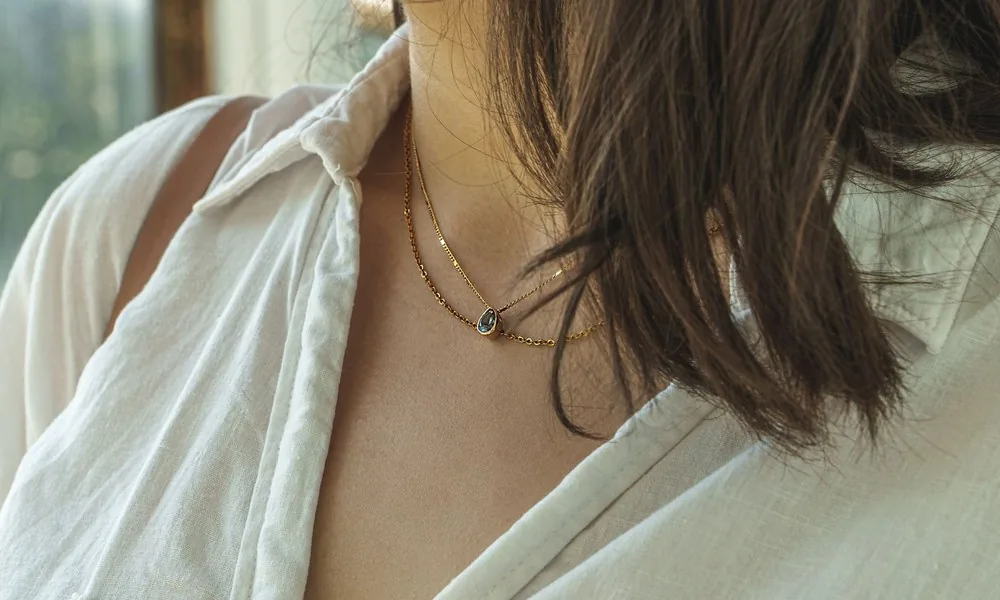
For layering, keep at least two inches between chains so they do not tangle: a topaz pendant at 18 inches pairs naturally with a shorter 16-inch plain chain, or with a longer 20-inch chain below it. Try it on with the clothes you will wear it with. A twisting chain, a flipping pendant or a migrating clasp are faults you can only catch on the body. The same rules apply to any gemstone pendant: our amethyst necklace guide runs through the same 16, 18 and 20-inch choices.
Settings, metals and the bail
Topaz scores 8 on the Mohs scale, so it resists scratching well. But topaz also has perfect cleavage in one direction, so a sharp knock can split it cleanly rather than chipping it. In a pendant that risk is small, since the stone hangs free, but a bezel setting still removes most of it. A four-prong setting shows off the stone best.
The bail, the loop joining pendant to chain, deserves as much attention as the setting: it should be soldered closed, not merely bent shut, and wide enough for the chain to move freely. Chain weight must match stone weight: a heavy pendant on a fine chain will kink, stretch and eventually snap it. As a rough rule, a pendant up to 3 carats suits a 1 to 1.5 millimetre cable or curb chain; a larger stone needs a 2 millimetre chain or heavier. White gold and platinum suit blue topaz; yellow gold warms imperial topaz; rose gold flatters pink topaz. Look for a hallmark: 925 for silver, 585 for 14-karat gold, 750 for 18-karat gold. No hallmark means walk away.
Treatments: the question that changes the price
Effectively all blue topaz is treated. Colourless topaz is irradiated to produce a blue colour centre, then heated to stabilise it. The result is permanent and safe, and accepted by every major gemmological laboratory. There is nothing wrong with buying a treated blue topaz, as long as you know it is treated and are paying a treated-stone price. Paying a natural-stone price for a treated stone would be a problem, so ask whether it has been irradiated and heated, and get the answer in writing.
Imperial topaz is generally not treated, though some pink material is made by heating orange stones, so ask and get the answer in writing. Mystic topaz is coated with a thin metallic film to create its rainbow colours, and that coating can scratch and wear with contact, so it suits a pendant worn gently rather than daily. Lab-created topaz is real topaz grown in a laboratory, and costs less than natural stone.
Size, carat and what a topaz necklace should cost
Carat is weight, not size, and topaz is less dense than sapphire, so a one-carat topaz looks slightly larger than a one-carat sapphire of the same shape. Because topaz crystals grow large, big stones are common, and price per carat climbs slowly. A smaller stone with better colour beats a larger stone with poor colour.
Treat these as a rough guide to 2027. A finished blue topaz pendant necklace often runs from around $150 to $600 in sterling silver, and from around $400 to $1,500 in gold, with the chain adding $50 to $500. Imperial topaz is a different market: a finished imperial pendant necklace typically runs from around $1,500 to $8,000 or more. Loose blue topaz runs around $20 to $100 per carat; imperial topaz runs $500 to $1,500 per carat, and $1,500 to $3,000 or more for fine stones. Topaz is not the only affordable gemstone that looks far more expensive in a pendant: our peridot necklace guide covers a stone with the same value maths.
Certificates, sellers and the paperwork that protects you
For any imperial or natural pink topaz necklace that costs serious money, insist on an independent lab report from GIA or AGL, confirming the stone is natural topaz, its colour, and its treatment. For an ordinary blue topaz necklace, a certificate is rarely needed, but the seller should still state the treatment in writing on the receipt. Buy the stone you can see, not the name on the label, and buy from a seller with a clear returns policy.
Checklist: what to look for in a topaz necklace
Run this checklist before you pay.
- Colour in daylight: an even blue in the shade you love, or a rich orange with a pink or red overtone for imperial topaz.
- Ask about treatment first: blue topaz is almost always irradiated and heated, imperial topaz should be untreated.
- Check clarity with your eyes: topaz should be eye-clean, with no cloudiness, no cracks, and no window in the middle.
- Check the chain and bail: the chain is strong enough for the pendant, the bail is soldered closed, and the clasp works smoothly.
- Try the length on: 18 inches is the default, and the pendant should not catch on your neckline or flip when you move.
- Ask for a lab report on any expensive stone: a GIA or AGL report for imperial or natural pink topaz, and the treatment in writing for blue topaz.
Frequently asked questions
What is the most important thing to look for in a topaz necklace?
Colour, judged by variety. For blue topaz, choose the shade you love, checked in daylight and against your skin. For imperial topaz, look for a rich orange with a pink or red overtone. Then check the chain and the length.
Is blue topaz a real gemstone?
Yes. Blue topaz is real topaz, but its colour is almost always created by irradiation followed by heating. The treatment is permanent and accepted, which is why a large, vivid blue stone is affordable.
What chain length is best for a topaz pendant necklace?
An 18-inch chain is the safest choice: it places a pendant at the collarbone, where a coloured stone reads clearly. A 16-inch chain suits shorter necklines, while 20 inches suits larger stones. For a gift, buy 18 inches.
Is topaz durable enough for a necklace worn daily?
Yes, for a pendant. Topaz scores 8 on the Mohs scale, so it resists scratching well, and in a necklace the stone hangs free, so the cleavage that worries ring buyers is rarely a factor. Take it off for the gym and chlorinated pools.
How can you tell a real topaz necklace from a fake one?
Glass imitations often have round air bubbles and a colour that looks painted on, while real topaz feels cool and warms slowly. Lab-created topaz is real topaz grown in a laboratory, and cannot be told from natural stone by eye alone.
How do you care for a topaz necklace?
Clean it with warm soapy water and a soft brush, rinse well and dry with a soft cloth. Avoid ultrasonic and steam cleaners, keep it away from perfume, and store it in a padded pouch so the chain does not tangle.
The bottom line
A good topaz necklace is bought in a clear order: decide which topaz you are buying first, then judge its colour in daylight, then check clarity and cut, then ask the treatment question, then choose a style, a length and a setting. Pay an imperial price only for a genuinely imperial stone.
If you remember one rule, make it this: buy colour and fit, not carats. A small, beautifully coloured pendant on a chain that sits right will outshine a large, dull one. Check it in daylight, run the checklist, and keep the receipt.
Note: Prices here are indicative 2027 market ranges, not quotes, and vary with colour, size, origin, treatment and seller. Always confirm the treatment, identity and price of the exact stone in writing before you pay.