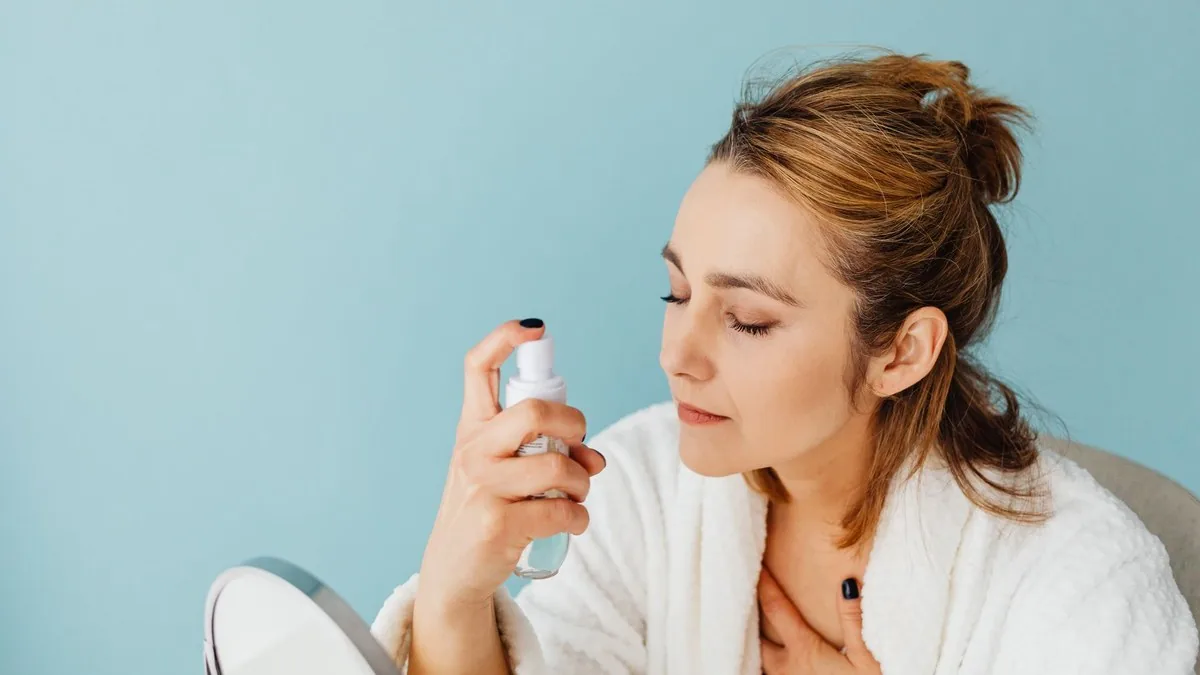
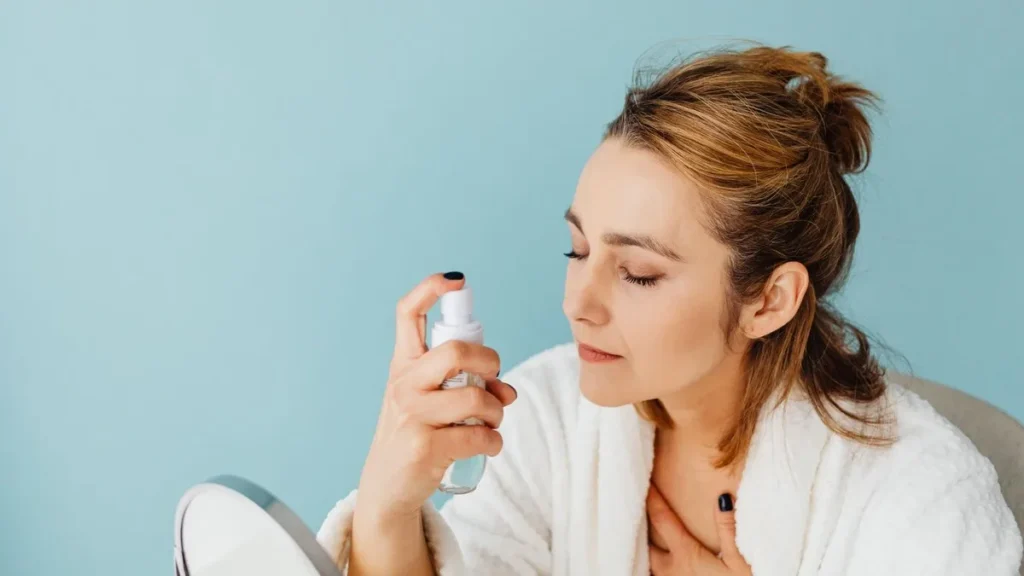
A face mist is a fine spray of water and skin-friendly ingredients that you mist over your face to hydrate, soothe, or refresh it. It comes in a small bottle with a spray nozzle, and one or two pumps leave a light veil of moisture on the skin. It feels cooling and takes seconds: spray it on when skin feels dry, tight, tired, or dull.
The confusion starts because a face mist looks like several other products at once: a spray bottle like a setting spray, watery like a toner, promising hydration like a serum. Yet it is none of those things. A mist is its own step, built for one job: adding a quick, light layer of water to the surface of the skin, whenever you need it, including over makeup.
This guide explains what a face mist is, what is inside the bottle, how it differs from toner, serum, and setting spray, and how to use one so the hydration stays put. It also covers the ingredients worth paying for, the ones to avoid, and the mistakes that make skin drier.
Key takeaways
- A face mist is a light spray of water, humectants, and soothing ingredients that hydrates and refreshes skin any time.
- Unlike a toner, a mist is not tied to cleansing, and unlike a serum, it carries few actives and treats nothing on its own.
- A mist only hydrates when sealed in: spray on damp skin, then follow with serum or moisturiser within a minute.
- What matters most are humectants such as glycerin and hyaluronic acid, plus calming extracts like aloe, rose water, and green tea.
- Skip mists with drying alcohol high on the list; a mist never replaces moisturiser, sunscreen, or treatment products.
What a face mist actually is
At its simplest, a face mist is water in a spray bottle with a few helpful additions. The base is usually purified water, thermal spring water, or rose water. Brands add humectants that attract water, soothing plant extracts, and sometimes a little oil or antioxidant. The formula is deliberately thin, so it passes through a fine nozzle and lands as an even, weightless veil rather than droplets.
The spray format is the whole point. A toner is poured or patted on, a serum is dropped or pressed in, and a cream is rubbed over the skin. A mist is the only one you can apply without touching your face, which is why it works over makeup, at your desk, or on a long flight. Close your eyes, hold the bottle about 20 centimetres away, and give two or three light pumps. Mists are not new — thermal spring waters have been bottled in European spa towns for over a century — but modern formulas contain the same humectants found in good moisturisers, so they can genuinely help dehydrated skin. Think of a mist as a top-up, not a treatment: it does not exfoliate, fade dark spots, or rebuild your skin barrier.

What is inside a face mist
The ingredient list is where a good mist separates from an expensive bottle of water. Humectants do the heavy lifting: glycerin draws water to the skin’s surface, hyaluronic acid holds many times its weight in water, and panthenol (pro-vitamin B5) attracts moisture and calms irritation. One of these near the top of the list means the mist can genuinely hydrate rather than just cool.
Soothing ingredients come next. Aloe vera, rose water, chamomile, green tea, and centella asiatica all calm the look of redness, which is why mists are popular after sun, after shaving, and after a workout. Thermal spring waters add trace minerals such as calcium, magnesium, and selenium, and some mists add a little niacinamide or vitamin C.
What to avoid matters just as much. Drying alcohols, listed as alcohol denat or denatured alcohol, can sting and strip moisture, which defeats the purpose entirely. Heavy synthetic fragrance is a common irritant in a product you spray near your eyes and breathe in. A mist made of water alone can even leave skin drier than before, as evaporating water pulls moisture out with it — which is why humectants and the sealing step matter so much.
Face mist vs toner vs serum vs setting spray
These four are the most confused group in skincare. A toner prepares freshly cleansed skin, a serum treats a specific concern with concentrated actives, a setting spray holds makeup in place, and a mist hydrates and refreshes whenever you like. They are not interchangeable. Our guide to What Is a Face Toner explains that step in detail.
| Feature | Face mist | Toner | Serum | Setting spray |
|---|---|---|---|---|
| Main job | Hydrate and refresh | Prep after cleansing | Treat a specific concern | Hold makeup in place |
| When used | Any time, including over makeup | After cleansing, morning and evening | After toner | Once, after makeup |
| How applied | Sprayed from about 20 cm | Patted on or swept with a pad | Dropped or pressed in | Sprayed over makeup |
| Key ingredients | Water, glycerin, hyaluronic acid | Humectants, niacinamide, mild acids | Concentrated actives | Film-forming polymers |
| Active strength | Low | Low to medium | High | None for skin |
| Over makeup | Yes | No | No | Yes, that is its purpose |
| Through the day | Yes, as often as needed | Not usually | No | No |
| Replaces moisturiser | No | No | No | No |
The setting spray comparison deserves a note, because the two bottles look almost identical. A setting spray uses film-forming polymers that bind makeup pigment together and resist sweat and friction, while a hydrating mist has no such film; it simply adds water. Read the label: polymers mean setting, humectants mean hydrating. Our roundup of the best setting sprays shows what a true setting formula looks like.
How to use a face mist, step by step
Technique matters more than the brand. Start with clean or slightly damp skin, hold the bottle about 20 centimetres away, close your eyes and mouth, and spray two or three light pumps across your face and neck. Aim for a fine, even veil, not dripping skin.
Do not wipe the mist off. Let it settle for five to ten seconds, then press it in gently with clean palms while the surface is still damp, and smooth on your serum and moisturiser to trap the water in the outer layers. Seal within about a minute, because after that the water has mostly evaporated. Our guide to What Is a Face Serum explains why serums work best on damp skin — and a mist is the easiest way to create it.
Through the day, the routine is simpler. Mist over bare skin or makeup, let it settle, and pat very lightly if needed. If you wear makeup, hold the bottle a little further away so the spray does not disturb your base. On a flight or in air conditioning, follow a midday mist with a little moisturiser — dry air pulls water away fast. It also helps after a workout, after shaving, and before makeup, when it helps foundation sit more smoothly.
Choosing the right face mist for your skin type
Dry or dehydrated skin benefits most, so choose a mist built around humectants: glycerin and hyaluronic acid near the top of the list, with ceramides or squalane for extra barrier support. Use it as the damp layer under serum and moisturiser; the mist alone will not hold water in for long.
Oily and combination skin can use a mist too, but the formula should be light and oil-free: water-based mists with green tea or niacinamide refresh without adding shine, while heavy oils or butters can feel greasy by midday. Sensitive skin needs the simplest formula — fragrance-free, alcohol-free, built around one or two calming ingredients such as thermal spring water, aloe, or centella. Patch test on your jawline first, and stop using it if your skin stings.
For dull skin, a mist with a little vitamin C or a brightening botanical can add a temporary glow, though it will not replace a proper brightening serum. Mature skin does well with humectants plus antioxidants such as green tea or vitamin E. Acne-prone skin should stick to non-comedogenic, oil-free formulas and skip heavy fragrance, to avoid breakouts.
A simple checklist before you buy
- Glycerin, hyaluronic acid, or panthenol is in the first few ingredients, not at the end.
- The formula is alcohol-free, or any drying alcohol sits near the bottom, not near the top.
- It is fragrance-free if your skin is sensitive or prone to redness.
- The spray nozzle gives a fine, even mist rather than large droplets or a jet.
- The bottle size suits your use: small for a handbag, larger for home.
- The price reflects the formula, not the packaging: water and glycerin should not cost a fortune.
Mistakes that make a face mist backfire
The most common mistake is using a mist as your only moisturiser. Water evaporates, and without a serum or cream over the top, a mist can leave skin feeling tighter than before. Always seal it in. The second mistake is spraying too close or too much: holding the bottle a few centimetres from your face soaks the skin, disturbs makeup, and wastes product. Twenty centimetres and two or three pumps is enough.
Another error is choosing a mist for its scent rather than its formula: a beautiful rose fragrance is pleasant, but a bottle of mostly water and perfume with no humectants does little for your skin. Do not spray an exfoliating acid toner several times a day as if it were a mist; acid toners belong in the routine once or twice a day, and overusing them irritates the barrier. Finally, a mist will not fix problems it was never designed for: it will not fade dark spots, clear breakouts, or replace sunscreen.
Frequently asked questions
Is a face mist the same as a toner?
Not quite. A toner is used after cleansing to prep and balance the skin, and it may contain actives such as mild acids or niacinamide. A face mist hydrates and refreshes at any time, including over makeup. Some products sit between the two — check the ingredient list.
Can a face mist replace my moisturiser?
No. A mist adds water to the surface, but nothing stops that water evaporating. A moisturiser seals it in, so use the mist as the damp layer underneath your moisturiser, not instead of it.
How often can I use a face mist?
As often as you like, provided the formula is gentle and alcohol-free. Most people use it once or twice in their routine and once or twice more through the day. If it contains acids or strong actives, use it only as directed.
Can I spray a face mist over makeup?
Yes, that is one of its best uses. Hold the bottle about 20 centimetres away, close your eyes, and use a light veil rather than soaking the skin. It refreshes makeup and softens a powdery finish; let it dry on its own.
Does a face mist help dry skin?
It can, but only as part of a routine. A mist with glycerin or hyaluronic acid adds water to the surface, and a moisturiser applied within a minute locks it in. Used alone in dry air, a water-only mist can make dryness worse through evaporation.
Do face mists have sunscreen in them?
No, face mists offer no meaningful sun protection. Always apply a dedicated broad-spectrum sunscreen as the last step of your morning routine.
The bottom line
A face mist is a simple, honest product: water and humectants in a spray bottle, made to hydrate and refresh your skin whenever it needs it. It is not a toner, not a serum, and not a setting spray; it does its best work as a supporting step, adding a damp layer that helps your serum and moisturiser perform better. Choose glycerin or hyaluronic acid, skip drying alcohol and heavy fragrance, and seal it in.
If your skin is already happy without one, you do not need it. But if your skin feels tight by midday, looks dull in dry air, or needs a quick refresh over makeup, a good face mist earns its place in your bag. The best routine is the one you will actually follow, and a two-second spritz is easy as skincare gets.
Note: This guide is general skincare information, not medical advice. If you have a diagnosed skin condition, persistent irritation, or a reaction to any product, stop using it and speak to a dermatologist before trying a new formula.