What Is a Nose Bar? 2027
A nose bar is a straight or gently curved piece of jewellery that passes through a nose piercing, with a small ball, gem or flat disc at each end to hold it in place. Unlike a nose ring, which is a closed circle, or a nose stud, which sits flat against the nostril, a nose bar is exactly what it sounds like: a tiny bar. It is most often worn in a nostril piercing or a septum piercing, and it gives a cleaner, more architectural line than a hoop, which is why it has become a quiet favourite in 2027.
The confusion around the term is understandable. Jewellers and piercers use several names for the same family of pieces. A straight barbell, a curved barbell, a labret-style bar and a nose bone are all variations on the bar idea, and they are not interchangeable. The right choice depends on where your piercing sits, how it healed, and whether you want the jewellery to be visible from the front or to sit almost invisibly against the skin.
This guide explains what a nose bar is, how it differs from the other nose jewellery you may already own, and what to check before you buy one in 2027. It covers the nine facts that matter most, from materials and sizes to healing, comfort and cost, so you can choose a bar that fits well and looks like it belongs. It also explains how to tell a straight bar from a curved one at a glance, and why the small ends matter as much as the bar itself, because they are what you see and what keeps the jewellery in place.
Key takeaways
- A nose bar is a straight or curved bar with a ball, gem or disc at each end, worn through a nostril or septum piercing.
- Straight barbells suit nostril piercings, while curved barbells are the usual choice for a septum piercing.
- Implant-grade titanium and 14-carat gold are the safest everyday metals, and the gauge and length must match your piercing exactly.
- A nose bar should be fitted only once a piercing is fully healed, which takes months, not weeks.
- No bar suits every piercing, and a bar that is too short, too long or made from a low-quality metal can irritate even a well-healed piercing.
What a nose bar actually is
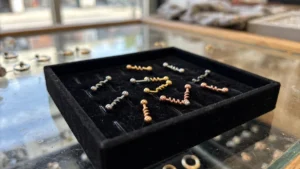
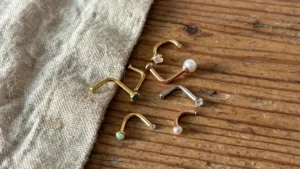
A nose bar is a short rod of metal, usually between 6 and 8 millimetres long, with a threaded or push-fit end at each side. One end is fixed, often a small ball or a gem setting, and the other end screws or clicks on after the bar has been passed through the piercing. The ends are what keep the jewellery in place, and they are also where most of the design lives: a plain ball looks minimal, a crystal end adds sparkle, and a flat disc sits discreetly against the inside of the nose.
The bar itself can be straight or curved. A straight barbell runs in a line through the piercing, which makes it the natural choice for a nostril piercing, where the jewellery passes through the side of the nose. A curved barbell has a gentle arc, which suits the septum, the wall of cartilage between the nostrils, where a straight bar would sit awkwardly. There are also L-shaped and screw-style bars, where one end is bent to hold the jewellery in place without a second ball, but these are closer cousins than true barbells.
What a nose bar is not is a hoop or a stud. A hoop is a continuous circle that hangs and moves freely, which gives it a softer, more decorative look but also more movement. A stud is a single post with one visible end, usually a gem or a small ball, which sits flat and barely moves. A bar sits between the two: it is more visible than a stud and more structured than a hoop, and that structure is exactly what some people want. It is also the most practical shape for anyone who finds hoops catch on hair and clothing, because a bar has nothing to swing.
How we chose these facts and what to look for
Look first at the metal. The safest everyday choices are implant-grade titanium and solid 14-carat gold, because both are well tolerated by most skin and resist tarnish. Surgical steel is a common budget option, but it contains nickel, so it is a poor choice if your skin reacts to nickel. Silver is not recommended for a fresh or healing piercing, and it can tarnish and stain skin over time, so keep it for short, occasional wear in a fully healed piercing.

Look next at the size. Two measurements matter: the gauge, which is the thickness of the bar, and the length, which is the distance between the two ends. Most nostril piercings are 18 gauge or 20 gauge, and most septum piercings are 16 gauge, but your piercing may differ, so check what you were pierced with before you order. A bar that is too thin can move around and irritate the piercing, while a bar that is too thick will not pass through at all. A bar that is too short will press into the skin, and a bar that is too long will catch and snag.
Finally, look at the ends and the closure. Threaded ends screw on, which is secure but needs a gentle hand, while push-fit ends click into place and are easier to change. Gem ends should be set securely, with no sharp prongs, and flat discs should be smooth, so nothing scratches the inside of your nose. A well-made bar feels smooth all over when you run a finger along it, and the ends sit evenly on either side of the piercing without digging in. Our guide to gold jewellery for everyday wear explains why solid gold is worth the extra cost for a piece you plan to wear daily, because the metal touches your skin for hours at a time.
The 9 facts about nose bars in 2027
It is a bar, not a ring or a stud
What we like: A nose bar gives a clean, straight line that suits minimal styling and sits neatly against the nose. What to consider: It is less decorative than a hoop, so if you want movement and sparkle, a ring may suit you better. Best For: Anyone who wants a tidy, understated look. Cost: About £10 to £60 for titanium or steel, more for gold. Time Needed: A few minutes to change, once you know your size.
Straight bars suit nostrils, curved bars suit septums
What we like: Matching the shape to the piercing means the jewellery sits naturally and heals comfortably. What to consider: A straight bar in a septum piercing will sit at an awkward angle, and a curved bar in a nostril can press on the skin. Best For: Choosing the right shape before you buy. Cost: No extra cost, it is a matter of choosing correctly. Time Needed: Five minutes to check your piercing placement.
The gauge and length must match your piercing
What we like: A bar that matches your piercing exactly feels comfortable and stays put. What to consider: The wrong gauge can irritate a piercing or fail to fit at all, and the wrong length can press or snag. Best For: Anyone buying their first bar. Cost: A sizing check at a piercer is often free. Time Needed: A few minutes to measure.
Titanium and solid gold are the safest metals
What we like: Implant-grade titanium and 14-carat gold are well tolerated, resist tarnish, and suit daily wear. What to consider: Gold costs more, and titanium comes in fewer colours than plated metals. Best For: Sensitive skin and everyday wear. Cost: About £15 to £40 for titanium, £60 and up for solid gold. Time Needed: No extra time, it is a buying decision.
A nose bar needs a fully healed piercing
What we like: Waiting until a piercing is healed means a new bar slides in easily and causes no soreness. What to consider: A nostril piercing can take four to six months to heal, and a septum three to four months. Best For: Anyone planning their first jewellery change. Cost: No cost, only patience. Time Needed: Three to six months of healing.
The ends are where the design lives
What we like: Ball, gem, flat disc and spike ends let you change the look without changing the bar. What to consider: Large or sharp ends can catch on clothing and bedding. Best For: Anyone who likes to vary their look cheaply. Cost: Replacement ends cost about £5 to £25. Time Needed: A minute to swap an end.
It stays put better than a hoop
What we like: A bar does not swing, spin or hang, so it is less likely to catch on scarves, hair and masks. What to consider: The fixed ends mean it cannot be flipped up and hidden the way a septum hoop can. Best For: Active days, work, and sleep. Cost: No extra cost. Time Needed: No extra time.
Cleaning is simple but not optional
What we like: Warm water and a gentle saline solution are enough to keep a bar clean. What to consider: Harsh soaps, alcohol and peroxide can dry out and irritate a piercing. Best For: Daily care of a healed piercing. Cost: A few pounds for saline solution. Time Needed: A minute a day.
Real gold and titanium hold value best
What we like: Solid gold and implant-grade titanium last for years, keep their finish, and can be resold or reused. What to consider: They cost more upfront than steel or plated jewellery. Best For: A bar you plan to wear every day for years. Cost: About £60 to £200 for a solid gold bar. Time Needed: No extra time.
Which nose bar is right for you
Start with your piercing. If you have a nostril piercing, a straight barbell in your gauge is the natural choice, with a small ball or gem at the front and a flat disc inside. If you have a septum piercing, a curved barbell in your gauge will follow the shape of your nose and sit more comfortably. If you are not sure of your gauge or your length, have it measured by a piercer before you buy, because a bar that does not fit will not be comfortable no matter how good it looks.
Then think about how you will wear it. For everyday wear, a small, smooth end in titanium or solid gold is the safest and most comfortable choice, and it goes with everything. For evenings or special occasions, a crystal or gem end adds sparkle without changing the bar, and you can swap it back in a minute. For work or sport, keep the ends small and smooth, so nothing catches or snags.
Finally, match the metal to the rest of your jewellery. If you wear gold rings and earrings, a gold nose bar will look intentional rather than random, and the same is true for silver-toned titanium. A nose ring guide can help you compare the bar shape with hoops and studs, because the right choice depends as much on your other jewellery as on the piercing itself.
The caveats that matter
A nose bar is a simple piece of jewellery, but it sits inside your body, so the details matter. The wrong size, the wrong metal, or a change made too early can turn a comfortable piercing into a sore one. Most problems are easy to avoid if you know your gauge, choose a safe metal, and wait until the piercing is fully healed.
| Detail | What is known |
|---|---|
| What it is | A straight or curved bar with a ball, gem or disc at each end, worn through a nostril or septum piercing |
| Best shape for nostrils | A straight barbell, usually 18 or 20 gauge |
| Best shape for septums | A curved barbell, usually 16 gauge |
| Safest metals | Implant-grade titanium and solid 14-carat gold |
| Healing time before changing | Three to four months for a septum, four to six months for a nostril |
| Who should avoid it | Anyone with an unhealed piercing, or a nickel allergy if the bar is steel |
| Cleaning | Warm water and saline, no alcohol, peroxide or harsh soap |
| What it does not do | It cannot be hidden by flipping it up the way a septum hoop can |
If your piercing becomes red, swollen, painful or starts to discharge after a jewellery change, remove the cause rather than the jewellery. Put the old, well-fitting piece back in, clean the area gently with saline, and speak to your piercer. Do not remove jewellery from a piercing you think is infected without advice, because the hole can close and trap the infection inside.
Checklist: buying a nose bar honestly
Use these checks before you buy, and again when the bar arrives.
- Check your gauge and length: know your piercing size before you order, or have it measured by a piercer.
- Check the metal: choose implant-grade titanium or solid 14-carat gold, and avoid plated jewellery for daily wear.
- Check the shape: straight for a nostril piercing, curved for a septum piercing.
- Check the ends: they should be smooth, securely set, and small enough not to catch on clothing.
- Check your healing: only change jewellery once the piercing is fully healed, with no tenderness or crusting.
- Check the fit: the ends should sit evenly on either side without pressing into the skin or leaving a gap.
Frequently asked questions
What is a nose bar?
A nose bar is a short straight or curved bar of jewellery that passes through a nose piercing, with a ball, gem or flat disc at each end to hold it in place. It is most often worn in a nostril or septum piercing.
Is a nose bar the same as a nose ring?
No. A nose ring is a closed circle that hangs and moves freely, while a nose bar is a straight or curved rod with two fixed ends. A bar stays in place, while a ring swings and catches more easily.
Can I wear a nose bar in a new piercing?
Only if your piercer fitted one as your first jewellery. Otherwise, wait until the piercing is fully healed, which takes three to six months depending on the piercing, before you change to a bar.
What gauge nose bar do I need?
Most nostril piercings are 18 or 20 gauge, and most septum piercings are 16 gauge, but your piercing may differ. Check what you were pierced with, or have a piercer measure it, before you order.
Can a nose bar be hidden?
Not easily. A septum hoop can be flipped up inside the nose, but a bar cannot, so if you need to hide your piercing for work, a retainer or a very small, discreet stud is a better choice.
How do I clean a nose bar?
Rinse it with warm water daily, and use a saline spray or salt-water soak if the area feels sore. Avoid alcohol, peroxide and harsh soaps, and do not twist the bar while you clean it. A pearl necklace guide is not about cleaning, but it is a reminder that delicate jewellery lasts longer when it is cared for gently, and the same is true for a nose bar.
The bottom line
A nose bar is a simple, structured piece of nose jewellery: a straight or curved rod with a ball, gem or disc at each end. It suits people who want a clean, minimal look that stays put, and it is most comfortable when the shape, gauge, length and metal all match the piercing. Titanium and solid gold are the safest choices, and the bar should only be fitted once the piercing is fully healed.
Choose the shape for your piercing, straight for a nostril and curved for a septum, check your size before you buy, and keep the ends small and smooth. Do that, and a nose bar is one of the easiest pieces of nose jewellery to live with, day after day, in 2027.