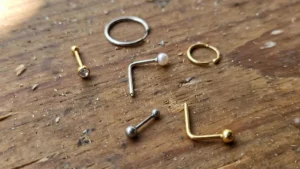
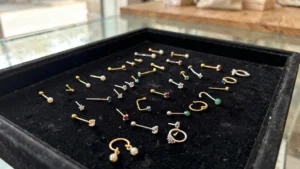
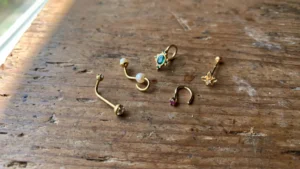
A nose screw holds itself in place with a bend. That bend is the whole design, and it comes in two shapes: the L shape, a short right-angle turn at the end of the post, and the corkscrew, a gentle spiral that twists into the piercing. Both do the same job, and both have been worn for years, but they feel different to put in, they sit differently in the nose, and they suit different people.
The L-shaped screw is the simpler of the two. It slides in, turns once, and sits flat. Its spiral grips the piercing from the inside, so it is harder to lose, harder to knock out, and better for people who sleep, swim, or change clothes without thinking about their jewellery. The trade-off is that it takes a little more patience to insert and remove.
Below are nine comparisons that matter in 2027, from comfort and security to cost, care, and how each shape behaves over months of wear. Each one is written so you can weigh the L shape against the corkscrew honestly, then choose the post that suits your piercing and your daily life.
Key takeaways
- L-shaped nose screws are easier to insert and remove, while corkscrew nose screws are more secure and less likely to fall out.
- Both shapes suit a healed nostril piercing, but the corkscrew is better for active days, sleep, and swimming, and the L shape is better for quick changes.
- The gauge and post length matter more than the shape: a screw in the wrong size will irritate a piercing in either shape.
- Corkscrews need slightly more care when cleaning, because the spiral can trap residue, while L-shaped posts are easier to wipe clean.
- No nose screw shape makes a piercing painless or risk-free, and a screw that is too short, too tight, or forced into a piercing that is not fully healed can cause irritation.
What L-shaped and corkscrew nose screws actually are
A nose screw is a nostril stud whose post bends so it stays in place without a back or a disc. The L-shaped version bends once, at a right angle, near the end of the post. The visible front is a small ball, stone, or disc, and the post is hidden. It is the shape most piercers fit first, because it is simple to insert and simple to explain.
The corkscrew version bends into a spiral, usually one and a half turns, at the end of the post. You twist it gently into the piercing, and the spiral sits inside the nostril like a small spring. The visible front is the same as an L-shaped screw, a ball, a stone, or a disc, and from the outside the two shapes look identical. The difference is entirely in how the post behaves inside the nose.
Both shapes are made in the same metals, solid gold, sterling silver, and titanium, and both come in the same gauges, usually 20 or 18 gauge for a nostril. What the shape does change is how the screw goes in, how it stays in, and how it feels over a full day.
How we chose these comparisons and what to look for
We chose these nine comparisons by looking at what actually changes the experience of wearing a nose screw: how easy it is to put in, how secure it feels, how comfortable it is after a full day, how much care it needs, what it costs, and how it behaves over months.

Look first at the post, not the front. A good L-shaped post has a clean, smooth bend with no rough edge, and the bent section should be long enough to sit flat inside the nostril without poking. A good corkscrew has a smooth, even spiral with no kinks, and the end should be rounded, not sharp. Our guide to the best necklaces for women is not about nose jewellery, but the same rule applies across jewellery: the parts you cannot see decide whether a piece is comfortable, and a smooth finish matters more than a pretty front.
Look next at the gauge and the length. Most nostril piercings take 20 or 18 gauge, and a screw in the wrong gauge will either slip or feel tight. Finally, check the stone setting if there is one. A stone held by prongs should sit firmly with no wobble, and a glued stone should sit flush with no visible glue.
The 9 comparisons that matter in 2027
First impressions and how they look on the nose
What we like: Both shapes look identical from the front, so the choice is about feel, not appearance. What to consider: The visible front, a ball, a stone, or a disc, matters far more for looks than the shape of the post. Best for: Either shape for any look, since the post is hidden inside the nostril. Material: Solid gold, sterling silver, and titanium. Price range: L-shaped from around £12 to £120; corkscrew from around £12 to £120. Standout feature: From the outside, nobody can tell which shape you are wearing.
Comfort and how they feel all day
What we like: The L shape sits flat and light, and most people forget it within a day. What to consider: The corkscrew can feel slightly more present at first, because the spiral touches more of the inside of the nostril. Best for: L-shaped for the lightest feel; corkscrew for people who want to feel that the screw is secure. Material: Solid gold, sterling silver, and titanium. Price range: L-shaped from around £12 to £120; corkscrew from around £12 to £120. Standout feature: A smooth post and the right length matter more than the shape for comfort.
Security and what stays put
What we like: The corkscrew is the most secure nose screw shape, because the spiral cannot slide out in a straight line. What to consider: The L shape can slide out if it is knocked, pulled by clothing, or loosened during sleep. Best for: Corkscrew for sleep, exercise, swimming, and active days; L-shaped for quiet days and easy removal. Material: Solid gold, sterling silver, and titanium. Price range: L-shaped from around £12 to £120; corkscrew from around £12 to £120. Standout feature: A corkscrew is the shape to choose if you have ever lost a nose screw.
Ease of putting it on and taking it off
What we like: The L shape slides in and out in seconds, with one simple turn. What to consider: The corkscrew needs a slow, gentle twist, and it can take a few tries to get the angle right. Best for: L-shaped for quick changes and beginners; corkscrew for people who rarely change their jewellery. Material: Solid gold, sterling silver, and titanium. Price range: L-shaped from around £12 to £120; corkscrew from around £12 to £120. Standout feature: An L-shaped screw is the easiest nose jewellery to change at home.
Versatility: dressing it up or down
What we like: Both shapes work with any outfit, because the visible front is the same. What to consider: The shape does not change the look, so versatility comes from the front, not the post. Best for: Either shape for any occasion, from a wedding to a festival. Material: Solid gold, sterling silver, and titanium. Price range: L-shaped from around £12 to £120; corkscrew from around £12 to £120. Standout feature: A tiny stone front dresses up in either shape, and a plain ball dresses down in either shape.
Durability and what can go wrong
What we like: The L shape has one bend, so there is less to go wrong, and a bent L-shaped post can often be straightened by a piercer. What to consider: The corkscrew’s spiral can kink if it is forced, and a kinked spiral is hard to fix. Best for: L-shaped for rough handling and frequent changes; corkscrew for steady, long-term wear. Material: Solid gold and titanium for strength; sterling silver for affordability. Price range: L-shaped from around £12 to £120; corkscrew from around £12 to £120. Standout feature: A smooth, even spiral is the sign of a well-made corkscrew.
Cost for one screw and for a set
What we like: Both shapes cost the same in the same metal, so the choice is free. What to consider: The metal decides the price, not the shape: silver is affordable, gold costs several times more. Best for: Either shape at any budget, since the shape adds nothing to the price. Material: Sterling silver and solid gold. Price range: Silver from around £12 to £60; solid gold from around £40 to £250. Standout feature: You can own one of each shape in silver for less than one gold screw.
Matching outfits and other jewellery
What we like: Both shapes match any outfit, because the visible front is the same and the post is hidden. What to consider: Matching comes from the metal and the front, not from the shape of the post. Best for: Either shape with any wardrobe, from minimal to bold. Material: Yellow gold, rose gold, and sterling silver. Price range: L-shaped from around £12 to £120; corkscrew from around £12 to £120. Standout feature: Matching the screw’s metal to your everyday jewellery matters far more than the post shape. Our guide to gold anklets makes the same point for anklets: matching the metal to the rest of your jewellery makes the whole look feel deliberate, and that rule holds for nose screws too.
Keeping it afterwards as a keepsake
What we like: A well-made screw in solid gold keeps its value and can be resold or kept as a keepsake, in either shape. What to consider: A silver screw has little resale value, and a kinked corkscrew is harder to repair than a bent L-shaped post. Best for: Gold in either shape for value that lasts; silver in either shape for wearing, not keeping. Material: Solid 14-carat or 18-carat gold and sterling silver. Price range: Silver from around £12 to £60; solid gold from around £40 to £250. Standout feature: A gold screw is a small piece of jewellery with real material value, whatever its shape.
Which nose screw is right for you
Start with how you live. If you sleep on your side, exercise, swim, or change clothes without thinking about your jewellery, a corkscrew is the safer choice, because it will not fall out. If you change your nose jewellery often, or you are new to nose screws and want the easiest possible piece to handle, an L shape is the better start, because it goes in and out in seconds.
Next, think about your piercing. Both shapes need a fully healed nostril, which usually takes two to three months, and both need the right gauge and length. If your piercing is easily irritated, choose titanium or solid gold, whichever shape you pick, because both are the kindest metals for sensitive skin.
Finally, be honest about patience. A corkscrew rewards patience: it takes a little longer to insert, but it stays put and needs less checking. An L shape rewards simplicity: it is quick to change and easy to clean, but it needs a glance in the mirror before you leave the house. Our guide to luxury watches is about a different kind of jewellery, but the lesson is the same: the best piece is the one that fits your daily habits, not the one that looks best in a photograph.
The caveats that matter
Both shapes are safe for most people, but neither is right for everyone. A nose screw should only be worn in a fully healed piercing, which usually takes two to three months for a nostril, and sometimes longer. If your piercing is still sore, crusty, or swollen, wait, and wear the plain stud your piercer fitted until it is fully settled.
| Detail | What is known |
|---|---|
| Which is easier to insert | L-shaped, with a slide and a single turn; the corkscrew needs a slow, gentle twist |
| Which is more secure | Corkscrew, because the spiral cannot slide out in a straight line |
| Which is more comfortable | Both are comfortable when the gauge and length are right; the L shape feels lighter at first |
| Which is easier to clean | L-shaped, because the post is a single bend; the corkscrew spiral can trap residue |
| Which lasts longer | Both last well, but a bent L-shaped post can be straightened and a kinked corkscrew usually cannot |
| Typical price | The shape adds nothing to the price; silver around £12 to £60, solid gold around £40 to £250 |
| When to wear it | Only in a fully healed nostril piercing, usually after two to three months |
| What neither shape fixes | A wrong gauge or post length will irritate a piercing in either shape |
If you are pregnant, have a skin condition, or take medication that affects healing, check with your piercer or clinician before changing nose jewellery. That is not a formality. A piercing that heals slowly needs more care, and a shape that suits most people can still cause a problem in a piercing that is not fully healed.
Checklist: choosing between L-shaped and corkscrew
Use these checks before you buy, and again after a week of wear.
- Check your routine: if you swim, exercise, or sleep on your side, a corkscrew is more secure.
- Check how often you change jewellery: if you swap daily, an L shape is quicker and easier.
- Check the post: it should be smooth, with no rough edges or kinks, and the end should be rounded.
- Check the gauge: it should match your piercing, usually 20 or 18 gauge, in either shape.
- Check the length: the screw should sit close to the nostril without pulling or moving around freely.
- Check your patience: if you will not spend a minute twisting a corkscrew in, buy an L shape instead.
Frequently asked questions
Which is better, L-shaped or corkscrew?
Neither is better in general. The corkscrew is more secure and less likely to fall out, while the L shape is easier to insert, remove, and clean. Choose the corkscrew if you want security, and the L shape if you want simplicity.
Can a corkscrew nose screw fall out?
It is very unlikely. The spiral has to be twisted out, so it cannot slide out on its own, and it resists being pulled out by clothing or bedding. It can still be lost if the spiral is kinked or the gauge is wrong, so check the fit with a piercer if it ever feels loose.
Is an L-shaped nose screw good for beginners?
Yes, it is the easiest nose screw to handle. It slides in with one turn, comes out the same way, and is simple to clean. Most piercers fit an L-shaped screw first for exactly that reason, and many people stay with it for years.
How do I clean a corkscrew nose screw?
Rinse it in warm water and wipe it with a soft cloth, paying attention to the spiral, where residue can collect. A soft brush helps if the spiral looks dull. Avoid harsh cleaners, and dry the screw fully before putting it back in.
Can I wear a corkscrew if my piercing is new?
No, not until it is fully healed, which usually takes two to three months. A screw of either shape should only go into a healed piercing. Wear the plain stud your piercer fitted until the piercing is settled, then switch to the shape you prefer.
Does the shape affect how a nose screw looks?
No. The post is hidden inside the nostril, so the two shapes look identical from the front. What you see is the ball, stone, or disc, and that is the same in either shape. Choose on comfort and practicality, not on appearance.
The bottom line
The best nose screw shape in 2027 is the one that fits your daily life. The L shape is the simple choice: it goes in and out in seconds, it is easy to clean, and it is the best place to start if you are new to nose screws.
Choose by habit first, then by fit. Try one of each in silver, see which you reach for, and buy the winner in the best metal you can afford. Check the gauge and the length with a piercer, and give the screw a week before you decide. That is the honest way to find a nose screw you will wear every day, in a shape that suits you.