Tuberose is a word you will see on a lot of perfume boxes, and it is one of the least understood notes in perfumery. It is a night-blooming flower from Mexico with a scent so strong that perfumers use it sparingly, and so distinctive that once you learn to recognise it, you will spot it in dozens of famous perfumes.
Understanding tuberose is useful because it changes how you shop. A perfume that lists tuberose in its notes will smell richer, warmer and more powerful than one built on jasmine or lily of the valley, and it will behave differently on skin. Knowing what the note actually does helps you choose a perfume you will enjoy, rather than one that overwhelms you.
This guide explains what a tuberose perfume is, how the note is made, why it smells the way it does, and how to wear it well. By the end, you should be able to smell a tuberose perfume and know what you are smelling, and why it works or does not work for you.
Key takeaways
- A tuberose perfume is a fragrance built around tuberose, a night-blooming white flower with a creamy, warm and intensely sweet scent.
- Tuberose smells fleshy and rich, with a green edge and a hint of spice, and it is one of the strongest floral notes a perfumer can use.
- Most modern tuberose perfumes blend natural tuberose absolute with other white florals and lab-built molecules that recreate the flower.
- Tuberose perfumes last longer and project further than most florals, so one or two sprays are usually enough.
- No tuberose perfume suits every person or every occasion, and the note can turn soapy, heavy or cloying depending on the formula and your skin.
What a tuberose perfume actually is
A tuberose perfume is a fragrance in which tuberose is the central note, the one the perfumer builds the whole composition around. It is not a single-ingredient scent. Like any perfume, it has top notes that you smell first, a heart where the tuberose sits, and a base that holds the scent on skin for hours. What makes it a tuberose perfume, rather than a general white floral, is that the tuberose character is unmistakable from the first spray to the dry-down.
Tuberose itself is the flower of Polianthes tuberosa, a plant from Mexico that blooms at night. The flowers release their scent after dark to attract night-flying moths, and that is why the smell is so intense. A single stem can scent a room. Perfumers have used tuberose since the seventeenth century, when it arrived in Europe.
It is worth knowing that tuberose has no connection to roses, despite the name. The name comes from the Latin word for a swollen root, a reference to the shape of the plant’s bulb. Expect a warm, creamy white flower with a green edge, and you will be close.
How to recognise tuberose in a perfume
The easiest way to learn tuberose is to smell a perfume where it is obvious. Fracas is the classic example, and a single spray on a test strip will show you the note in full: creamy, sweet, slightly green, and very strong.
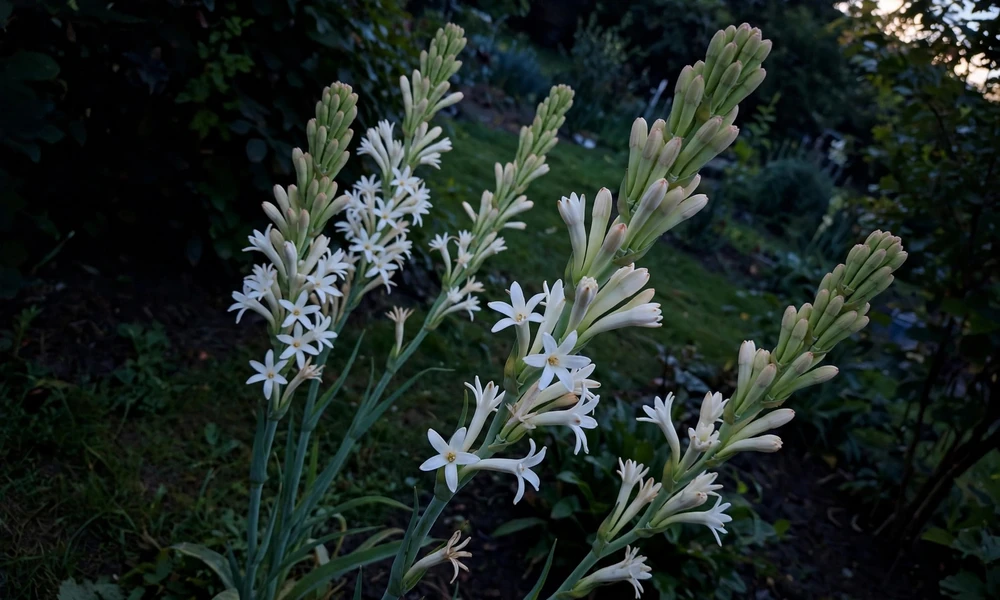
Look for three qualities. First, creaminess, a soft, almost buttery richness that feels warm rather than sharp. Second, a green edge, a leafy freshness that keeps the sweetness from becoming flat. Third, weight, a sense that the scent is thick and present in the air, rather than light and transparent. If a white floral perfume has all three, tuberose is almost certainly in the formula. Our guide to what a fig perfume is uses the same three-part test, because learning to name what you smell is the fastest way to shop with confidence.
It also helps to know what tuberose is not. It is not the cool, soapy freshness of lily of the valley, and it is not the soft, powdery sweetness of orange blossom.
9 things to know about tuberose
Tuberose blooms at night, and it smells strongest after dark
What it shows: The flower releases its scent at night to attract moths, which is why the smell is so intense and why tuberose perfumes feel made for evenings. What to consider: That intensity means a tuberose perfume can feel too much in a bright, hot room, so dose it lightly in daylight. Best for: Evening wear and anyone who wants to understand why tuberose feels so nocturnal. Material: Tuberose absolute and night-blooming floral accords. Price range: Tuberose absolute is costly, roughly several hundred pounds per kilo, which is why it is used sparingly. Standout feature: The night-blooming habit explains the whole character of the note.
Tuberose is mostly leaf and green, not fruit
What it shows: The green, leafy side of tuberose is what keeps it from smelling like a jam or a syrup, and it is the part perfumers work hardest to preserve. What to consider: In cheap formulas the green side disappears and only the sweetness remains, which is when tuberose turns cloying. Best for: Shoppers who want to tell a good tuberose perfume from a poor one. Material: Green leaf notes, galbanum, and tuberose absolute. Price range: Well-balanced formulas usually start around £60 for 50 ml. Standout feature: The green edge is the quality mark of a good tuberose perfume.
Tuberose absolute is expensive and hard to work with
What it shows: Real tuberose absolute is one of the pricier floral materials in perfumery, and it is sticky, powerful and difficult to dose, which is why perfumers use it in small amounts. What to consider: A low price does not mean a perfume has no real tuberose, because lab-built tuberose molecules are excellent, but a very cheap tuberose perfume is unlikely to use much of the natural material. Best for: Understanding why tuberose perfumes cost what they do. Material: Tuberose absolute, jasmine absolute, and synthetic tuberose molecules. Price range: Natural tuberose absolute can cost several hundred pounds per kilo. Standout feature: The cost of the raw material is why tuberose is a luxury note.
Most tuberose perfumes today are a blend of a small amount of natural absolute and lab-built molecules that fill in the creamy, green character.
Tuberose pairs best with jasmine and gardenia
What it shows: Jasmine lightens tuberose and gardenia adds a soft, buttery depth, which is why the three flowers appear together in so many classic white florals. What to consider: A perfume with all three can feel very full, so it suits evenings and cold weather more than hot days. Best for: Lovers of classic white florals who want the full bouquet. Material: Tuberose, jasmine, gardenia, and white musk. Price range: Classic white floral perfumes usually range from £60 to £200 for 50 ml. Standout feature: The white floral trio is the backbone of tuberose perfumery.
If you like tuberose, you will probably like jasmine and gardenia too, and learning the trio helps you read perfume notes with confidence. A formula that lists all three is telling you it is a full, warm white floral, not a light one.
Tuberose blends well with citrus and green notes
What it shows: Bergamot, green mandarin, eucalyptus and galbanum all cut through the richness of tuberose and make it wearable in daylight. What to consider: The citrus fades first, so a perfume that opens fresh can still turn rich and heavy after an hour. Best for: Daytime tuberose and warm-weather wear. Material: Tuberose, bergamot, eucalyptus, green mandarin. Price range: Modern green tuberose perfumes usually range from £90 to £280 for 50 ml. Standout feature: Citrus and green notes are what make tuberose modern.
The green and citrus top notes give you freshness at the start, and the tuberose underneath gives you depth later. Our guide to what a floral perfume is explains how these combinations are built, because a floral perfume is rarely one flower on its own.
Tuberose is a warm-weather flower that suits cold weather too
What it shows: Tuberose comes from a warm climate, but its richness holds up better in cold air, where the sweetness softens and the scent lasts longer. What to consider: In high heat, tuberose can turn heavy and cloying, so choose a lighter formula in summer. Best for: Autumn and winter evenings, when the richness feels right. Material: Tuberose, sandalwood, amber, and soft musk. Price range: Rich tuberose perfumes for cold weather usually range from £70 to £200 for 50 ml. Standout feature: Tuberose is one of the few florals that improves in cold weather.
This is a useful rule of thumb. If it is hot, wear a light tuberose. If it is cold, wear a rich one. The same bottle can smell like two different perfumes in July and in January.
Tuberose changes a lot on skin
What it shows: Skin warmth and chemistry can bring out the sweet side of tuberose on one person and the green side on another, so the same perfume can smell different on two people. What to consider: Never buy a tuberose perfume from a test strip alone, because the strip shows only the opening. Best for: Anyone who has been disappointed by a perfume that smelled different at home. Material: Tuberose absolute, skin musk, and sandalwood. Price range: Samples and discovery sets are the cheapest way to test, usually £5 to £30. Standout feature: Tuberose is one of the most skin-dependent notes in perfumery.
Tuberose has a long history in perfumery
What it shows: Tuberose has been used in perfume since the seventeenth century, and it was a favourite of French perfumers long before modern chemistry made it affordable. What to consider: That history is why tuberose can feel vintage or old-fashioned in some formulas, and why modern perfumers work hard to lighten it. Best for: Understanding why tuberose carries such a strong reputation. Material: Tuberose absolute, jasmine, and traditional floral bases. Price range: Heritage tuberose perfumes usually range from £100 to £300 for 50 ml. Standout feature: Tuberose is one of the oldest notes still in regular use.
Tuberose is not the same as jasmine or lily
What it shows: Jasmine is softer and greener, lily of the valley is cooler and soapier, and tuberose is thicker, creamier and more powerful than either. What to consider: If a perfume lists all three, the tuberose will usually dominate, so expect a rich scent. Best for: Shoppers who want to tell white florals apart. Material: Tuberose, jasmine, lily of the valley, and white musk. Price range: White floral perfumes that blend the three usually range from £60 to £200 for 50 ml. Standout feature: Tuberose is the heaviest of the white florals, and the easiest to recognise once you know it.
How tuberose is used in perfumery
In a formula, tuberose usually sits in the heart, the middle of the perfume that you smell after the top notes fade. The perfumer pairs it with top notes that lighten it, such as bergamot, green mandarin or eucalyptus, and with base notes that hold it, such as sandalwood, musk or amber. The heart is where the character lives, and tuberose is a heart note with a strong personality.
The dose matters more than with most notes. A small amount of tuberose absolute can dominate a formula, so perfumers measure it carefully and often surround it with other white florals to soften it. Too little and the perfume loses its character. Too much and it becomes overwhelming. That balance is what separates a good tuberose perfume from a bad one, and it is why the best formulas feel rich without feeling heavy. If you want to compare how different white florals are dosed, our guide to jasmine perfumes is a useful next read, because jasmine is the note most often paired with tuberose
It is also worth knowing that tuberose is rarely used alone. Even a perfume that calls itself a tuberose soliflore will usually contain supporting notes, because the flower on its own can be too one-dimensional.
The caveats that matter
Tuberose is a demanding note, and it is honest to say so. It can turn soapy on some skin, especially when layered over a fragranced body lotion, and it can feel overwhelming in a small, warm room. It can also trigger headaches for people who are sensitive to strong scents, which is a real consideration if you share a workspace or travel on crowded transport.
| Detail | What is known |
|---|---|
| What it is | A night-blooming white flower from Mexico, used as the central note in a tuberose perfume |
| What it smells like | Creamy, warm and sweet, with a green edge and a slightly fleshy floral character |
| How strong it is | One of the strongest floral notes; a little goes a long way |
| How it is made | Natural tuberose absolute blended with other white florals and lab-built molecules |
| Best season | Autumn and winter for rich formulas; summer for light, green tuberose perfumes |
| How long it lasts | Usually 6 to 10 hours, longer for the boldest formulas |
| Who should start lightly | Anyone new to tuberose, sensitive noses, and people in small shared spaces |
| What it is not | It is not a rose, not a lily, and not a light floral, even when it is blended with citrus |
If you are sensitive to strong scents, or you are buying a tuberose perfume as a gift, choose a lighter formula and include the receipt. A scent this powerful is a personal choice, and the kindest gift is one that can be exchanged.
Checklist: understanding a tuberose perfume honestly
Use these checks before you buy, and again after a full day of wear.
- Smell a classic tuberose perfume once, so you know what the note actually smells like.
- Test on skin, not paper, and wait at least twenty minutes before judging the scent.
- Check the dry-down after two hours, because that is the part you will live with all day.
- Look for the green edge, the freshness under the cream, which marks a well-balanced formula.
- Start with one spray and add a second only if the scent disappears within an hour.
- Match the formula to the season: lighter tuberose for heat and day, richer tuberose for cold and evenings.
Frequently asked questions
Is tuberose a rose?
No. The name comes from the Latin word for a swollen root, a reference to the shape of the plant’s bulb. Tuberose is a night-blooming white flower from Mexico, and it smells creamy and warm, not like a rose at all.
Why is tuberose so strong?
The flower releases its scent at night to attract moths, so it evolved to be intensely fragrant. That strength carries into perfume, which is why tuberose perfumes last longer and project further than most florals.
Is tuberose a natural or synthetic note?
Both. Most tuberose perfumes use a small amount of natural tuberose absolute blended with lab-built molecules that recreate the flower. That is standard practice, and the molecules are how perfumers make the note affordable without losing its character.
Can I wear tuberose in summer?
Yes, if you choose a light one. Greener tuberose perfumes with citrus, marine notes or eucalyptus work well in heat, while the heavy classics can feel too much.
Why does tuberose smell different on my skin than on a test strip?
Skin warmth changes how the notes develop, and your own skin chemistry can bring out the sweet or the green side of the flower. A test strip shows the opening, but only skin shows the dry-down, which is why testing on skin matters.
What perfumes should I try first if I am new to tuberose?
Start with a light, approachable one such as Gucci Bloom or Jo Malone Tuberose Angelica, then try a classic such as Fracas once you know you like the note.
The bottom line
A tuberose perfume is a fragrance built around one of the strongest, richest white flowers in perfumery. It smells creamy, warm and slightly green, it lasts for hours, and it rewards a light hand. Once you learn to recognise it, you will spot it in dozens of perfumes, and you will understand why some white florals feel soft and others feel grand.
Start with a light tuberose, test it on skin, and judge it on the dry-down. Tuberose is not a note for everyone, and it is not a note for every occasion, but when it suits you, there is nothing else in perfumery quite like it.