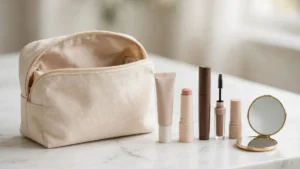
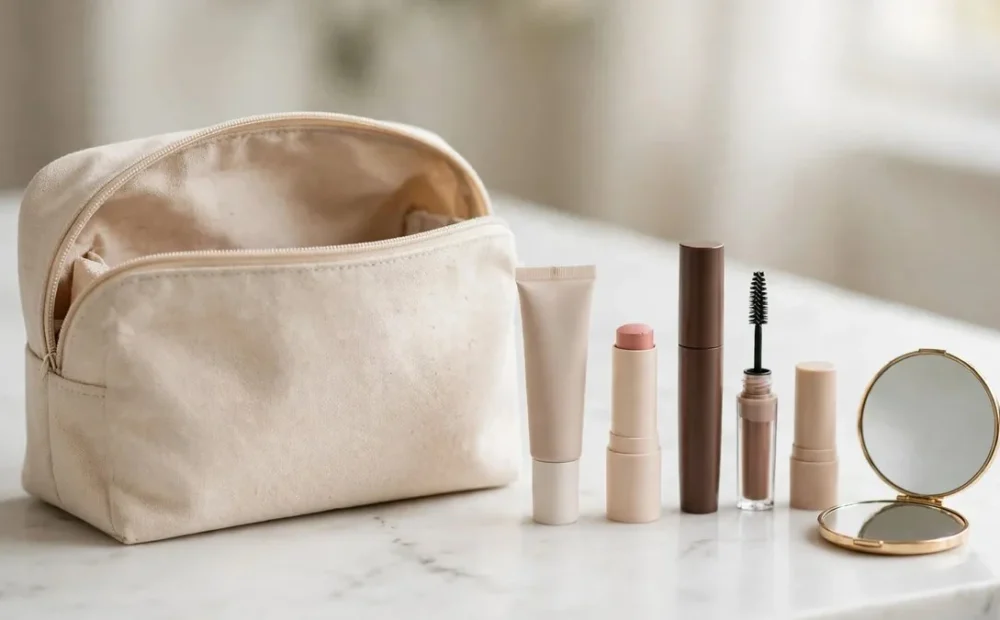
Open most makeup bags and you will find a small museum of good intentions: three half-used foundations and a lipstick bought for one wedding. A capsule makeup bag is the opposite: a small, deliberate collection where every product earns its place and covers a full face.
The idea borrows its logic from the capsule wardrobe, where a few well-chosen pieces create many outfits. Applied to beauty, it turns a chaotic drawer into a kit you can actually use: a base, one colour for cheeks and lips, a mascara, a brow product, and a daily lip shade.
In 2027 the capsule makeup bag has moved from a niche organising trend to a mainstream habit, as shorter routines, multi-use formulas, and a distaste for waste made the small kit the default for busy mornings and travellers.
Key takeaways
- A capsule makeup bag is a small, curated kit of six to ten products that covers a full everyday face with no duplicates.
- Every product must do more than one job or be used at least weekly.
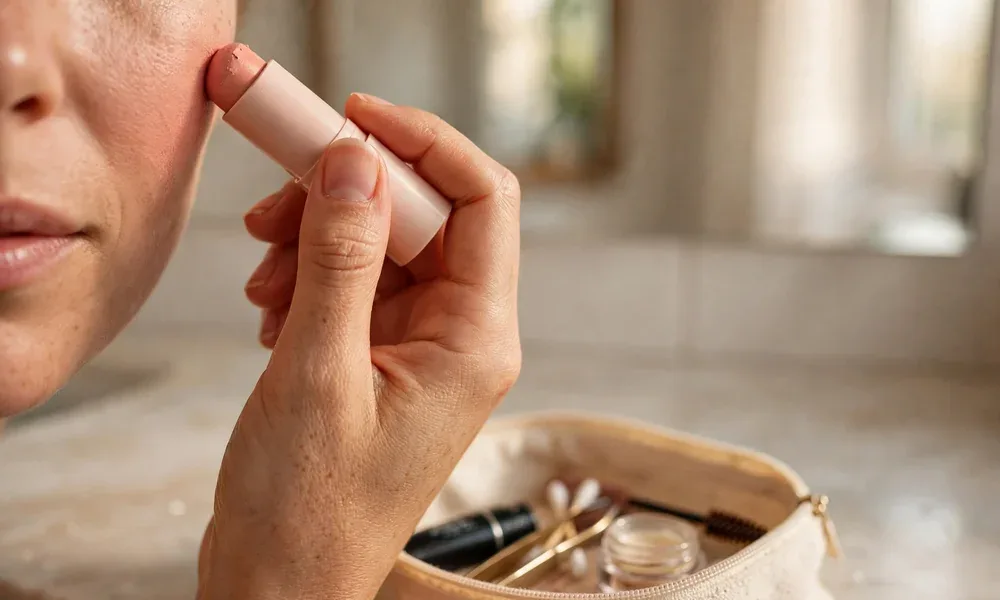
- Multi-use creams are the backbone: one stick can colour cheeks, lips, and eyelids.
- Shades should share one undertone family so any combination works.
- The bag matters too: a compact, wipe-clean pouch with a flat base.
What a capsule makeup bag actually is
A capsule makeup bag is a small collection of makeup, usually six to ten products, chosen so that every item works with the others and nothing is duplicated. It is not a fixed shopping list. It is a principle: one function, one product. One base, one cheek colour, one mascara, one brow product, one lip shade.
The word capsule comes from the capsule wardrobe, where a limited set of versatile pieces creates far more outfits than a wardrobe full of one-off purchases. The makeup version applies the same discipline to a vanity: one blush that suits your undertone and doubles as a lip tint, instead of five near-identical blushes, and one skin tint for day or evening, instead of a drawer of foundations.
A capsule is built around your face, your skin, your routine, and your life, so the contents are personal. It also changes how you shop: you buy to fill a gap or replace a finished product, not because something is new.
Why the capsule idea took off in 2027
Several trends converged in 2027. The first is time. Mornings have not got longer, and the five-minute face has become the realistic goal for most people. A kit of six to ten familiar products can be applied in five minutes, largely with fingertips.
The second is multi-use formulas: cream sticks for cheeks, lips, and eyelids, skin tints that double as concealer, and balms that add glow. The third is waste: products expire before they are finished, drawers fill with shades that were never right, and the cost adds up. A capsule simply asks that everything you own gets used and everything you buy has a job.
What belongs in a capsule makeup bag
A good capsule covers five jobs: even the skin, add colour, define the eyes, frame the brows, and finish the lips.
| Product | Role | How to choose it |
|---|---|---|
| Skin tint | Evens skin tone | Match your neck; buildable finish for your skin type |
| Concealer | Spot coverage | One to two shades lighter; same undertone as base |
| Cream blush | Cheek and lip colour | Peach or coral for warm skin, rose for cool skin |
| Mascara | Eye definition | Brown for softness, black-brown for more impact |
| Brow gel | Frames the face | One shade lighter than your brow hair |
| Lip colour | Finishing shade | A my-lips-but-better tone for every day |
| Setting product | Locks the look | Powder for oily skin, spray for dry skin |
| Balm highlighter | Sheen, not shimmer | Translucent glow that melts into skin |
That is eight products, and many people stop at six by letting the concealer double as the base on light days, or by skipping the highlighter. The count matters less than the rule: each product has one clear job, and no job is covered twice. Tools deserve the same discipline: at most three, a sponge or brush for the base, a fluffy brush for powder, and a spoolie for brows and lashes. Creams are made for fingertips, which is faster than brushes and works anywhere, even without a mirror.
Choosing shades is where most capsules succeed or fail, and the trick is undertone. Work out whether your skin leans warm, cool, or neutral, and keep every shade in that family. When every product shares an undertone, any combination works.
Mascara is the highest-impact product in the bag. Brown gives soft daytime definition, black-brown adds evening presence, and one tube replaced regularly beats a drawer of half-used mascaras.
How to build your capsule in five steps
Start by emptying your current bag completely and sorting everything into three groups: products you use at least once a week, products you use occasionally, and products you have not touched in a month. The first group is the seed of your capsule; the third group can go.
Next, identify the gaps by comparing what you use weekly against the five jobs in the table above. Most people discover they are missing nothing, or that one product is doing a job badly. A gap is a reason to shop; a duplicate is not.
Then lock down your undertone and base shade, the two facts that decide everything else. Test foundation along your jawline in daylight and match it to your neck, not your hand, and choose a concealer one to two shades lighter in the same undertone family.
After that, choose your colour products as a set. Pick a cream blush, a lip shade, and, if you want one, a bronzer in the same undertone family. Hold them together before buying: if they look like they belong to the same face, they do.
Finally, live with the kit for two weeks before changing anything. Keep a note of anything you genuinely miss, and anything you never reach for, then swap the unused product for the missed one.
The bag itself: size, material, and layout
The pouch matters, because a capsule only works if the bag is pleasant to use every day. The right size slips into a handbag but lets products lie flat. A flat base makes the difference: with the bag open, you can see everything at once.
Material is a practical choice. A wipe-clean lining means spills are a quick wipe rather than a ruined bag, and a darker lining hides stains better than a pale one. A zip that opens wide keeps the kit visible. Layout is simple: daily products in the main compartment, tools in a small inner pocket, and no extra organisers, since with six to ten products the bag organises itself.
Capsule makeup for travel
Travel is where the capsule earns its keep. A full collection cannot be packed sensibly, but a capsule can be lifted from the vanity into a suitcase exactly as it is. The routine does not change on holiday, and there is no morning spent wondering which of three blushes to bring.
The travel version needs only small adjustments. Add a miniature setting spray or pressed powder if the climate is humid, and consider a tinted lip balm instead of a full lipstick, since it can be reapplied without a mirror. A cream blush that doubles as a lip tint is even more valuable away from home: it replaces two products and cannot shatter in transit. Keep the kit in your hand luggage, not a checked bag, so it stays available and safe from temperature changes in the hold.
Common mistakes that break a capsule
The most common mistake is building the capsule from products you wish you used rather than products you actually use. A bold red lipstick looks exciting in the shop, but if you wear nude lips every day, the red will sit unused. Build from your real routine first, then add one statement piece if you genuinely want it.
The second mistake is choosing shades that fight each other. A warm peach blush, a cool pink lipstick, and a golden bronzer can each be lovely alone and clash together. Keeping every shade in one undertone family prevents this. If a product does not coordinate with the rest of the bag, it does not belong in it.
The third mistake is keeping backups inside the bag. A second mascara, a spare lipstick, and a backup concealer turn a capsule back into a cluttered pouch; backups belong in a drawer at home. The final mistake is never editing: skin and routines change, so a quick review every few months keeps the kit honest.
Above all, do not confuse a capsule with a punishment. The point is not to own as little as possible, but to own what you love and use. If ten products make you happy and six feel sparse, ten is your capsule.
Your capsule makeup bag checklist
- Empty your bag and keep only products you use at least once a week.
- Check every job is covered once: base, colour, eyes, brows, lips, setting product.
- Confirm all shades share one undertone family.
- Choose multi-use creams where possible, so one product does two jobs.
- Pick a compact, wipe-clean pouch with a flat base.
- Live with the kit for two weeks, then swap anything unused.
Frequently asked questions
How many products should a capsule makeup bag have?
Most hold six to ten products, plus two or three tools. Six covers a full face when several products multitask, while ten allows a little more variety, such as a bronzer and a highlighter. The right number is the one where every product gets used weekly.
What is the difference between a capsule makeup bag and a minimalist makeup bag?
The two ideas overlap, but a capsule is more structured. Minimalism is about owning less, while a capsule is a coordinated set where every product works with the others: small, and deliberately built around one undertone, one base, and multi-use formulas.
Can a capsule makeup bag work for evening looks?
Yes. Layer the same kit for evening: build the skin tint up, deepen the cream blush, add a second coat of mascara, and swap the daytime lip balm for a stronger lip shade. Many wearers keep one statement lipstick outside the daily bag for evenings.
How do I choose the right shades for my capsule?
Start with your undertone: peach, coral, and gold for warm skin; rose, berry, and pink for cool skin. Match your base to your neck in daylight, choose a concealer in the same undertone family, and keep blush and lip shades on the same side of the temperature line. When in doubt, a cream blush is the safest first colour purchase.
How often should I replace products in my capsule?
Mascara should be replaced every three months, since it dries out fastest. Creams and liquids generally last around a year once opened, while powders last longer. Check the open-jar symbol on the packaging, and retire anything that smells different, changes texture, or irritates the skin.
Is a capsule makeup bag worth it if I love makeup?
Yes. A capsule is the daily kit, not the whole collection, and many makeup lovers find it makes their collection more enjoyable. You can still keep special-occasion products at home, while the capsule holds the favourites you reach for every morning.
The bottom line
A capsule makeup bag is a small, deliberate kit of six to ten products that covers a full face with no duplicates, built around your undertone, skin, and real routine. Its power comes not from owning less, but from choosing well: multi-use formulas, shades that coordinate, and a pouch that makes the kit easy to use every day.
Start with what you already use, fill the gaps rather than duplicating what works, and give the kit two weeks before judging it. By the second week most people find the routine faster and the vanity calmer. A good capsule does not ask you to give up makeup, only to keep the makeup that loves you back. For a finishing touch, a well-chosen lipstick in your undertone can lift the whole kit, and a cream blush that works on cheeks and lips remains the single most useful product in the bag.
Note: shades and formulas suit different skin tones differently, so test a new base or colour on your jawline in daylight before committing, and retire any product that irritates your skin.