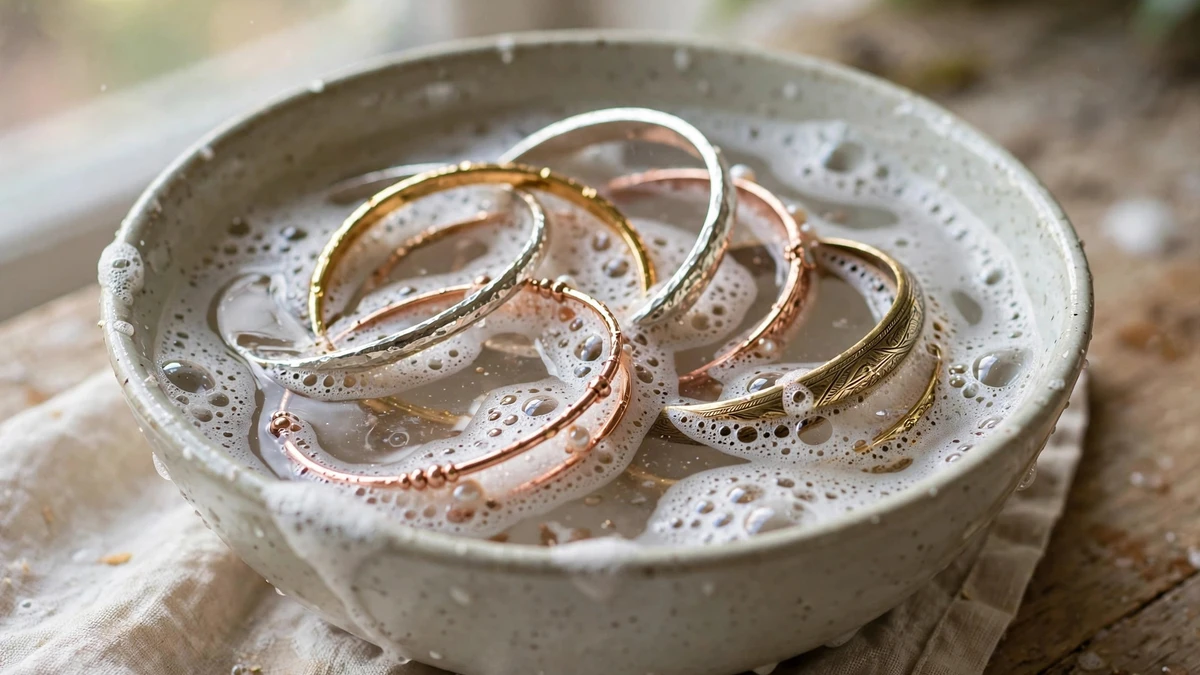

Bangle bracelets pick up more dirt than almost any other piece of jewellery. They sit against the skin all day, collect hand cream, soap, sweat, and dust, and knock against desks, doorframes, and steering wheels. The result is a slow loss of shine: gold looks dull, silver turns grey, stones look cloudy, and enamel loses its gloss. The good news is that most bangles are easy to clean at home, and a ten-minute routine once a month is enough to keep them looking new.
The mistake most people make is treating every bangle the same way. A solid silver bangle can be soaked and scrubbed gently. A pearl bangle cannot. A gold vermeil bangle needs a soft touch, while a stainless steel bangle can take far more. An enamel bangle should never meet an abrasive cloth, and a beaded bangle on elastic should never be soaked for long. Cleaning the wrong way is worse than not cleaning at all, because it can strip plating, loosen glue, and crack enamel.
Below are nine steps that cover every common bangle material, from solid metal to pearls, enamel, leather, and beaded stone. Each step explains what to do, what to avoid, who it suits, how long it takes, and the one tip that makes the difference, so you can clean your bangles with confidence instead of guessing.
Key takeaways
- Most bangle bracelets need only warm water, a drop of mild soap, and a soft cloth, cleaned once a month and wiped weekly.
- Always identify the material first: solid metal, plated metal, pearls, enamel, leather, and beaded stone each need different care.
- Never soak pearls, leather, or glued-stone bangles, and never use abrasive cloths, toothpaste, or harsh chemicals on any bangle.
- Dry bangles fully before storing them, because trapped moisture causes tarnish and weakens elastic and glue.
- No home cleaning method restores worn plating or repairs chipped enamel, and a bangle that is already damaged needs a jeweller, not a deeper clean.
What bangle bracelets are made of
Most bangles fall into five material groups. Solid metals, such as sterling silver, stainless steel, and solid gold, are the toughest and the easiest to clean. Plated metals, including gold vermeil and gold-plated brass, look the same but have a thin surface layer that can wear away if scrubbed hard. Pearls and soft stones are delicate and react badly to chemicals, heat, and soaking. Enamel and lacquer give bright colour but chip easily and hate abrasives. Leather and beaded stone bangles are held together by glue or elastic, both of which weaken in water.
Before you clean anything, work out which group your bangle belongs to. Check the inside of the bangle for a stamp: 925 means sterling silver, 750 or 585 means gold, and a maker’s mark often tells you more. If there is no stamp and the colour is very even and bright, it is probably plated. If the bangle has stones, check whether they are set in claws or glued in. If it has an elastic core, assume it should not be soaked.
Our guide to how to clean gold jewellery covers gold pieces in more detail, and the same gentle principles apply here: mild soap, soft tools, and no harsh chemicals. The steps below adapt those principles to the specific shapes and materials of bangle bracelets.
How to clean bangle bracelets safely
The safest cleaning method for most bangles is also the simplest: warm water, a drop of mild dish soap or hand soap, a soft cloth or a very soft toothbrush, and patience. Harsh cleaners, baking soda pastes, toothpaste, and ultrasonic machines are all risky for bangles, because they can strip plating, loosen stones, and crack enamel. If a method sounds aggressive, it probably is, and a gentler version will work just as well with a little more time.

Work over a towel on a table, not over a sink, so a dropped bangle does not chip or fall down the drain. Clean one bangle at a time, so you can give each one proper attention and check it before moving on. Keep a soft, lint-free cloth ready for drying, because a bangle left wet will tarnish faster than a bangle that was never cleaned at all.
The nine steps below follow the order that works best: inspect first, identify the material, then clean, rinse, dry, polish, and store. Skip any step that does not apply to your bangle, and stop if you find damage, because a loose stone or a cracked finish needs a jeweller, not more cleaning.
The 9 steps to clean bangle bracelets
Take the bangles off and inspect them first
What to do: Lay each bangle on a clean towel in good light and look closely at the surface, the stones, the edges, and any joints or clasps. What to avoid: Do not clean a bangle that has a loose stone, a crack, or a bent section, because cleaning can make the damage worse. Best for: Every bangle, every time. Time needed: 2 minutes. Standout tip: Run a fingernail gently over each stone; if it moves, stop and take the bangle to a jeweller.
Inspection takes two minutes and saves hours of regret. A bangle with a loose stone can lose it in soapy water, and a cracked enamel bangle can let water under the coating, where it will lift the enamel further.
Identify the material before you touch water
What to do: Check for stamps, look at how the stones are set, and note whether the bangle is solid metal, plated, pearl, enamel, leather, or beaded. What to avoid: Do not assume a gold-coloured bangle is solid gold, and do not soak anything you cannot identify. Best for: Plated, pearl, enamel, and beaded bangles in particular. Time needed: 2 minutes. Standout tip: If in doubt, treat the bangle as the most delicate material it could be, and clean it by wiping only.
This step decides everything that follows. Solid silver and stainless steel can be soaked. Gold vermeil should be wiped and rinsed briefly. Pearls, leather, and glued stones should only ever be wiped with a damp cloth.
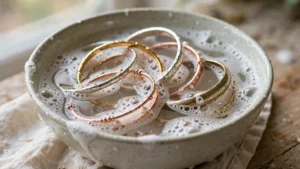
Mix warm water with a drop of mild soap
What to do: Fill a small bowl with lukewarm water and add one drop of mild dish soap or fragrance-free hand soap, then stir gently. What to avoid: Do not use hot water, antibacterial soap, bleach, or any cleaner with ammonia or alcohol. Best for: Solid metal and stone bangles. Time needed: 1 minute. Standout tip: Lukewarm is the key word: if the water is too hot to hold your hand in comfortably, it is too hot for the bangle.
Soak plain metal and stone bangles briefly
What to do: Place solid silver, stainless steel, or solid gold bangles in the soapy water for five to ten minutes, then lift them out. What to avoid: Do not soak plated, pearl, enamel, leather, or beaded bangles, and never leave any bangle soaking for more than fifteen minutes. Best for: Solid metal bangles with set stones. Time needed: 5 to 10 minutes. Standout tip: Soak bangles one at a time so they do not scratch each other in the bowl.
Clean gently with a soft brush or cloth
What to do: Use a very soft toothbrush or a soft cloth to work around stones, grooves, and engraved details, using light, short strokes. What to avoid: Do not use a hard brush, a scouring pad, toothpaste, or baking soda, all of which scratch metal and strip plating. Best for: Engraved, patterned, and stone-set bangles. Time needed: 3 to 5 minutes per bangle. Standout tip: Let the soap do the work; if a mark does not lift with gentle strokes, leave it and ask a jeweller rather than scrubbing harder.
Rinse under clean lukewarm water
What to do: Hold the bangle under a gentle stream of lukewarm water, turning it slowly so every part is rinsed, or swish it in a second bowl of clean water. What to avoid: Do not rinse over an open drain, and do not use hot water, which can loosen glue and shock soft stones. Best for: Every bangle that was soaked or soaped. Time needed: 1 minute. Standout tip: Put the plug in the sink or rinse over a bowl, because a slippery bangle is easy to drop.
Dry fully with a soft lint-free cloth
What to do: Pat the bangle dry with a soft, lint-free cloth, then leave it on a towel for ten minutes to air-dry completely before storing. What to avoid: Do not use a hairdryer, a radiator, or direct sunlight to speed up drying, and do not store a bangle that still feels damp. Best for: Every bangle, without exception. Time needed: 2 minutes plus 10 minutes of air-drying. Standout tip: Pay attention to the inside of the bangle and around stones, where water hides and tarnish starts.
Water left on metal causes tarnish, water left in elastic weakens it, and water left under a stone setting can loosen the glue. Drying is not the boring end of the job; it is the step that protects the cleaning you just did.
Polish lightly and check the settings again
What to do: Give solid silver and solid gold bangles a light polish with a jewellery polishing cloth, and check every stone and joint once more. What to avoid: Do not polish plated, pearl, or enamel bangles with a polishing cloth, because the cloth is mildly abrasive and will wear the surface. Best for: Solid silver and solid gold bangles. Time needed: 2 minutes. Standout tip: A polishing cloth should feel smooth; if it feels rough or gritty, it is worn out and should be replaced.
Polishing is optional and only for solid metals. For plated and delicate bangles, a soft dry cloth is the right finish. The second inspection catches anything the cleaning loosened, before it becomes a lost stone.
Store them properly straight away
What to do: Put each bangle in its own soft pouch or a lined compartment, away from other jewellery, in a cool, dry place. What to avoid: Do not pile bangles together in a drawer, where they scratch each other, and do not store them in a bathroom, where humidity speeds up tarnish. Best for: Every bangle, especially plated, pearl, and enamel styles. Time needed: 1 minute. Standout tip: A small silica gel packet in the jewellery box absorbs moisture and slows tarnish noticeably.
Good storage is half of good cleaning. A bangle that is cleaned and then thrown into a drawer with other jewellery will be scratched within a week. Our guide to how to store bracelets explains pouches, boxes, and travel storage in detail, and it is worth following if you own more than a few bangles.
Which bangles need extra care
Pearl bangles need the most care. Pearls are soft, porous, and easily damaged by perfume, hairspray, and cleaning products, so they should only ever be wiped with a soft, damp cloth and dried immediately. Never soak a pearl bangle, never use soap on it unless a jeweller advises it, and always put pearls on last, after perfume and hairspray, so chemicals never touch them.
Enamel and plated bangles come next. Enamel chips if knocked and hates abrasives, so wipe it with a soft cloth and nothing else. Plated bangles wear at the edges, so clean them gently, keep them dry, and accept that the plating will eventually need re-plating by a jeweller. Leather and beaded bangles should never be soaked, because water weakens leather and elastic. Wipe them with a barely damp cloth, dry them at once, and store them flat.
Solid silver, stainless steel, and solid gold bangles are the easiest to care for. They can be soaked, brushed gently, rinsed, and polished, and they forgive the occasional mistake. Even so, they last longer with the gentle routine in this guide than with aggressive cleaning, and our roundup of the best bangle bracelets of 2027 notes which materials are toughest if you want to choose a low-maintenance bangle next time.
The caveats that matter
Home cleaning has limits. It removes dirt, oils, and light tarnish, but it does not restore worn plating, repair chipped enamel, re-glue loose stones, or fix a bent bangle. If a bangle looks dull after a proper clean, the finish itself may be worn, and no amount of scrubbing will bring it back. That is a job for a jeweller, who can re-plate, re-enamel, or re-set a stone properly.
| Detail | What is known |
|---|---|
| Safest cleaner | Warm water with one drop of mild soap; nothing stronger is needed |
| How often to clean | A quick wipe weekly, a proper clean once a month |
| What can be soaked | Solid silver, stainless steel, and solid gold bangles, for 5 to 10 minutes |
| What must never be soaked | Pearls, leather, enamel, plated, and beaded bangles |
| What to never use | Toothpaste, baking soda, bleach, ammonia, alcohol, and abrasive cloths |
| Drying rule | Pat dry with a lint-free cloth, then air-dry for 10 minutes before storing |
| When to see a jeweller | Loose stones, cracks, chips, bent sections, or a finish that stays dull after cleaning |
| What cleaning cannot fix | Worn plating, chipped enamel, stretched elastic, and deep scratches |
Ultrasonic cleaners deserve a special warning. They are sold for home use and work well on some solid pieces, but they can shatter soft stones, loosen glued settings, and crack enamel. Unless a jeweller has told you a specific bangle is safe in one, do not use it.
Checklist: cleaning bangle bracelets honestly
Use these checks before you start, and again before you put bangles away.
- Check for damage first: loose stones, cracks, chips, or bent sections mean stop and see a jeweller.
- Check the material: solid metal can be soaked, but pearls, leather, enamel, and plated bangles should only be wiped.
- Check your tools: a soft cloth and a very soft brush only, never toothpaste, baking soda, or a scouring pad.
- Check the water: lukewarm, one drop of mild soap, and a plugged sink or a bowl, never an open drain.
- Check the drying: pat dry, air-dry for ten minutes, and pay attention to the inside of the bangle and around stones.
- Check the storage: each bangle in its own pouch or compartment, in a cool, dry place, never piled in a drawer.
Frequently asked questions
How often should I clean my bangle bracelets?
Once a month is enough for most bangles, with a quick wipe with a soft cloth once a week. Bangles worn every day in warm weather, or after exercise, benefit from a wipe after each wear.
Can I use toothpaste to clean bangles?
No. Toothpaste is abrasive and scratches metal, strips plating, and dulls soft stones. Warm water with a drop of mild soap cleans just as well without the damage.
Can I clean gold vermeil bangles in soapy water?
Briefly, yes, but gently. A quick wipe with a damp, soapy cloth followed by a rinse and a thorough dry is safer than soaking, because prolonged water contact wears the vermeil layer.
How do I clean a pearl bangle?
Wipe it with a soft, slightly damp cloth and dry it immediately. Never soak it, never use soap or cleaning products on it, and keep it away from perfume and hairspray.
Why has my silver bangle turned black?
Silver tarnishes when it reacts with sulphur in the air and on the skin. It is normal and reversible: a gentle clean with mild soap and a silver polishing cloth will restore the shine.
Can I put bangle bracelets in an ultrasonic cleaner?
Only if a jeweller has confirmed that the specific bangle is safe. Ultrasonic cleaners can crack soft stones, loosen glued settings, and damage enamel, so they are risky for most bangles.
The bottom line
Cleaning bangle bracelets is simple once you know the material: warm water, a drop of mild soap, a soft cloth, and a thorough dry. That routine, done once a month, keeps solid metal bangles bright, protects plated and enamel finishes, and stops dirt from building up around stones and in engraved details.
Start by inspecting and identifying each bangle, clean only as firmly as the material allows, and store each piece separately when it is fully dry. That is the honest way to keep bangles looking good for years, without the damage that comes from guessing or from cleaning too hard.